
Using Standards To Plan For Teaching And Assessment
![“Methods” [2] Audiolingual method � Behaviourist, popular in 60 s & 70 s �](https://slidetodoc.com/presentation_image_h2/2f71355eeb3e34aab6fbe66265ab5f97/image-12.jpg "“Methods” [2] Audiolingual method � Behaviourist, popular in 60 s & 70 s �")
![Lifelong learners [your students] are: knowledgeable persons with deep understanding � complex thinkers �](https://slidetodoc.com/presentation_image_h2/2f71355eeb3e34aab6fbe66265ab5f97/image-40.jpg "Lifelong learners [your students] are: knowledgeable persons with deep understanding � complex thinkers �")
![A lesson could contain: Anticipatory set Objective [what] (linked to your course guides) Rationale](https://slidetodoc.com/presentation_image_h2/2f71355eeb3e34aab6fbe66265ab5f97/image-41.jpg "A lesson could contain: Anticipatory set Objective [what] (linked to your course guides) Rationale")


- Slides: 69
Using Standards To Plan For Teaching And Assessment By Lester Ford Senior Education Officer QSA
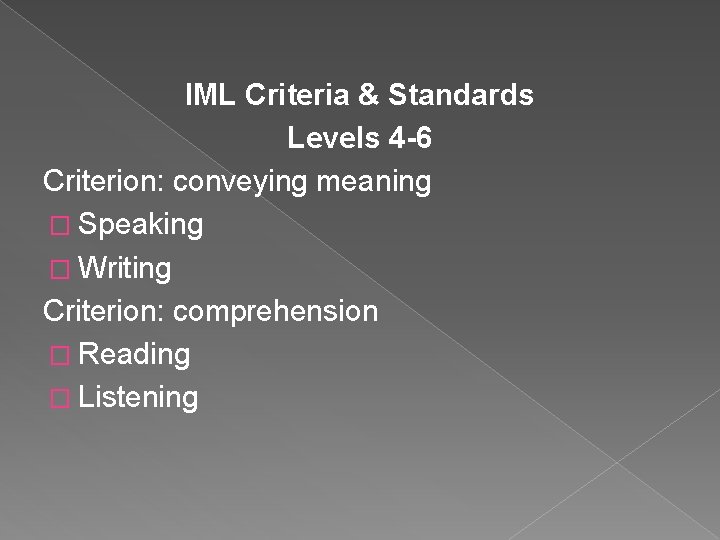
IML Criteria & Standards Levels 4 -6 Criterion: conveying meaning � Speaking � Writing Criterion: comprehension � Reading � Listening
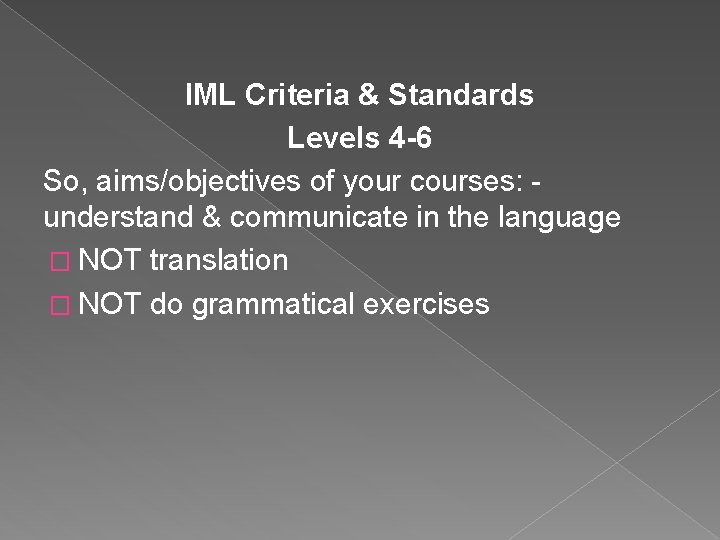
IML Criteria & Standards Levels 4 -6 So, aims/objectives of your courses: understand & communicate in the language � NOT translation � NOT do grammatical exercises
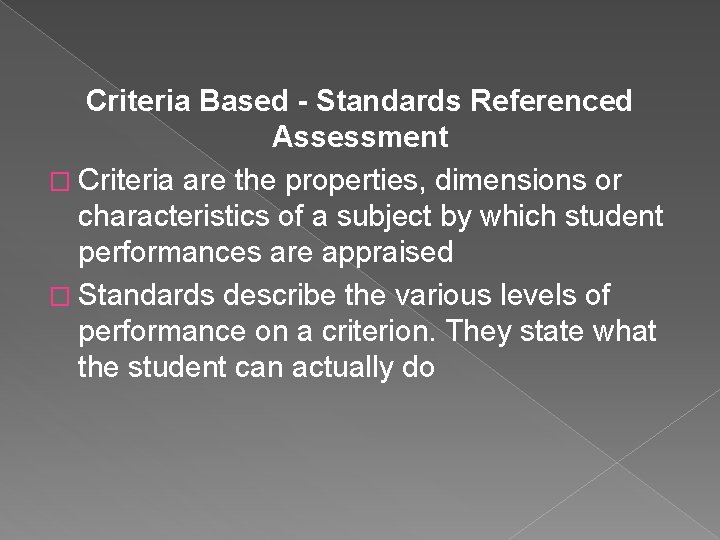
Criteria Based - Standards Referenced Assessment � Criteria are the properties, dimensions or characteristics of a subject by which student performances are appraised � Standards describe the various levels of performance on a criterion. They state what the student can actually do
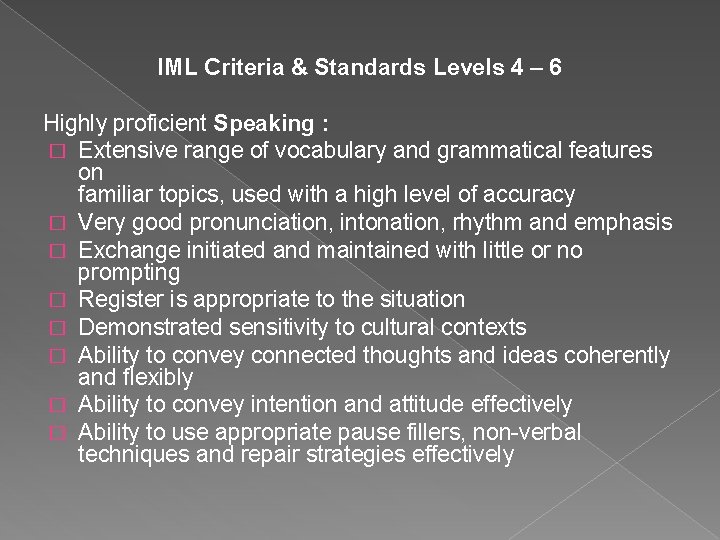
IML Criteria & Standards Levels 4 – 6 Highly proficient Speaking : � Extensive range of vocabulary and grammatical features on familiar topics, used with a high level of accuracy � Very good pronunciation, intonation, rhythm and emphasis � Exchange initiated and maintained with little or no prompting � Register is appropriate to the situation � Demonstrated sensitivity to cultural contexts � Ability to convey connected thoughts and ideas coherently and flexibly � Ability to convey intention and attitude effectively � Ability to use appropriate pause fillers, non-verbal techniques and repair strategies effectively
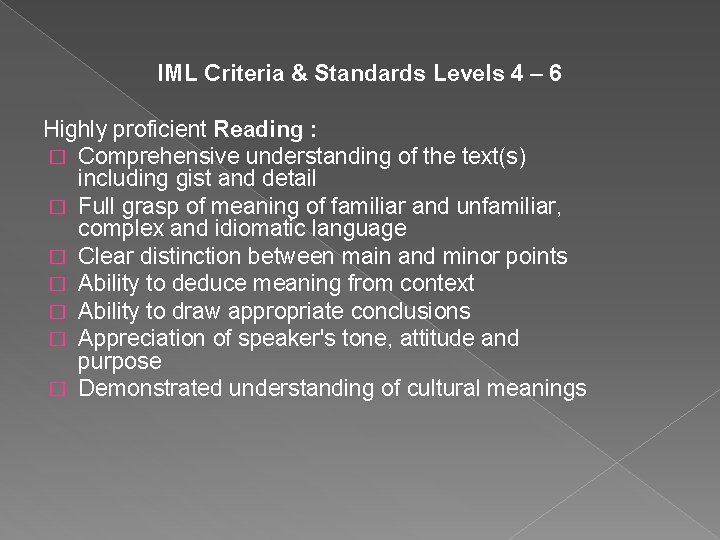
IML Criteria & Standards Levels 4 – 6 Highly proficient Reading : � Comprehensive understanding of the text(s) including gist and detail � Full grasp of meaning of familiar and unfamiliar, complex and idiomatic language � Clear distinction between main and minor points � Ability to deduce meaning from context � Ability to draw appropriate conclusions � Appreciation of speaker's tone, attitude and purpose � Demonstrated understanding of cultural meanings
BUT. . . To achieve this level of competence, knowledge of grammar is essential
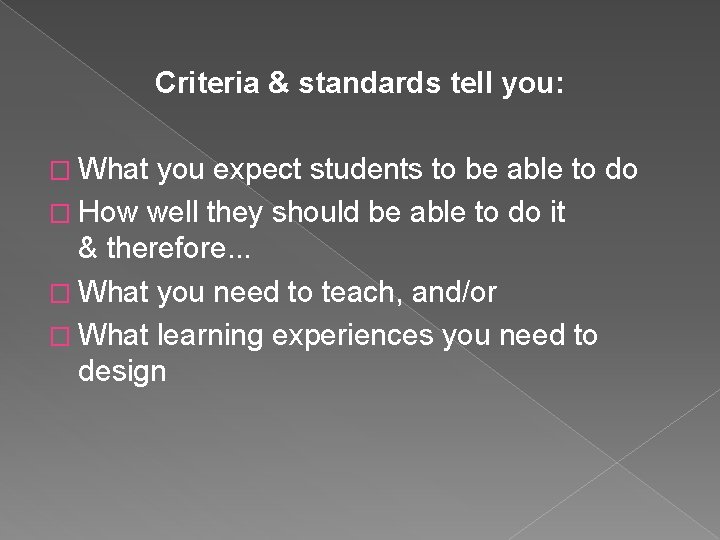
Criteria & standards tell you: � What you expect students to be able to do � How well they should be able to do it & therefore. . . � What you need to teach, and/or � What learning experiences you need to design
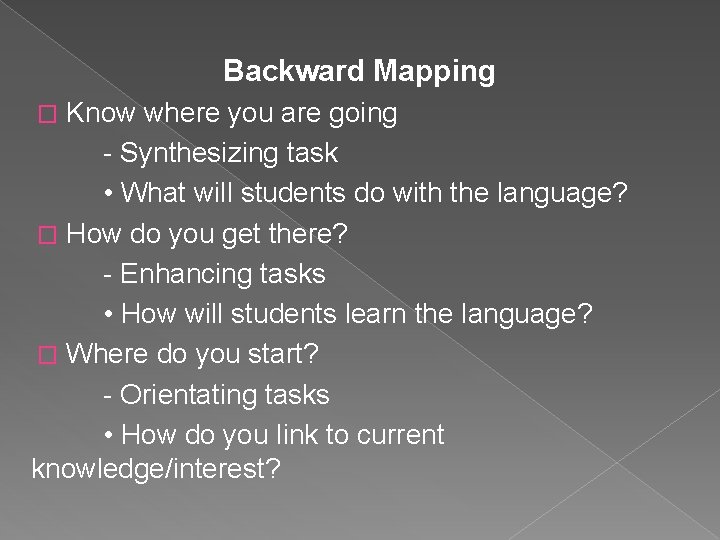
Backward Mapping Know where you are going - Synthesizing task • What will students do with the language? � How do you get there? - Enhancing tasks • How will students learn the language? � Where do you start? - Orientating tasks • How do you link to current knowledge/interest? �
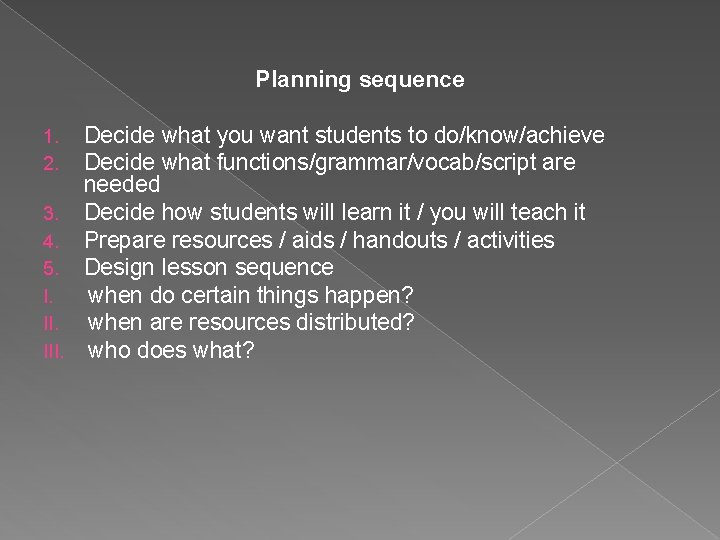
Planning sequence Decide what you want students to do/know/achieve Decide what functions/grammar/vocab/script are needed 3. Decide how students will learn it / you will teach it 4. Prepare resources / aids / handouts / activities 5. Design lesson sequence I. when do certain things happen? II. when are resources distributed? III. who does what? 1. 2.
“Methods” � Grammar-translation method � Traditional � Learn the grammar & translate texts Immersion � Learn other subjects in the language
“Methods” [2] Audiolingual method � Behaviourist, popular in 60 s & 70 s � Learn a language through habit-formation � Need to practise drills until new habit learned Communicative Language Teaching � Learn a language through communication � ‘Real life’ or 'lifelike' activities � Less emphasis on formal grammar
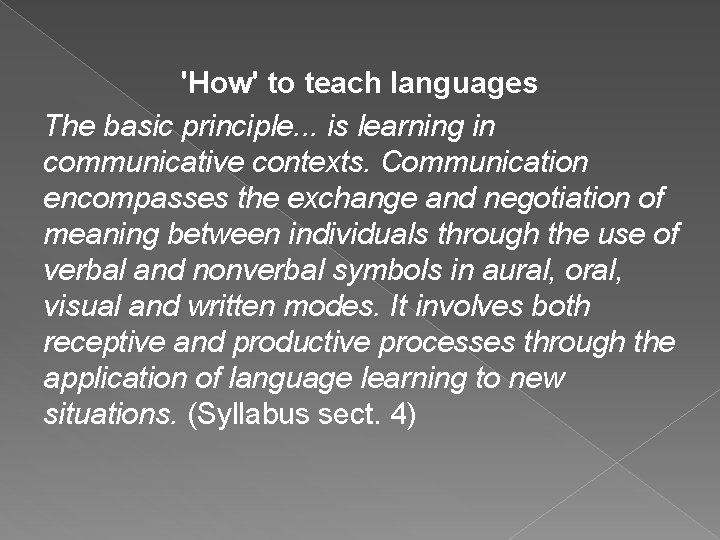
'How' to teach languages The basic principle. . . is learning in communicative contexts. Communication encompasses the exchange and negotiation of meaning between individuals through the use of verbal and nonverbal symbols in aural, oral, visual and written modes. It involves both receptive and productive processes through the application of language learning to new situations. (Syllabus sect. 4)
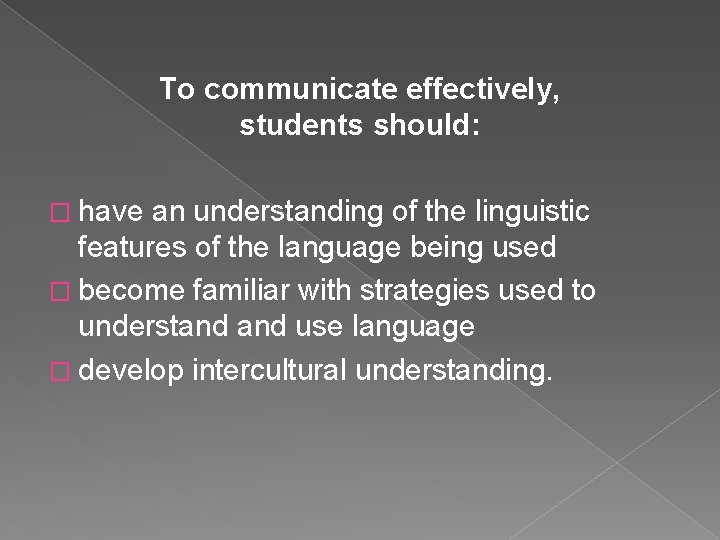
To communicate effectively, students should: � have an understanding of the linguistic features of the language being used � become familiar with strategies used to understand use language � develop intercultural understanding.
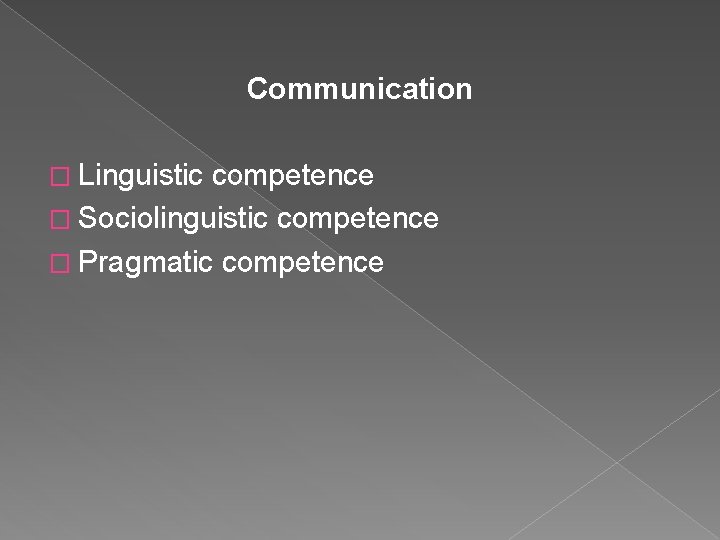
Communication � Linguistic competence � Sociolinguistic competence � Pragmatic competence
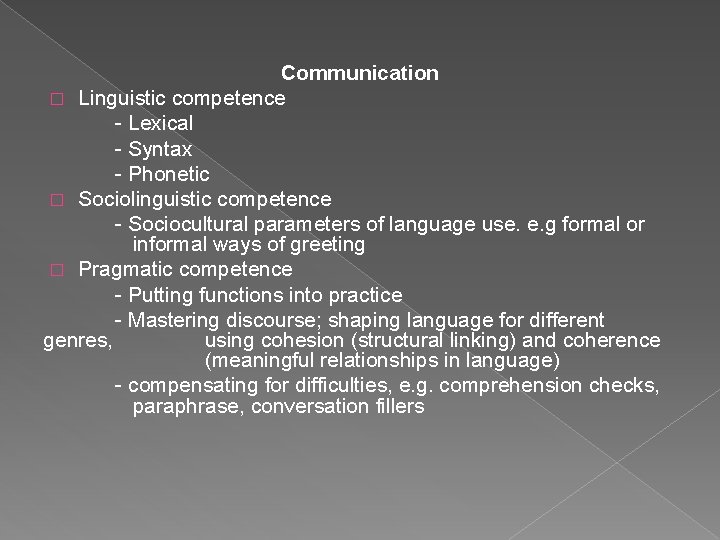
Communication � Linguistic competence - Lexical - Syntax - Phonetic � Sociolinguistic competence - Sociocultural parameters of language use. e. g formal or informal ways of greeting � Pragmatic competence - Putting functions into practice - Mastering discourse; shaping language for different genres, using cohesion (structural linking) and coherence (meaningful relationships in language) - compensating for difficulties, e. g. comprehension checks, paraphrase, conversation fillers
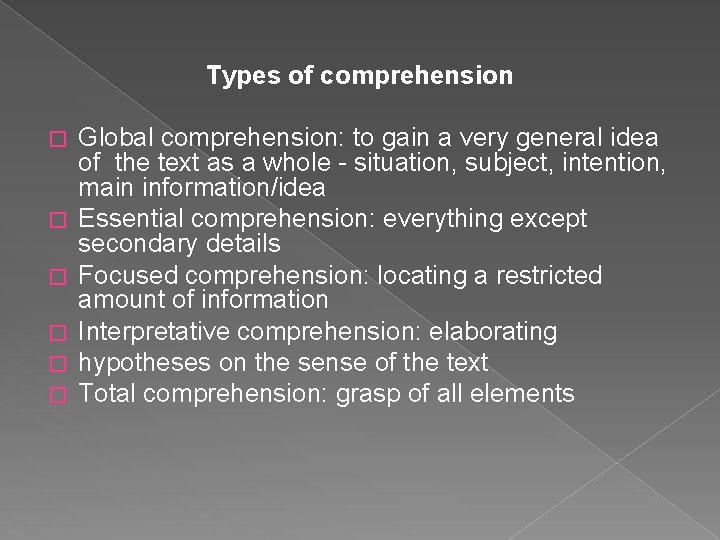
Types of comprehension � � � Global comprehension: to gain a very general idea of the text as a whole - situation, subject, intention, main information/idea Essential comprehension: everything except secondary details Focused comprehension: locating a restricted amount of information Interpretative comprehension: elaborating hypotheses on the sense of the text Total comprehension: grasp of all elements
Reading purposes � � � � Skimming: glancing over a text to grasp the essential Scanning: searching for a precise piece of information Extensive reading: of longer texts, often for pleasure and a global understanding Intensive reading: of shorter texts, focusing on precision and detail � All different from translating
Listening purposes � � � � � To hear: trying to hear noises in the silence of the night To select: searching for clues according to the sound To identify: regrouping various bits of information to make a holistic judgement [e. g. of a person] To reformulate: analysing & synthesizing the elements of a message To do: to select the elements necessary for action
The communicative approach (1) Uses research from many fields; not tied to one theory Favours meaning, but balanced with syntax Inferred principles : - all communication has a social purpose - learner has something to say or find out - activities that involve real communication promote learning - activities in which language is used for carrying out meaningful tasks promote learning - language that is meaningful to the learner promotes learning � � �
The communicative approach (2) � � � � Is learner-centred & responsive to learners' interests Language is acquired through interactive communicative use that encourages the negotiation of meaning Genuinely meaningful language use is emphasized, involving unpredictability, taking risks and making choices Authentic language from the TL is used Language forms are always treated within a communicative context, never in isolation from use Individual discovery of forms and structures is encouraged Listening, speaking, reading & writing are integrated in a whole-language approach
The communicative approach (3) Ideal for beginners; starts with oral; communication learned through functions � Advanced learners: more emphasis on writing & analysis of discourse � Allows choice of material relevant to learners: age, interest, ability, existing knowledge, integrated projects, etc � Closest to reality; quickest route to communicating in TL �
The communicative approach (4) Motivation of teacher: choice of resources, learning experiences relevant to learners � More student control over own learning � Results: - 30 yrs ago: « I studied French for 4 years & I can't say anything » - Now: leave 1 st lesson able to communicate basic information �
Why use authentic documents Partial substitute for TL community: newspaper & magazine articles, poems, songs, games, news, visual representations [videos, film, media downloads] � More motivating for learner (real language for real purposes), especially if current & relevant to age & interest � Allows for independent learning � Goes far beyond the textbook � Is less likely to contain mistakes (beware material on net) �
Your attitude to mistakes is? � They show lack of learning They show ineffective teaching � They show student willingness to communicate in spite of risks � They are inevitable in all language use, and part of language learning
Alignment Aligning teaching, learning and assessment
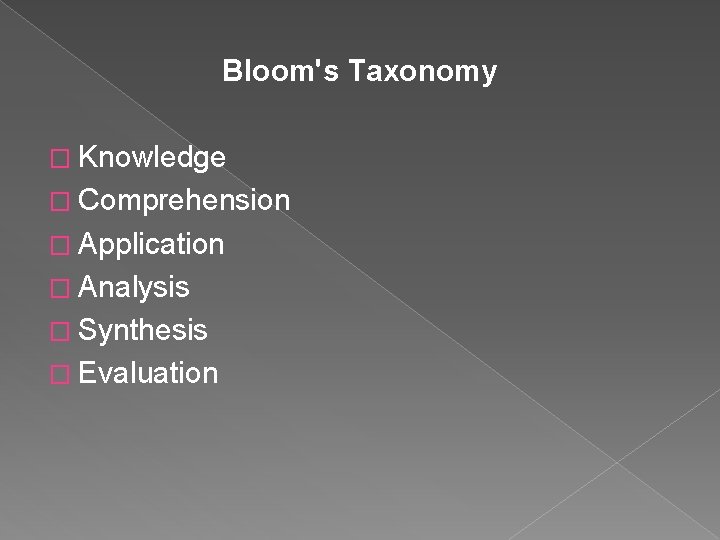
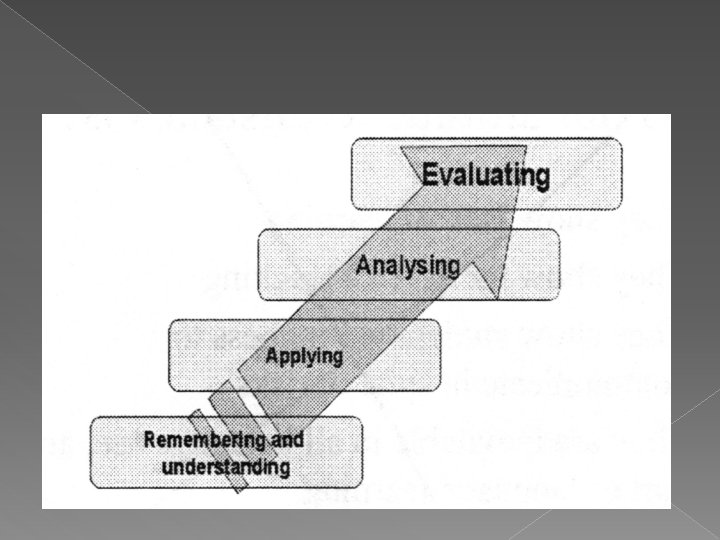
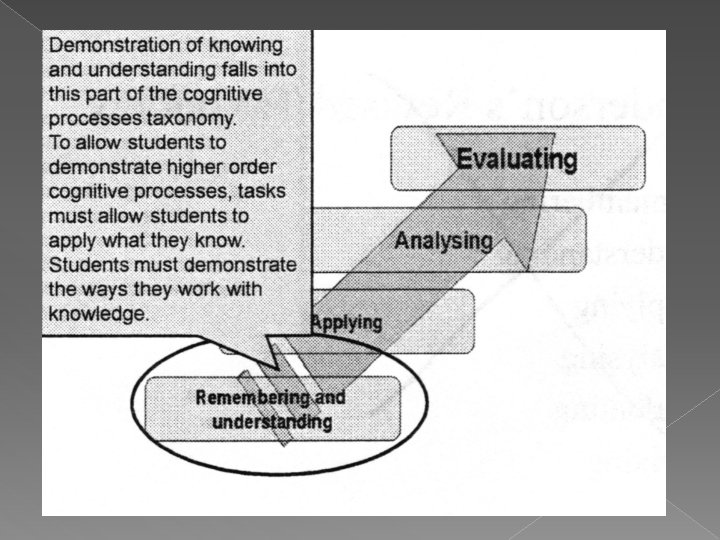
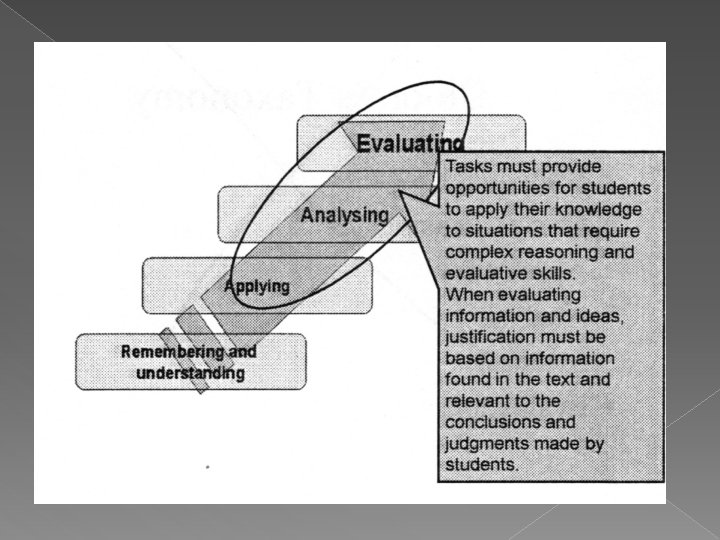
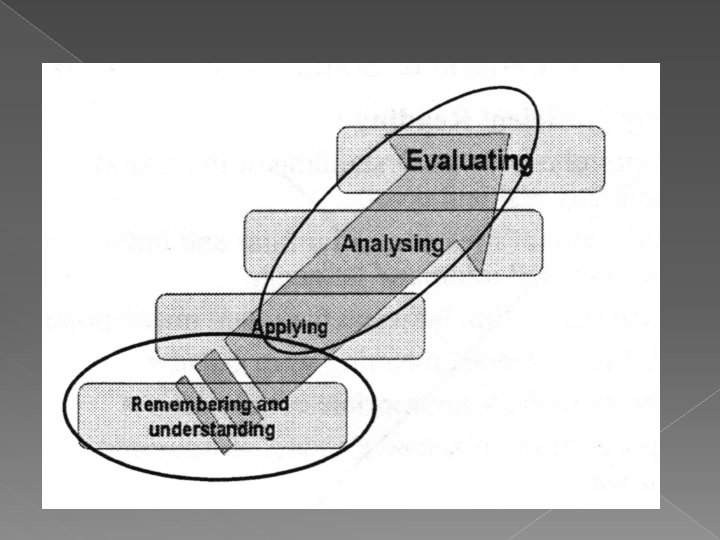
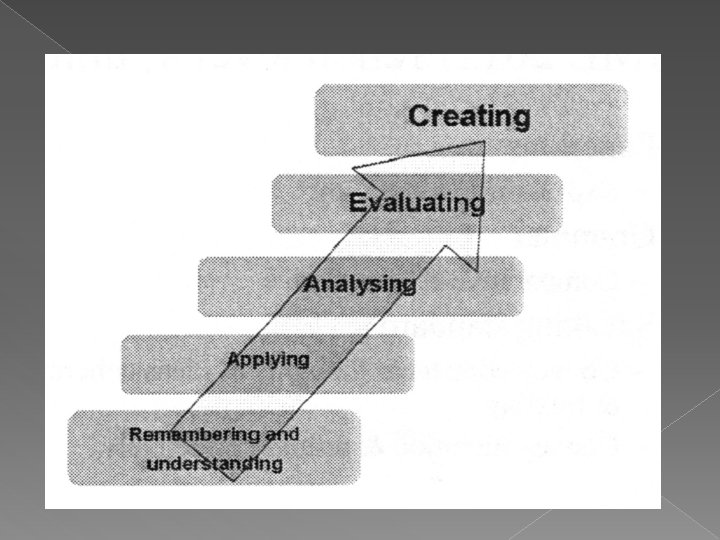
Bloom's Taxonomy � Knowledge � Comprehension � Application � Analysis � Synthesis � Evaluation
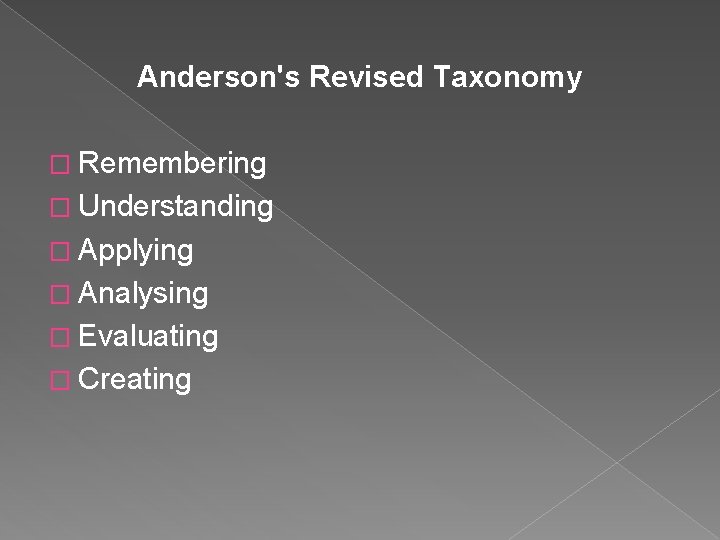
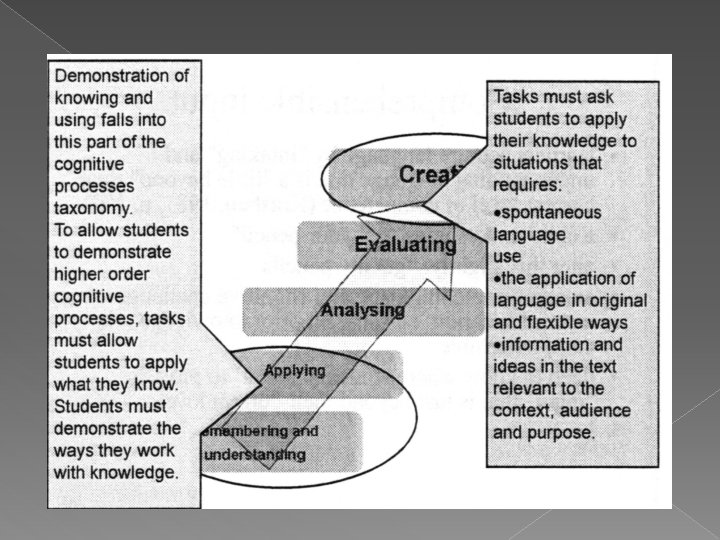
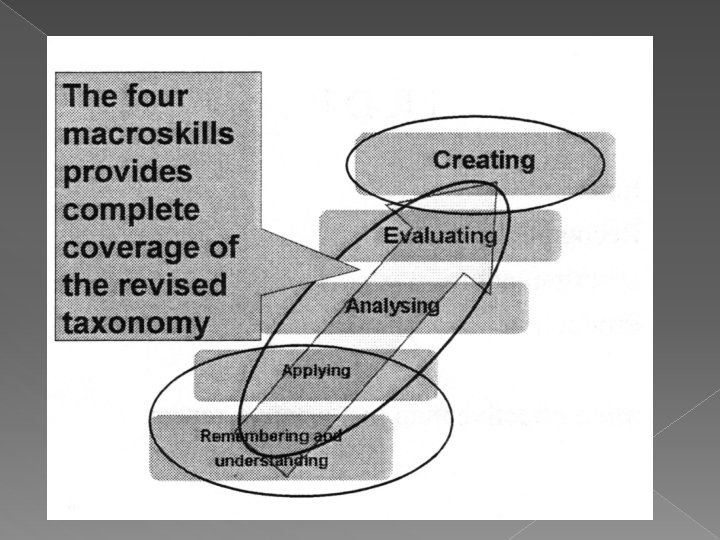
Anderson's Revised Taxonomy � Remembering � Understanding � Applying � Analysing � Evaluating � Creating
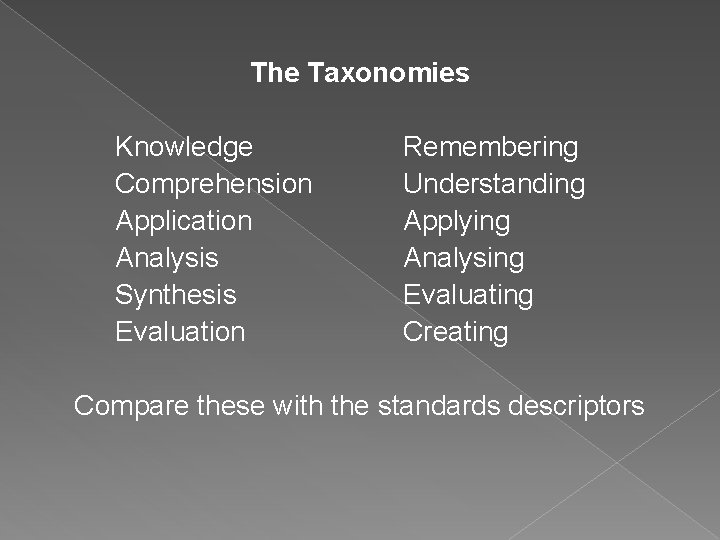
The Taxonomies Knowledge Comprehension Application Analysis Synthesis Evaluation Remembering Understanding Applying Analysing Evaluating Creating Compare these with the standards descriptors
IML Criteria & Standards Levels 4 -6 � � � � Highly proficient Reading : Comprehensive understanding of the text(s) including gist and detail Full grasp of meaning of familiar and unfamiliar, complex and idiomatic language Clear distinction between main and minor points Ability to deduce meaning from context Ability to draw appropriate conclusions Appreciation of speaker's tone, attitude and purpose Demonstrated understanding of cultural meanings
Receptive skills
Productive skills
Lifelong learners [your students] are: knowledgeable persons with deep understanding � complex thinkers � creative persons � active investigators � effective communicators � participants in an interdependent world � reflective and self-directed learners �
A lesson could contain: Anticipatory set Objective [what] (linked to your course guides) Rationale [why] Your job will be [students' tasks] Input [new learning, main info of lesson] Modelling [the finished article/process] Checking for understanding [can be incorporated with modelling, checks that most students can go on] � Guided practice [students practice with help, a 'trial run', remediation for some] � Independent practice [students able to work success!] � � � �
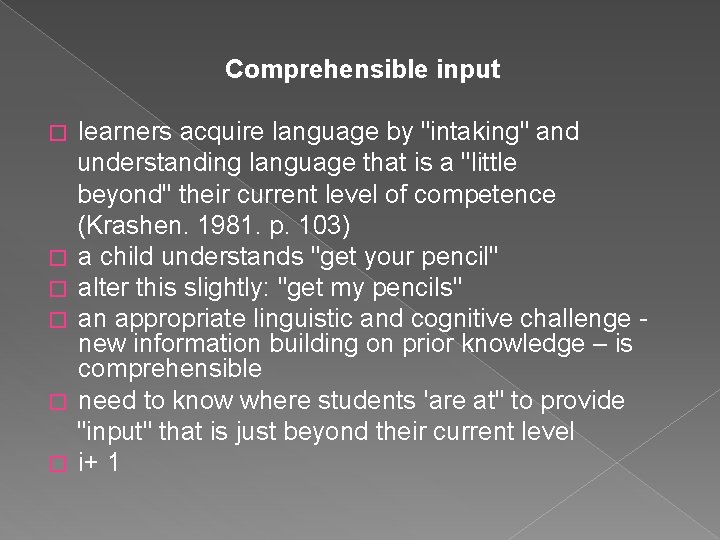
Comprehensible input learners acquire language by "intaking" and understanding language that is a "little beyond" their current level of competence (Krashen. 1981. p. 103) � a child understands "get your pencil" � alter this slightly: "get my pencils" � an appropriate linguistic and cognitive challenge new information building on prior knowledge – is comprehensible � need to know where students 'are at" to provide "input" that is just beyond their current level � i+ 1 �
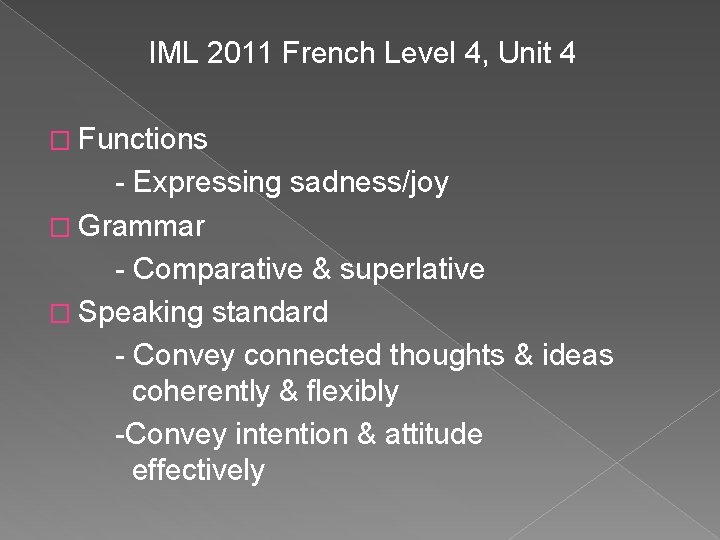
IML 2011 French Level 4, Unit 4 � Functions - Expressing sadness/joy � Grammar - Comparative & superlative � Speaking standard - Convey connected thoughts & ideas coherently & flexibly -Convey intention & attitude effectively
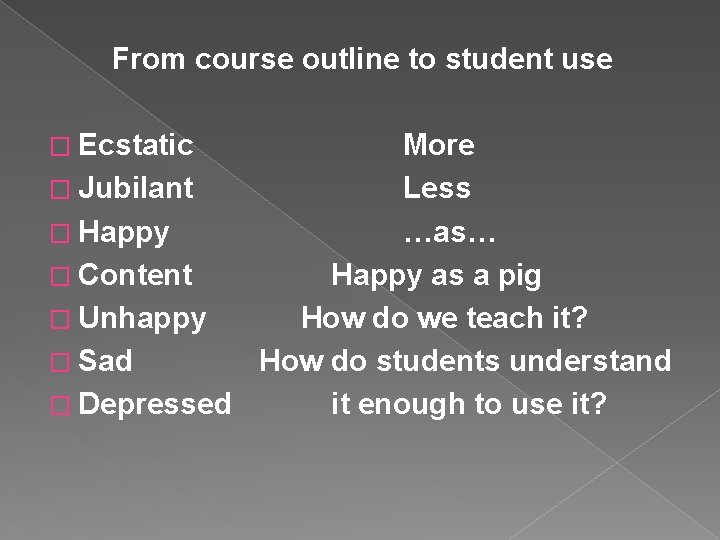
From course outline to student use � Ecstatic More � Jubilant Less � Happy …as… � Content Happy as a pig � Unhappy How do we teach it? � Sad How do students understand � Depressed it enough to use it?
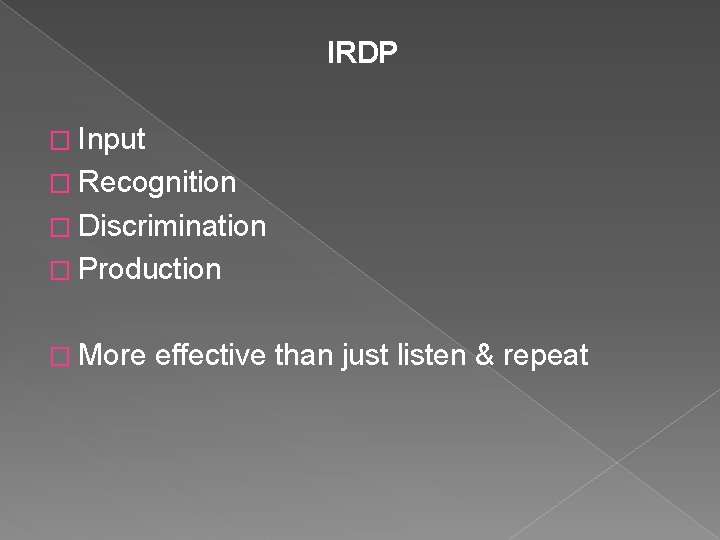
IRDP � Input � Recognition � Discrimination � Production � More effective than just listen & repeat
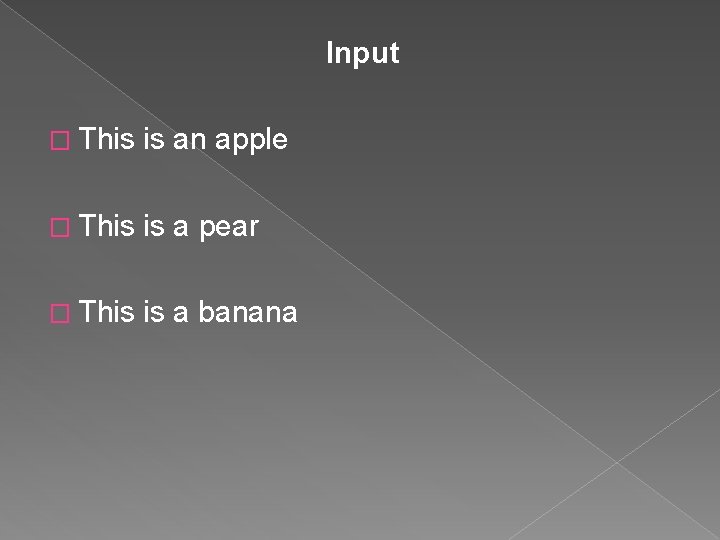
Input � This is an apple � This is a pear � This is a banana
Recognition � Is this an apple? Yes/No � Is this a pear? Yes/No � Is this a banana? Yes/No
Discrimination � Is this an apple or a pear? � Is this a banana or an apple? � Is this a pear or a banana?
Production � What is this?
Input Assume students know colours � The apple is red � The pear is green � The banana is yellow
Recognition � What colour is the apple? - Red � What colour is the pear? - Green � What colour is the banana? - Yellow
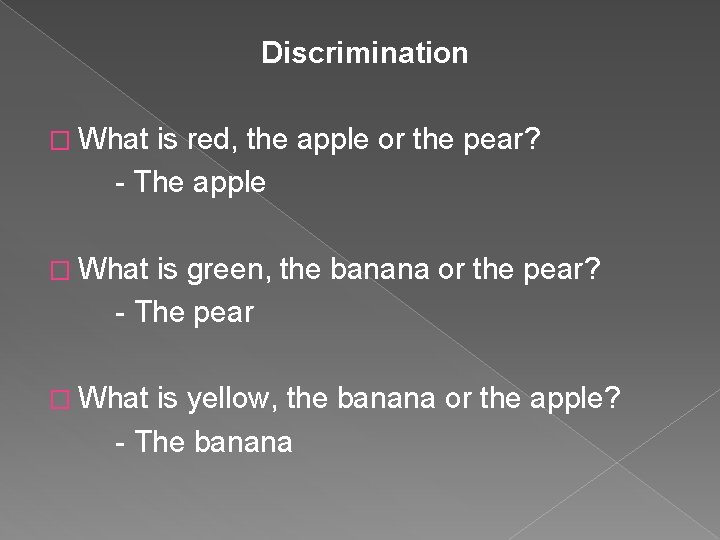
Discrimination � What is red, the apple or the pear? - The apple � What is green, the banana or the pear? - The pear � What is yellow, the banana or the apple? - The banana
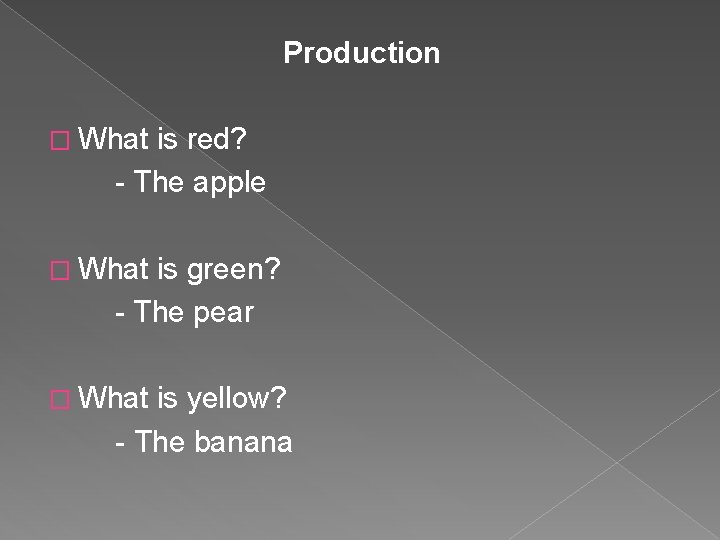
Production � What is red? - The apple � What is green? - The pear � What is yellow? - The banana
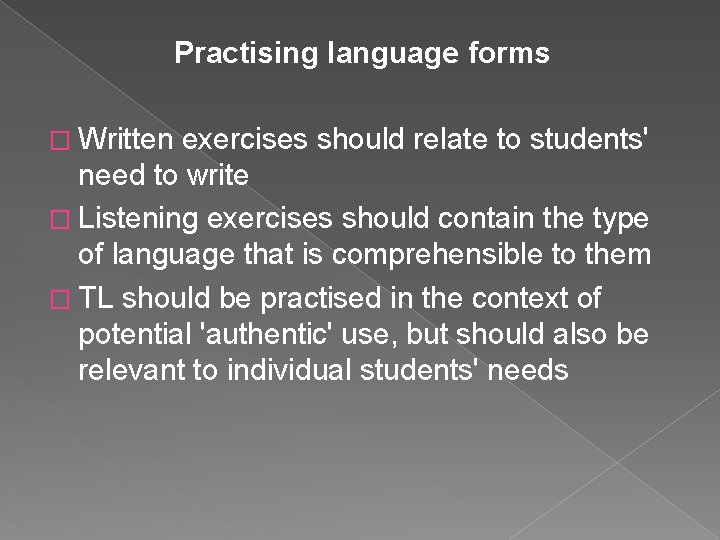
Practising language forms � Written exercises should relate to students' need to write � Listening exercises should contain the type of language that is comprehensible to them � TL should be practised in the context of potential 'authentic' use, but should also be relevant to individual students' needs
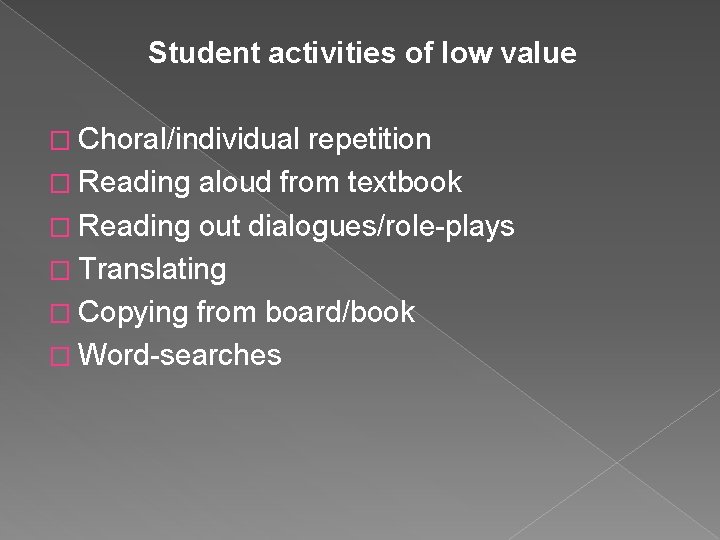
Student activities of low value � Choral/individual repetition � Reading aloud from textbook � Reading out dialogues/role-plays � Translating � Copying from board/book � Word-searches
Student activities of mixed value � Drill-like activities � Student-student dialogue � Receiving grammatical explanations
Student activities of high value � Listening to the TL � Replying to questions in the TL � Asking questions in the TL � Engaging in dramatic activities � Increasing active/passive vocabulary � Reading silently � Relating language to social/cultural context � Doing written work of an error-free nature
Assessment instruments & learning experiences should be consistent � Realistic, communicative, in the four macroskills � promote the use of spontaneous language � cover a variety of genres � show a balance across the macroskills
Variety of tasks �A variety of tasks, which include inquiry and/or problem solving, promotes the progressive development of the four macroskills [syllabus 5]
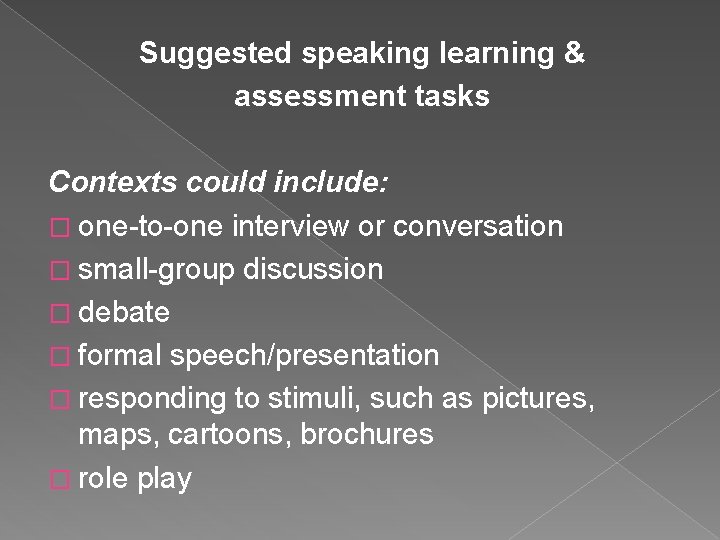
Suggested speaking learning & assessment tasks Contexts could include: � one-to-one interview or conversation � small-group discussion � debate � formal speech/presentation � responding to stimuli, such as pictures, maps, cartoons, brochures � role play
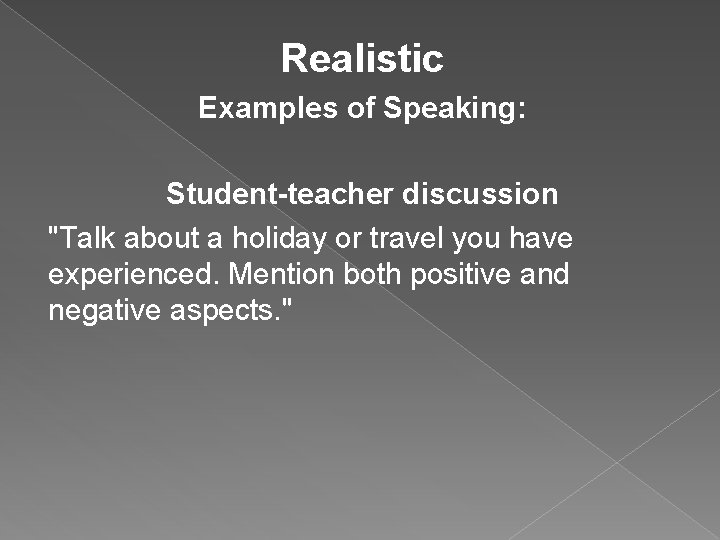
Realistic Examples of Speaking: Student-teacher discussion "Talk about a holiday or travel you have experienced. Mention both positive and negative aspects. "
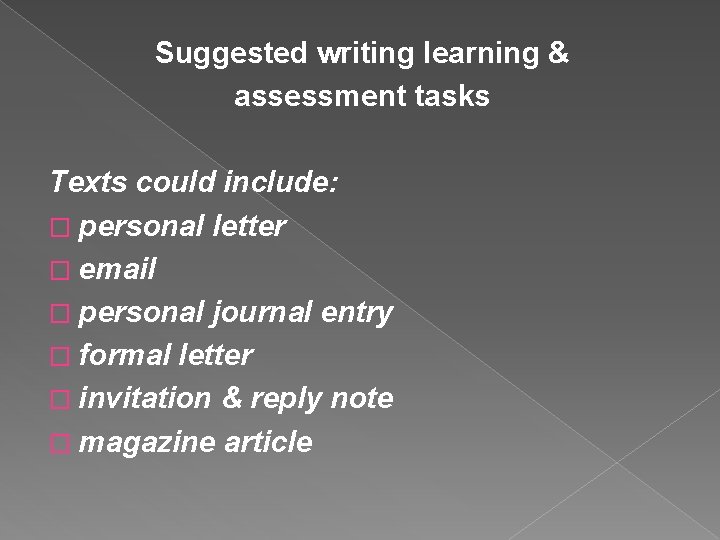
Suggested writing learning & assessment tasks Texts could include: � personal letter � email � personal journal entry � formal letter � invitation & reply note � magazine article
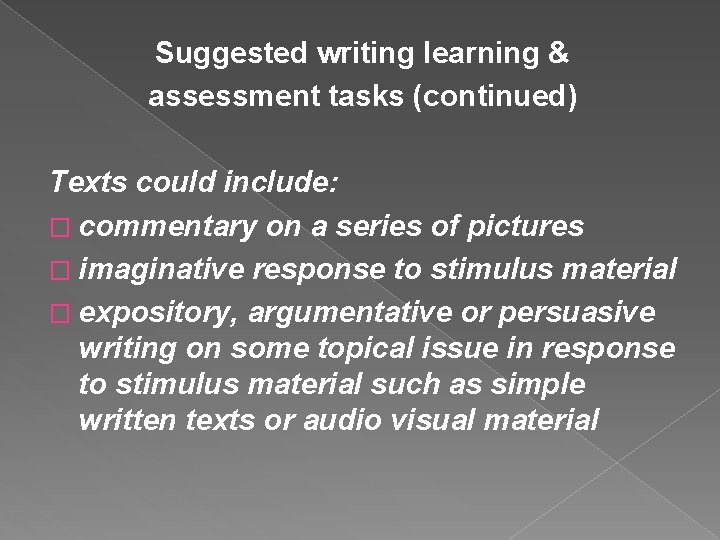
Suggested writing learning & assessment tasks (continued) Texts could include: � commentary on a series of pictures � imaginative response to stimulus material � expository, argumentative or persuasive writing on some topical issue in response to stimulus material such as simple written texts or audio visual material
Realistic Example of Writing: Personal letter/email "Assume you are writing to a TL friend with whom you correspond regularly. Talk about events you anticipate happening during the rest of this year and your plans for next year. Find out what your friend anticipates doing and also catch up on some gossip since your last contact. "
Summary � Real language for real purposes � Focus on learner & communication - Solving a problem; attaining a goal - Producing something - brochure, play - Expressing opinions & own experience � Use of authentic documents � Alignment of teaching, learning, assessment
References � Krashen, Stephen D. Principles and Practice in Second Language Acquisition. Prentice. Hall International, 1987. � Krashen. Stephen D. Second Language Acquisition and Second Language Learning. Prentice-Hall International, 1988.
References Evelyne Berard; L'Approche Communicative: theorie et pratiques; CLE International: 1991 � Gabor Boldizsar (coord) An introduction to the current European context in language teaching; Council of Europe; http: //wvyw. ecml. at/documents/pub 214 E 2003 Bold izsar. pdf � Michele Pendanx; Les Activites d'Apprentissage en Classe de Langue: Hachette. 1998 �
References David Little & Radka Perclova: The European Language Portfolio: a guide for teachers and teacher trainers; Council of Europe; http: //www. culture 2. coe. int/portfolio//documents/ ELPguide_teacherstrainers. pdf � Joe Shells; La Communication dans la Classe de Langue: Conseil de 1'Europe: 1993 � Cadre Europeen Commun de Reference pour les Langues: Conseil de 1'Europe; 2000(? ) http: //www. culture 2. coe. int/portfolio/docurnents/c adrecommun. pdf �