
Using Social Media to Inform Influence and Persuade
- Slides: 25
Using Social Media to Inform, Influence, and Persuade: Challenges and Considerations for Defence Christopher Paul, Ph. D 30 March 2017 Keyboard Warriors? Military operations in the Information Age – Opportunities and Challenges Monash University, Melbourne, Australia
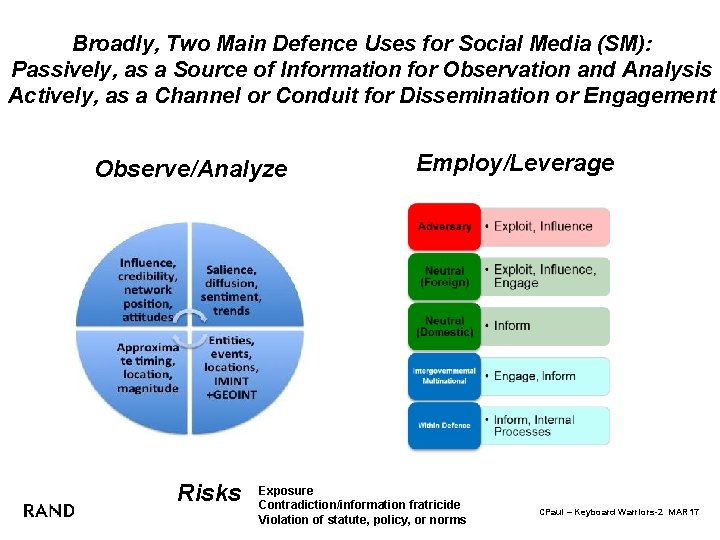
Broadly, Two Main Defence Uses for Social Media (SM): Passively, as a Source of Information for Observation and Analysis Actively, as a Channel or Conduit for Dissemination or Engagement Observe/Analyze Risks Employ/Leverage Exposure Contradiction/information fratricide Violation of statute, policy, or norms CPaul – Keyboard Warriors-2 MAR 17
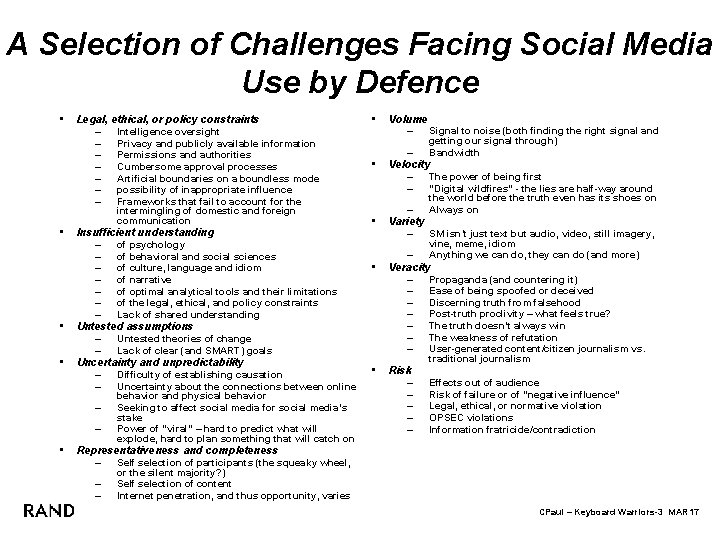
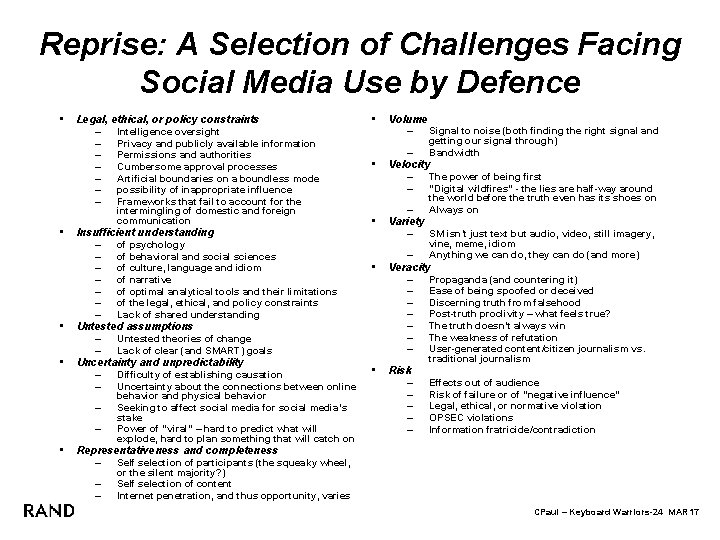
A Selection of Challenges Facing Social Media Use by Defence • • Legal, ethical, or policy constraints – Intelligence oversight – Privacy and publicly available information – Permissions and authorities – Cumbersome approval processes – Artificial boundaries on a boundless mode – possibility of inappropriate influence – Frameworks that fail to account for the intermingling of domestic and foreign communication Insufficient understanding – of psychology – of behavioral and social sciences – of culture, language and idiom – of narrative – of optimal analytical tools and their limitations – of the legal, ethical, and policy constraints – Lack of shared understanding Untested assumptions – Untested theories of change – Lack of clear (and SMART) goals Uncertainty and unpredictability – Difficulty of establishing causation – Uncertainty about the connections between online – – • behavior and physical behavior Seeking to affect social media for social media’s stake Power of “viral” – hard to predict what will explode, hard to plan something that will catch on • • • Volume – Signal to noise (both finding the right signal and getting our signal through) – Bandwidth Velocity – The power of being first – “Digital wildfires” - the lies are half-way around the world before the truth even has its shoes on – Always on Variety – SM isn’t just text but audio, video, still imagery, vine, meme, idiom – Anything we can do, they can do (and more) Veracity – Propaganda (and countering it) – Ease of being spoofed or deceived – Discerning truth from falsehood – Post-truth proclivity – what feels true? – The truth doesn’t always win – The weakness of refutation – User-generated content/citizen journalism vs. traditional journalism Risk – Effects out of audience – Risk of failure or of “negative influence” – Legal, ethical, or normative violation – OPSEC violations – Information fratricide/contradiction Representativeness and completeness – Self selection of participants (the squeaky wheel, – – or the silent majority? ) Self selection of content Internet penetration, and thus opportunity, varies CPaul – Keyboard Warriors-3 MAR 17
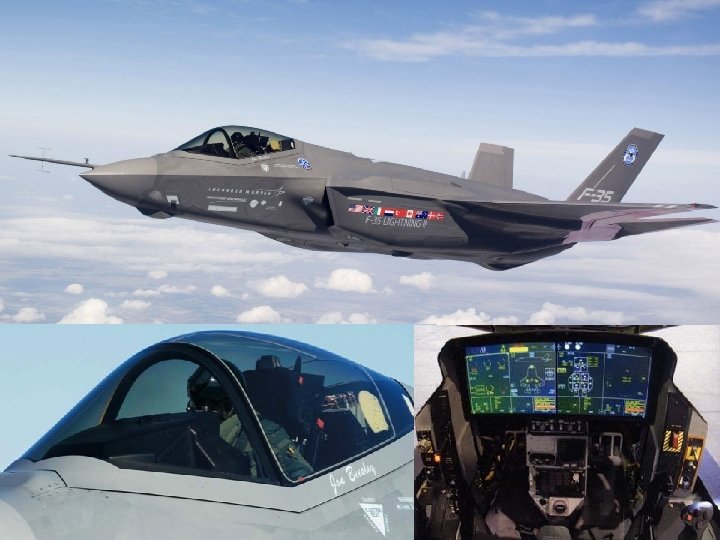
When is it “Intelligence” (and bound by rules governing intelligence collection and oversight), and when is it not? CPaul – Keyboard Warriors-4 MAR 17
CPaul – Keyboard Warriors-5 MAR 17
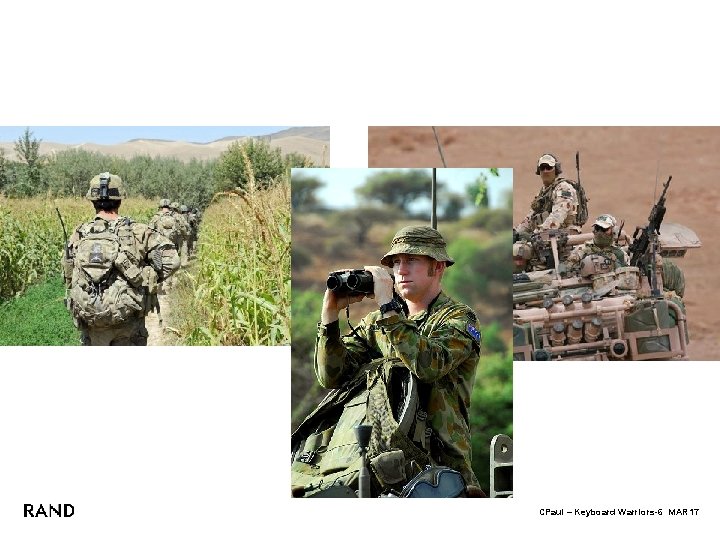
CPaul – Keyboard Warriors-6 MAR 17
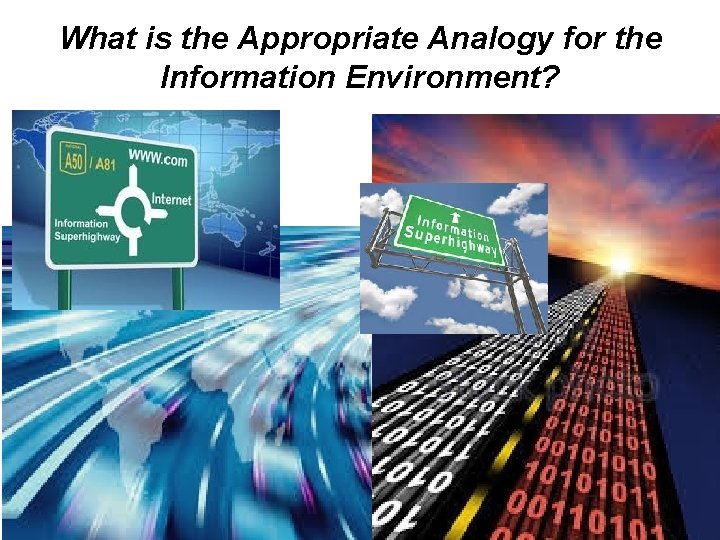
What is the Appropriate Analogy for the Information Environment? CPaul – Keyboard Warriors-7 MAR 17
The Power of Narrative • Lots of disagreement about what narrative is and how best to think about it, but strong consensus that… 1. People use narratives to make sense of the world and their place in it – we are homo narratus – the storytelling species 2. compelling narratives have consistency, familiarity, and proof 3. narratives already exist, and although they can be shaped over time, they cannot always be changed or replaced CPaul – Keyboard Warriors-8 MAR 17
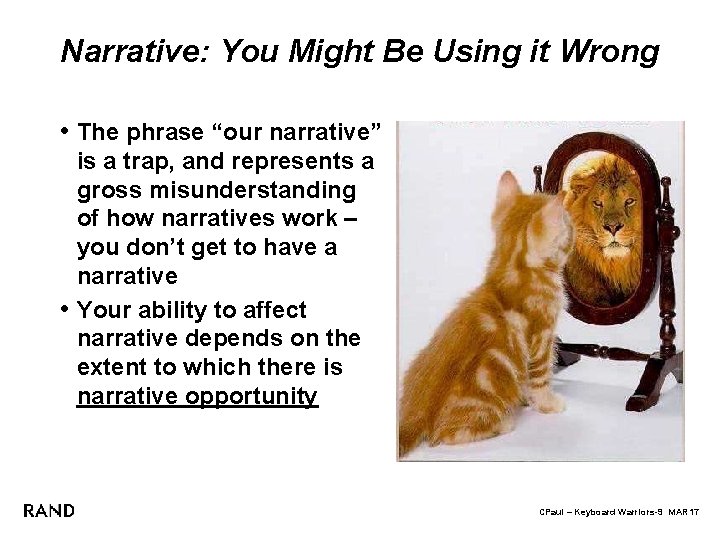
Narrative: You Might Be Using it Wrong • The phrase “our narrative” is a trap, and represents a gross misunderstanding of how narratives work – you don’t get to have a narrative • Your ability to affect narrative depends on the extent to which there is narrative opportunity CPaul – Keyboard Warriors-9 MAR 17
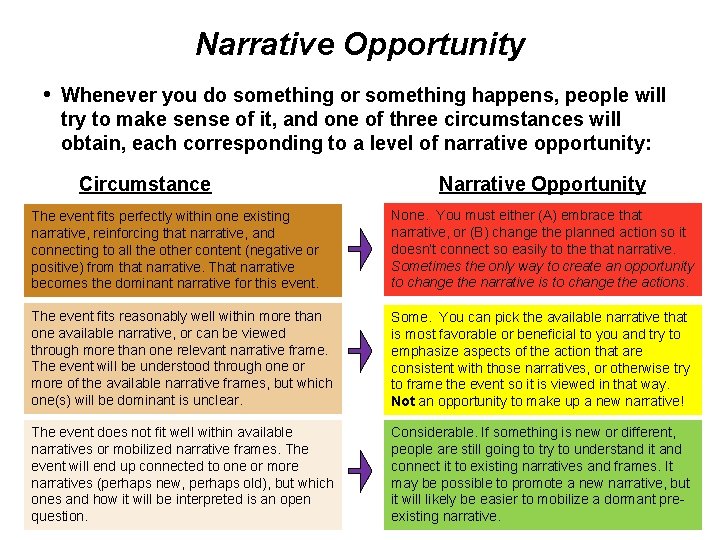
Narrative Opportunity • Whenever you do something or something happens, people will try to make sense of it, and one of three circumstances will obtain, each corresponding to a level of narrative opportunity: Circumstance Narrative Opportunity The event fits perfectly within one existing narrative, reinforcing that narrative, and connecting to all the other content (negative or positive) from that narrative. That narrative becomes the dominant narrative for this event. None. You must either (A) embrace that narrative, or (B) change the planned action so it doesn’t connect so easily to the that narrative. Sometimes the only way to create an opportunity to change the narrative is to change the actions. The event fits reasonably well within more than one available narrative, or can be viewed through more than one relevant narrative frame. The event will be understood through one or more of the available narrative frames, but which one(s) will be dominant is unclear. Some. You can pick the available narrative that is most favorable or beneficial to you and try to emphasize aspects of the action that are consistent with those narratives, or otherwise try to frame the event so it is viewed in that way. Not an opportunity to make up a new narrative! The event does not fit well within available narratives or mobilized narrative frames. The event will end up connected to one or more narratives (perhaps new, perhaps old), but which ones and how it will be interpreted is an open question. Considerable. If something is new or different, people are still going to try to understand it and connect it to existing narratives and frames. It may be possible to promote a new narrative, but it will likely be easier to mobilize a dormant pre. CPaul – Keyboard Warriors-10 MAR 17 existing narrative.
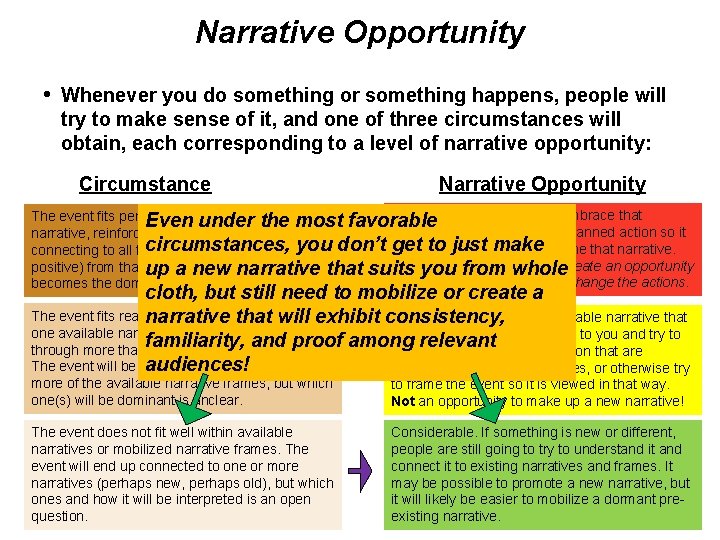
Narrative Opportunity • Whenever you do something or something happens, people will try to make sense of it, and one of three circumstances will obtain, each corresponding to a level of narrative opportunity: Circumstance Narrative Opportunity None. You must either (A) embrace that The event fits perfectly within one existing Even under the most favorable narrative, or (B) change the planned action so it narrative, reinforcing that narrative, and circumstances, you don’t get toconnect just make doesn’t so easily to the that narrative. connecting to all the other content (negative or Sometimes the onlywhole way to create an opportunity positive) from that up narrative. Thatnarrative a new that suits you from to change the narrative is to change the actions. becomes the dominant narrative for this event. cloth, but still need to mobilize or create a The event fits reasonably well within more thanexhibit consistency, Some. You can pick the available narrative that will one available narrative, or can be viewed is most favorable or beneficial to you and try to familiarity, and proof among relevant through more than one relevant narrative frame. emphasize aspects of the action that are audiences! The event will be understood through one or consistent with those narratives, or otherwise try more of the available narrative frames, but which one(s) will be dominant is unclear. to frame the event so it is viewed in that way. Not an opportunity to make up a new narrative! The event does not fit well within available narratives or mobilized narrative frames. The event will end up connected to one or more narratives (perhaps new, perhaps old), but which ones and how it will be interpreted is an open question. Considerable. If something is new or different, people are still going to try to understand it and connect it to existing narratives and frames. It may be possible to promote a new narrative, but it will likely be easier to mobilize a dormant pre. CPaul – Keyboard Warriors-11 MAR 17 existing narrative.
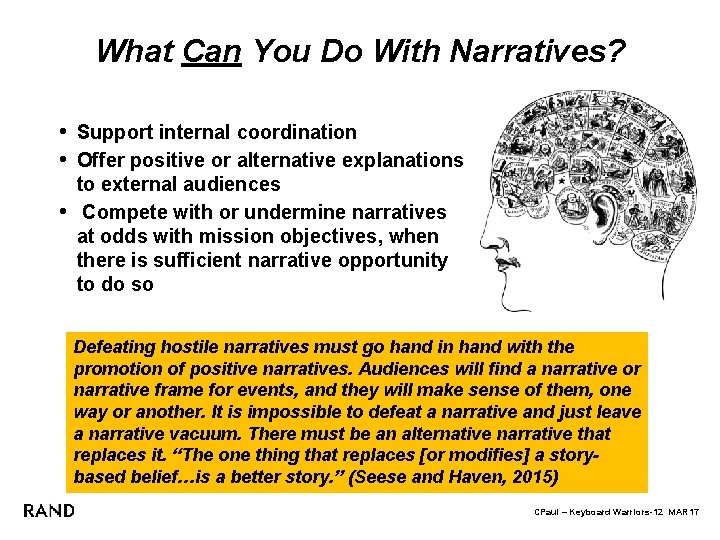
What Can You Do With Narratives? • Support internal coordination • Offer positive or alternative explanations to external audiences • Compete with or undermine narratives at odds with mission objectives, when there is sufficient narrative opportunity to do so Defeating hostile narratives must go hand in hand with the promotion of positive narratives. Audiences will find a narrative or narrative frame for events, and they will make sense of them, one way or another. It is impossible to defeat a narrative and just leave a narrative vacuum. There must be an alternative narrative that replaces it. “The one thing that replaces [or modifies] a storybased belief…is a better story. ” (Seese and Haven, 2015) CPaul – Keyboard Warriors-12 MAR 17
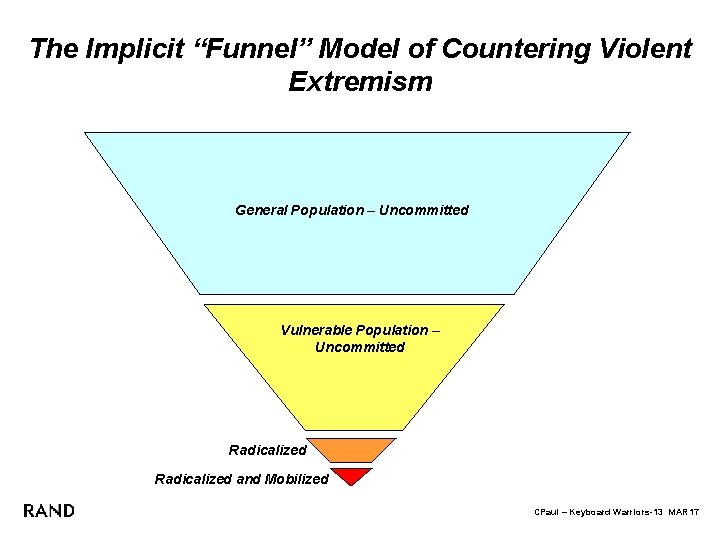
The Implicit “Funnel” Model of Countering Violent Extremism General Population – Uncommitted Vulnerable Population – Uncommitted Radicalized and Mobilized CPaul – Keyboard Warriors-13 MAR 17
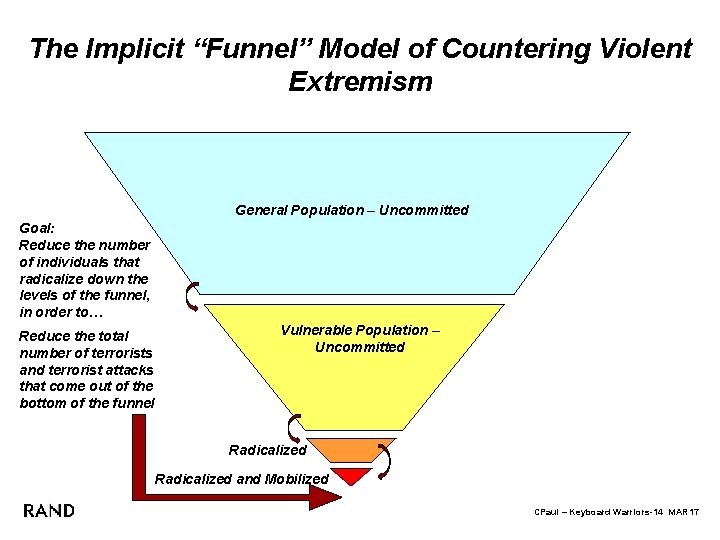
The Implicit “Funnel” Model of Countering Violent Extremism General Population – Uncommitted Goal: Reduce the number of individuals that radicalize down the levels of the funnel, in order to… Reduce the total number of terrorists and terrorist attacks that come out of the bottom of the funnel Vulnerable Population – Uncommitted Radicalized and Mobilized CPaul – Keyboard Warriors-14 MAR 17
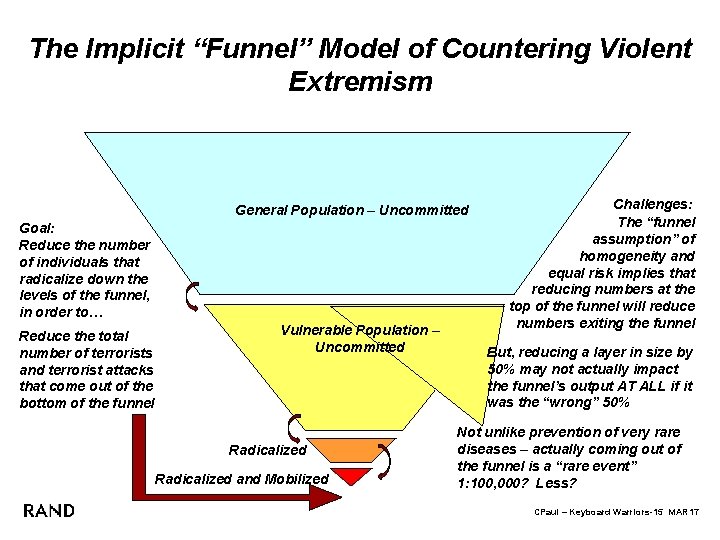
The Implicit “Funnel” Model of Countering Violent Extremism General Population – Uncommitted Goal: Reduce the number of individuals that radicalize down the levels of the funnel, in order to… Reduce the total number of terrorists and terrorist attacks that come out of the bottom of the funnel Vulnerable Population – Uncommitted Radicalized and Mobilized Challenges: The “funnel assumption” of homogeneity and equal risk implies that reducing numbers at the top of the funnel will reduce numbers exiting the funnel But, reducing a layer in size by 50% may not actually impact the funnel’s output AT ALL if it was the “wrong” 50% Not unlike prevention of very rare diseases – actually coming out of the funnel is a “rare event” 1: 100, 000? Less? CPaul – Keyboard Warriors-15 MAR 17
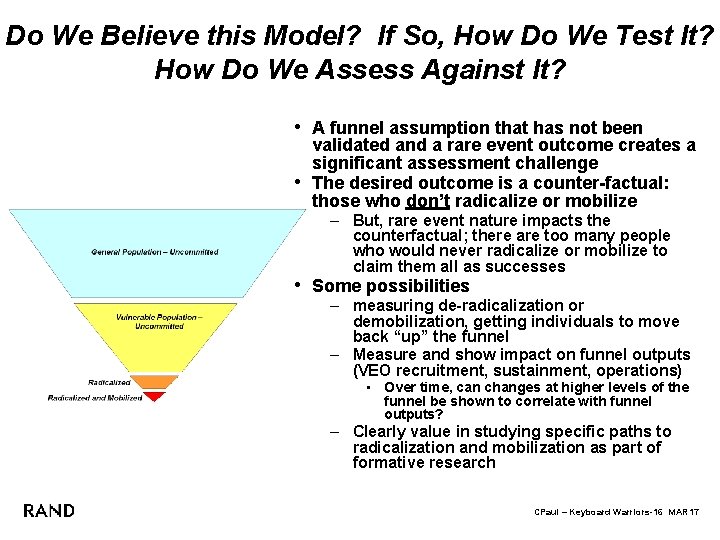
Do We Believe this Model? If So, How Do We Test It? How Do We Assess Against It? • A funnel assumption that has not been validated and a rare event outcome creates a significant assessment challenge • The desired outcome is a counter-factual: those who don’t radicalize or mobilize – But, rare event nature impacts the counterfactual; there are too many people who would never radicalize or mobilize to claim them all as successes • Some possibilities – measuring de-radicalization or demobilization, getting individuals to move back “up” the funnel – Measure and show impact on funnel outputs (VEO recruitment, sustainment, operations) • Over time, can changes at higher levels of the funnel be shown to correlate with funnel outputs? – Clearly value in studying specific paths to radicalization and mobilization as part of formative research CPaul – Keyboard Warriors-16 MAR 17
CPaul – Keyboard Warriors-17 MAR 17
But that isn’t true about the information environment! Commanders and leaders need to remember that we care about what happens in the IE not because of what stays in the IE, but because effects transit through the IE and echo in the physical world CPaul – Keyboard Warriors-18 MAR 17
The Russian “Firehose of Falsehood” Propaganda Model Why it might work and options to counter it CPaul – Keyboard Warriors-19 MAR 17
The problem CPaul – Keyboard Warriors-20 MAR 17
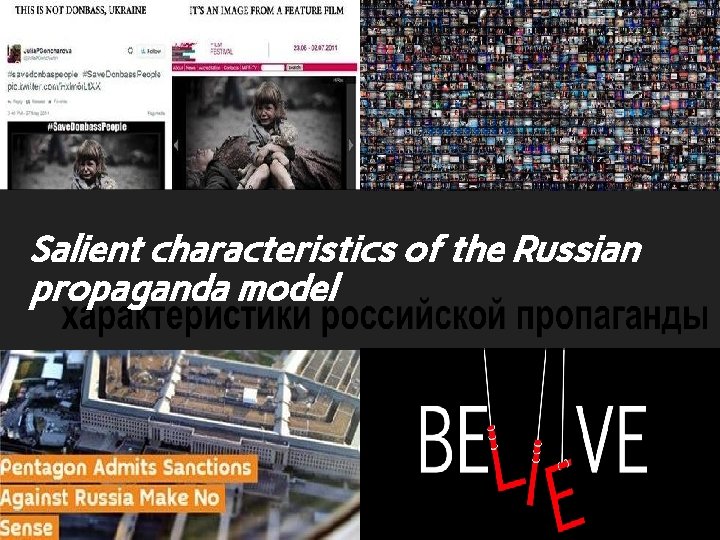
Salient characteristics of the Russian propaganda model CPaul – Keyboard Warriors-21 MAR 17
Why might the firehose be effective? Lessons from the social psychology literature CPaul – Keyboard Warriors-22 MAR 17
What can we do to counter this? (Or, let’s torture the “water” metaphor) CPaul – Keyboard Warriors-23 MAR 17
Reprise: A Selection of Challenges Facing Social Media Use by Defence • • Legal, ethical, or policy constraints – Intelligence oversight – Privacy and publicly available information – Permissions and authorities – Cumbersome approval processes – Artificial boundaries on a boundless mode – possibility of inappropriate influence – Frameworks that fail to account for the intermingling of domestic and foreign communication Insufficient understanding – of psychology – of behavioral and social sciences – of culture, language and idiom – of narrative – of optimal analytical tools and their limitations – of the legal, ethical, and policy constraints – Lack of shared understanding Untested assumptions – Untested theories of change – Lack of clear (and SMART) goals Uncertainty and unpredictability – Difficulty of establishing causation – Uncertainty about the connections between online – – • behavior and physical behavior Seeking to affect social media for social media’s stake Power of “viral” – hard to predict what will explode, hard to plan something that will catch on • • • Volume – Signal to noise (both finding the right signal and getting our signal through) – Bandwidth Velocity – The power of being first – “Digital wildfires” - the lies are half-way around the world before the truth even has its shoes on – Always on Variety – SM isn’t just text but audio, video, still imagery, vine, meme, idiom – Anything we can do, they can do (and more) Veracity – Propaganda (and countering it) – Ease of being spoofed or deceived – Discerning truth from falsehood – Post-truth proclivity – what feels true? – The truth doesn’t always win – The weakness of refutation – User-generated content/citizen journalism vs. traditional journalism Risk – Effects out of audience – Risk of failure or of “negative influence” – Legal, ethical, or normative violation – OPSEC violations – Information fratricide/contradiction Representativeness and completeness – Self selection of participants (the squeaky wheel, – – or the silent majority? ) Self selection of content Internet penetration, and thus opportunity, varies CPaul – Keyboard Warriors-24 MAR 17
Questions? Comments? • The Russian "Firehose of Falsehood Propaganda Model: Why It Might Work and Options to Counter It (http: //www. rand. org/pubs/perspectives/PE 198. html) • “Fighting Against, With, and Through Narrative” (forthcoming Marine Corps Gazette, available on request) • "Assessing against and moving past the ‘funnel model’ of counterterrorism communication. " Defence Strategic Communication, Winter 2015, v. 1 no. 1, p. 26 -40. Christopher Paul, Ph. D. cpaul@rand. org CPaul – Keyboard Warriors-25 MAR 17