
Using skills to identify a bird Use your
Using skills to identify a bird Use your field notebook to take notes on a bird’s size and shape. Pay attention to the shape and size of the bird’s body parts, as well as how a bird lives its life, what it eats, how it flies, and where it lives. These are the clues that will help you identify birds. Example: Vireos are a good example, because they are small birds seen among leaves and trees. They look like most warblers, but their bills are thicker and very slight hooked.
judge size of bird against birds you know well When birds hunker down or fluff up they are harder to identify. With more tricks, you can identify a bird by its size. Compare birds that you have a hard time identifying, with common birds that you know. It is important to know the size of a bird, whether it’s large or small, so you can compare it to others. For example, comparing a sparrow, robin or crow can help you choose between two familiar species, such as Sharpshinned Hawk and Cooper’s Hawk, or Downy and Hairy Woodpecker.
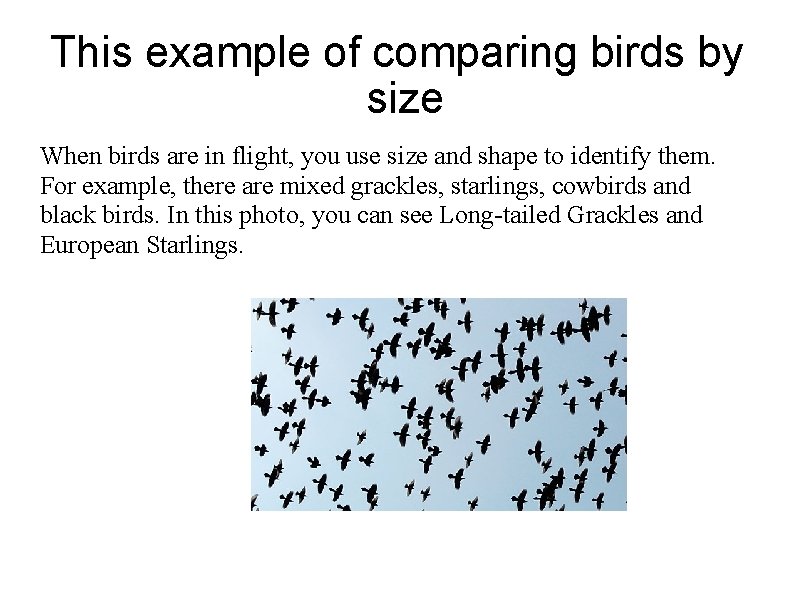
This example of comparing birds by size When birds are in flight, you use size and shape to identify them. For example, there are mixed grackles, starlings, cowbirds and black birds. In this photo, you can see Long-tailed Grackles and European Starlings.
Apply your size and shape skills to the part of bird Use your field note book take notes on birds size and shape. Pay attention to shape and size by birds body parts. You can find clues on how a bird lives it live, what eats, how it flies and where it lives
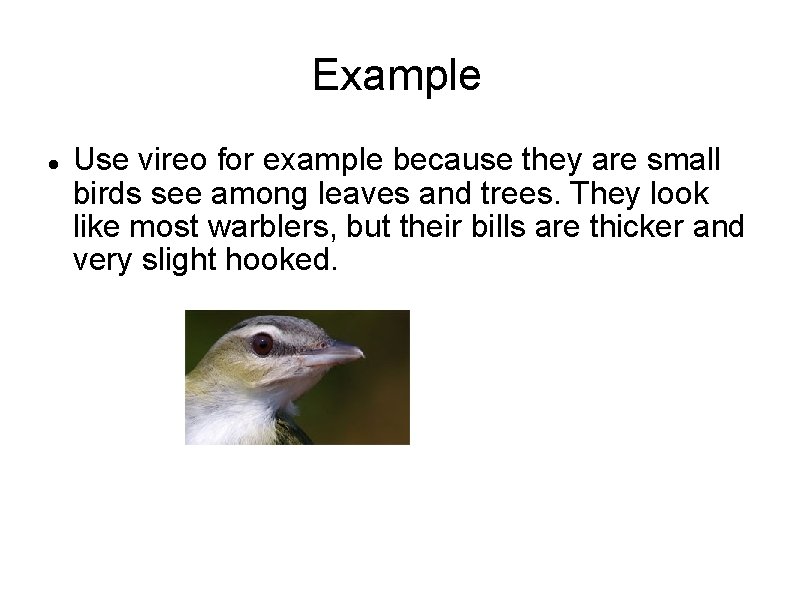
Example Use vireo for example because they are small birds see among leaves and trees. They look like most warblers, but their bills are thicker and very slight hooked.
Bill and Beak A bird’s bill is an all-purpose tool that functions like a bird’s hand, pliers, knitting needles, knife and fork and bull horn. The shape of a bill plays a very important part of bird identification. Have you ever wondered why there are so many different bird beaks? The main function of a bird beak is to feed. The shape of a beak depends on what it feeds on. When you look at a beak you will know what a bird feeds on.

Example of different Beaks A cone shaped bill is found in many birds such as finches and grosbeaks. It is a strong beak used for cracking seeds.
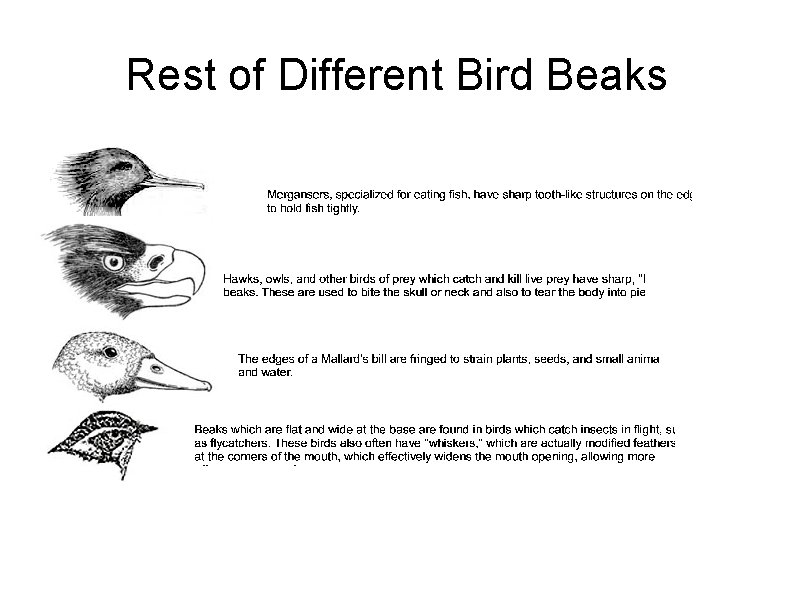
Rest of Different Bird Beaks
Others parts bird good for bird identification and pay close attention to details The other parts of a bird that can help you identify them are tail shape, wing shape, head shape, neck length, and body shape. Noticing detail can help avoid identification mistakes. Example: If you see a Northern Flicker you might think it is a Northern Mockingbird, so you need to check the parts of the bird to make correct identifications, because there are different bird families.
Comparing bird against it self You can always compare a bird’s key body parts to others of its species to tell the difference between different breeds. Specific details, like how long a bird’s is bill, are great ways to tell the difference between a Downy Woodpecker and Hairy Woodpecker. This is useful for identifying most bird species. Another example is comparing the size of the head of a Cooper’s Hawk and Sharp-shinned Hawk. A Cooper’s head is bigger than a Sharp-shinned head. Get in a habit of measuring a bird against itself. Pay attention to the different parts of a bird. How they are extended, and how big or small it is.
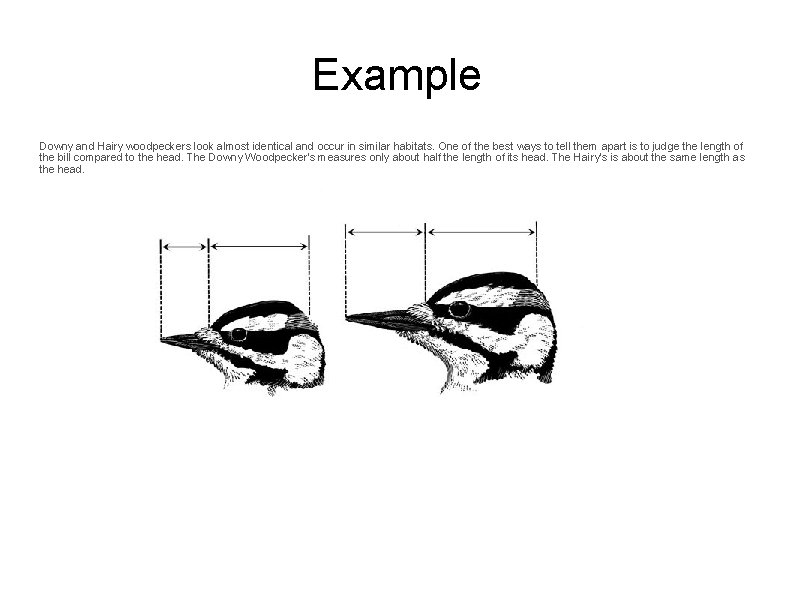
Example Downy and Hairy woodpeckers look almost identical and occur in similar habitats. One of the best ways to tell them apart is to judge the length of the bill compared to the head. The Downy Woodpecker's measures only about half the length of its head. The Hairy's is about the same length as the head.
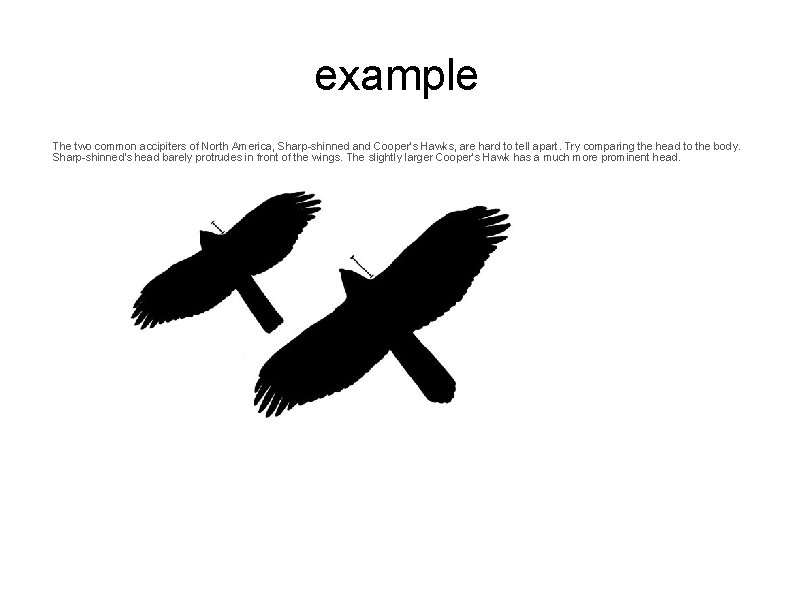
example The two common accipiters of North America, Sharp-shinned and Cooper's Hawks, are hard to tell apart. Try comparing the head to the body. Sharp-shinned's head barely protrudes in front of the wings. The slightly larger Cooper's Hawk has a much more prominent head.
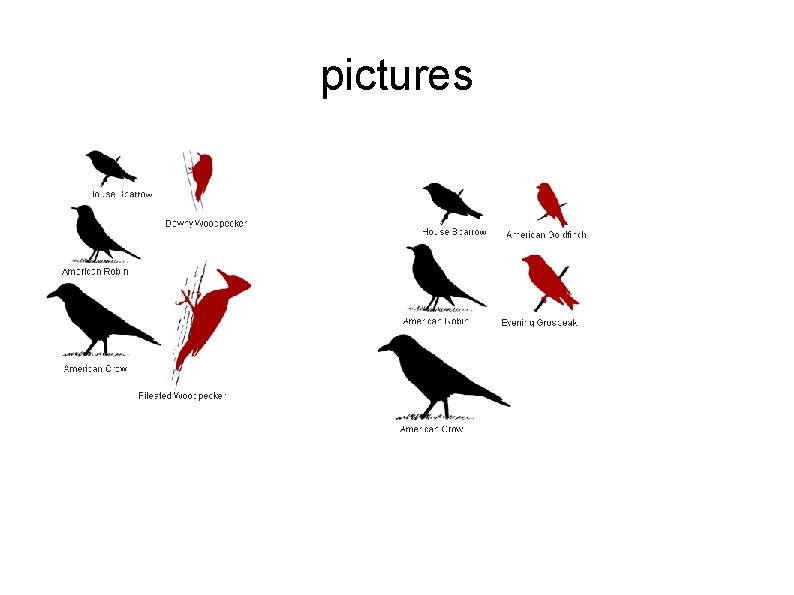
Size can be great a clue to what bird group it is in and its actual species. Size can help when you see an unknown bird side by side with a common bird. Some things effect how you identify a bird’s size, like poor lighting, or distance. A bird’s size can be hard to identify in the field. Example: A crow-sized woodpecker would be a Pileated, but one the size of a sparrow might be a Downy Woodpecker (or a Ladder-backed Woodpecker in the Southwest).
example Woodpeckers: A crow-sized woodpecker would be a Pileated, but one the size of a sparrow might be a Downy Woodpecker (or a Ladder-backed Woodpecker in the Southwest). A yellow-and-black finch that is smaller than a sparrow is probably an American Goldfinch. Evening Grosbeaks have similar colors and patterns, but are almost robin-sized.
pictures
Example
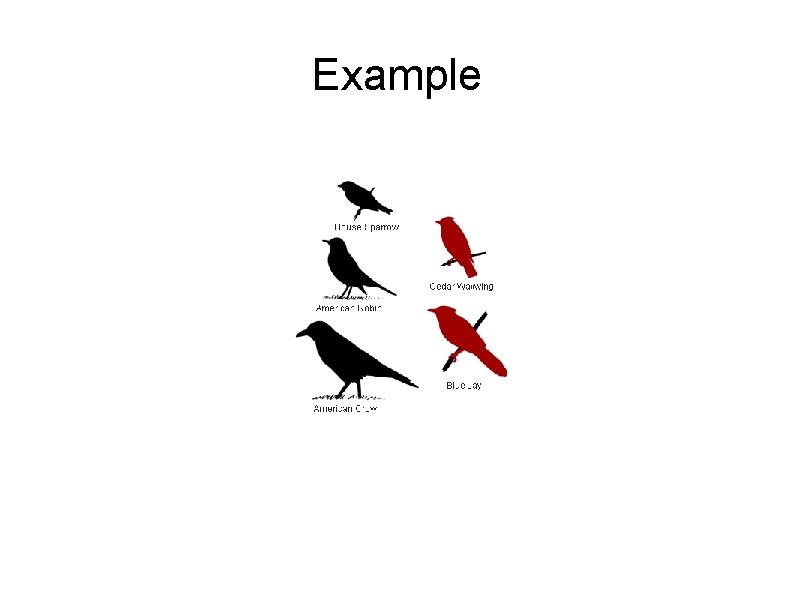
In between sizes Most time you will need to reference other birds for a comparison. Example: Robins are smaller than Cedar Waxwings, but are bigger than sparrows. Crows are bigger than blue jays and robins.
Feathers vary greatly in color, function and pattern. A bird’s field marks are a wonderful combination of pattern and color that are unique to ornithologist. These can help you make a positive identification. It is important to understand the function of feathers, and the process where birds replace them. Juvenile males and females have different color schemes, which sometimes complicates identification.
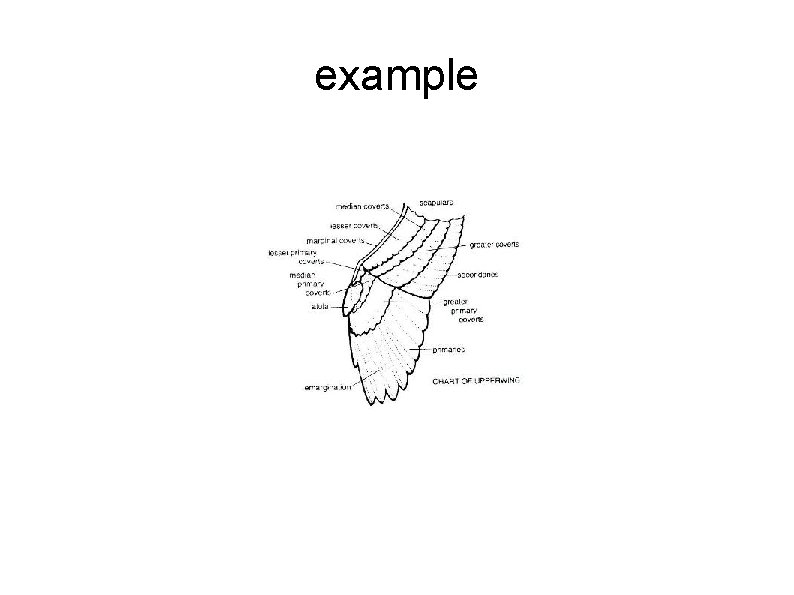
example
Downy warmth and Sharpley Curves Most birds have different types of feathers on different parts of their bodies. A large number of their feathers are hidden or have evolved into peculiar shapes. Contour Feathers are feathers that lay on the body and give a bird its basic shape. Underneath contour feathers are downy feathers which help insulate birds in cold weather. Some birds have feathers modified for sexual advertisement.
Flying high with primary colors A bird’s largest feathers are its primaries, which point sharply and are located along the outer edge of its wings. The Secondary feathers will occur at the midpoint of the wings and are usually blunt or rounded. Ornithologist call tail feathers rectrices, which are stiff and used in flight. Small feathers, called coverts, lie near borders of wings and tail and make borders for remiges feathers and contours.
Method of molting Feathers are not composed of living cells. They wear as they age. Birds replace their feathers after shedding them. This is called molting. When they molt, they lose some their best field marks. Molting can replace a whole feather or just part of one. This often occurs before migration or after they nest. Those that molt in harsh climates only do two complete molts.
Other birds Birds might have the same plumage year-round. Some species look different in spring than in winter. Males will have bright plumage before breeding seasons.
Video of birds molting https: //www. youtube. com/watch? v=ukwz. HVka. OK Q https: //www. youtube. com/watch? v=u. PJSNhz. JHw 0
Males females and youngster colors Males, females, and youngsters display different colors. Fledgling birds won’t resemble their parents. A skilled birder knows how identify all birds. Most birds exhibit sexual dichromatism in which male females display different colors. Male birds usually have bolder colors which is a sign of fitness which is attractive to females.
Olive sided flycatcher Breeds in montane and northern coniferous forests, at forest edges and openings, such as meadows and ponds. Winters at forest edges and clearings where tall trees or snags are present. Flying insects, especially bees. Nest is an open cup of twigs, rootlets, and lichens, placed out near tip of horizontal branch of a tree. Sallies out from top of tall tree or snag to catch flying insect, and frequently returns to the same perch. Beats large prey on perch.
More on olive sided fly catcher Olive-sided Flycatcher declined by over 3. 3% per year between 1966 and 2014, resulting in a cumulative decline of 81%, according to the North American Breeding Bird Survey. Partners in Flight estimates a global breeding population of 1. 7 million, with 49% spending some part of the year in the U. S. , 2% in Mexico, and 51% breeding in Canada. The species rates a 13 out of 20 on the Continental Concern Score. Olivesided Flycatcher is a Tri-National Concern species, and is on the 2014 State of the Birds Watch List, which lists bird species that are at
Burrowing Owls are unmistakable birds, and that goes double for a long-legged owl that hunts on the ground during the day. Burrowing Owls are small, sandy colored owls with bright-yellow eyes. They live underground in burrows they’ve dug themselves or taken over from a prairie dog, ground squirrel, or tortoise. They live in grasslands, deserts, and other open habitats, where they hunt mainly insects and rodents. Their numbers have declined sharply with human alteration of their habitat and the decline of prairie dogs and ground squirrels. Burrowing Owls live in open, treeless areas with low, sparse vegetation, usually on gently sloping terrain. The owls can be found in grasslands, deserts, and steppe environments; on golf courses, pastures, agricultural fields, airport medians, and road embankments; in cemeteries and urban vacant lots. They are often associated with high densities of burrowing mammals such as prairie dogs, ground squirrels, and tortoises. Breeding pairs stay near a dedicated nesting burrow, while wintering owls may move around and may roost in tufts of vegetation rather than in burrows Burrowing Owls eat invertebrates and small vertebrates, including lizards, birds, and mammals. Invertebrates, especially insects, constitute the majority of food items, while vertebrates make up the bulk of the diet by mass. Burrowing Owls commonly hunt grasshoppers, crickets, moths, beetles, mice, voles, and shrews. They also prey on dragonflies, giant water bugs, earwigs, caterpillars, scorpions, and earthworms, frogs, toads, snakes, lizards, turtles, and salamanders, bats, ground squirrels, small weasels, young rabbits, songbirds, waterbirds, baby ducks, and even young burrowing owls. Females catch more insects, mostly during the day; males take most of the vertebrates, mostly at night.
More on Burrowing Owl The nest burrow can be several yards long and is usually less than 3 feet deep, but size depends on the mammal that originally excavated it. Burrows tend to make numerous twists and turns, with a mound of dirt at the entrance and an opening at least 4– 6 inches wide. The owls often line their burrow with livestock manure, sometimes with feathers, grass, or other materials. When owls dig their own burrows, the process may take several days, but it takes them less time to prepare the burrow for nesting when they use an existing burrow. Nesting owls tend to use areas with a high density of surrounding burrows, which may provide extra escape options for developing young. Preferred sites have loose soil, a bit of elevation to avoid flooding, and nearby lookouts such as dirt mounds, bushes, fence posts, or road signs. They use burrows dug by prairie dogs, ground squirrels, badgers, marmots, skunks, armadillos, kangaroo rats, and tortoises. Both members of a pair enlarge and maintain the existing burrow by digging with their beaks and kicking back soil with their feet. Most owls use existing burrows, but in Florida and the Caribbean, they usually excavate their own burrows and on rare occasions western owls excavate their own burrows. Nonmigrating owls use burrows year-round. Burrowing Owls hunt at all hours of the day and night. Usually staying close to the ground, they fly, hover, walk, or run, seizing prey in their talons. Between forays for food, they sleep on dirt mounds at their burrow entrances or on depressions in the ground. Disturbed owls bob jerkily up and down, as do hunting owls pinpointing prey. They are mostly monogamous and breed close together in loose colonies. Females stay in or near the nest burrow until chicks fledge, while males tend to stand guard at a nearby burrow or perch. Males defend their territories against other males by vocalizing, displaying in a weaving crouch with feathers fluffed, or chasing and attacking with outstretched talons. Courting adults—mainly males— display by circling overhead or flying dozens of feet into the air, hovering for a few seconds and then rapidly descending. Pairs vocalize, rub bills, and preen, the male calling and presenting food to the female. Young owls play-hunt by jumping on each other, on prey brought by their parents, and on dung around the burrow.
Additional info Burrowing Owls are still numerous, but populations declined by about 33% between 1966 and 2015, according to the North American Breeding Bird Survey. Declines have been particularly sharp in Florida, the Dakotas, and coastal California. Partners in Flight estimates a global breeding population of 2 million, with 31% spending some part of the year in the U. S. , and 15% in Mexico. The species rates a 12 out of 20 on the Continental Concern Score and is not on the 2016 State of the Birds Watch List. The species is listed as Endangered in Canada and as a species with Special Protection in Mexico. Agriculture and development have significantly diminished the colonies of prairie dogs and other burrowing animals where Burrowing Owls once nested by the hundreds. Pesticides, collisions with vehicles, shooting, entanglement in loose fences and similar manmade hazards, and hunting by introduced predators (including domestic cats and dogs) are also major sources of mortality. At the same time, Burrowing Owls have benefited from protective legislation, reintroduction and habitat protection programs, and artificial nest burrows. Because they do not require large uninterrupted stretches of habitat, these owls can benefit from the protection of relatively small patches of suitable land.
Turkey Vulture If you’ve gone looking for raptors on a clear day, your heart has probably leaped at the sight of a large, soaring bird in the distance– perhaps an eagle or osprey. But if it's soaring with its wings raised in a V and making wobbly circles, it's likely a Turkey Vulture. These birds ride thermals in the sky and use their keen sense of smell to find fresh carcasses. They are a consummate scavenger, cleaning up the countryside one bite of their sharply hooked bill at a time, and never mussing a feather on their bald heads. size & Shape Turkey Vultures are large dark birds with long, broad wings. Bigger than other raptors except eagles and condors, they have long "fingers" at their wingtips and long tails that extend past their toe tips in flight. When soaring, Turkey Vultures hold their wings slightly raised, making a ‘V’ when seen head-on. Color Pattern Turkey Vultures appear black from a distance but up close are dark brown with a featherless red head and pale bill. While most of their body and forewing are dark, the undersides of the flight feathers (along the trailing edge and wingtips) are paler, giving a two-toned appearance. Behavior Turkey Vultures are majestic but unsteady soarers. Their teetering flight with very few wingbeats is characteristic. Look for them gliding relatively low to the ground, sniffing for carrion, or else riding thermals up to higher vantage points. They may soar in small groups and roost in larger numbers. You may also see them on the ground in small groups, huddled around roadkill or dumpsters.
More on turkey vulture Turkey Vultures eat carrion, which they find largely by their excellent sense of smell. Mostly they eat mammals but are not above snacking on reptiles, other birds, amphibians, fish, and even invertebrates. They prefer freshly dead animals, but often have to wait for their meal to soften in order to pierce the skin. They are deft foragers, targeting the softest bits first and are even known to leave aside the scent glands of dead skunks. Thankfully for them, vultures appear to have excellent immune systems, happily feasting on carcasses without contracting botulism, anthrax, cholera, or salmonella. Unlike their Black Vulture relatives, Turkey Vultures almost never attack living prey. Turkey Vultures don’t build full nests. They may scrape out a spot in the soil or leaf litter, pull aside obstacles, or arrange scraps of vegetation or rotting wood. Once found, many of these nest sites may be used repeatedly for a decade or more. Turkey Vultures nest in rock crevices, caves, ledges, thickets, mammal burrows and hollow logs, fallen trees, abandoned hawk or heron nests, and abandoned buildings. These nest sites are typically much cooler (by 13°F or more) than surroundings, and isolated from human traffic or disturbance. While they often feed near humans, Turkey Vultures prefer to nest far away from civilization. The Turkey Vulture's distinctive slow, teetering flight style probably helps the bird soar at low altitudes, where it is best able to use its nose to find carrion. At other times they may soar high on thermals and form mixed flocks or kettles. On the ground they move with ungainly hops and are less agile than Black Vultures. Often, especially in the morning, they can be seen standing erect, wings spread in the sun, presumably to warm up, cool off, or dry off. Outside of the breeding season, Turkey Vultures form roosts of dozens to a hundred individuals. When Turkey Vultures court, pairs perform a "follow flight" display where one bird leads the other through twisting, turning, and flapping flights for a minute or so, repeated over periods as long as 3 hours. Migrating flocks can number in the thousands. At carcasses, several Turkey Vultures may gather but typically one feeds at a time, chasing the others off and making them wait their turn. Despite their size, Turkey Vultures are often driven off by smaller Black Vultures, Crested Caracaras, Zone-tailed Hawks, and other species. Turkey Vultures increased in number across North America from 1966 to 2014, according to the North American Breeding Bird Survey. Partners in Flight estimates a global breeding population of 18 million with 28% spending some part of the year in the U. S. , 9% in Mexico, and 1% breeding in Canada. The species rates a 5 out of 20 on the Continental Concern Score. Turkey Vulture is not on the 2014 State of the Birds Watch List. These birds were threatened by side-effects of the pesticide DDT, but today they are among the most common large carnivorous birds in North America. However, because they live on rotting meat,
- Slides: 32