
USING SIGNWRITING FOR A PERUVIAN SIGN LANGUAGE LSP
- Slides: 17
USING SIGNWRITING FOR A PERUVIAN SIGN LANGUAGE (LSP) DICTIONARY MIGUEL RODRÍGUEZ-MONDOÑEDO PONTIFICIA UNIVERSIDAD CATÓLICA DEL PERÚ
OVERVIEW • We will discuss the possibilities of using Sign. Writting (SW) to represent lexical entries in a Peruvian Sign Language Dictionary (Diccionario Anotado de Lengua de Señas Peruana, DALSP in Spanish). • Antecedents: (almost) none • Introduction to Peruvian Sign Language • Some remarks on Peruvian Deaf Community and their education • Properties of DALSP • Challenges for Sign. Writting in DALSP
ANTECEDENTS: (ALMOST) NONE • Currently, no published dictionary on Peruvian Sign Language (LSP in Spanish) exists---we are only aware of two lexical repertoires, which basically contain different versions of the same entries: -ASSOLI 2012 (http: //www. slideshare. net/assoliperu/documents) -Ministerio de Educación 2010 (http: //basicaespecial. perueduca. edu. pe/web/libros_digebe/5/files/assets/basic-html/toc. html )
ANTECEDENTS: (ALMOST) NONE • In fact, there is almost no research on LSP, and very few systematically gathered data on the language. • Almost no known data collected is publically available. For instance researchers from the Summer Institute of Linguistics have a substantial amount of data not intended for publication : http: //www. peru. sil. org/es/resources/search/language/prl ? sort_by=field_reap_title&sort_order=DESC
ANTECEDENTS: (ALMOST) NONE • The only repertoire of data on Peruvian Sign Language that is publically available is the Repositorio Digital de Lengua de Señas Peruana, collected by the Research Group Señas Gramaticales (Grammatical Signs), based on the Pontificia Universidad Católica del Perú (PUCP, Lima): • http: //repositorio. pucp. edu. pe/index/handle/123456789/46588 • This is the primary source of the planned DALSP.
PERUVIAN SIGN LANGUAGE • Peruvian Sign Language is a language created by the Peruvian Deaf Community. • It is understudied • Not a single paper on LSP grammar • Two sociolinguistic reports (Parks & Parks 2009, Ministerio de Educación 2012) • We are preparing a grammar • Two PUCP students are preparing their thesis on LSP.
PERUVIAN SIGN LANGUAGE • It is not clear how many varieties of LSP we have in the country • Intelligibility among all communities have not been established (Parks & Parks 2010) • Anecdotic reports show huge inter-generational variation. • This is probably due to the influenced of ASL in younger generations (> 30) of LSP signers. • More research needs to be conducted.
PERUVIAN SIGN LANGUAGE • We have identified in LSP many of the features usually found in sign languages: • • heavy use of classifier constructions flexible word order substantial amount of iconicity different patterns of verbal agreement (plain, inflectional, spatial) • Something that seems to be specific of LSP is a SOV basic word order (verb final)
PERUVIAN DEAF COMMUNITY • Approximately half a million deaf or hard-of-hearing individuals in the country. • The Deaf community is much smaller, though---if we define it as the community that uses LSP. • Deaf Peruvians have very few opportunities to get an education or to find a job. • There are only two regular schools where they can receive education in sign language: EFATA School, Bethoveen School (in addition, some NGOs fund efforts from parents to organize schools for their children)
PERUVIAN DEAF COMMUNITY • “Inclusive” education in Peru has meant that the Deaf student sits on a mainstream class, and gets passing grades year after year without learning anything. • As a result, there are generations of Deaf students with little literacy, or none. • LSP is an official language since 2010, by Law. But the law has not been implemented yet. • LSP is entirely excluded from State language politics: it is not even mentioned in most official documents listing Peruvian languages (officials from Secretary of Culture publicly reject to comply with the Law)
PERUVIAN DEAF COMMUNITY • Scholars behave no differently. • There is not a single academic book on Peruvian languages that even mentions LSP. • Nobody has ever written a grammar or a professional dictionary on LSP. • There is not a single book on how to teach Spanish to Peruvian Deaf people. • There is not professional career or college degree for LSP interpreters (there is not a single professional LSP interpreter), or for Deaf educators in LSP.
DALSP • Under these circumstances, it is not small task to write a Dictionary on LSP. • For this reason, the goal of our DALSP is very humble. • We do not aim to collect a vast amount of signs. Our target is to analyze 500 signs (but we may end up with 1000). • We aim to develop a methodology to make sign language dictionaries. • This is why we call it “Diccionario Anotado” (Annotated Dictionary)
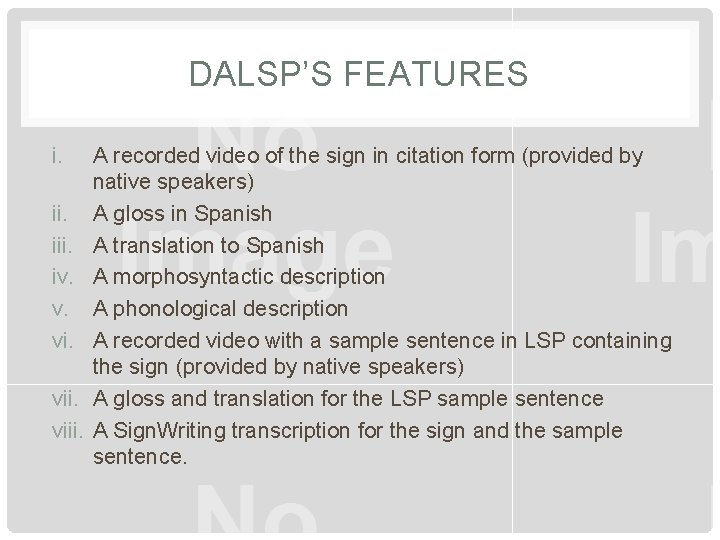
DALSP’S FEATURES i. iii. iv. v. viii. A recorded video of the sign in citation form (provided by native speakers) A gloss in Spanish A translation to Spanish A morphosyntactic description A phonological description A recorded video with a sample sentence in LSP containing the sign (provided by native speakers) A gloss and translation for the LSP sample sentence A Sign. Writing transcription for the sign and the sample sentence.
DALSP’S FEATURES • https: //sites. google. com/a/pucp. pe/diccionario-lspejemplo/
CHALLENGES • We use Sign Maker, which is a wonderful tool. http: //www. signbank. org/signmaker. html • We are actually learning to use SW. • Do students need to use SW? • Main advantage: SW practices and conventions will allow us to have a deeper awareness of LSP signs phonological features, since we will need to identify them clearly in order to make the proper transcription.
CHALLENGES • Using SW in the Dictionary will visualize a hardly known property of sign languages, i. e. the fact that they can be written in a phonological fashion, in the same way oral language is. This is important because in our country, LSP is still fighting for social and cultural recognition across different sectors of the society, including the education system, and even the Deaf families.
CHALLENGES • We will train our team in the conventions of SW, and potentially we will be able to attract the interest of Peruvian Deaf community in a writing system for LSP.