
Using Semicolons and Colons Why are semicolons and

- Slides: 11
Using Semicolons and Colons Why are semicolons and colons important? Semicolons between independent clauses Colons before lists of items Conventional uses of colons Review A Review B
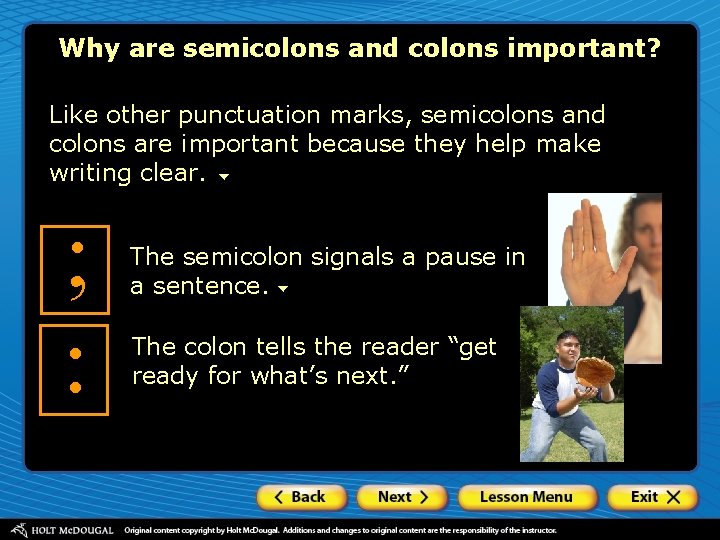
Why are semicolons and colons important? Like other punctuation marks, semicolons and colons are important because they help make writing clear. ; : The semicolon signals a pause in a sentence. The colon tells the reader “get ready for what’s next. ”
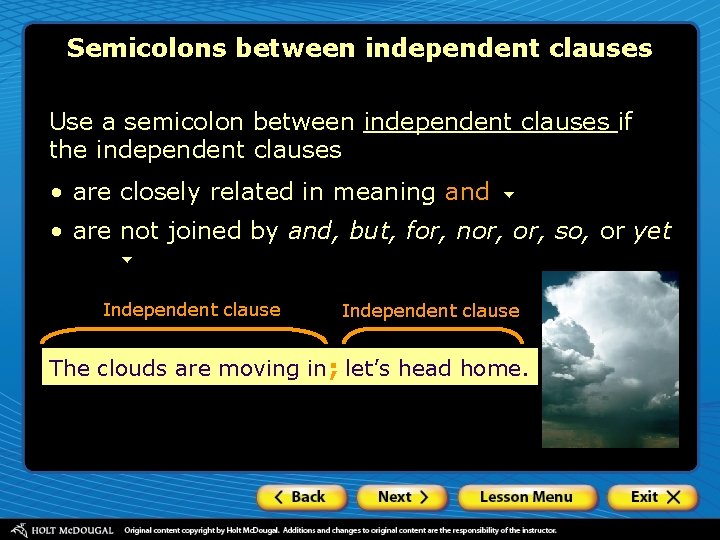
Semicolons between independent clauses Use a semicolon between independent clauses if the independent clauses • are closely related in meaning and • are not joined by and, but, for, nor, so, or yet Independent clause The clouds are moving in; let’s head home.
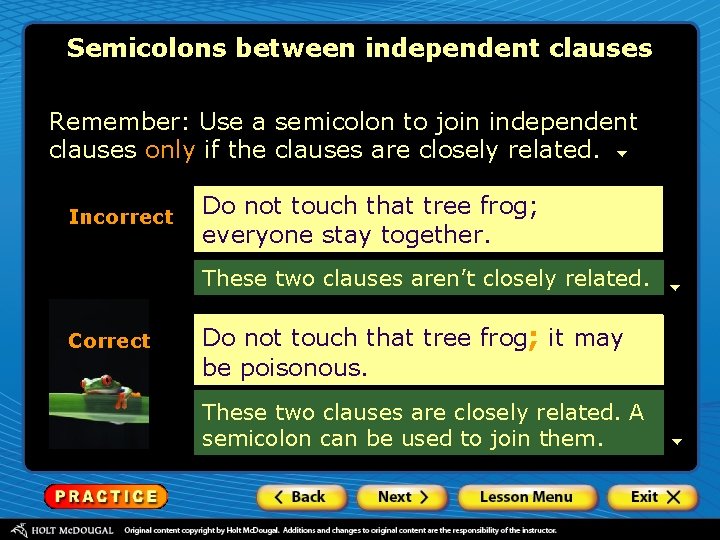
Semicolons between independent clauses Remember: Use a semicolon to join independent clauses only if the clauses are closely related. Incorrect Do not touch that tree frog; everyone stay together. These two clauses aren’t closely related. Correct Do not touch that tree frog; . it may be poisonous. Everyone stay together. A period is clauses used since two related. clauses A These two are the closely are not closely related. semicolon can be used to join them.
Semicolons between independent clauses Use a semicolon between independent clauses joined by a conjunctive adverb or a transitional expression. Kim loaded the camera incorrectly; therefore, the film was ruined. in fact, most of my clothes are I like cotton; in made of cotton. Notice that the conjunctive adverb and the transitional expression are followed by commas.
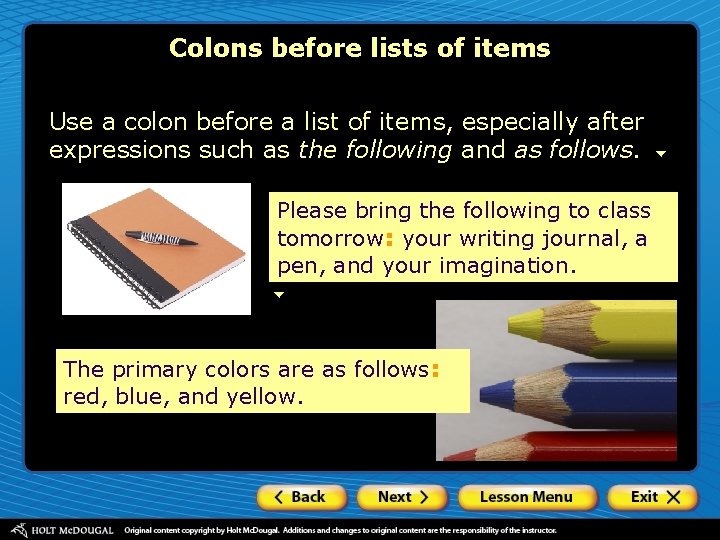
Colons before lists of items Use a colon before a list of items, especially after expressions such as the following and as follows. Please bring the following to class tomorrow: your writing journal, a pen, and your imagination. The primary colors are as follows: red, blue, and yellow.
Colons before lists of items Do not place a colon right after a verb. Verb Incorrect Marcelo’s hobbies include: fishing, hiking, and painting. Correct Marcelo’s hobbies include the following: fishing, hiking, and painting.
Colons before lists of items Do not place a colon right after a preposition. Preposition Incorrect Last fall we traveled through: New York, Vermont, New Hampshire, and Maine. Correct Last fall we traveled through the following states: New York, Vermont, New Hampshire, and Maine.
Conventional uses of colons Use a colon in certain conventional situations. Between the hour and the minute in times 8: 15 this evening 6: 00 in the morning
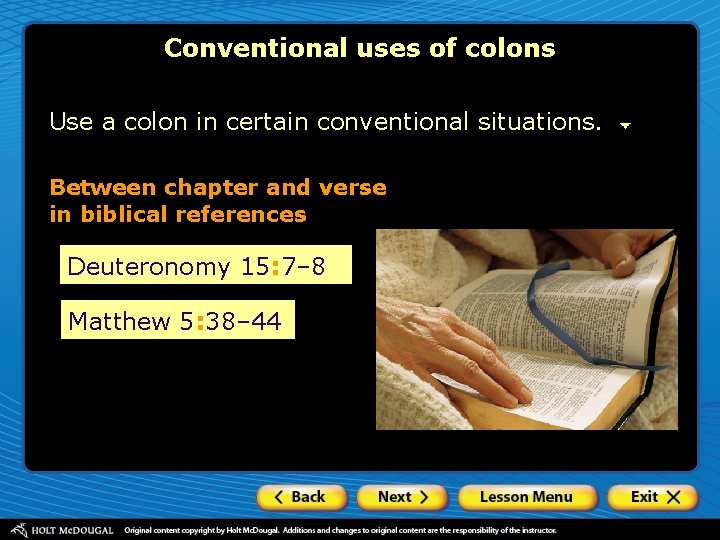
Conventional uses of colons Use a colon in certain conventional situations. Between chapter and verse in biblical references Deuteronomy 15: 7– 8 Matthew 5: 38– 44
Conventional uses of colons Use a colon in certain conventional situations. After the salutation of a business letter Dear Ms. Weinberg: Dear Sales Manager: