
Using Semicolons and Colons Using a Semicolon A

- Slides: 17
Using Semi-colons and Colons
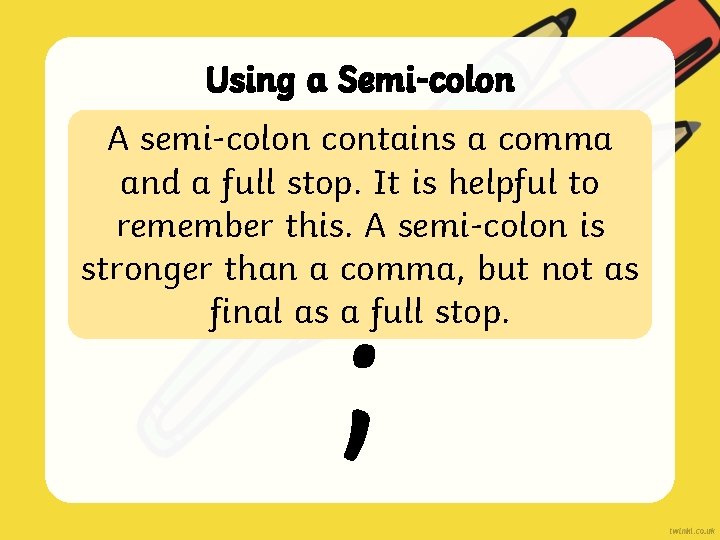
Using a Semi-colon A semi-colon contains a comma and a full stop. It is helpful to remember this. A semi-colon is stronger than a comma, but not as final as a full stop. ;
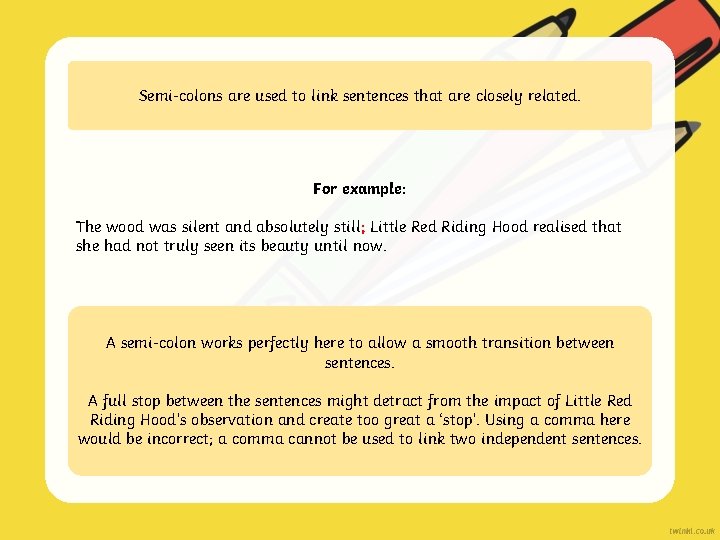
Semi-colons are used to link sentences that are closely related. For example: The wood was silent and absolutely still; Little Red Riding Hood realised that she had not truly seen its beauty until now. A semi-colon works perfectly here to allow a smooth transition between sentences. A full stop between the sentences might detract from the impact of Little Red Riding Hood’s observation and create too great a ‘stop’. Using a comma here would be incorrect; a comma cannot be used to link two independent sentences.
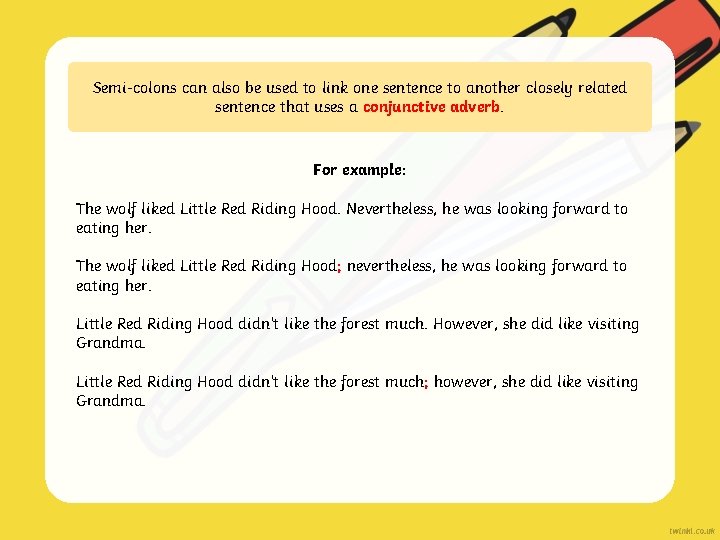
Semi-colons can also be used to link one sentence to another closely related sentence that uses a conjunctive adverb. For example: The wolf liked Little Red Riding Hood. Nevertheless, he was looking forward to eating her. The wolf liked Little Red Riding Hood; nevertheless, he was looking forward to eating her. Little Red Riding Hood didn’t like the forest much. However, she did like visiting Grandma. Little Red Riding Hood didn’t like the forest much; however, she did like visiting Grandma.
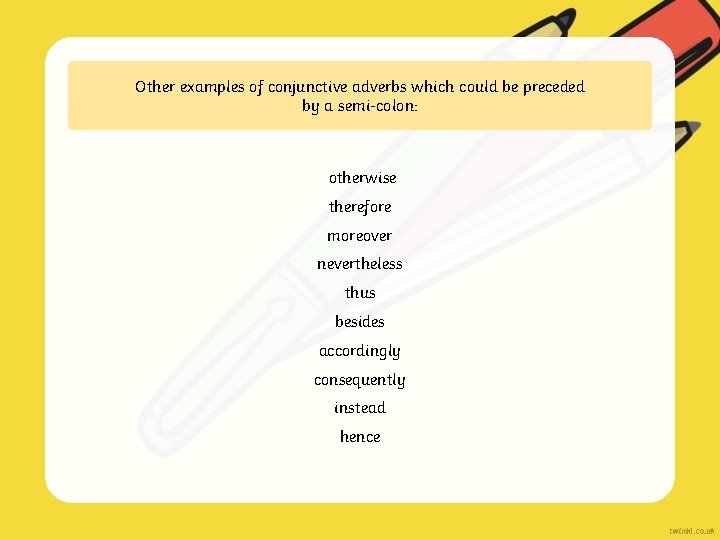
Other examples of conjunctive adverbs which could be preceded by a semi-colon: otherwise therefore moreover nevertheless thus besides accordingly consequently instead hence
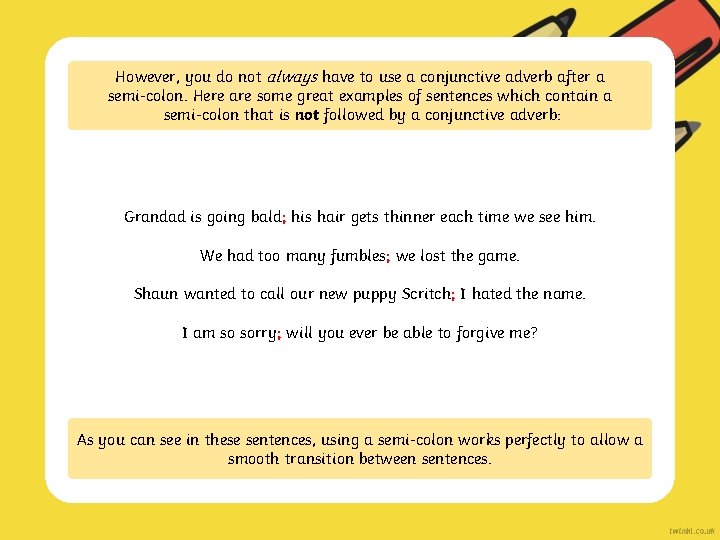
However, you do not always have to use a conjunctive adverb after a semi-colon. Here are some great examples of sentences which contain a semi-colon that is not followed by a conjunctive adverb: Grandad is going bald; his hair gets thinner each time we see him. We had too many fumbles; we lost the game. Shaun wanted to call our new puppy Scritch; I hated the name. I am so sorry; will you ever be able to forgive me? As you can see in these sentences, using a semi-colon works perfectly to allow a smooth transition between sentences.
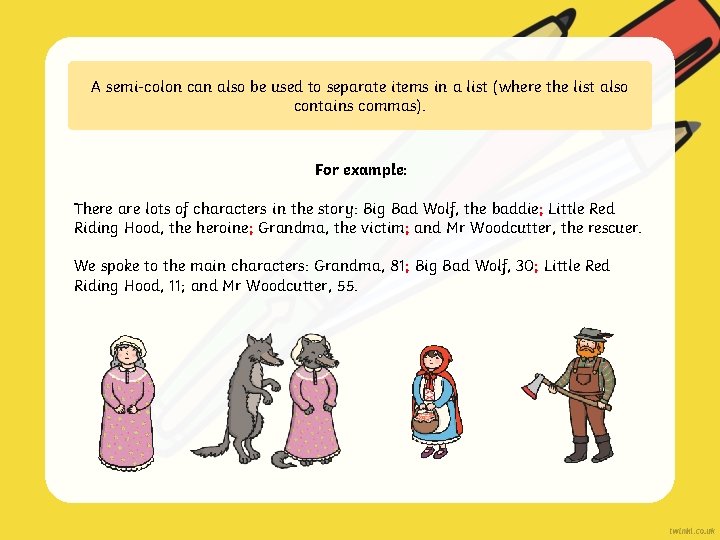
A semi-colon can also be used to separate items in a list (where the list also contains commas). For example: There are lots of characters in the story: Big Bad Wolf, the baddie; Little Red Riding Hood, the heroine; Grandma, the victim; and Mr Woodcutter, the rescuer. We spoke to the main characters: Grandma, 81; Big Bad Wolf, 30; Little Red Riding Hood, 11; and Mr Woodcutter, 55.
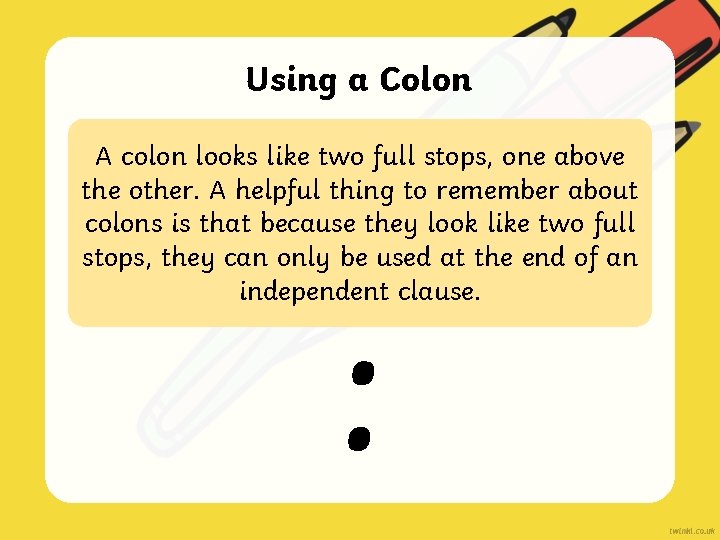
Using a Colon A colon looks like two full stops, one above the other. A helpful thing to remember about colons is that because they look like two full stops, they can only be used at the end of an independent clause. :
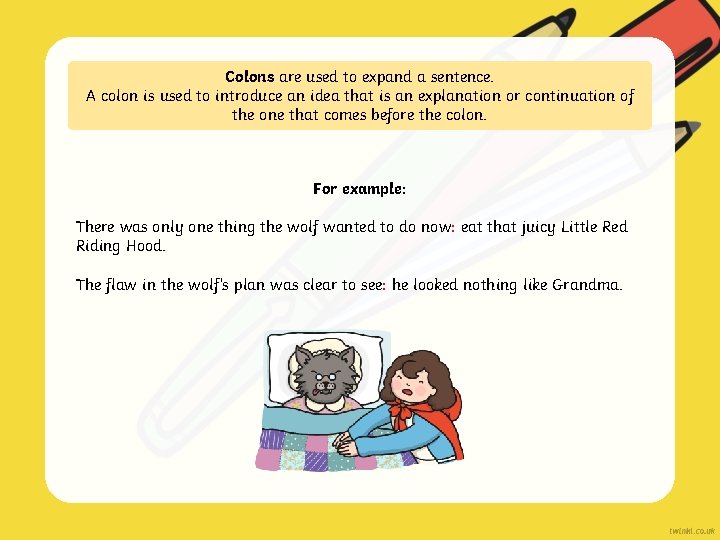
Colons are used to expand a sentence. A colon is used to introduce an idea that is an explanation or continuation of the one that comes before the colon. For example: There was only one thing the wolf wanted to do now: eat that juicy Little Red Riding Hood. The flaw in the wolf’s plan was clear to see: he looked nothing like Grandma.
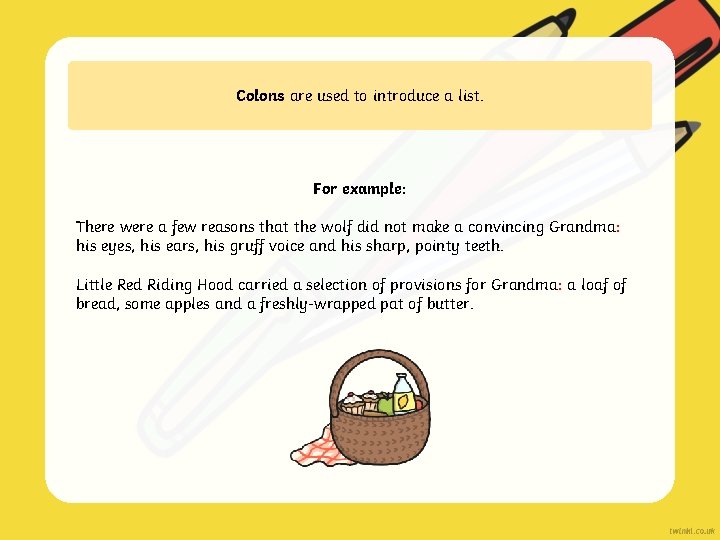
Colons are used to introduce a list. For example: There were a few reasons that the wolf did not make a convincing Grandma: his eyes, his ears, his gruff voice and his sharp, pointy teeth. Little Red Riding Hood carried a selection of provisions for Grandma: a loaf of bread, some apples and a freshly-wrapped pat of butter.
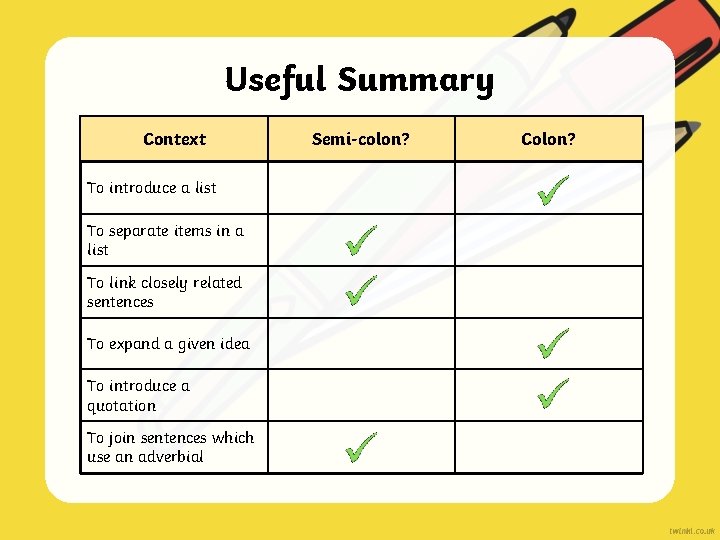
Useful Summary Context To introduce a list To separate items in a list To link closely related sentences To expand a given idea To introduce a quotation To join sentences which use an adverbial Semi-colon? Colon?
Semi-colon or Colon? Quiz
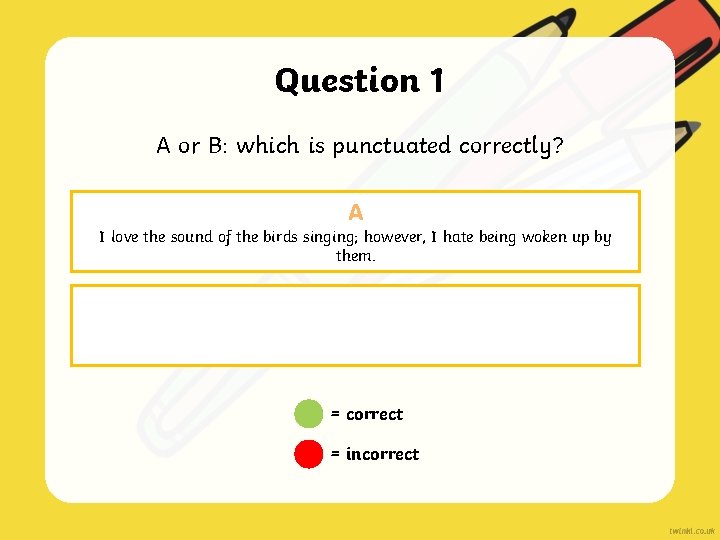
Question 1 A or B: which is punctuated correctly? A I love the sound of the birds singing; however, I hate being woken up by them. = correct = incorrect
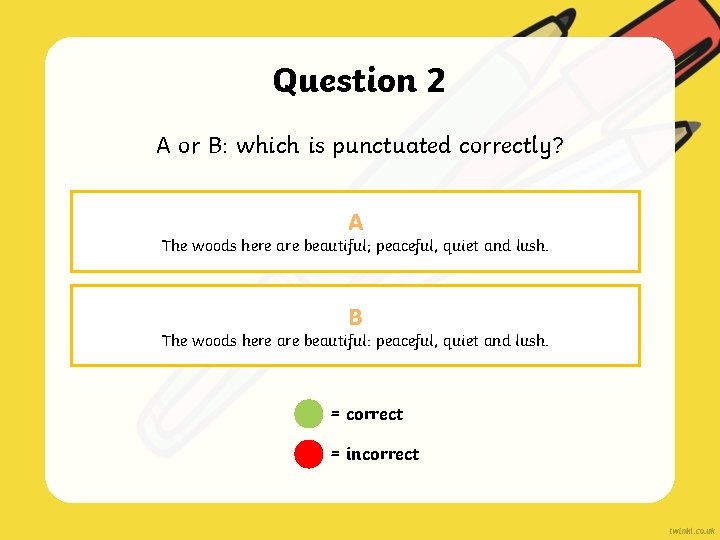
Question 2 A or B: which is punctuated correctly? A The woods here are beautiful; peaceful, quiet and lush. B The woods here are beautiful: peaceful, quiet and lush. = correct = incorrect
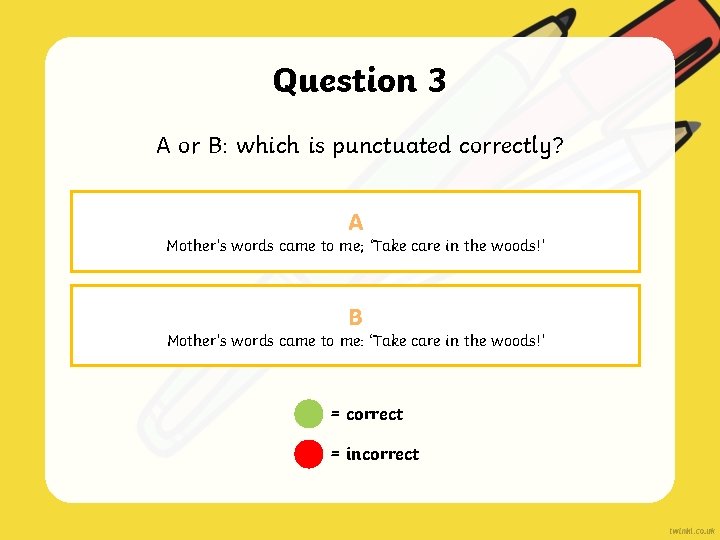
Question 3 A or B: which is punctuated correctly? A Mother’s words came to me; ‘Take care in the woods!’ B Mother’s words came to me: ‘Take care in the woods!’ = correct = incorrect
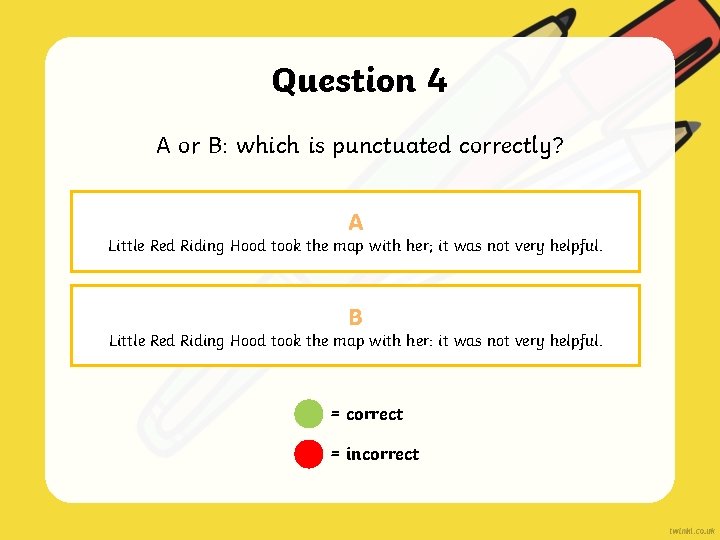
Question 4 A or B: which is punctuated correctly? A Little Red Riding Hood took the map with her; it was not very helpful. B Little Red Riding Hood took the map with her: it was not very helpful. = correct = incorrect