
USING SELFORGANIZING MAPS TO IDENTIFY COHERENT CONUS PRECIPITATION
- Slides: 1
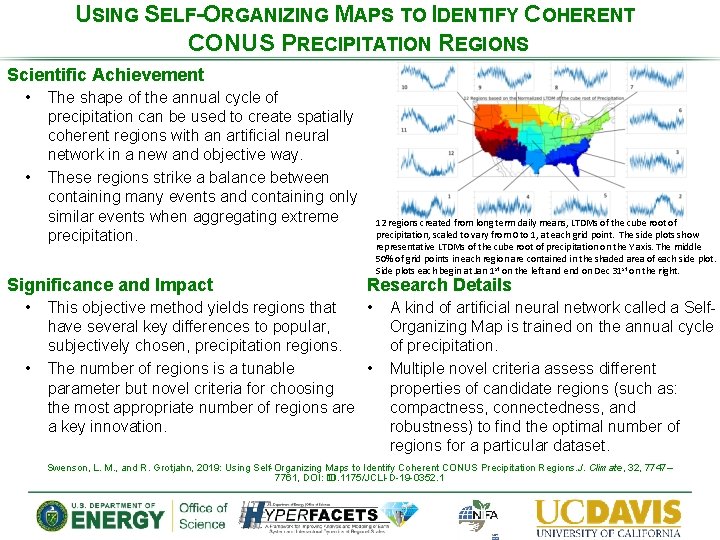
USING SELF-ORGANIZING MAPS TO IDENTIFY COHERENT CONUS PRECIPITATION REGIONS Scientific Achievement • • The shape of the annual cycle of precipitation can be used to create spatially coherent regions with an artificial neural network in a new and objective way. These regions strike a balance between containing many events and containing only similar events when aggregating extreme precipitation. Significance and Impact • • 12 regions created from long term daily means, LTDMs of the cube root of precipitation, scaled to vary from 0 to 1, at each grid point. The side plots show representative LTDMs of the cube root of precipitation on the Y axis. The middle 50% of grid points in each region are contained in the shaded area of each side plot. Side plots each begin at Jan 1 st on the left and end on Dec 31 st on the right. Research Details This objective method yields regions that • have several key differences to popular, subjectively chosen, precipitation regions. The number of regions is a tunable • parameter but novel criteria for choosing the most appropriate number of regions are a key innovation. A kind of artificial neural network called a Self. Organizing Map is trained on the annual cycle of precipitation. Multiple novel criteria assess different properties of candidate regions (such as: compactness, connectedness, and robustness) to find the optimal number of regions for a particular dataset. Swenson, L. M. , and R. Grotjahn, 2019: Using Self-Organizing Maps to Identify Coherent CONUS Precipitation Regions. J. Climate, 32, 7747– 7761, DOI: � 10. 1175/JCLI-D-19 -0352. 1