
Using secondary and primary data Presentation 7 8
- Slides: 41
Using secondary and primary data. Presentation 7, 8 secondary and primary data Dr Majed El-Farra 1
First: Using secondary data o o Most researches use some combination of secondary and primary data. How about your research? Usually researchers refer to secondary data first. Why? secondary and primary data Dr Majed El-Farra 2
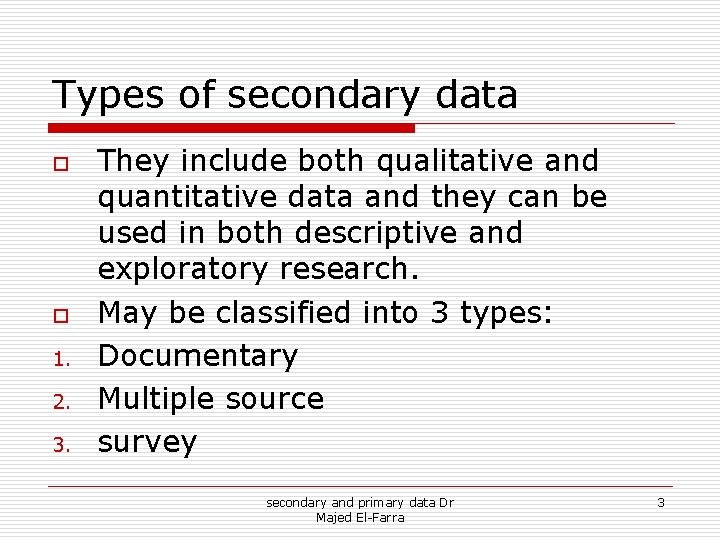
Types of secondary data o o 1. 2. 3. They include both qualitative and quantitative data and they can be used in both descriptive and exploratory research. May be classified into 3 types: Documentary Multiple source survey secondary and primary data Dr Majed El-Farra 3
Documentary secondary data o 1. 2. Classified into two: Written materials Non-written materials secondary and primary data Dr Majed El-Farra 4
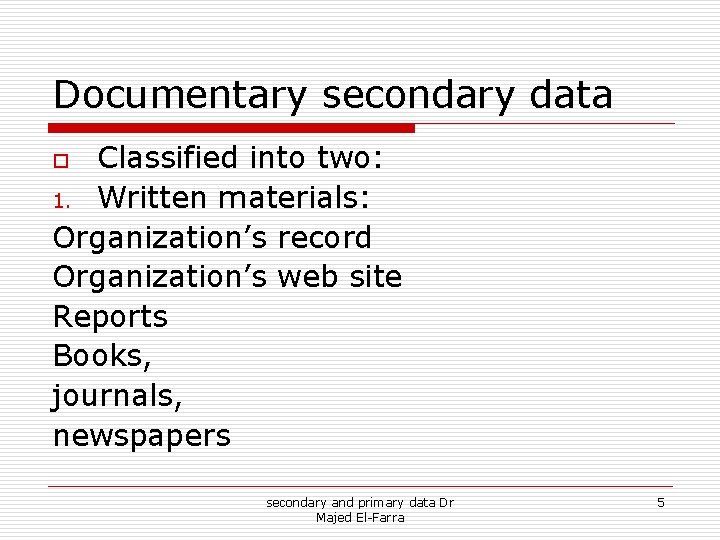
Documentary secondary data Classified into two: 1. Written materials: Organization’s record Organization’s web site Reports Books, journals, newspapers o secondary and primary data Dr Majed El-Farra 5
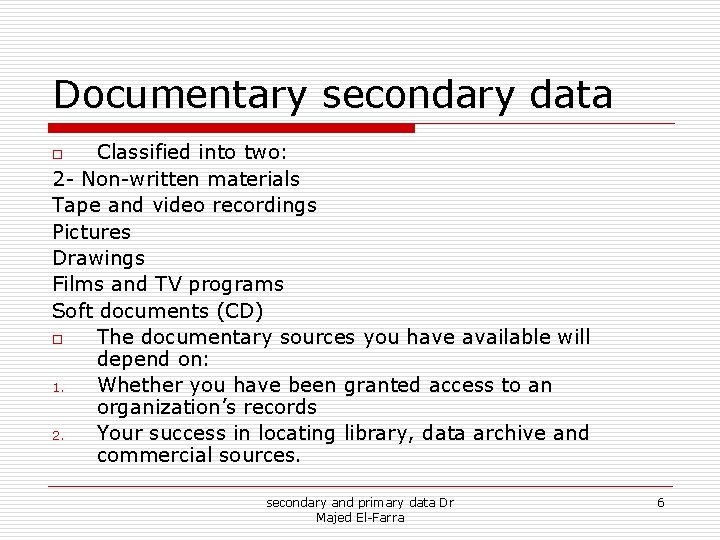
Documentary secondary data Classified into two: 2 - Non-written materials Tape and video recordings Pictures Drawings Films and TV programs Soft documents (CD) o The documentary sources you have available will depend on: 1. Whether you have been granted access to an organization’s records 2. Your success in locating library, data archive and commercial sources. o secondary and primary data Dr Majed El-Farra 6
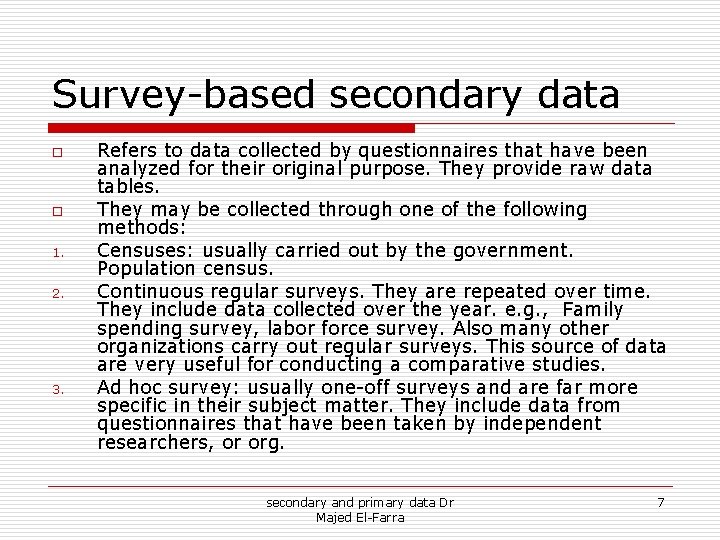
Survey-based secondary data o o 1. 2. 3. Refers to data collected by questionnaires that have been analyzed for their original purpose. They provide raw data tables. They may be collected through one of the following methods: Censuses: usually carried out by the government. Population census. Continuous regular surveys. They are repeated over time. They include data collected over the year. e. g. , Family spending survey, labor force survey. Also many other organizations carry out regular surveys. This source of data are very useful for conducting a comparative studies. Ad hoc survey: usually one-off surveys and are far more specific in their subject matter. They include data from questionnaires that have been taken by independent researchers, or org. secondary and primary data Dr Majed El-Farra 7
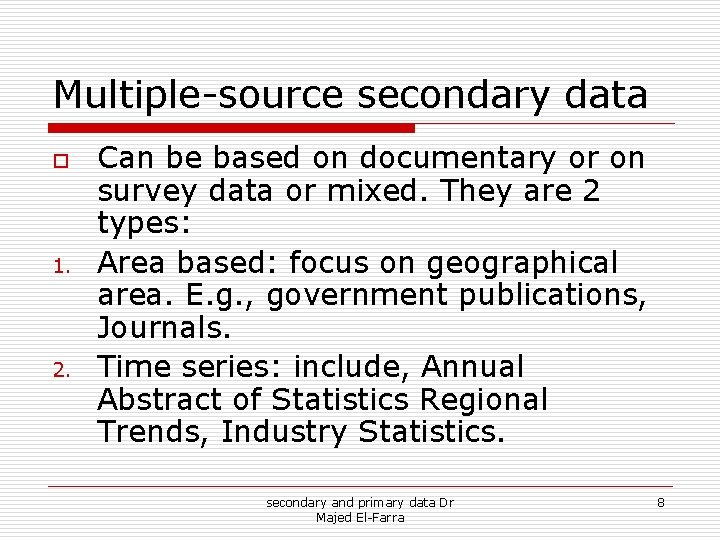
Multiple-source secondary data o 1. 2. Can be based on documentary or on survey data or mixed. They are 2 types: Area based: focus on geographical area. E. g. , government publications, Journals. Time series: include, Annual Abstract of Statistics Regional Trends, Industry Statistics. secondary and primary data Dr Majed El-Farra 8
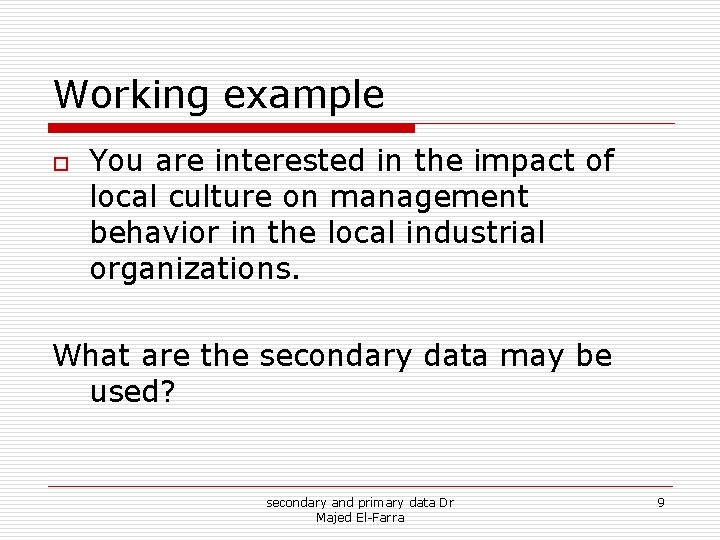
Working example o You are interested in the impact of local culture on management behavior in the local industrial organizations. What are the secondary data may be used? secondary and primary data Dr Majed El-Farra 9
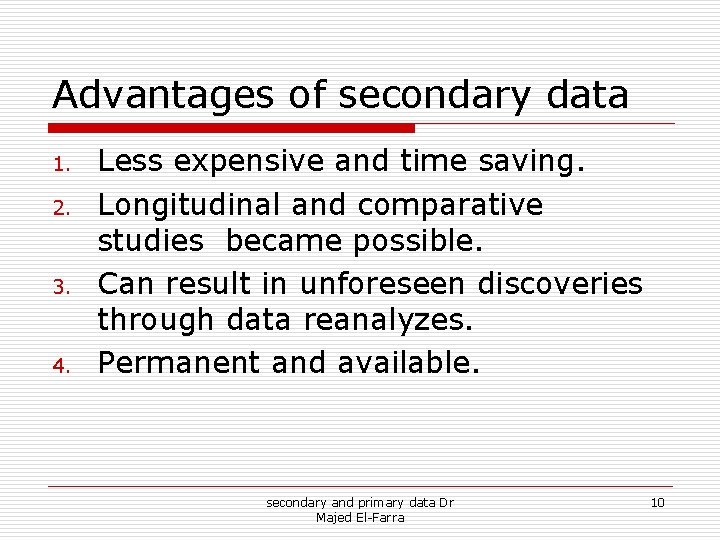
Advantages of secondary data 1. 2. 3. 4. Less expensive and time saving. Longitudinal and comparative studies became possible. Can result in unforeseen discoveries through data reanalyzes. Permanent and available. secondary and primary data Dr Majed El-Farra 10
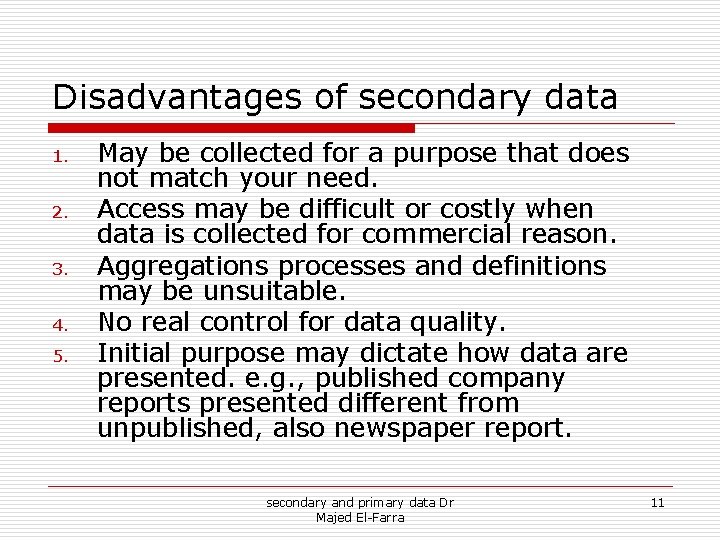
Disadvantages of secondary data 1. 2. 3. 4. 5. May be collected for a purpose that does not match your need. Access may be difficult or costly when data is collected for commercial reason. Aggregations processes and definitions may be unsuitable. No real control for data quality. Initial purpose may dictate how data are presented. e. g. , published company reports presented different from unpublished, also newspaper report. secondary and primary data Dr Majed El-Farra 11
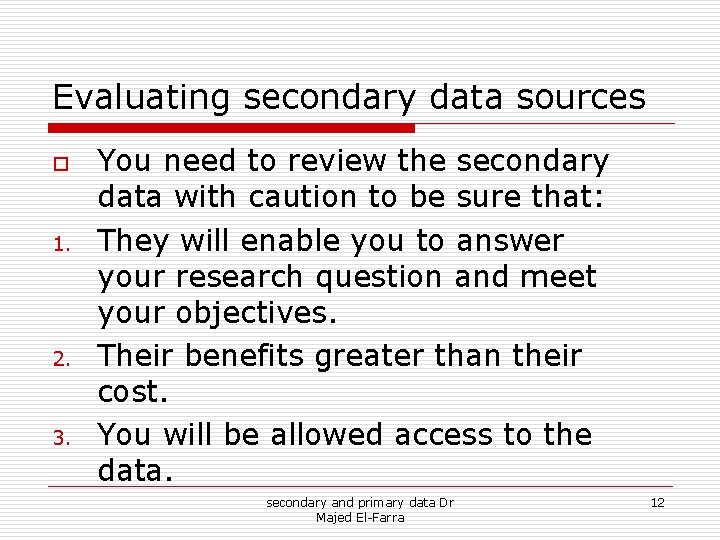
Evaluating secondary data sources o 1. 2. 3. You need to review the secondary data with caution to be sure that: They will enable you to answer your research question and meet your objectives. Their benefits greater than their cost. You will be allowed access to the data. secondary and primary data Dr Majed El-Farra 12
Overall suitability Measurement validity The validity measured in relation to the data ability to answer your research problem and meet your objectives. e. g. , a company may record monthly sales whereas you are interested in monthly orders. Here the data are invalid. o secondary and primary data Dr Majed El-Farra 13
Overall suitability Coverage and unmeasured variables. You need to make sure that the data cover your population, cover the time period you study and covers your research variables. o secondary and primary data Dr Majed El-Farra 14
Overall suitability Precise suitability Reliability and validity: To measure these criterions you look at the source of data. Source of data from government organizations are likely to be reliable. You need to consider the accuracy and consistency of the data. The methods the data were collected with, and who is responsible for data collection are important to evaluate the reliability and validity. o secondary and primary data Dr Majed El-Farra 15
Overall suitability Cost and benefits Comparing the cost of acquiring the data with benefits they will bring. o secondary and primary data Dr Majed El-Farra 16
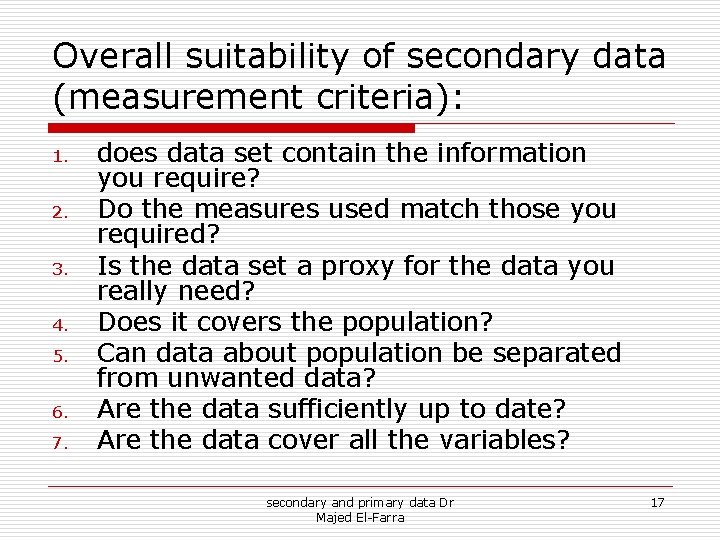
Overall suitability of secondary data (measurement criteria): 1. 2. 3. 4. 5. 6. 7. does data set contain the information you require? Do the measures used match those you required? Is the data set a proxy for the data you really need? Does it covers the population? Can data about population be separated from unwanted data? Are the data sufficiently up to date? Are the data cover all the variables? secondary and primary data Dr Majed El-Farra 17
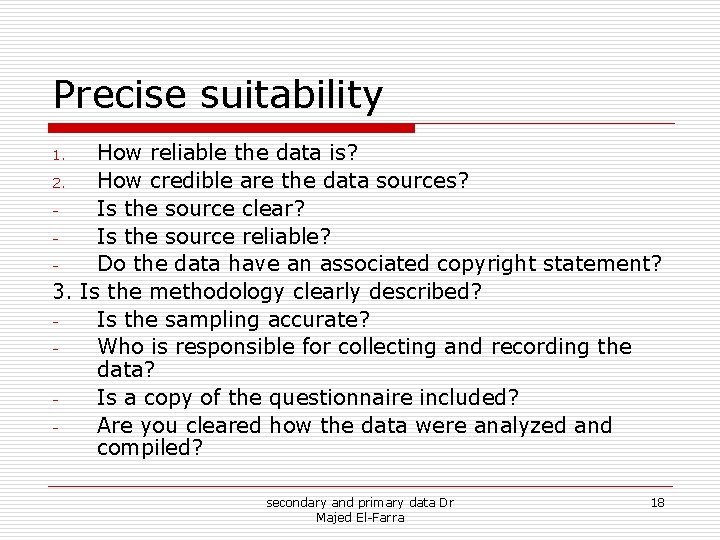
Precise suitability How reliable the data is? 2. How credible are the data sources? Is the source clear? Is the source reliable? Do the data have an associated copyright statement? 3. Is the methodology clearly described? Is the sampling accurate? Who is responsible for collecting and recording the data? Is a copy of the questionnaire included? Are you cleared how the data were analyzed and compiled? 1. secondary and primary data Dr Majed El-Farra 18
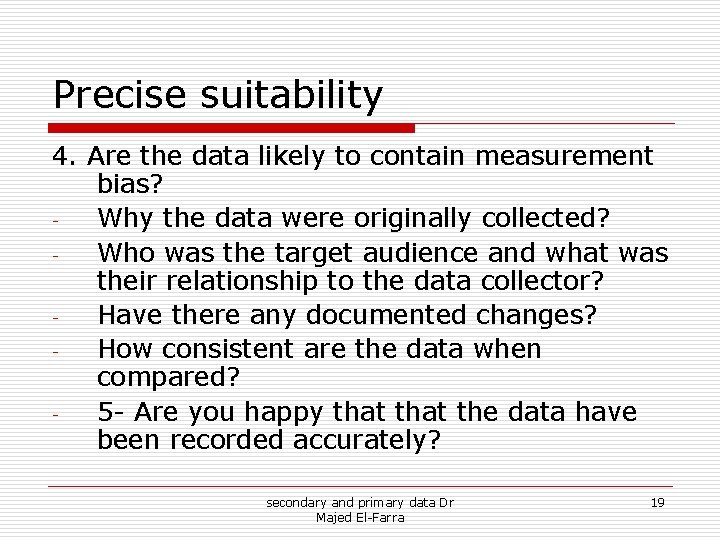
Precise suitability 4. Are the data likely to contain measurement bias? Why the data were originally collected? Who was the target audience and what was their relationship to the data collector? Have there any documented changes? How consistent are the data when compared? 5 - Are you happy that the data have been recorded accurately? secondary and primary data Dr Majed El-Farra 19
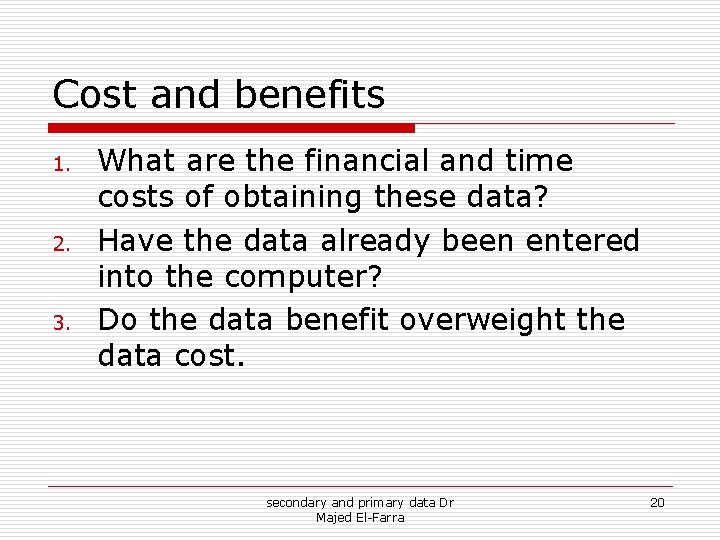
Cost and benefits 1. 2. 3. What are the financial and time costs of obtaining these data? Have the data already been entered into the computer? Do the data benefit overweight the data cost. secondary and primary data Dr Majed El-Farra 20
Home work o Assess the suitability of the secondary data for your research? secondary and primary data Dr Majed El-Farra 21
Second: collecting primary data o o o Observation Interviews Questionnaire secondary and primary data Dr Majed El-Farra 22
Data collection through observation Presentation 8 secondary and primary data Dr Majed El-Farra 23
Observation Participative observation: Here the researcher attempts to participate fully in the lives of subjects and thus becomes a member of their group, organization or community. o It has its roots in social anthropology. o But it has been used much less in management and business research. o Example: study how significant decisions are made at a company, by acting as a member of governing body. o secondary and primary data Dr Majed El-Farra 24
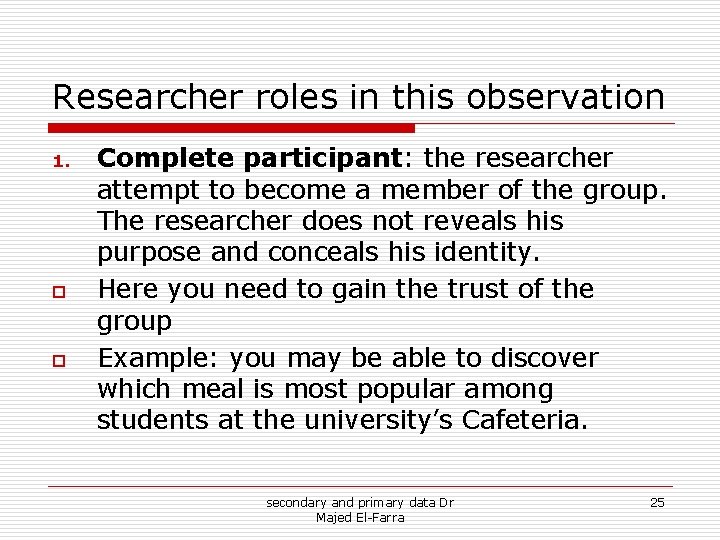
Researcher roles in this observation 1. o o Complete participant: the researcher attempt to become a member of the group. The researcher does not reveals his purpose and conceals his identity. Here you need to gain the trust of the group Example: you may be able to discover which meal is most popular among students at the university’s Cafeteria. secondary and primary data Dr Majed El-Farra 25
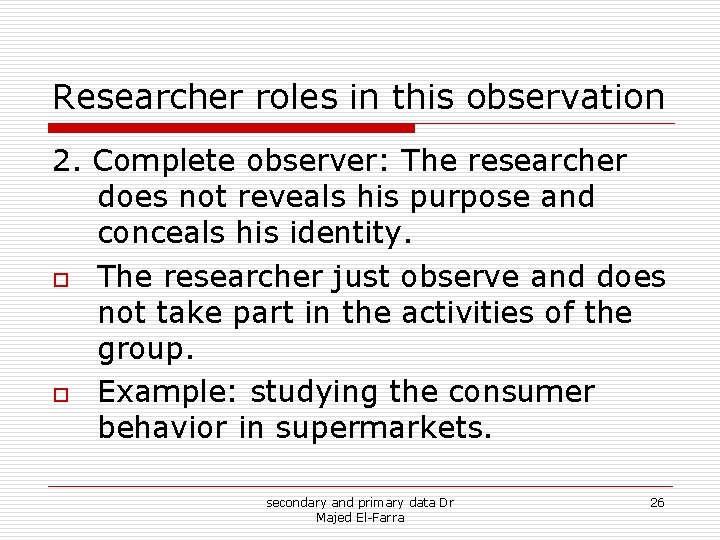
Researcher roles in this observation 2. Complete observer: The researcher does not reveals his purpose and conceals his identity. o The researcher just observe and does not take part in the activities of the group. o Example: studying the consumer behavior in supermarkets. secondary and primary data Dr Majed El-Farra 26
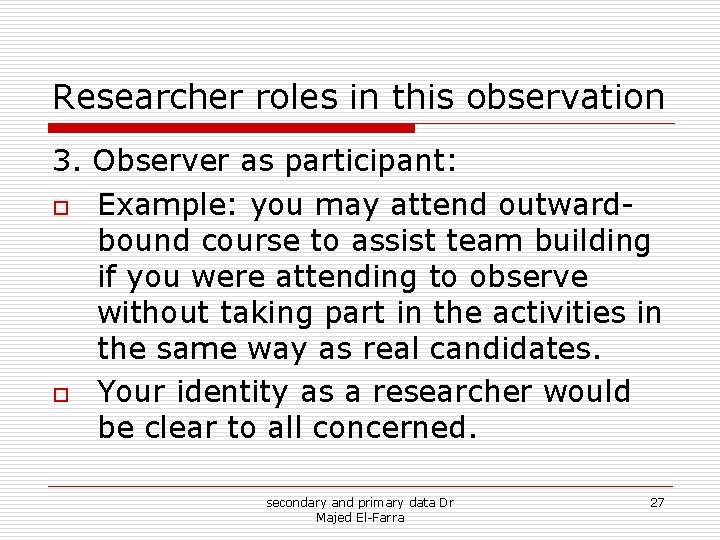
Researcher roles in this observation 3. Observer as participant: o Example: you may attend outwardbound course to assist team building if you were attending to observe without taking part in the activities in the same way as real candidates. o Your identity as a researcher would be clear to all concerned. secondary and primary data Dr Majed El-Farra 27
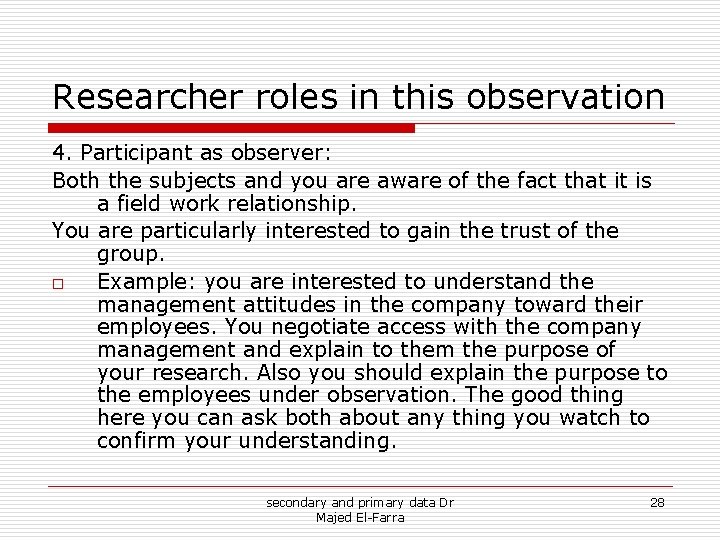
Researcher roles in this observation 4. Participant as observer: Both the subjects and you are aware of the fact that it is a field work relationship. You are particularly interested to gain the trust of the group. o Example: you are interested to understand the management attitudes in the company toward their employees. You negotiate access with the company management and explain to them the purpose of your research. Also you should explain the purpose to the employees under observation. The good thing here you can ask both about any thing you watch to confirm your understanding. secondary and primary data Dr Majed El-Farra 28
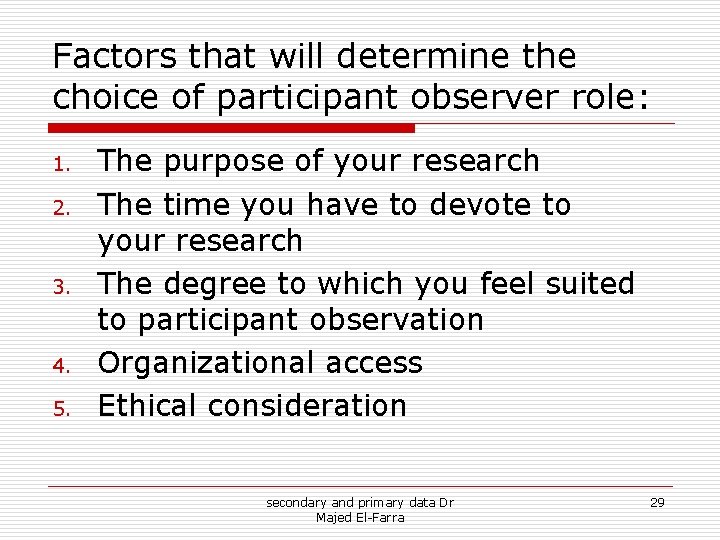
Factors that will determine the choice of participant observer role: 1. 2. 3. 4. 5. The purpose of your research The time you have to devote to your research The degree to which you feel suited to participant observation Organizational access Ethical consideration secondary and primary data Dr Majed El-Farra 29
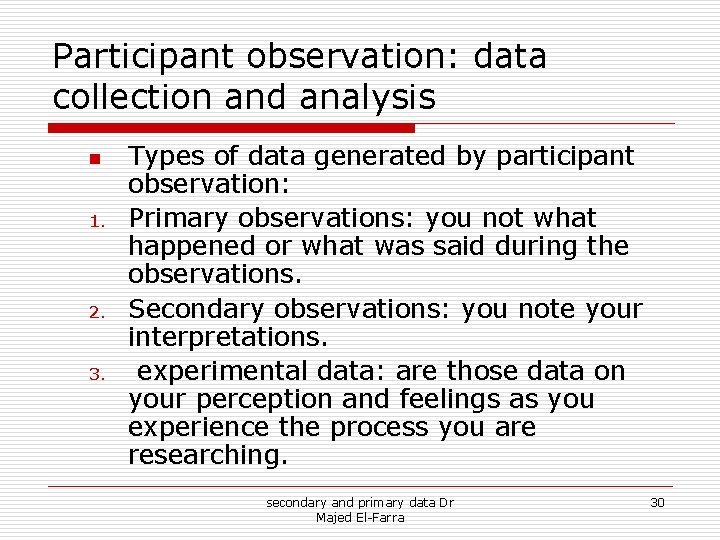
Participant observation: data collection and analysis n 1. 2. 3. Types of data generated by participant observation: Primary observations: you not what happened or what was said during the observations. Secondary observations: you note your interpretations. experimental data: are those data on your perception and feelings as you experience the process you are researching. secondary and primary data Dr Majed El-Farra 30
Participant observation: data collection and analysis n 1. 2. 3. Types of data generated by participant observation: Primary observations: you not what happened or what was said during the observations. Secondary observations: you note your interpretations. experimental data: are those data on your perception and feelings as you experience the process you are researching. secondary and primary data Dr Majed El-Farra 31
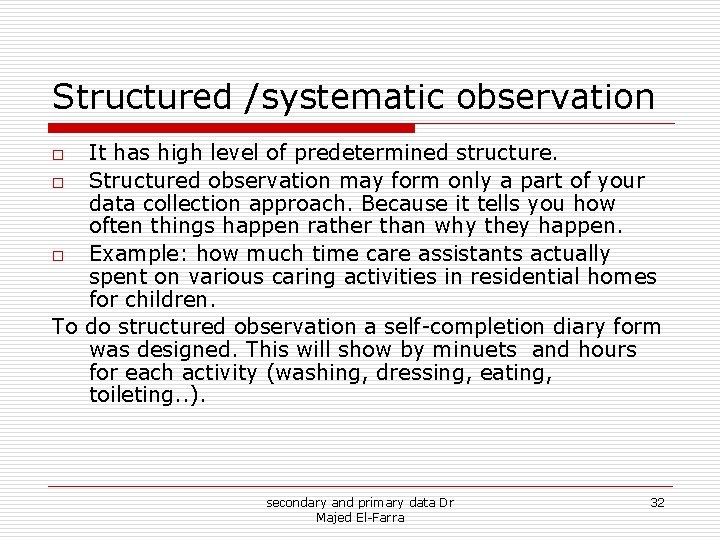
Structured /systematic observation It has high level of predetermined structure. o Structured observation may form only a part of your data collection approach. Because it tells you how often things happen rather than why they happen. o Example: how much time care assistants actually spent on various caring activities in residential homes for children. To do structured observation a self-completion diary form was designed. This will show by minuets and hours for each activity (washing, dressing, eating, toileting. . ). o secondary and primary data Dr Majed El-Farra 32
Data collection through semistructured and in-depth interviews Presentation 8 secondary and primary data Dr Majed El-Farra 33
Definition of interview o A purposeful discussion between two or more people. It can help you to gather valid and reliable data that are relevant to your research question and objectives. secondary and primary data Dr Majed El-Farra 34
Types of interview o o o Structured interview: using standardized questions. Unstructured interview: informal, there is no prepared questions before interview. It is used to explore in depth a general area in which you are interested. Semi-structured interview: mix between the two. secondary and primary data Dr Majed El-Farra 35
Types of interview o o 1. 2. Another classification based on the form of interaction between interviewer and interviewees: Qualitative interviews: divided into two groups: One to one: face-to-face, telephone interviews. One to many: focus group interviews. secondary and primary data Dr Majed El-Farra 36
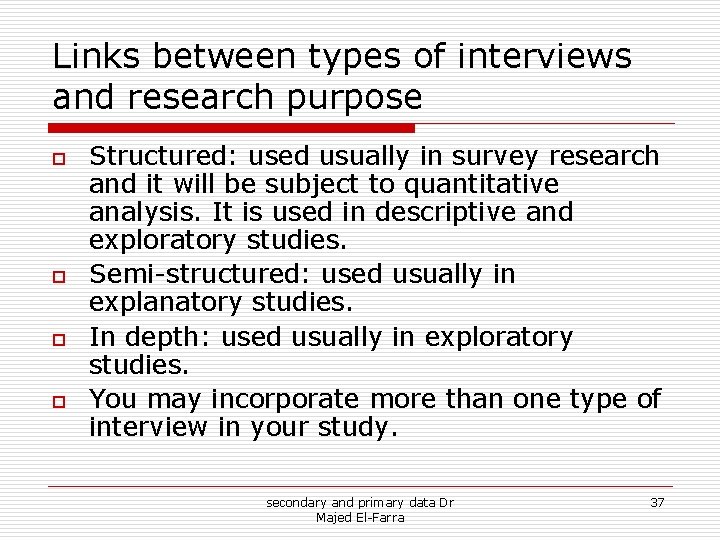
Links between types of interviews and research purpose o o Structured: used usually in survey research and it will be subject to quantitative analysis. It is used in descriptive and exploratory studies. Semi-structured: used usually in explanatory studies. In depth: used usually in exploratory studies. You may incorporate more than one type of interview in your study. secondary and primary data Dr Majed El-Farra 37
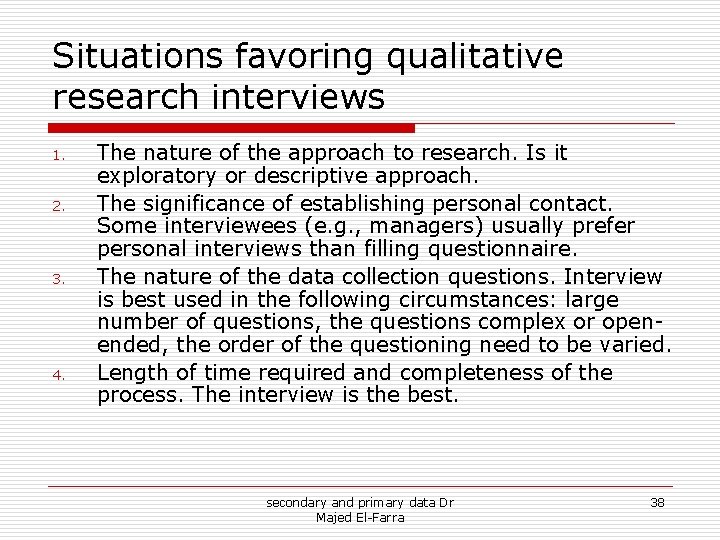
Situations favoring qualitative research interviews 1. 2. 3. 4. The nature of the approach to research. Is it exploratory or descriptive approach. The significance of establishing personal contact. Some interviewees (e. g. , managers) usually prefer personal interviews than filling questionnaire. The nature of the data collection questions. Interview is best used in the following circumstances: large number of questions, the questions complex or openended, the order of the questioning need to be varied. Length of time required and completeness of the process. The interview is the best. secondary and primary data Dr Majed El-Farra 38
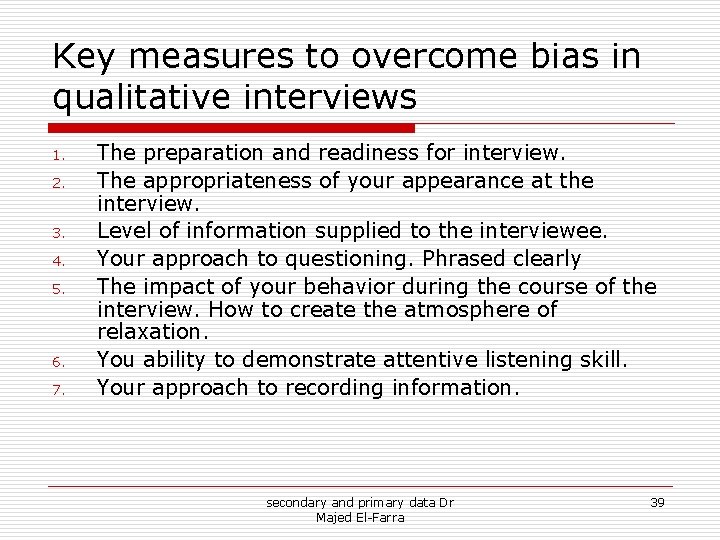
Key measures to overcome bias in qualitative interviews 1. 2. 3. 4. 5. 6. 7. The preparation and readiness for interview. The appropriateness of your appearance at the interview. Level of information supplied to the interviewee. Your approach to questioning. Phrased clearly The impact of your behavior during the course of the interview. How to create the atmosphere of relaxation. You ability to demonstrate attentive listening skill. Your approach to recording information. secondary and primary data Dr Majed El-Farra 39
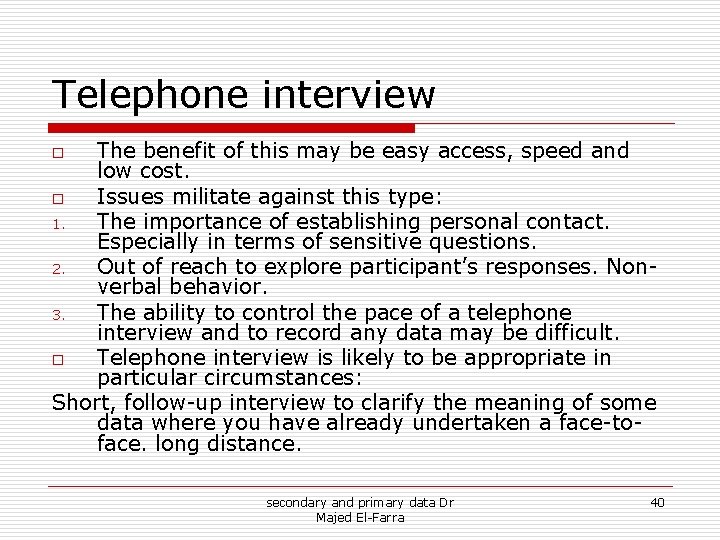
Telephone interview The benefit of this may be easy access, speed and low cost. o Issues militate against this type: 1. The importance of establishing personal contact. Especially in terms of sensitive questions. 2. Out of reach to explore participant’s responses. Nonverbal behavior. 3. The ability to control the pace of a telephone interview and to record any data may be difficult. o Telephone interview is likely to be appropriate in particular circumstances: Short, follow-up interview to clarify the meaning of some data where you have already undertaken a face-toface. long distance. o secondary and primary data Dr Majed El-Farra 40
Group interviews o o o The researcher act as a facilitator or moderator of the discussion that occur. This is likely to be unstructured. It may lead to a rich flow of data. Several participants. High level of skills is needed by the interviewer. Suitable for complexity and in case of limited data available. How to insure the success of group interview? secondary and primary data Dr Majed El-Farra 41