
Using ROOT classes from Python ROOT Workshop 14
- Slides: 20
Using ROOT classes from Python ROOT Workshop 14 -16 October 2002 P. Mato / CERN 8/3/02 Using ROOT classes in Python
Contents u Motivation u Examples u Why Python? u Software requirements, Design, Status u Integration using Python as a Software Bus u Summary 8/3/02 Using ROOT classes in Python 2
Motivation u Be able to use any ROOT class from Python in a generic way. – – u u Without the need of wrapping each class Using the ROOT object dictionary information Facilitate access of ROOT files and other facilities from non-ROOT applications Proof-of-concept that Python can be viewed as Software Bus – In analogy to a “hardware bus” where you can plug a variety of modules and interface adaptors to other buses. 8/3/02 Using ROOT classes in Python 3
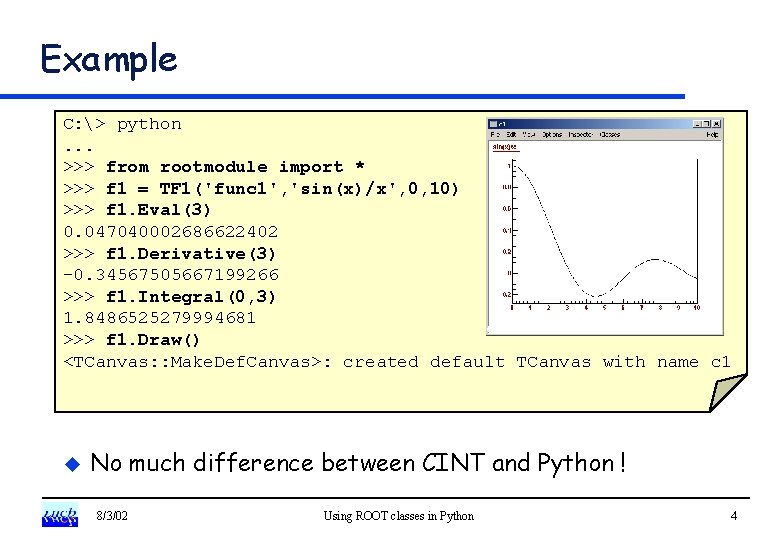
Example C: > python. . . >>> from rootmodule import * >>> f 1 = TF 1('func 1', 'sin(x)/x', 0, 10) >>> f 1. Eval(3) 0. 047040002686622402 >>> f 1. Derivative(3) -0. 34567505667199266 >>> f 1. Integral(0, 3) 1. 8486525279994681 >>> f 1. Draw() <TCanvas: : Make. Def. Canvas>: created default TCanvas with name c 1 u No much difference between CINT and Python ! 8/3/02 Using ROOT classes in Python 4
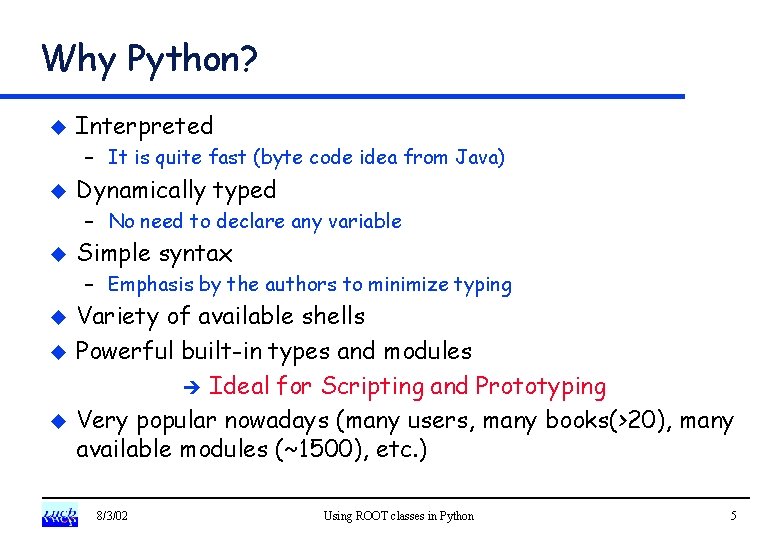
Why Python? u Interpreted – It is quite fast (byte code idea from Java) u Dynamically typed – No need to declare any variable u Simple syntax – Emphasis by the authors to minimize typing u u u Variety of available shells Powerful built-in types and modules è Ideal for Scripting and Prototyping Very popular nowadays (many users, many books(>20), many available modules (~1500), etc. ) 8/3/02 Using ROOT classes in Python 5
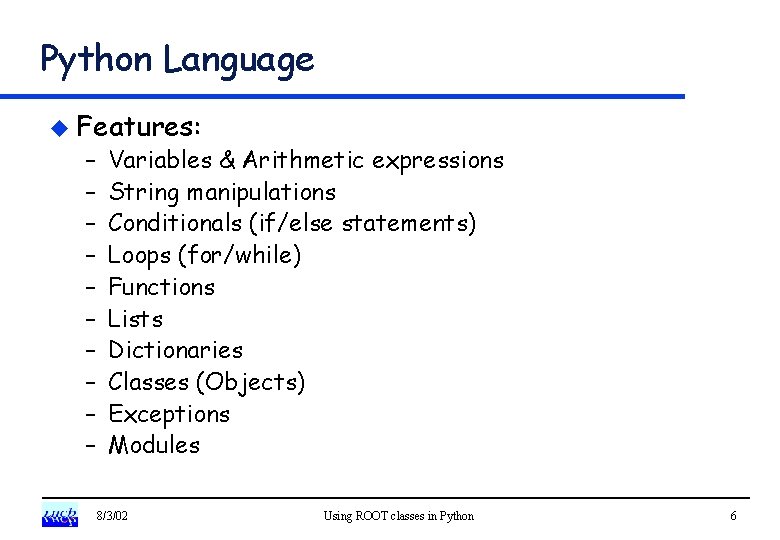
Python Language u Features: – – – – – Variables & Arithmetic expressions String manipulations Conditionals (if/else statements) Loops (for/while) Functions Lists Dictionaries Classes (Objects) Exceptions Modules 8/3/02 Using ROOT classes in Python 6
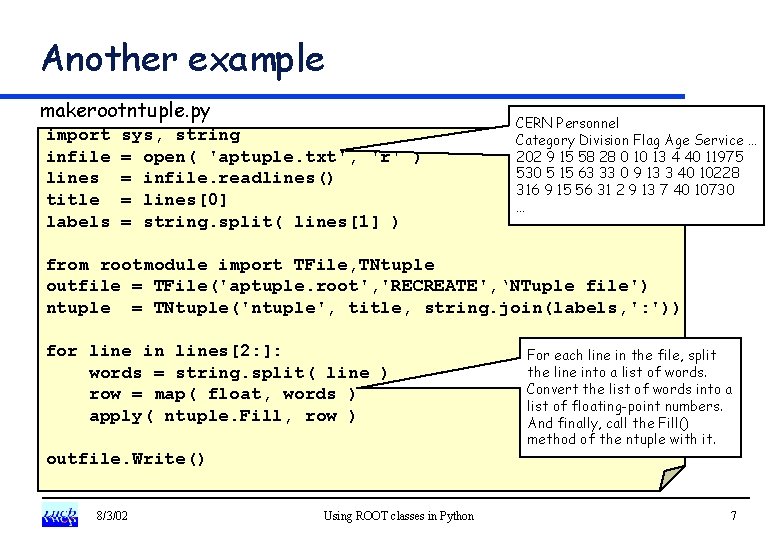
Another example makerootntuple. py import infile lines title labels sys, string = open( 'aptuple. txt', 'r' ) = infile. readlines() = lines[0] = string. split( lines[1] ) CERN Personnel Category Division Flag Age Service … 202 9 15 58 28 0 10 13 4 40 11975 530 5 15 63 33 0 9 13 3 40 10228 316 9 15 56 31 2 9 13 7 40 10730 … from rootmodule import TFile, TNtuple outfile = TFile('aptuple. root', 'RECREATE', ‘NTuple file') ntuple = TNtuple('ntuple', title, string. join(labels, ': ')) for line in lines[2: ]: words = string. split( line ) row = map( float, words ) apply( ntuple. Fill, row ) For each line in the file, split the line into a list of words. Convert the list of words into a list of floating-point numbers. And finally, call the Fill() method of the ntuple with it. outfile. Write() 8/3/02 Using ROOT classes in Python 7
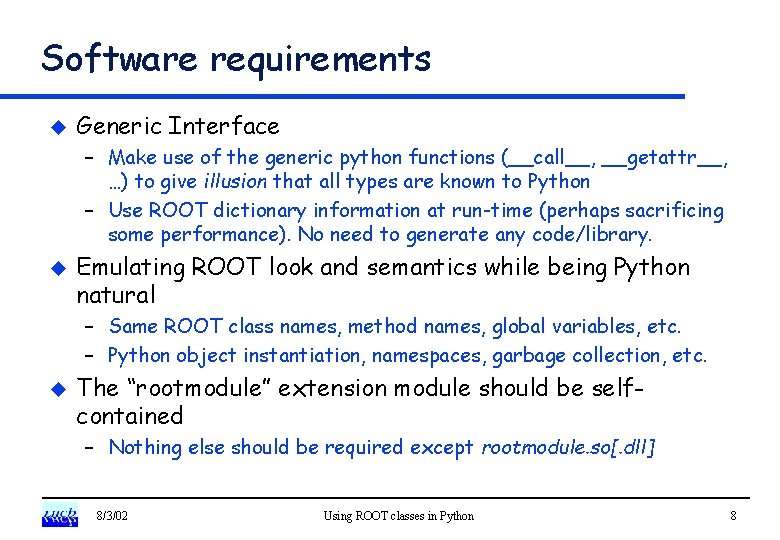
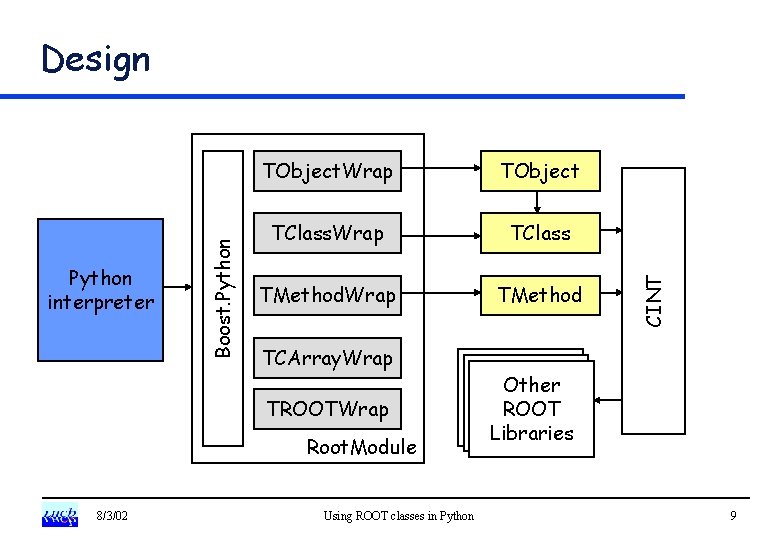
Software requirements u Generic Interface – Make use of the generic python functions (__call__, __getattr__, …) to give illusion that all types are known to Python – Use ROOT dictionary information at run-time (perhaps sacrificing some performance). No need to generate any code/library. u Emulating ROOT look and semantics while being Python natural – Same ROOT class names, method names, global variables, etc. – Python object instantiation, namespaces, garbage collection, etc. u The “rootmodule” extension module should be selfcontained – Nothing else should be required except rootmodule. so[. dll] 8/3/02 Using ROOT classes in Python 8
TObject. Wrap TObject TClass. Wrap TClass TMethod. Wrap TMethod TCArray. Wrap TROOTWrap Root. Module 8/3/02 Using ROOT classes in Python CINT Python interpreter Boost. Python Design Other ROOT Libraries 9
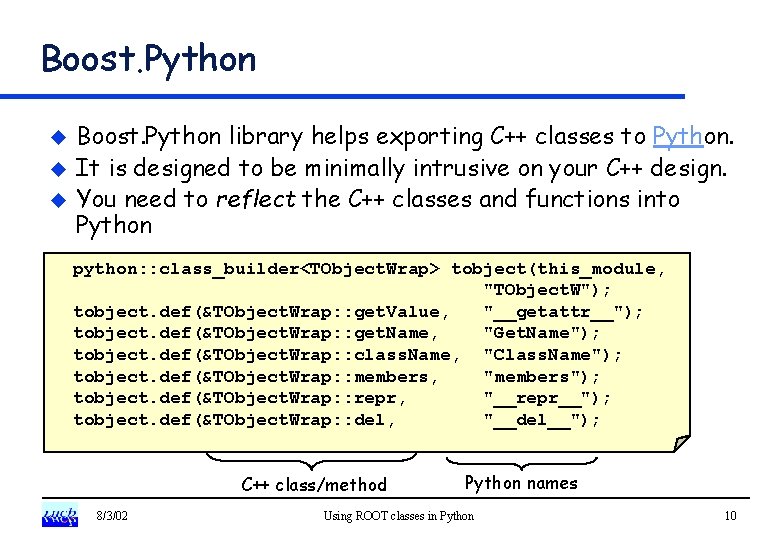
Boost. Python u u u Boost. Python library helps exporting C++ classes to Python. It is designed to be minimally intrusive on your C++ design. You need to reflect the C++ classes and functions into Python python: : class_builder<TObject. Wrap> tobject(this_module, "TObject. W"); tobject. def(&TObject. Wrap: : get. Value, "__getattr__"); tobject. def(&TObject. Wrap: : get. Name, "Get. Name"); tobject. def(&TObject. Wrap: : class. Name, "Class. Name"); tobject. def(&TObject. Wrap: : members, "members"); tobject. def(&TObject. Wrap: : repr, "__repr__"); tobject. def(&TObject. Wrap: : del, "__del__"); C++ class/method 8/3/02 Python names Using ROOT classes in Python 10
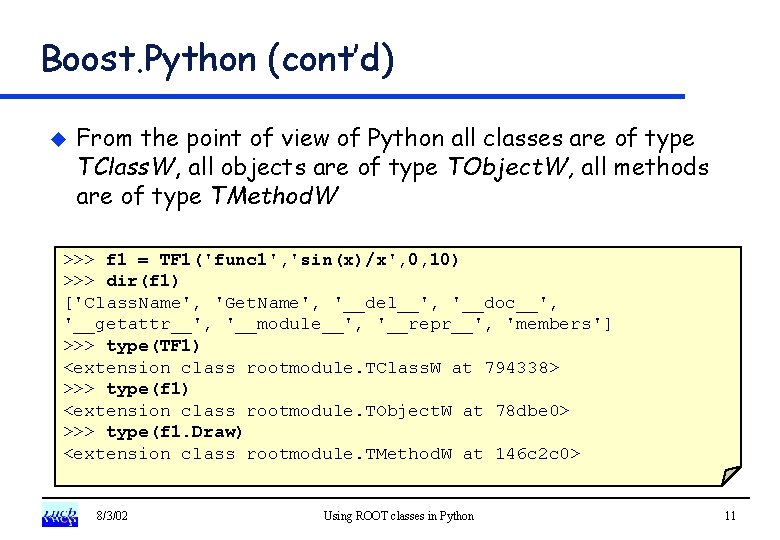
Boost. Python (cont’d) u From the point of view of Python all classes are of type TClass. W, all objects are of type TObject. W, all methods are of type TMethod. W >>> f 1 = TF 1('func 1', 'sin(x)/x', 0, 10) >>> dir(f 1) ['Class. Name', 'Get. Name', '__del__', '__doc__', '__getattr__', '__module__', '__repr__', 'members'] >>> type(TF 1) <extension class rootmodule. TClass. W at 794338> >>> type(f 1) <extension class rootmodule. TObject. W at 78 dbe 0> >>> type(f 1. Draw) <extension class rootmodule. TMethod. W at 146 c 2 c 0> 8/3/02 Using ROOT classes in Python 11
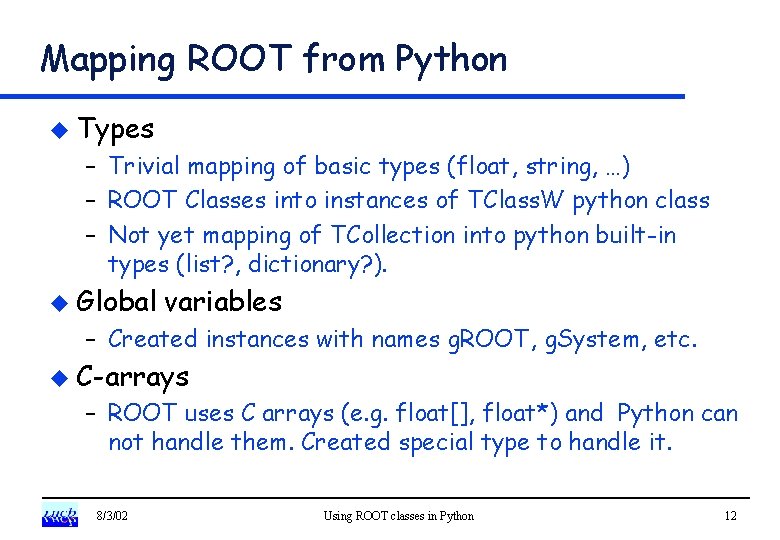
Mapping ROOT from Python u Types – Trivial mapping of basic types (float, string, …) – ROOT Classes into instances of TClass. W python class – Not yet mapping of TCollection into python built-in types (list? , dictionary? ). u Global variables – Created instances with names g. ROOT, g. System, etc. u C-arrays – ROOT uses C arrays (e. g. float[], float*) and Python can not handle them. Created special type to handle it. 8/3/02 Using ROOT classes in Python 12
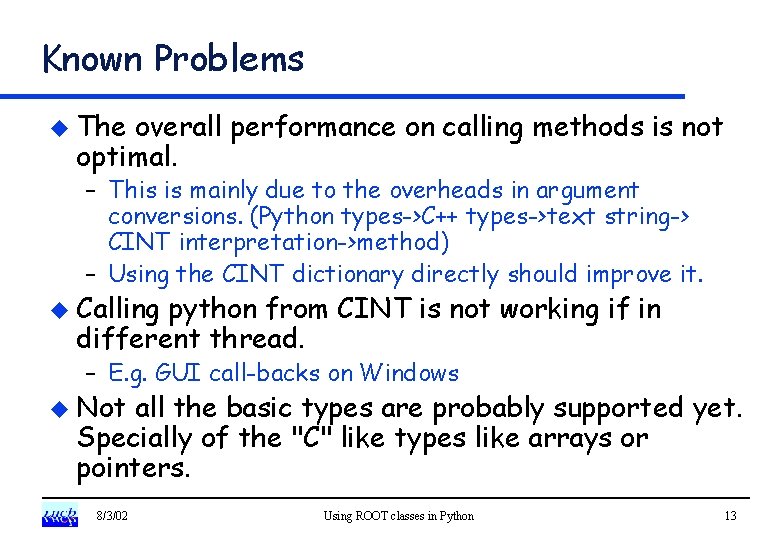
Known Problems u The overall performance on calling methods is not optimal. – This is mainly due to the overheads in argument conversions. (Python types->C++ types->text string-> CINT interpretation->method) – Using the CINT dictionary directly should improve it. u Calling python from CINT is not working if in different thread. – E. g. GUI call-backs on Windows u Not all the basic types are probably supported yet. Specially of the "C" like types like arrays or pointers. 8/3/02 Using ROOT classes in Python 13
Known problems (cont’d) u Naïve memory management (object ownership). ROOT objects created by Python are deleted by Python. u The ROOT classes are not yet 100% equivalent to native Python classes, therefore some built-in functionality in shells (e. g. command completion) is not working. 8/3/02 Using ROOT classes in Python 14
It is available for testing u The code can be downloaded from http: //cern. ch/Gaudi/Root. Python for tests u It currently uses – Boost 1. 27, Python 2. 2, ROOT 3. 03 u It is built using CMT for the time being u Some python scripts examples exists at …/tutorials 8/3/02 Using ROOT classes in Python 15
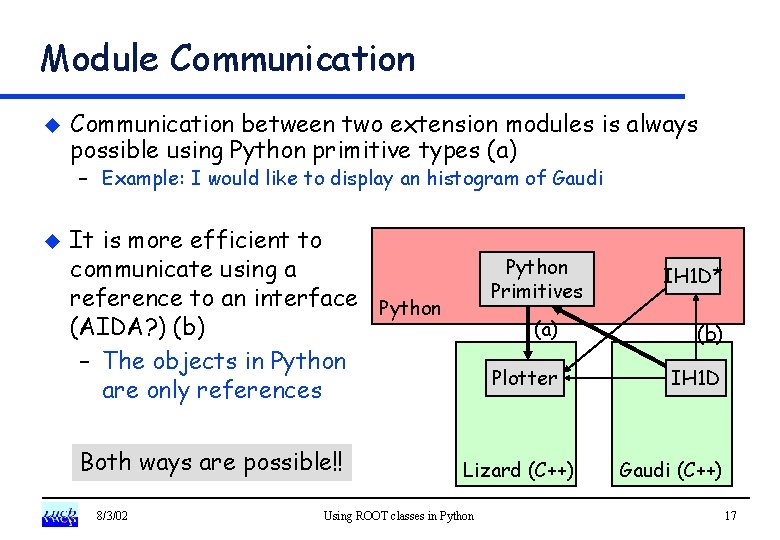
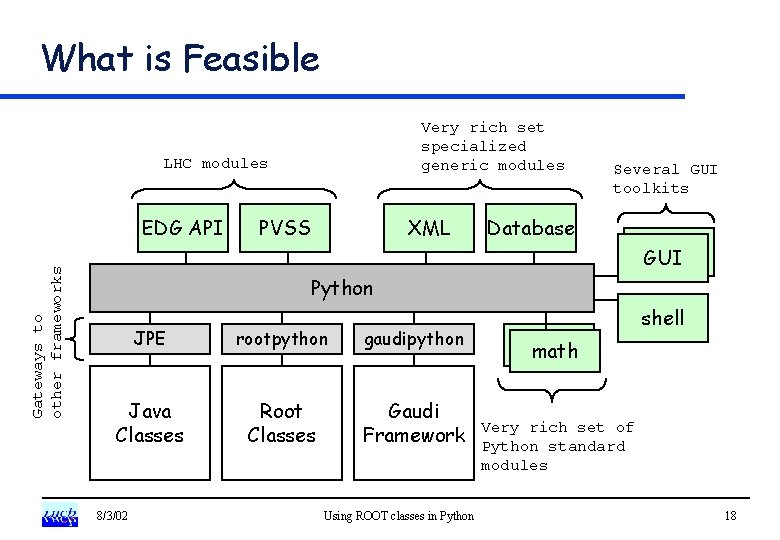
Python as a Software-Bus u Python could also be seen as a framework where you can plug easily “extension modules” in binary form implemented using other languages. – Very easy and natural to interface to C++ classes (C++ API) – Python should only be the “glue” between modules developed in C++ or other languages – The interface (API) for Python extension modules is quite simple and at the same time very flexible (generic functions) 8/3/02 Using ROOT classes in Python 16
Module Communication u Communication between two extension modules is always possible using Python primitive types (a) – Example: I would like to display an histogram of Gaudi u It is more efficient to communicate using a reference to an interface Python (AIDA? ) (b) – The objects in Python are only references Both ways are possible!! 8/3/02 Python Primitives (a) (b) Plotter IH 1 D Lizard (C++) Using ROOT classes in Python IH 1 D* Gaudi (C++) 17
What is Feasible Very rich set specialized generic modules LHC modules Gateways to other frameworks EDG API PVSS XML Several GUI toolkits Database GUI Python JPE rootpython gaudipython Java Classes Root Classes Gaudi Framework 8/3/02 Using ROOT classes in Python math shell Very rich set of Python standard modules 18
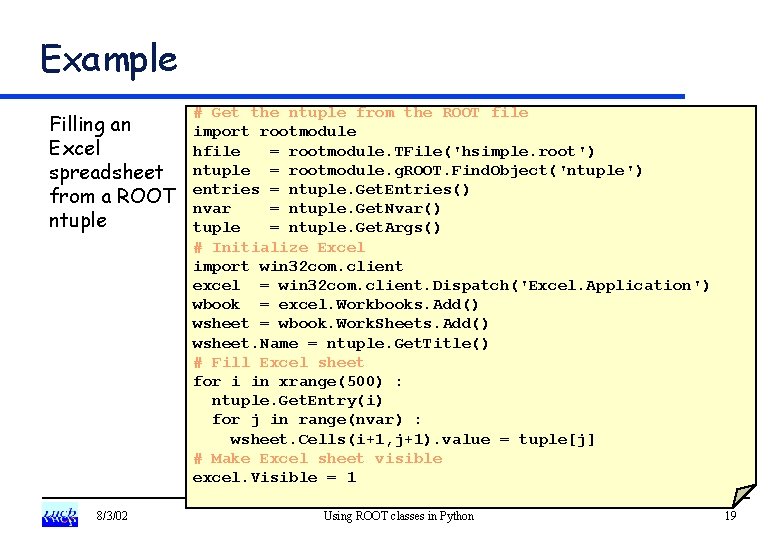
Example Filling an Excel spreadsheet from a ROOT ntuple 8/3/02 # Get the ntuple from the ROOT file import rootmodule hfile = rootmodule. TFile('hsimple. root') ntuple = rootmodule. g. ROOT. Find. Object('ntuple') entries = ntuple. Get. Entries() nvar = ntuple. Get. Nvar() tuple = ntuple. Get. Args() # Initialize Excel import win 32 com. client excel = win 32 com. client. Dispatch('Excel. Application') wbook = excel. Workbooks. Add() wsheet = wbook. Work. Sheets. Add() wsheet. Name = ntuple. Get. Title() # Fill Excel sheet for i in xrange(500) : ntuple. Get. Entry(i) for j in range(nvar) : wsheet. Cells(i+1, j+1). value = tuple[j] # Make Excel sheet visible excel. Visible = 1 Using ROOT classes in Python 19
Summary u Exercise to proof that is possible to interface ROOT with Python with very little effort. – Demonstrate the power of having an object dictionary u The module is functional and it is already in use to provide access to ROOT files from other applications (e. g. Hippo. Draw) – Of course, more work is needed to make it complete and fix the current performance problems u Step in the direction of high level integration using a “software-bus” – One more Python “gateway” to other frameworks or languages like DCOM, Java, Gaudi, etc. 8/3/02 Using ROOT classes in Python 20