
Using Relational Database Model to Access Review and
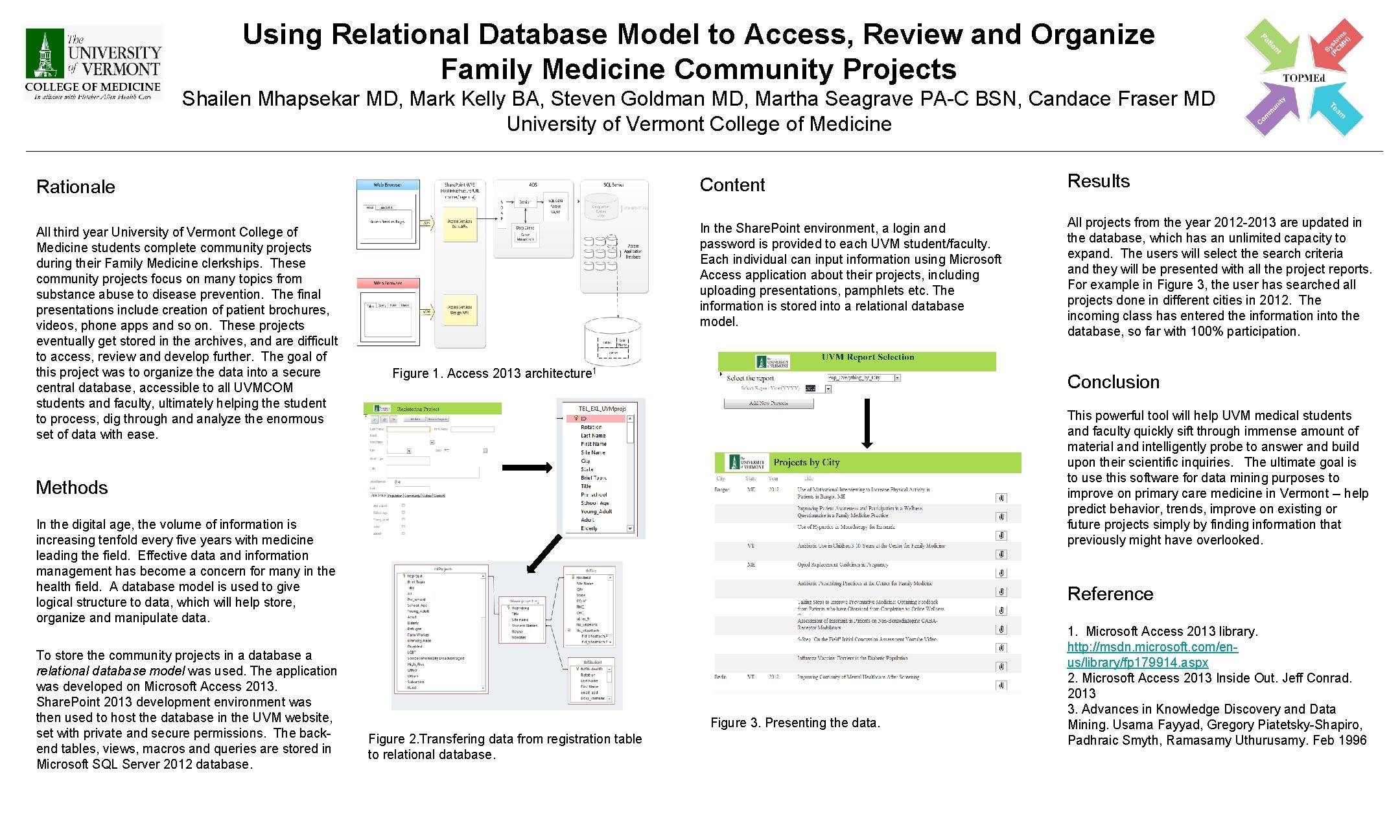
Using Relational Database Model to Access, Review and Organize Family Medicine Community Projects Shailen Mhapsekar MD, Mark Kelly BA, Steven Goldman MD, Martha Seagrave PA-C BSN, Candace Fraser MD University of Vermont College of Medicine Rationale Content Results All third year University of Vermont College of Medicine students complete community projects during their Family Medicine clerkships. These community projects focus on many topics from substance abuse to disease prevention. The final presentations include creation of patient brochures, videos, phone apps and so on. These projects eventually get stored in the archives, and are difficult to access, review and develop further. The goal of this project was to organize the data into a secure central database, accessible to all UVMCOM students and faculty, ultimately helping the student to process, dig through and analyze the enormous set of data with ease. In the Share. Point environment, a login and password is provided to each UVM student/faculty. Each individual can input information using Microsoft Access application about their projects, including uploading presentations, pamphlets etc. The information is stored into a relational database model. All projects from the year 2012 -2013 are updated in the database, which has an unlimited capacity to expand. The users will select the search criteria and they will be presented with all the project reports. For example in Figure 3, the user has searched all projects done in different cities in 2012. The incoming class has entered the information into the database, so far with 100% participation. Figure 1. Access 2013 architecture 1 Conclusion This powerful tool will help UVM medical students and faculty quickly sift through immense amount of material and intelligently probe to answer and build upon their scientific inquiries. The ultimate goal is to use this software for data mining purposes to improve on primary care medicine in Vermont -- help predict behavior, trends, improve on existing or future projects simply by finding information that previously might have overlooked. Methods In the digital age, the volume of information is increasing tenfold every five years with medicine leading the field. Effective data and information management has become a concern for many in the health field. A database model is used to give logical structure to data, which will help store, organize and manipulate data. To store the community projects in a database a relational database model was used. The application was developed on Microsoft Access 2013. Share. Point 2013 development environment was then used to host the database in the UVM website, set with private and secure permissions. The backend tables, views, macros and queries are stored in Microsoft SQL Server 2012 database. Reference Figure 3. Presenting the data. Figure 2. Transfering data from registration table to relational database. 1. Microsoft Access 2013 library. http: //msdn. microsoft. com/enus/library/fp 179914. aspx 2. Microsoft Access 2013 Inside Out. Jeff Conrad. 2013 3. Advances in Knowledge Discovery and Data Mining. Usama Fayyad, Gregory Piatetsky-Shapiro, Padhraic Smyth, Ramasamy Uthurusamy. Feb 1996
- Slides: 1