
Using Racket to Display your puzzle Pepper More

- Slides: 5
Using Racket to Display your puzzle Pepper
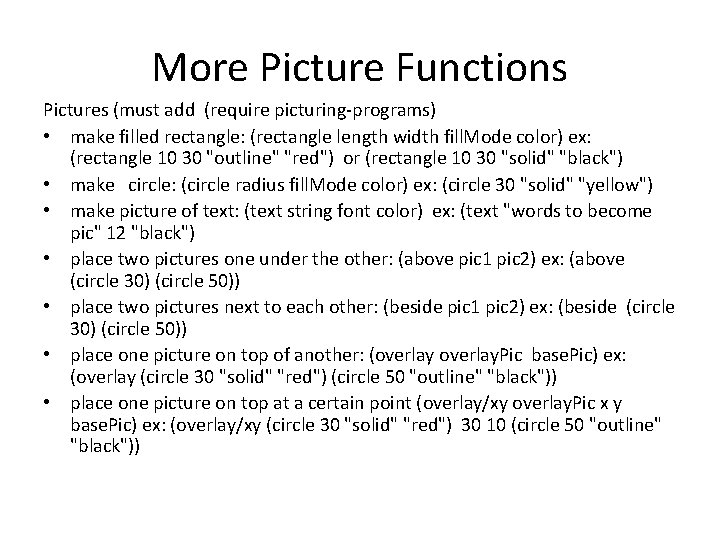
More Picture Functions Pictures (must add (require picturing-programs) • make filled rectangle: (rectangle length width fill. Mode color) ex: (rectangle 10 30 "outline" "red") or (rectangle 10 30 "solid" "black") • make circle: (circle radius fill. Mode color) ex: (circle 30 "solid" "yellow") • make picture of text: (text string font color) ex: (text "words to become pic" 12 "black") • place two pictures one under the other: (above pic 1 pic 2) ex: (above (circle 30) (circle 50)) • place two pictures next to each other: (beside pic 1 pic 2) ex: (beside (circle 30) (circle 50)) • place one picture on top of another: (overlay. Pic base. Pic) ex: (overlay (circle 30 "solid" "red") (circle 50 "outline" "black")) • place one picture on top at a certain point (overlay/xy overlay. Pic x y base. Pic) ex: (overlay/xy (circle 30 "solid" "red") 30 10 (circle 50 "outline" "black"))
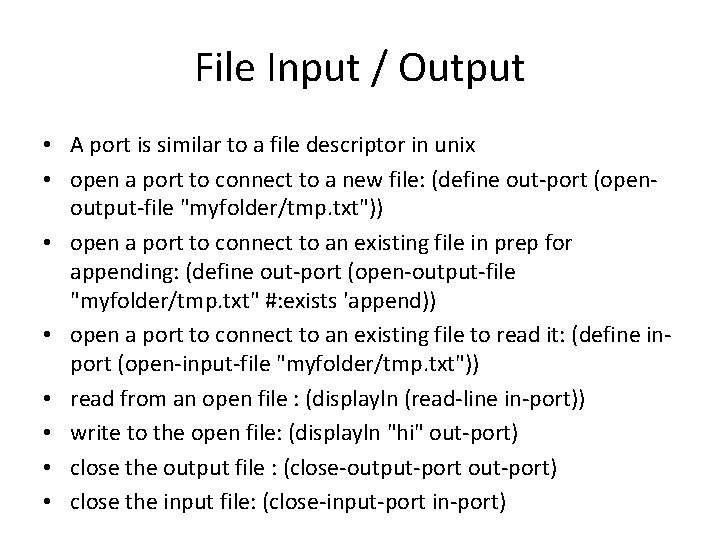
File Input / Output • A port is similar to a file descriptor in unix • open a port to connect to a new file: (define out-port (openoutput-file "myfolder/tmp. txt")) • open a port to connect to an existing file in prep for appending: (define out-port (open-output-file "myfolder/tmp. txt" #: exists 'append)) • open a port to connect to an existing file to read it: (define inport (open-input-file "myfolder/tmp. txt")) • read from an open file : (displayln (read-line in-port)) • write to the open file: (displayln "hi" out-port) • close the output file : (close-output-port out-port) • close the input file: (close-input-port in-port)
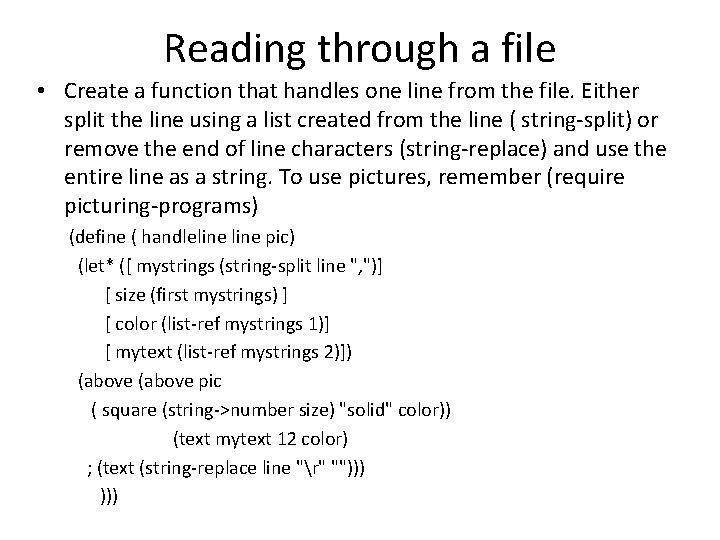
Reading through a file • Create a function that handles one line from the file. Either split the line using a list created from the line ( string-split) or remove the end of line characters (string-replace) and use the entire line as a string. To use pictures, remember (require picturing-programs) (define ( handleline pic) (let* ([ mystrings (string-split line ", ")] [ size (first mystrings) ] [ color (list-ref mystrings 1)] [ mytext (list-ref mystrings 2)]) (above pic ( square (string->number size) "solid" color)) (text mytext 12 color) ; (text (string-replace line "r" "")))
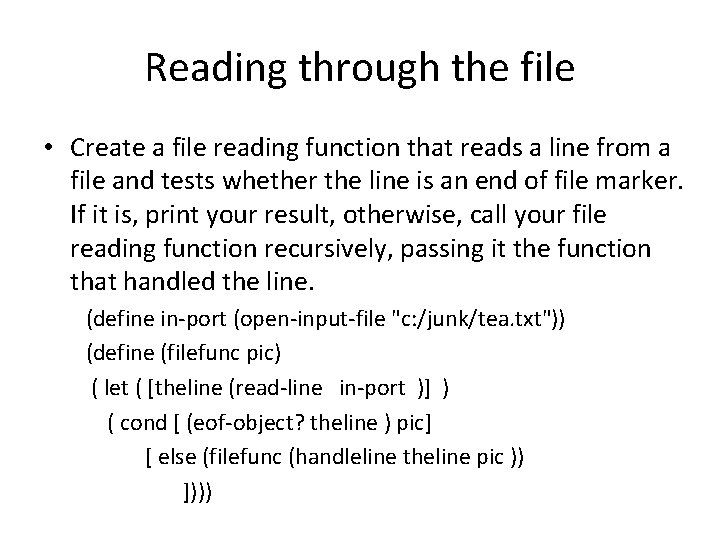
Reading through the file • Create a file reading function that reads a line from a file and tests whether the line is an end of file marker. If it is, print your result, otherwise, call your file reading function recursively, passing it the function that handled the line. (define in-port (open-input-file "c: /junk/tea. txt")) (define (filefunc pic) ( let ( [theline (read-line in-port )] ) ( cond [ (eof-object? theline ) pic] [ else (filefunc (handleline theline pic )) ])))