
Using Quality Safety Education for Nurses QSEN as
- Slides: 28
Using Quality & Safety Education for Nurses (QSEN) as a framework for RN Orientation David H. James DNP, RN-BC, CCNS Patricia A. Patrician RN, Ph. D, FAAN Rebecca S. Miltner RN, Ph. D, CNL, NEA-BC
Objectives 1. Describe how one large academic medical center uses the QSEN competencies and associated selected Knowledge, Skills, and Attitudes (KSAs) as a framework for general nursing orientation 2. Discuss opportunities for leveraging QSEN competencies beyond a RN orientation program. Page 2
Conflict of Interest? ? ? Page 3
Special Thanks… § Ashlea Herrero – Data Analyst UAB Hospital Center for Nursing Excellence § I-Clicker Guru § Pariya Fazeli, Ph. D –UAB Hospital Center for Nursing Excellence § Stats Consultant § UAB Center for Nursing Excellence Staff § Revision of lectures to reflect QSEN competencies Page 4
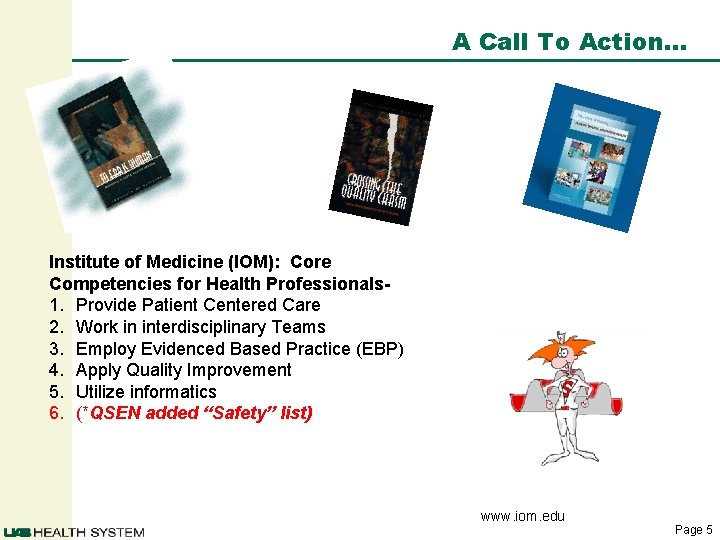
A Call To Action… Institute of Medicine (IOM): Core Competencies for Health Professionals 1. Provide Patient Centered Care 2. Work in interdisciplinary Teams 3. Employ Evidenced Based Practice (EBP) 4. Apply Quality Improvement 5. Utilize informatics 6. (*QSEN added “Safety” list) www. iom. edu Page 5
Nursing Response – QSEN Project § Quality & Safety Education for Nurses (QSEN) – funded by RWJF § Goal: w Address the challenge of preparing future nurses with the knowledge, skills, and attitudes (KSA) necessary to continuously improve the quality and safety of the healthcare systems in which they work. Page 6
Minding the Gap… § How do we ensure that we are building on content taught in nursing programs? § Does the practice setting look anything like academia? § What about RN hired before patient safety movement (before QSEN)? § What about RN from A. D. N. programs? Page 7
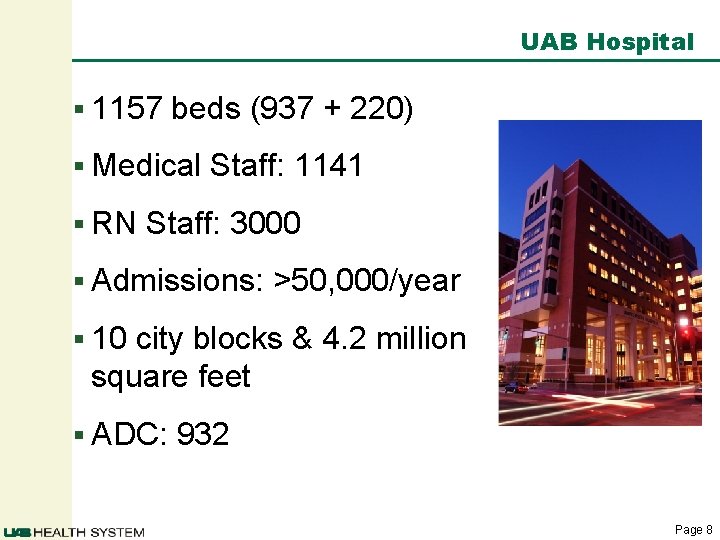
UAB Hospital § 1157 beds (937 + 220) § Medical § RN Staff: 1141 Staff: 3000 § Admissions: >50, 000/year § 10 city blocks & 4. 2 million square feet § ADC: 932 Page 8
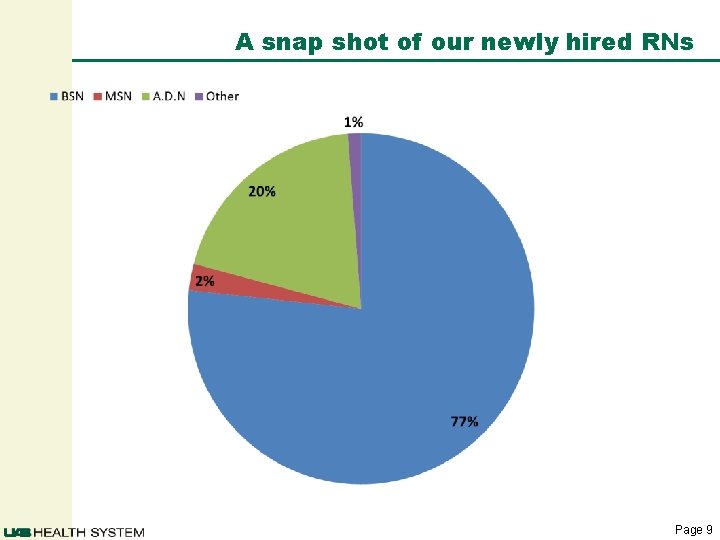
A snap shot of our newly hired RNs Page 9
Revising RN Orientation Page 10
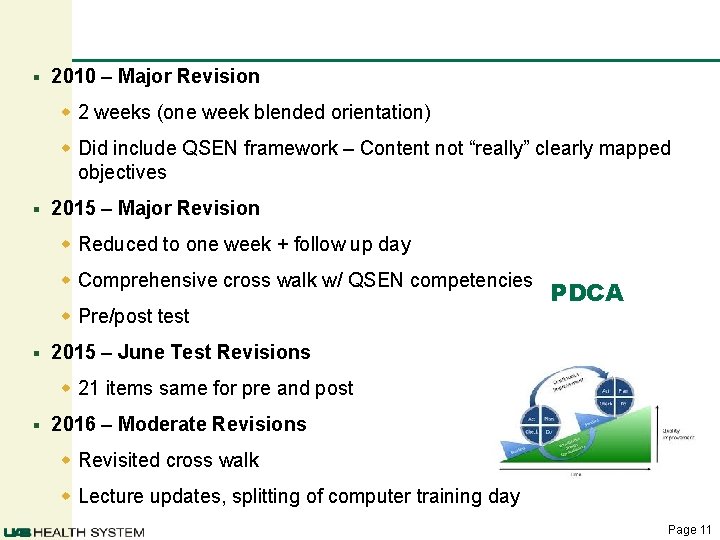
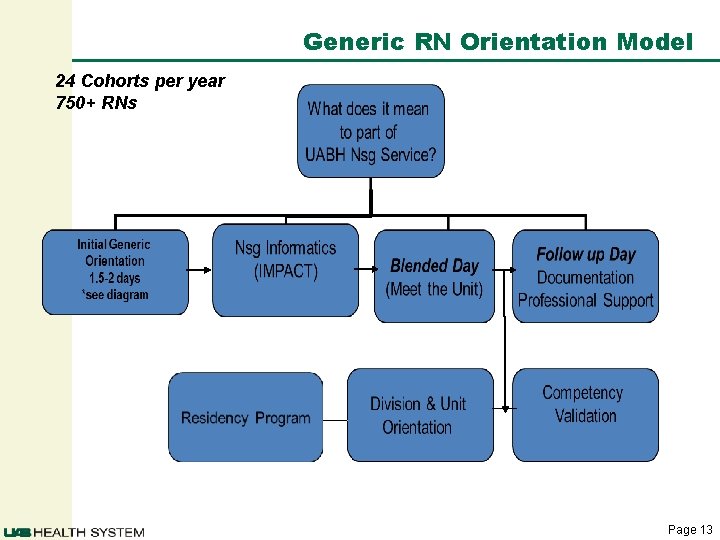
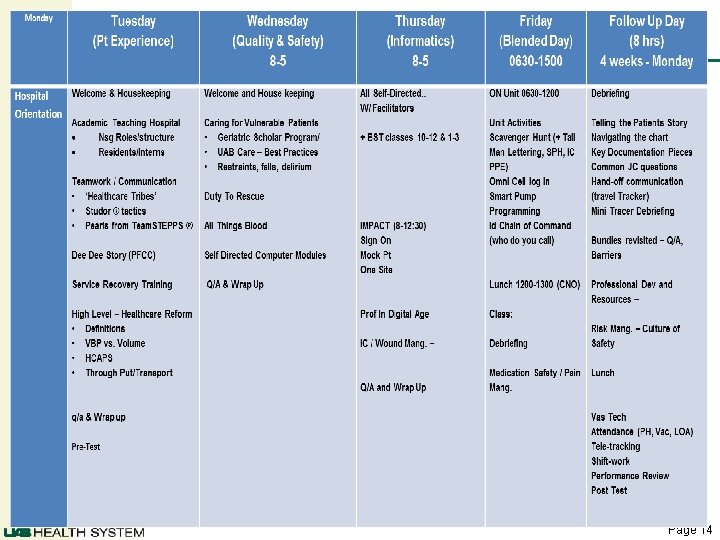
§ 2010 – Major Revision w 2 weeks (one week blended orientation) w Did include QSEN framework – Content not “really” clearly mapped objectives § 2015 – Major Revision w Reduced to one week + follow up day w Comprehensive cross walk w/ QSEN competencies w Pre/post test § PDCA 2015 – June Test Revisions w 21 items same for pre and post § 2016 – Moderate Revisions w Revisited cross walk w Lecture updates, splitting of computer training day Page 11
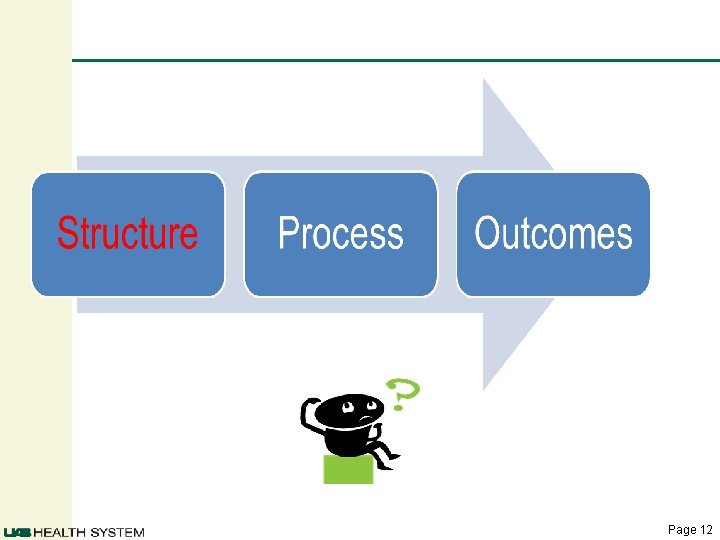
Page 12
Generic RN Orientation Model 24 Cohorts per year 750+ RNs Page 13
Page 14
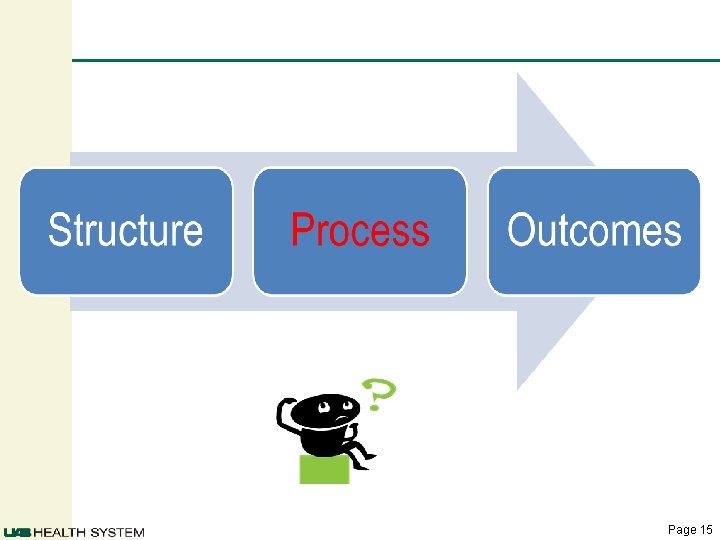
Page 15
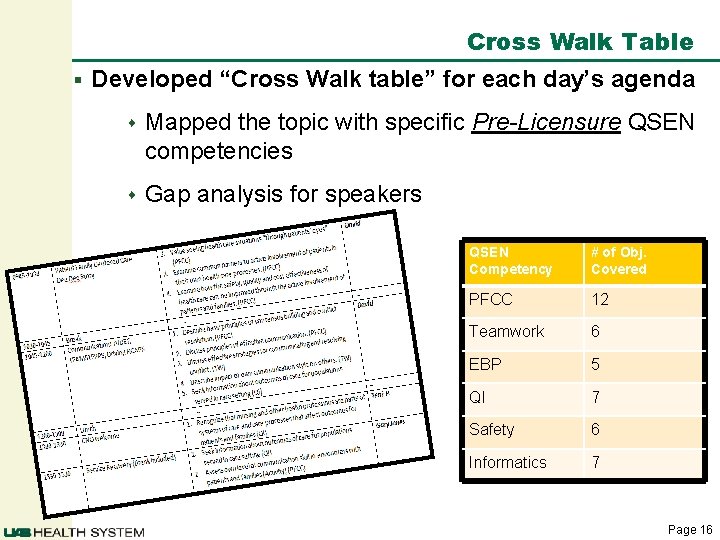
Cross Walk Table § Developed “Cross Walk table” for each day’s agenda s Mapped the topic with specific Pre-Licensure QSEN competencies s Gap analysis for speakers QSEN Competency # of Obj. Covered PFCC 12 Teamwork 6 EBP 5 QI 7 Safety 6 Informatics 7 Page 16
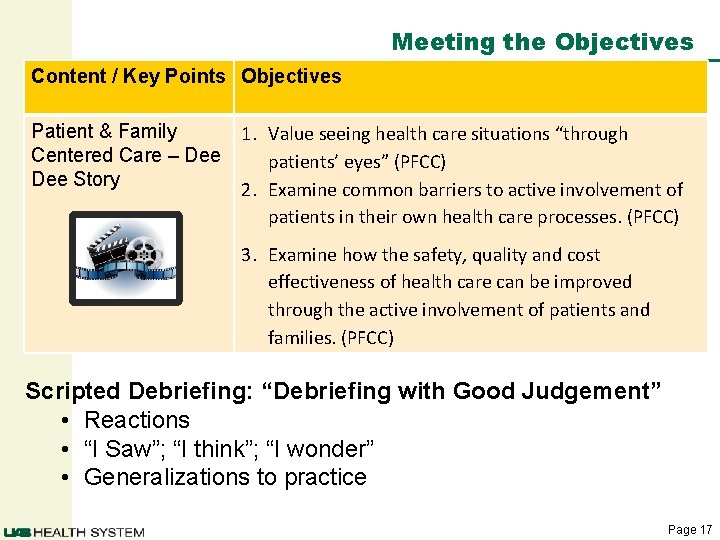
Meeting the Objectives Content / Key Points Objectives Patient & Family 1. Value seeing health care situations “through Centered Care – Dee patients’ eyes” (PFCC) Dee Story 2. Examine common barriers to active involvement of patients in their own health care processes. (PFCC) 3. Examine how the safety, quality and cost effectiveness of health care can be improved through the active involvement of patients and families. (PFCC) Scripted Debriefing: “Debriefing with Good Judgement” • Reactions • “I Saw”; “I think”; “I wonder” • Generalizations to practice Page 17
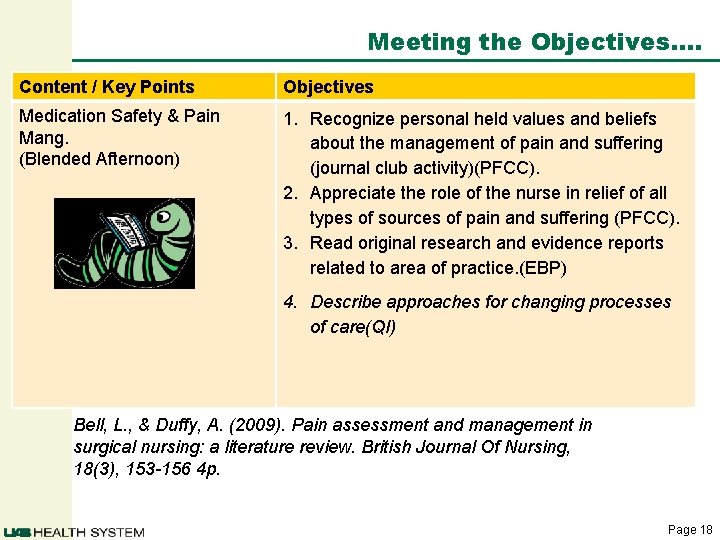
Meeting the Objectives…. Content / Key Points Objectives Medication Safety & Pain Mang. (Blended Afternoon) 1. Recognize personal held values and beliefs about the management of pain and suffering (journal club activity)(PFCC). 2. Appreciate the role of the nurse in relief of all types of sources of pain and suffering (PFCC). 3. Read original research and evidence reports related to area of practice. (EBP) 4. Describe approaches for changing processes of care(QI) Bell, L. , & Duffy, A. (2009). Pain assessment and management in surgical nursing: a literature review. British Journal Of Nursing, 18(3), 153 -156 4 p. Page 18
Page 19
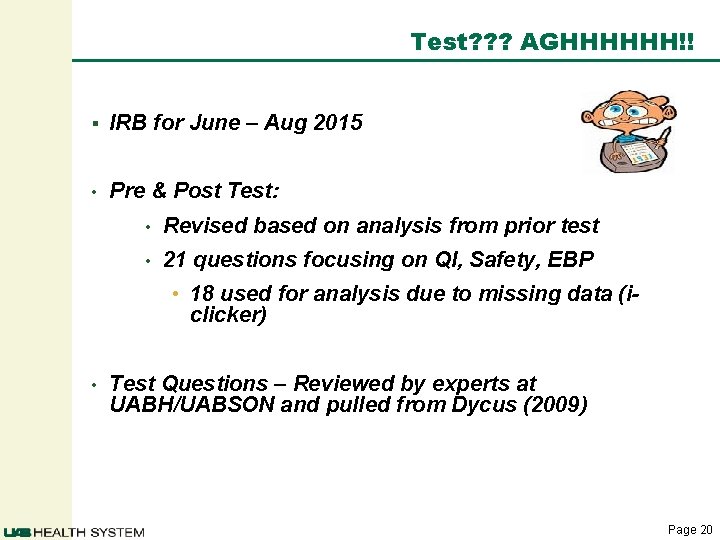
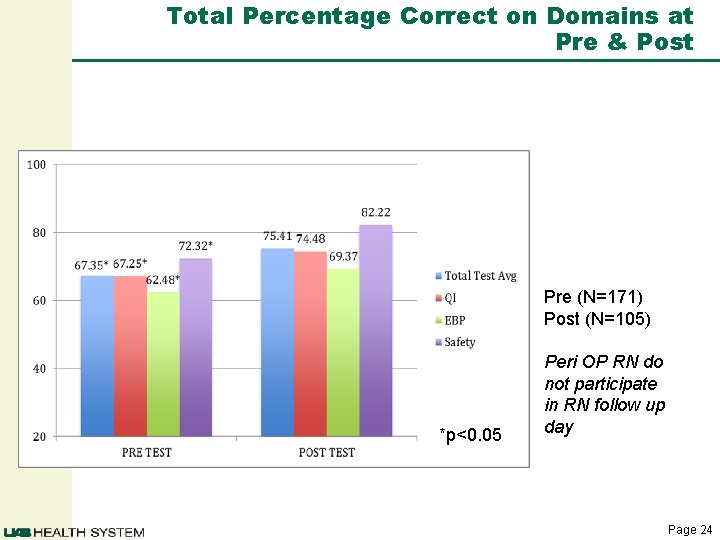
Test? ? ? AGHHHHHH!! § IRB for June – Aug 2015 • Pre & Post Test: • Revised based on analysis from prior test • 21 questions focusing on QI, Safety, EBP • 18 used for analysis due to missing data (iclicker) • Test Questions – Reviewed by experts at UABH/UABSON and pulled from Dycus (2009) Page 20
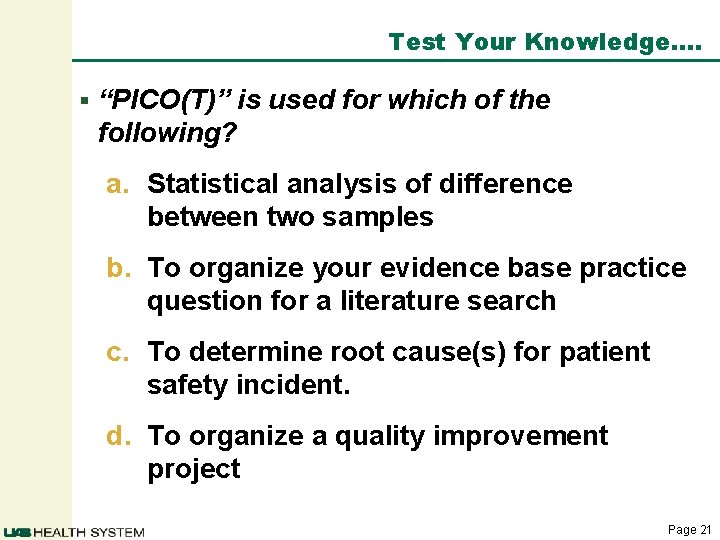
Test Your Knowledge…. § “PICO(T)” is used for which of the following? a. Statistical analysis of difference between two samples b. To organize your evidence base practice question for a literature search c. To determine root cause(s) for patient safety incident. d. To organize a quality improvement project Page 21
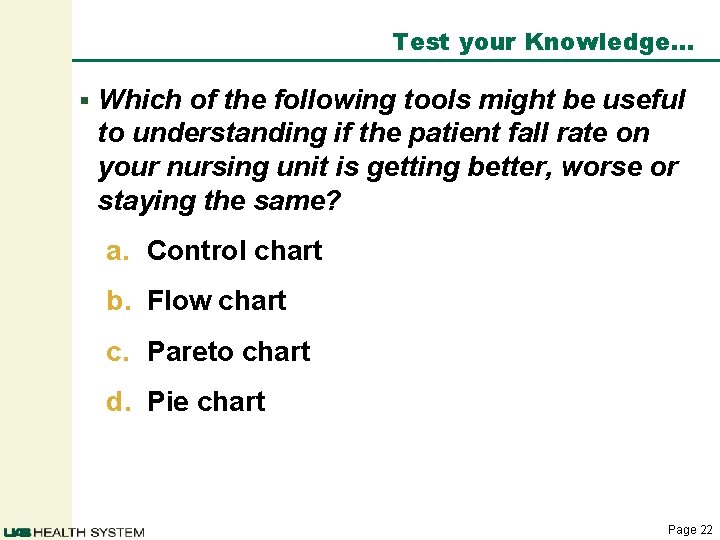
Test your Knowledge… § Which of the following tools might be useful to understanding if the patient fall rate on your nursing unit is getting better, worse or staying the same? a. Control chart b. Flow chart c. Pareto chart d. Pie chart Page 22
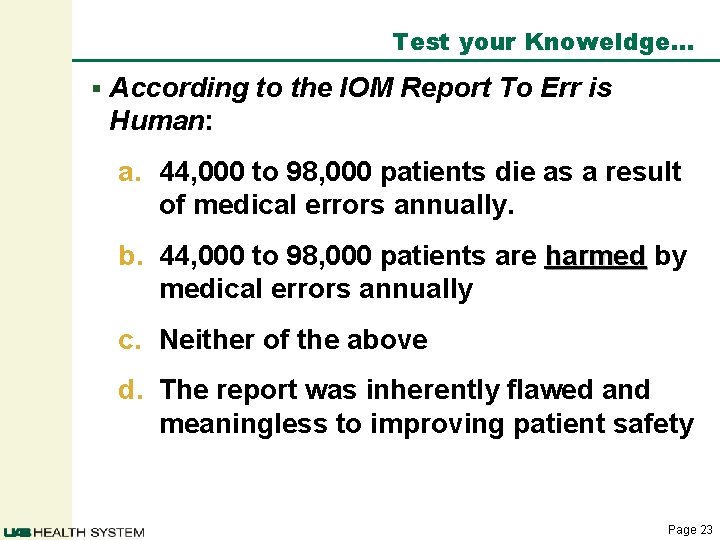
Test your Knoweldge… § According to the IOM Report To Err is Human: a. 44, 000 to 98, 000 patients die as a result of medical errors annually. b. 44, 000 to 98, 000 patients are harmed by medical errors annually c. Neither of the above d. The report was inherently flawed and meaningless to improving patient safety Page 23
Total Percentage Correct on Domains at Pre & Post Pre (N=171) Post (N=105) *p<0. 05 Peri OP RN do not participate in RN follow up day Page 24
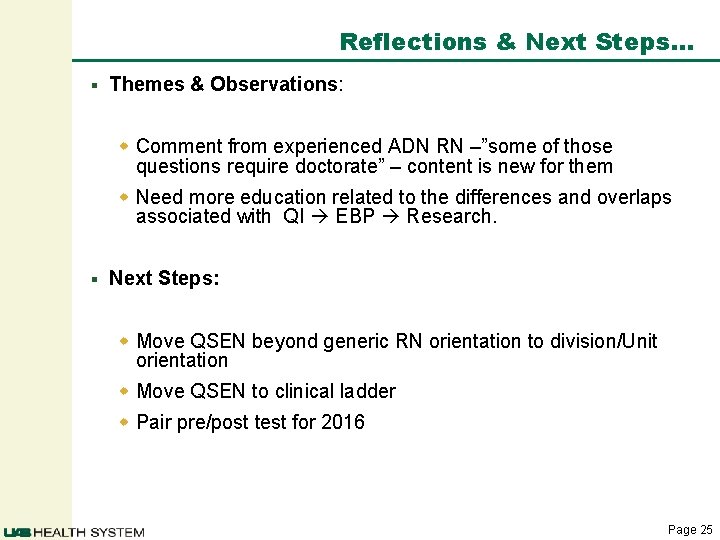
Reflections & Next Steps… § Themes & Observations: w Comment from experienced ADN RN –”some of those questions require doctorate” – content is new for them w Need more education related to the differences and overlaps associated with QI EBP Research. § Next Steps: w Move QSEN beyond generic RN orientation to division/Unit orientation w Move QSEN to clinical ladder w Pair pre/post test for 2016 Page 25
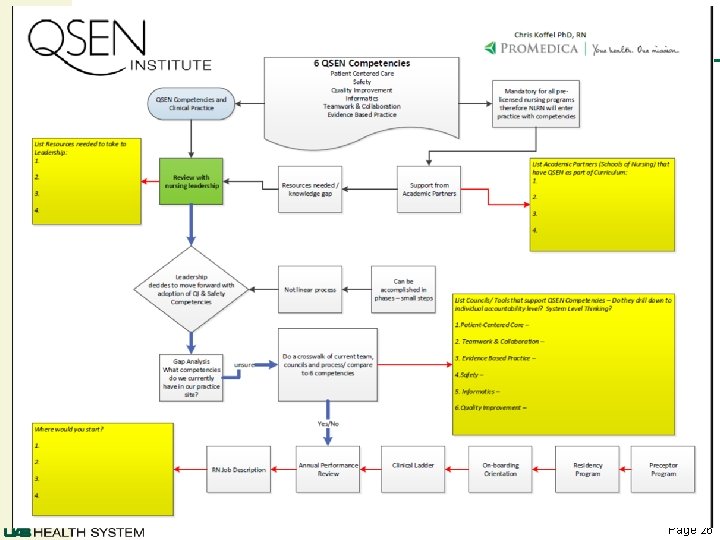
Page 26
Questions & Contact… § David H. James DNP, RN-BC, CCNS wdjames@uabmc. edu Page 27
References: § Cronenwett L, Sherwood G, Warren J, et al. Quality and safety education for nurses. Nurs Outlook. 2007; 55(3): 122 -131. § Dycus, P. , & Mc. Keon, L. (2009). Using QSEN to measure quality and safety knowledge, skills, and attitudes of experienced pediatric oncology nurses: an international study. Quality Management In Health Care, 18(3), 202 -208 § QSEN Institute. QSEN. http: //qsen. org. 2014. Accessed August 20, 2014 Page 28