
USING QUALITATIVE METHODS IN LARGE SCALE PROJECTS LESLIE

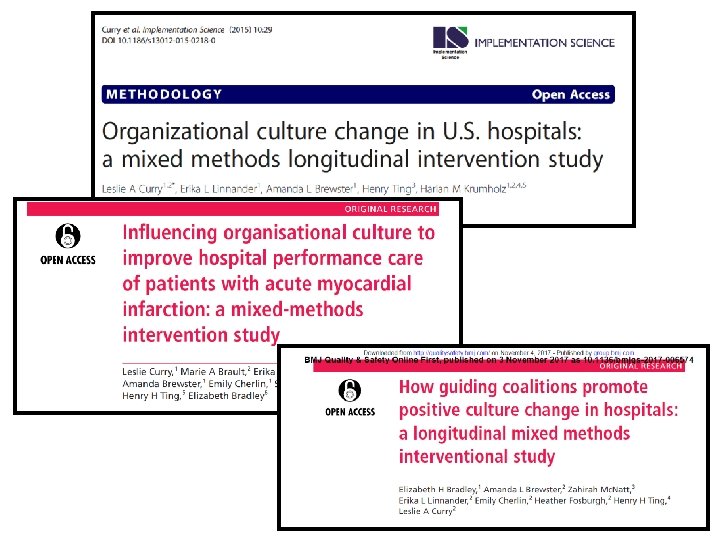

- Slides: 34
USING QUALITATIVE METHODS IN LARGE SCALE PROJECTS LESLIE CURRY, PHD, MPH SENIOR RESEARCH SCIENTIST, YALE SCHOOL OF PUBLIC HEALTH LECTURER, YALE COLLEGE April 2018
Overview of our session § § Qualitative methods in large scale research projects Challenges in implementation Strategies: Illustrations from Leadership Saves Lives Application to your current work/discussion
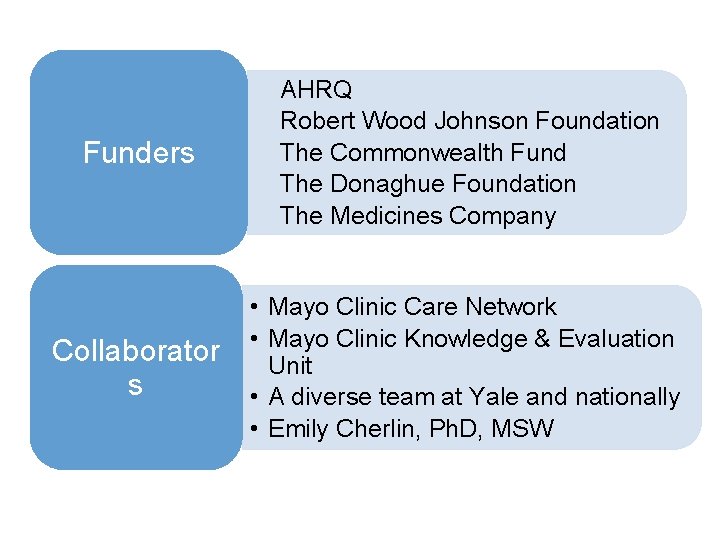
Funders AHRQ Robert Wood Johnson Foundation The Commonwealth Fund The Donaghue Foundation The Medicines Company Collaborator s • Mayo Clinic Care Network • Mayo Clinic Knowledge & Evaluation Unit • A diverse team at Yale and nationally • Emily Cherlin, Ph. D, MSW
Qualitative methods in large scale research projects
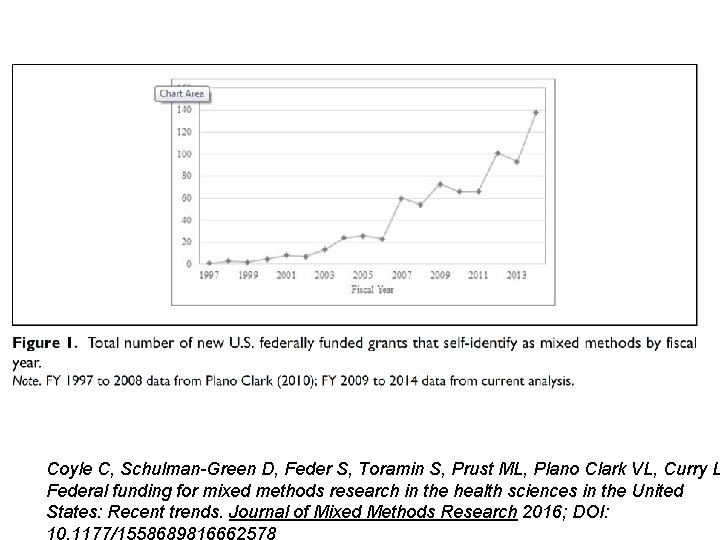
Qualitative methods are becoming increasingly common in large scale projects § § Complex interventions Program and policy evaluations Randomized controlled trials Implementation science approaches Curry LA, Krumholz HM, O’Cathain A, Plano Clark VL, Cherlin E, Bradley EH. Mixed methods in biomedical and health services research. Circulation: Cardiovascular Quality and Outcomes. 2013; 6: 119 -123
Coyle C, Schulman-Green D, Feder S, Toramin S, Prust ML, Plano Clark VL, Curry L Federal funding for mixed methods research in the health sciences in the United States: Recent trends. Journal of Mixed Methods Research 2016; DOI:
Challenges
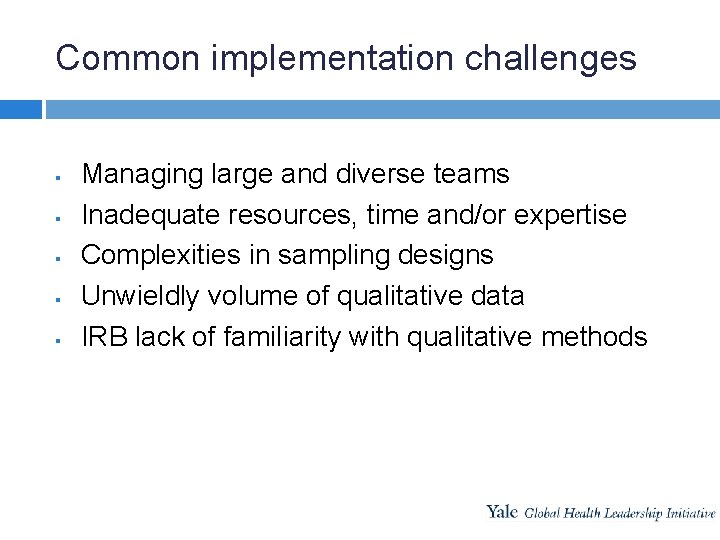
Common implementation challenges § § § Managing large and diverse teams Inadequate resources, time and/or expertise Complexities in sampling designs Unwieldly volume of qualitative data IRB lack of familiarity with qualitative methods
Strategies: Illustrations from Leadership Saves Lives
§ Each year, over 800, 000 people in the US have a heart attack § About 200, 000 die § Risk-standardized mortality rates vary substantially
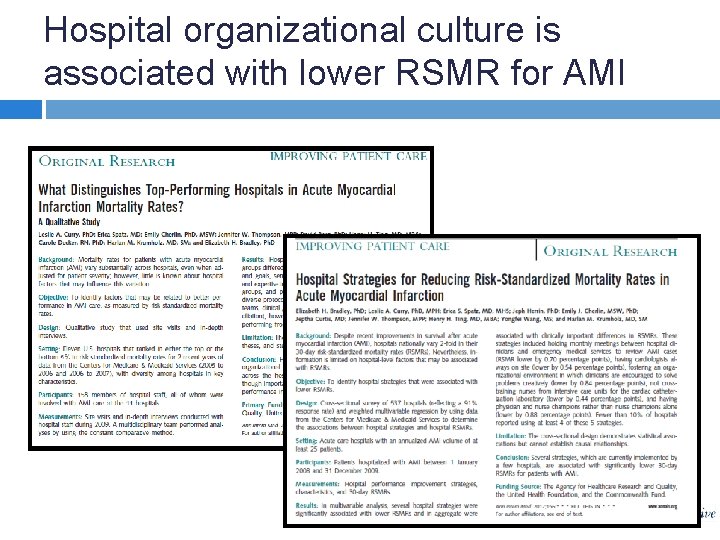
Hospital organizational culture is associated with lower RSMR for AMI
Leadership Saves Lives § Intervention to promote organizational culture change in US hospitals & improve outcomes for patients with AMI § Outcomes: § Uptake of 5 evidence-based strategies § Changes in key dimensions of culture § RSMR for AMI § Mixed methods evaluation to measure change
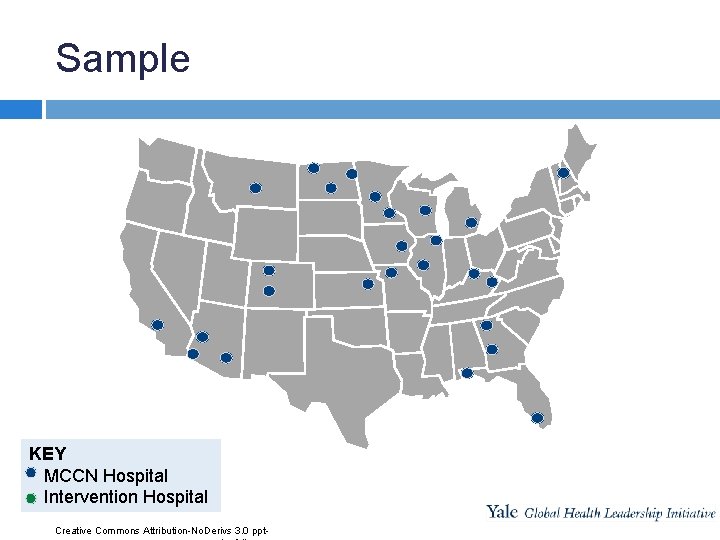
Sample KEY MCCN Hospital Intervention Hospital Creative Commons Attribution-No. Derivs 3. 0 ppt-
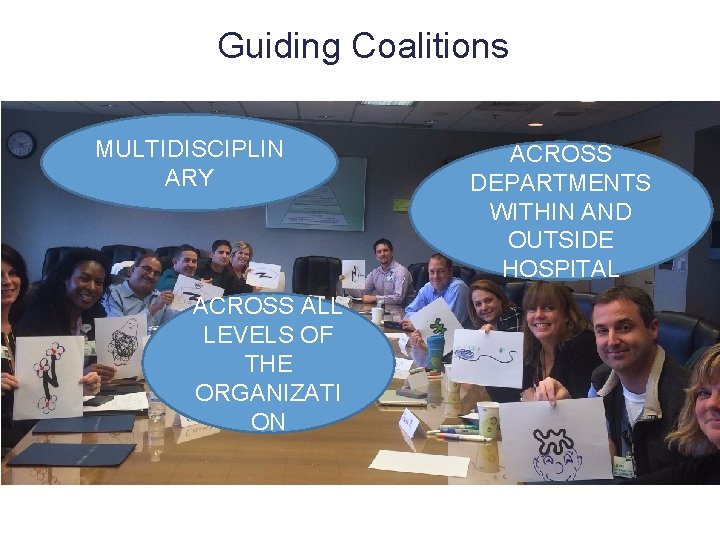
Guiding Coalitions MULTIDISCIPLIN ARY ACROSS ALL LEVELS OF THE ORGANIZATI ON ACROSS DEPARTMENTS WITHIN AND OUTSIDE HOSPITAL
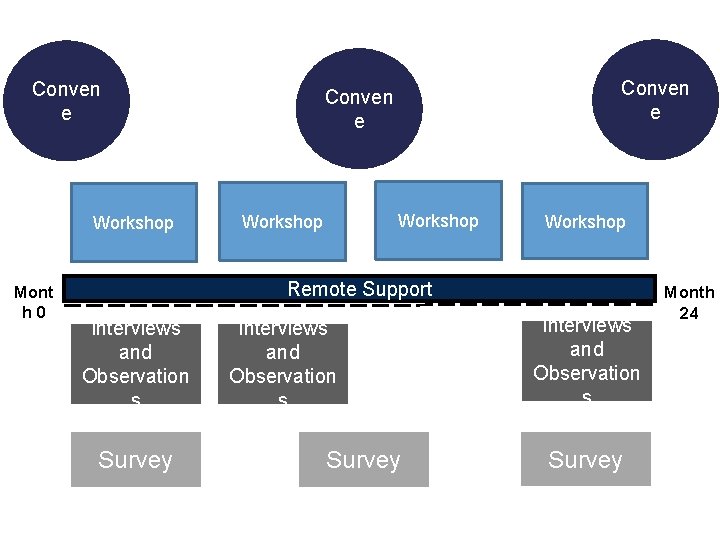
Conven e Workshop Mont h 0 Conven e Workshop Conven e Workshop Remote Support Interviews and Observation s Survey Month 24
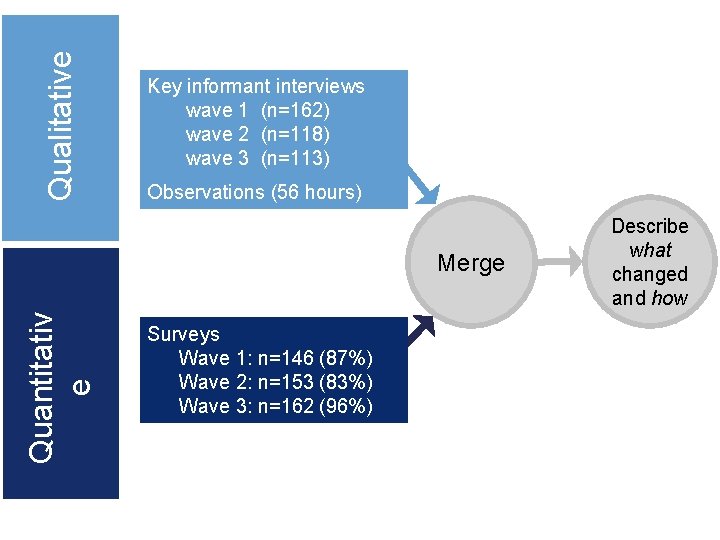
Qualitative Key informant interviews wave 1 (n=162) wave 2 (n=118) wave 3 (n=113) Observations (56 hours) Quantitativ e Merge Surveys Wave 1: n=146 (87%) Wave 2: n=153 (83%) Wave 3: n=162 (96%) Describe what changed and how
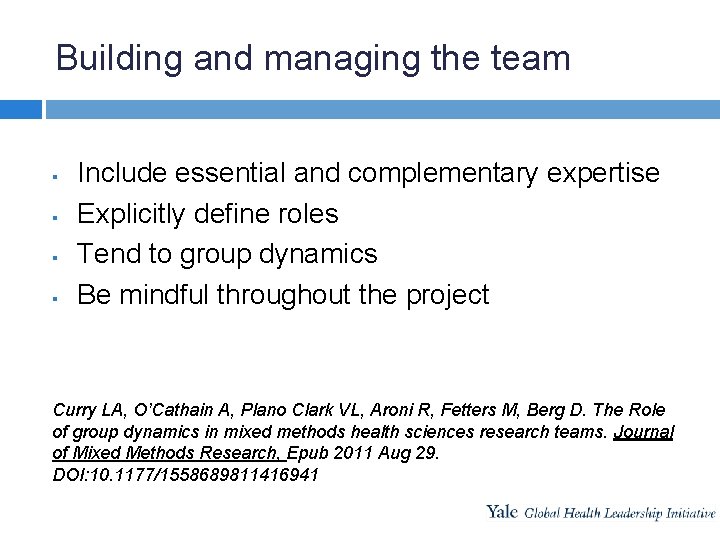
Building and managing the team § § Include essential and complementary expertise Explicitly define roles Tend to group dynamics Be mindful throughout the project Curry LA, O’Cathain A, Plano Clark VL, Aroni R, Fetters M, Berg D. The Role of group dynamics in mixed methods health sciences research teams. Journal of Mixed Methods Research, Epub 2011 Aug 29. DOI: 10. 1177/1558689811416941
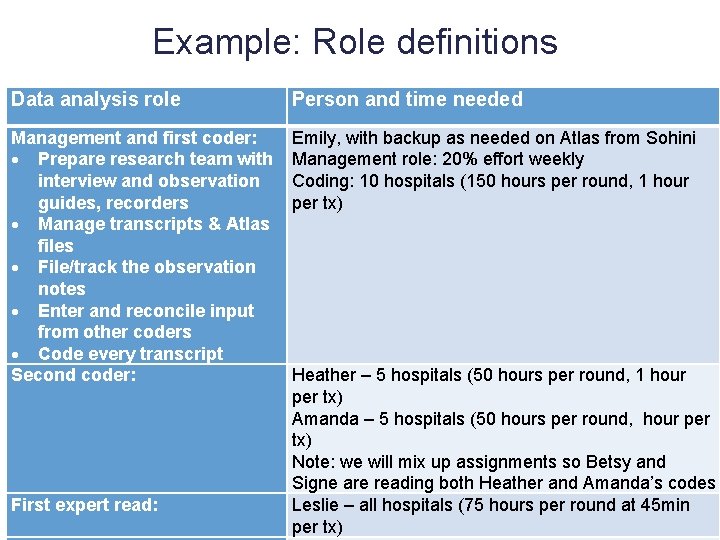
Example: Role definitions Data analysis role Person and time needed Management and first coder: Prepare research team with interview and observation guides, recorders Manage transcripts & Atlas files File/track the observation notes Enter and reconcile input from other coders Code every transcript Second coder: Emily, with backup as needed on Atlas from Sohini Management role: 20% effort weekly Coding: 10 hospitals (150 hours per round, 1 hour per tx) First expert read: Heather – 5 hospitals (50 hours per round, 1 hour per tx) Amanda – 5 hospitals (50 hours per round, hour per tx) Note: we will mix up assignments so Betsy and Signe are reading both Heather and Amanda’s codes Leslie – all hospitals (75 hours per round at 45 min per tx)
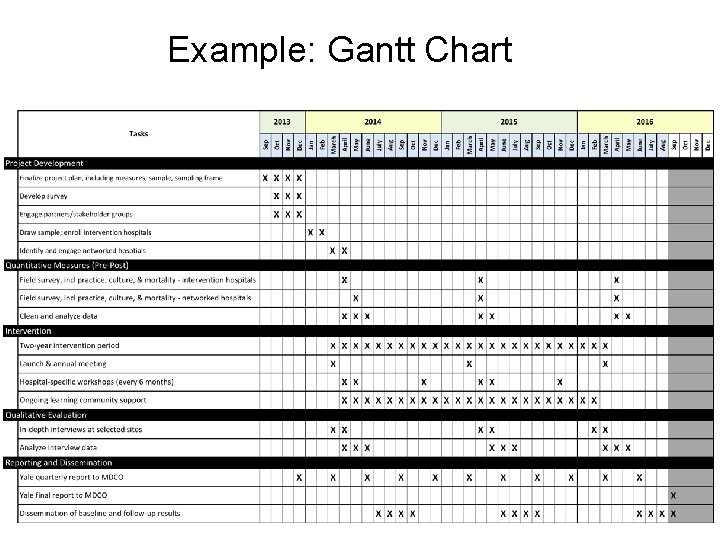
Example: Gantt Chart
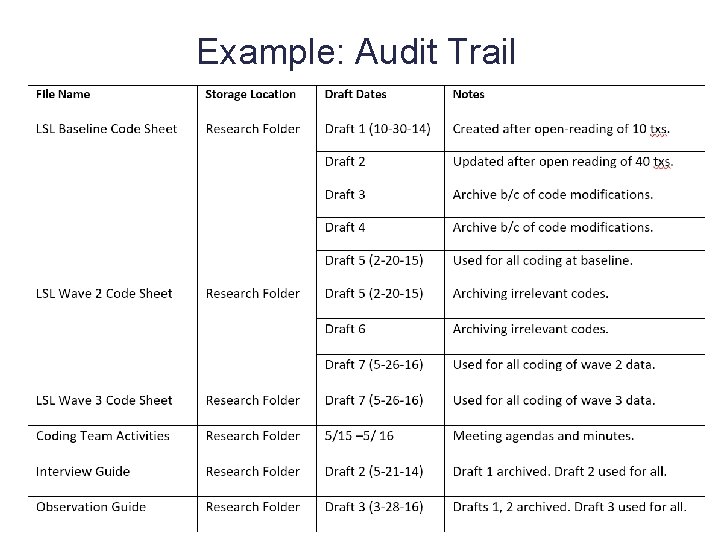
Example: Audit Trail
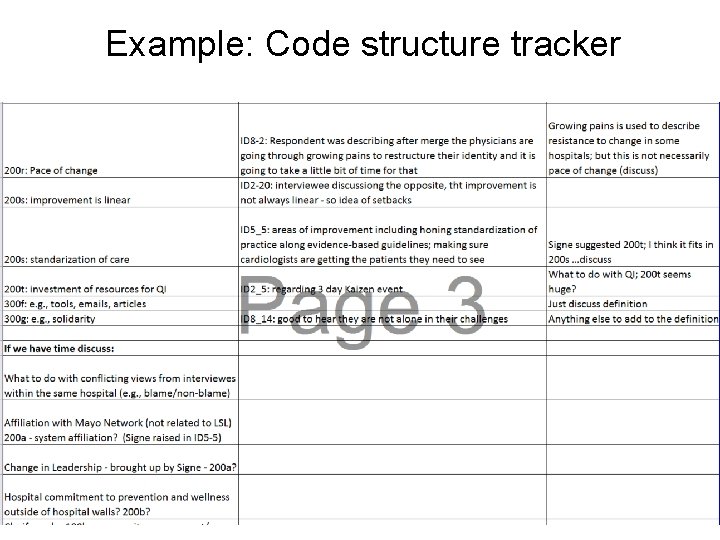
Example: Code structure tracker
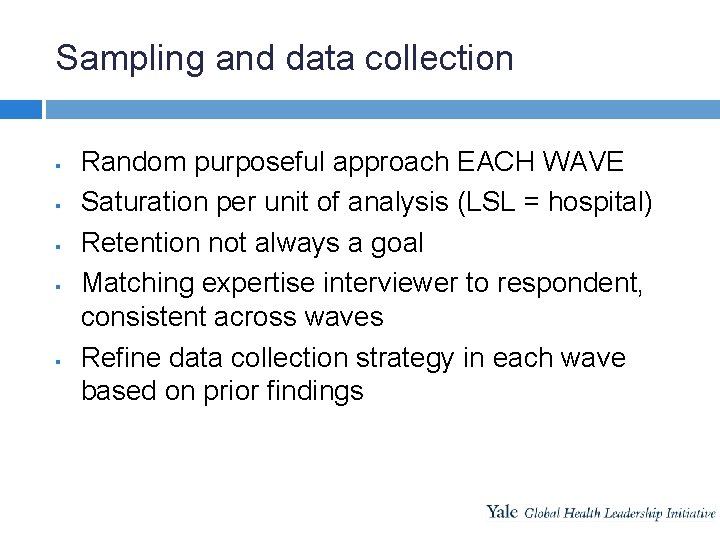
Sampling and data collection § § § Random purposeful approach EACH WAVE Saturation per unit of analysis (LSL = hospital) Retention not always a goal Matching expertise interviewer to respondent, consistent across waves Refine data collection strategy in each wave based on prior findings
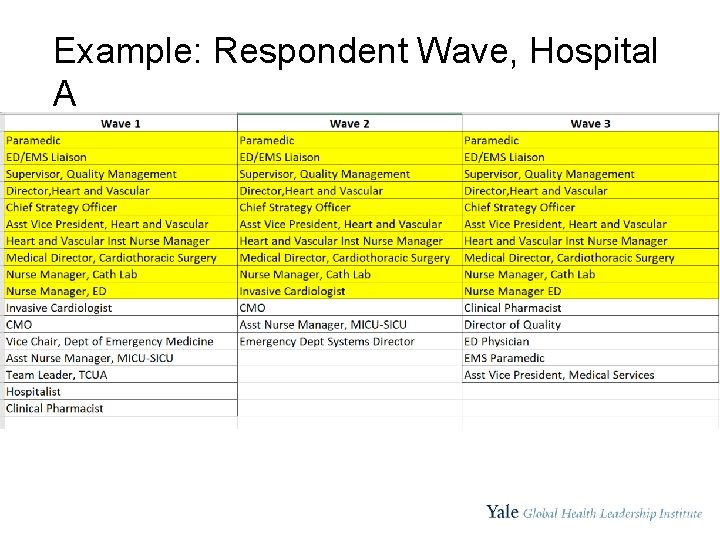
Example: Respondent Wave, Hospital A
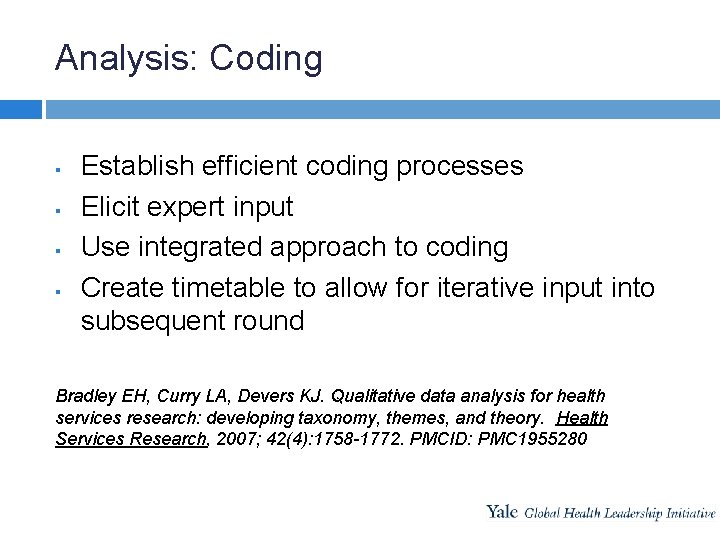
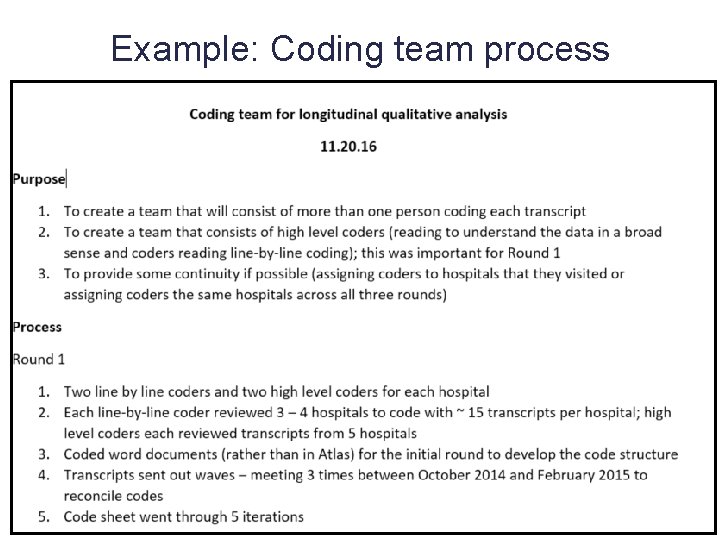
Analysis: Coding § § Establish efficient coding processes Elicit expert input Use integrated approach to coding Create timetable to allow for iterative input into subsequent round Bradley EH, Curry LA, Devers KJ. Qualitative data analysis for health services research: developing taxonomy, themes, and theory. Health Services Research, 2007; 42(4): 1758 -1772. PMCID: PMC 1955280
Example: Coding team process
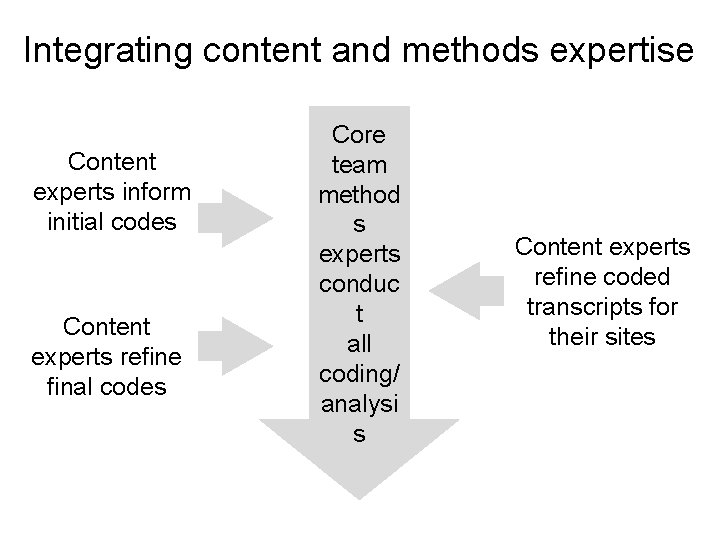
Integrating content and methods expertise Content experts inform initial codes Content experts refine final codes Core team method s experts conduc t all coding/ analysi s Content experts refine coded transcripts for their sites
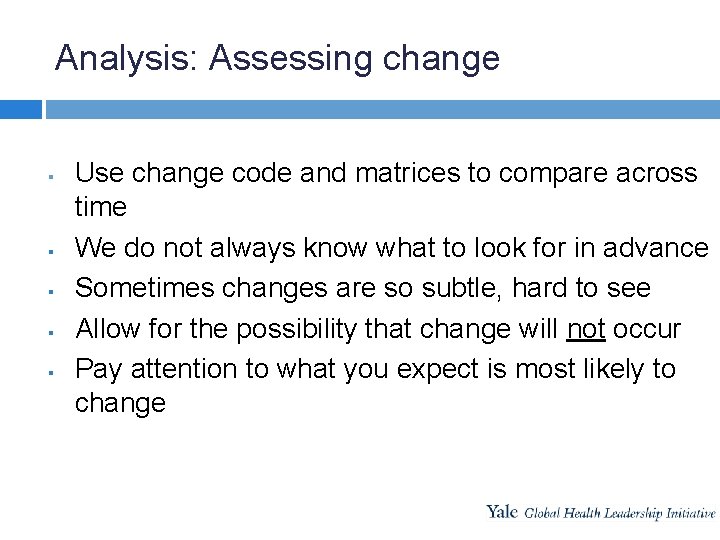
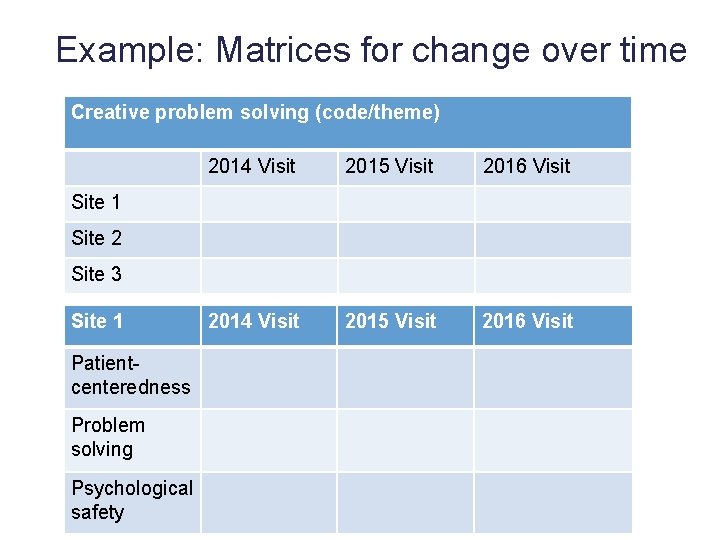
Analysis: Assessing change § § § Use change code and matrices to compare across time We do not always know what to look for in advance Sometimes changes are so subtle, hard to see Allow for the possibility that change will not occur Pay attention to what you expect is most likely to change
Example: Matrices for change over time Creative problem solving (code/theme) 2014 Visit 2015 Visit 2016 Visit Site 1 Site 2 Site 3 Site 1 Patientcenteredness Problem solving Psychological safety
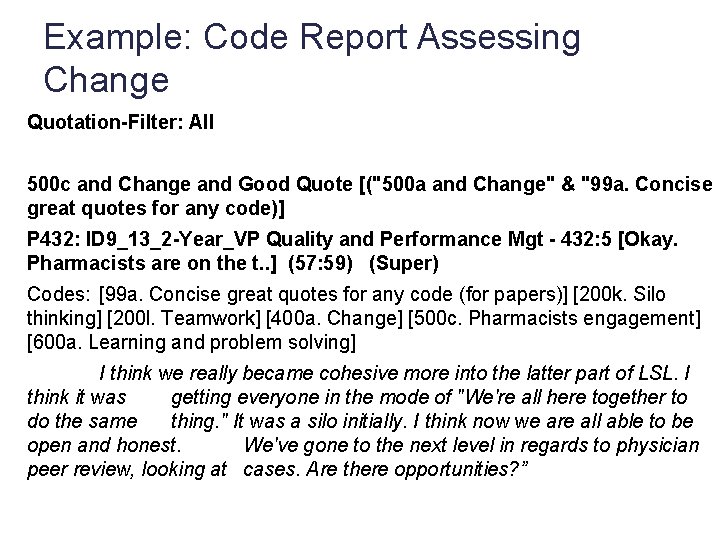
Example: Code Report Assessing Change Quotation-Filter: All 500 c and Change and Good Quote [("500 a and Change" & "99 a. Concise great quotes for any code)] P 432: ID 9_13_2 -Year_VP Quality and Performance Mgt - 432: 5 [Okay. Pharmacists are on the t. . ] (57: 59) (Super) Codes: [99 a. Concise great quotes for any code (for papers)] [200 k. Silo thinking] [200 l. Teamwork] [400 a. Change] [500 c. Pharmacists engagement] [600 a. Learning and problem solving] I think we really became cohesive more into the latter part of LSL. I think it was getting everyone in the mode of "We're all here together to do the same thing. " It was a silo initially. I think now we are all able to be open and honest. We've gone to the next level in regards to physician peer review, looking at cases. Are there opportunities? ”
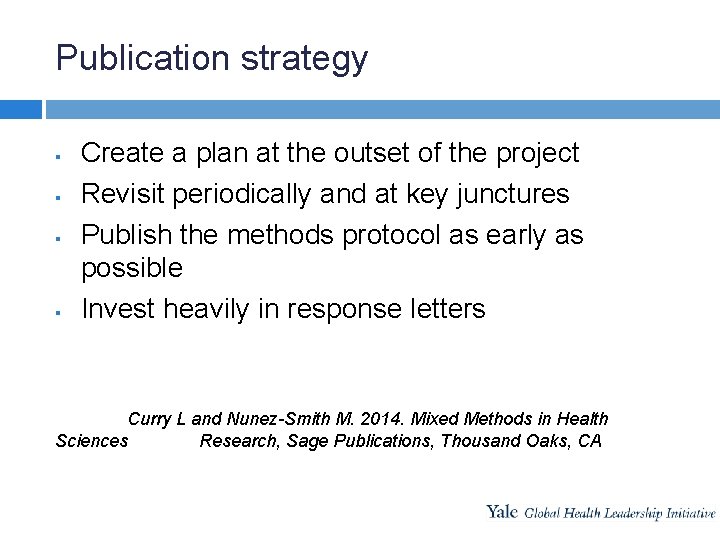
Publication strategy § § Create a plan at the outset of the project Revisit periodically and at key junctures Publish the methods protocol as early as possible Invest heavily in response letters Curry L and Nunez-Smith M. 2014. Mixed Methods in Health Sciences Research, Sage Publications, Thousand Oaks, CA
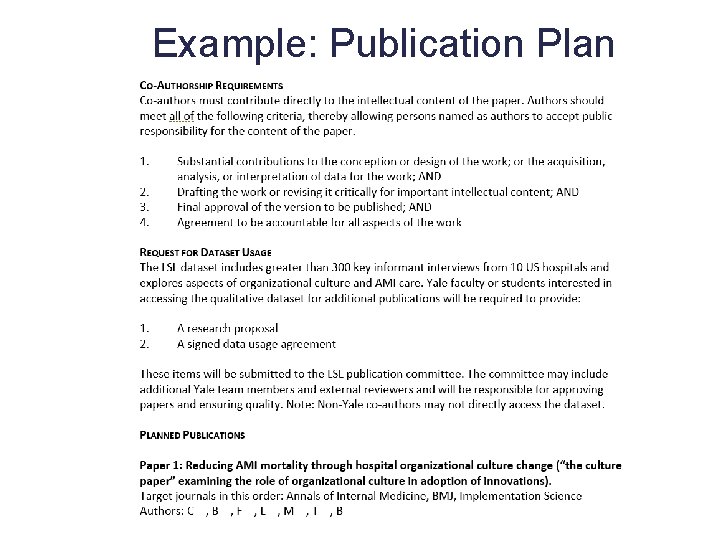
Example: Publication Plan
THANK YOU! CONVERSATION
Contact Information 34 Leslie Curry, Ph. D, MPH Senior Research Scientist Yale Global Health Leadership Institute Yale University leslie. curry@yale. edu http: //ghli. yale. edu @lesliecyale, @Yale. GH Yale. Global. Health