
Using Python to Build a General Purpose Test
Using Python to Build a General Purpose Test Framework Rahul Verma rahul_verma@mcafee. com rahul_verma@testingperspective. com Sr QA Technical Lead, Anti-Malware Core, Mc. Afee Labs
Speaker Profile Rahul Verma is a Sr QA Technical Lead with Mc. Afee Software India, with special interest in performance testing, security testing, Python and design of test automation frameworks. Rahul has presented at several conferences, organizations and academic institutions including CONQUEST, STe. P-IN, ISQT, TEST 2008, Yahoo! India, Mc. Afee, Applabs, IIT Chennai and STIG. He runs the website – Testing Perspective (www. testingperspective. com ) for which he got the Testing Thought Leadership Award. His paper on the subject of “Design of Fuzzing Frameworks” won the “Best Innovative Paper “Award at TEST 2008. He also recently launched a website Python+Testing (http: //www. pythontesting. com ) powered by Google App. Engine
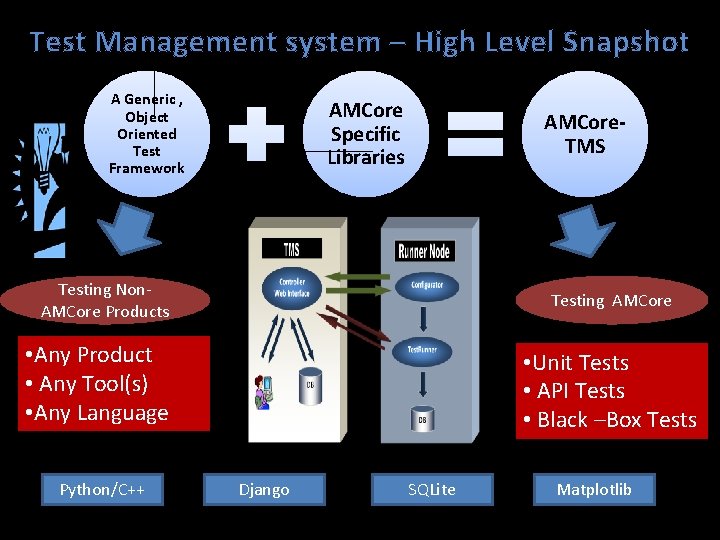
Test Management system – High Level Snapshot A Generic , Object Oriented Test Framework AMCore Specific Libraries AMCore. TMS Testing Non. AMCore Products Testing AMCore • Any Product • Any Tool(s) • Any Language Python/C++ • Unit Tests • API Tests • Black –Box Tests Django SQLite Matplotlib
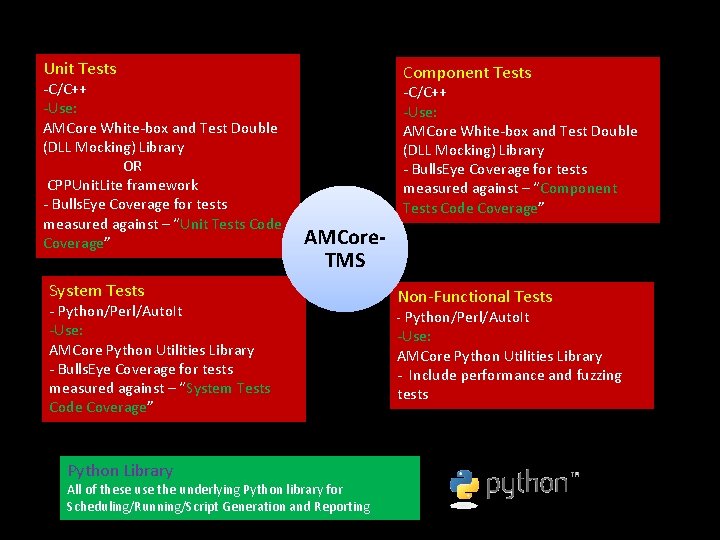
Unit Tests -C/C++ -Use: AMCore White-box and Test Double (DLL Mocking) Library OR CPPUnit. Lite framework - Bulls. Eye Coverage for tests measured against – “Unit Tests Code Coverage” Component Tests -C/C++ -Use: AMCore White-box and Test Double (DLL Mocking) Library - Bulls. Eye Coverage for tests measured against – “Component Tests Code Coverage” AMCore. TMS System Tests - Python/Perl/Auto. It -Use: AMCore Python Utilities Library - Bulls. Eye Coverage for tests measured against – “System Tests Code Coverage” Python Library All of these use the underlying Python library for Scheduling/Running/Script Generation and Reporting Non-Functional Tests - Python/Perl/Auto. It -Use: AMCore Python Utilities Library - Include performance and fuzzing tests
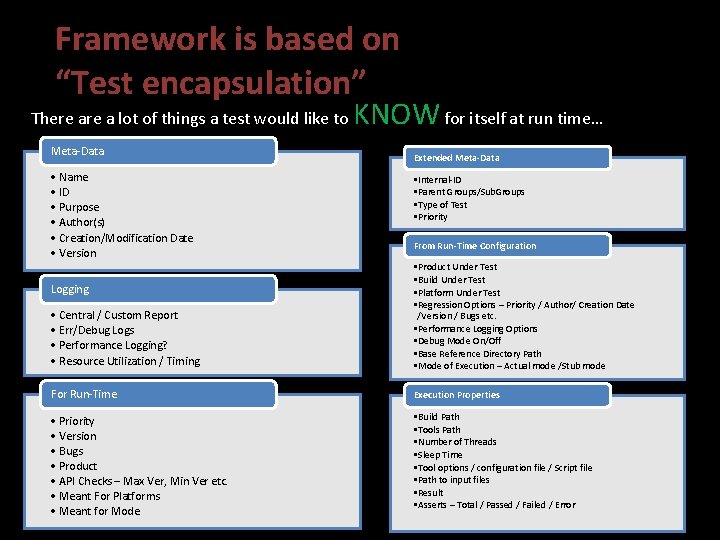
Framework is based on “Test encapsulation” There a lot of things a test would like to Meta-Data • Name • ID • Purpose • Author(s) • Creation/Modification Date • Version KNOW for itself at run time… Extended Meta-Data • Internal-ID • Parent Groups/Sub. Groups • Type of Test • Priority From Run-Time Configuration • Central / Custom Report • Err/Debug Logs • Performance Logging? • Resource Utilization / Timing • Product Under Test • Build Under Test • Platform Under Test • Regression Options – Priority / Author/ Creation Date /Version / Bugs etc. • Performance Logging Options • Debug Mode On/Off • Base Reference Directory Path • Mode of Execution – Actual mode /Stub mode For Run-Time Execution Properties • Priority • Version • Bugs • Product • API Checks – Max Ver, Min Ver etc. • Meant For Platforms • Meant for Mode • Build Path • Tools Path • Number of Threads • Sleep Time • Tool options / configuration file / Script file • Path to input files • Result • Asserts – Total / Passed / Failed / Error Logging
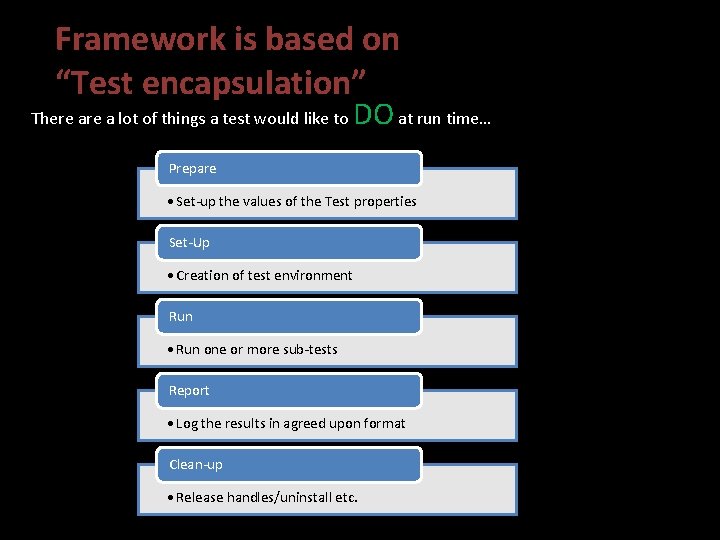
Framework is based on “Test encapsulation” There a lot of things a test would like to DO at run time… Prepare • Set-up the values of the Test properties Set-Up • Creation of test environment Run • Run one or more sub-tests Report • Log the results in agreed upon format Clean-up • Release handles/uninstall etc.
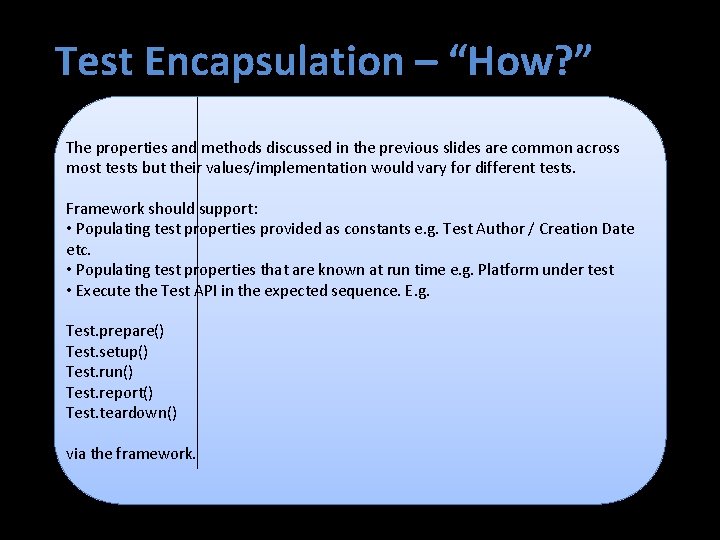
Test Encapsulation – “How? ” The properties and methods discussed in the previous slides are common across most tests but their values/implementation would vary for different tests. Framework should support: • Populating test properties provided as constants e. g. Test Author / Creation Date etc. • Populating test properties that are known at run time e. g. Platform under test • Execute the Test API in the expected sequence. E. g. Test. prepare() Test. setup() Test. run() Test. report() Test. teardown() via the framework.
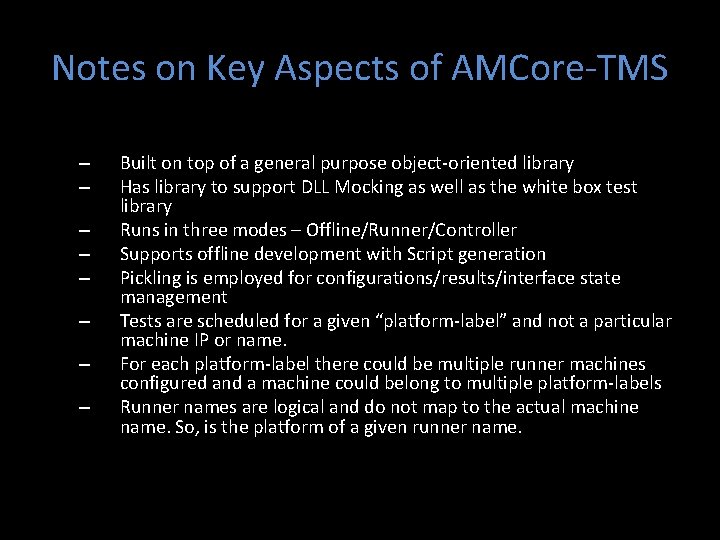
Notes on Key Aspects of AMCore-TMS – – – – Built on top of a general purpose object-oriented library Has library to support DLL Mocking as well as the white box test library Runs in three modes – Offline/Runner/Controller Supports offline development with Script generation Pickling is employed for configurations/results/interface state management Tests are scheduled for a given “platform-label” and not a particular machine IP or name. For each platform-label there could be multiple runner machines configured and a machine could belong to multiple platform-labels Runner names are logical and do not map to the actual machine name. So, is the platform of a given runner name.
Notes on AMCore-TMS – – – Groups tests into Test-Group, Test Sub-Group, Type (Blackbox/whitebox) and Test Category. Class names and purpose map to the testing theory – Test Category, Test. Oracle, Test. Results, Test. Runner etc. All information that is required to run a test is contained in a test – via properties Any run-time errors in a test are confined to the test and does not stop execution. Reports detailed information for a test category right to the level of timestamp, oracle, actual result, employed tool etc. for an individual check
Notes on AMCore-TMS – – – Employs Pull Model of execution – a runner machine pulls execution details by sending a single parameter i. e. its name (logical) State of execution of a runner machine is maintained on the controller machine so that tests are managed across multiple restarts or even fresh snapshots. Apache web server is used as the controller side multithreaded daemon. So, no socket programming involved. Runners use HTTP protocol to pull execution settings, intermittent reporting of status and fetching state information Status of execution for current or past test cycles can be seen in the web interface Easy archiving because everything is file based including the DB.
AMcore-TMS – What it employs – • • • – – – • • • Programming: Python 2. 5 (controller)/2. 6(test nodes) as the base language C/C++ for white-box lib (utilities and test doubles) Auto. It for behavior generation Apache web server (2. 2) + mod_python SQLite as the database (file based) Following Python modules are used: Django for Web interface (based on MVC design pattern) Matplotlib for plotting test cycle status and performance statistics API-documentation for the package is done using epydoc WMI is used for performance stats logging Urllib 2 for http communication
Q/A I hear and I forget. I see and I remember. I do and I understand. - Confucious
- Slides: 12