
Using prosody and intonation to identify accents The
![[e: xemploh] Asique, por eso también, media que se complica No. ahora estoy acá](https://slidetodoc.com/presentation_image_h2/820b43ac40d5b673bf525dd6d625bb37/image-4.jpg "[e: xemploh] Asique, por eso también, media que se complica No. ahora estoy acá")
- Slides: 33
Using prosody and intonation to identify accents: The role of peak and valley alignment in the Spanish of Córdoba, Argentina Jennifer Lang-Rigal James Madison University In. To. Span I, University of Massachusetts Amherst Oct. 2014
Outline 1. 2. 3. Intonation of Córdoba Spanish Research questions Methodology 1: Production Acoustic analysis of tokens Results : Peak alignment 4. Methodology 2: Perception Positive and negative Córdoba identification Results : mis-identified tokens 5. Discussion of perception and peak alignment
Intonation of Córdoba Spanish The tonada cordobesa: the regional variety of Spanish spoken in Córdoba, Argentina lengthened pre-tonic vowel (i. e. /to: ná. da/) phrase final position accompanied by a rise in pitch which is anchored to the pre-tonic syllable (Fontanella de Weinberg 1971; Yorio 1973)
[e: xemploh] Asique, por eso también, media que se complica No. ahora estoy acá desde el año pasado. viste, no emití opinión ni nada porque. Porque esa opinión, pequeña, que yo a emitir, va a pasar como teléfono descompuesto. Puede hacer otro círculo, y… entonces me quedé en el molde.
Previous Impressionistic descriptive studies - Fontanella de Weinberg (1971) lengthening is accompanied by a tonal ascent or descent on the second half of that vowel and even in cases where the tonal height did not change, there was still tonal contrast of the lengthened vowel the pre-tonic and tonic syllables and any post-tonic syllables the combined center of not just the lexical pitch contour but the principal pitch movement of the intonational phrase
Previous descriptive studies – Yorio (1973), Malmberg (1950) Pre-tonic vowel lengthening is nearly obligatory in spontaneous speech, less frequent in read speech (Yorio 1973) The tonada cordobesa displays a “stress-shift” (Malmberg)
Empirical Pilot studies in vowel lengthening Lang (2010) – tonic vowel had a significantly higher mean pitch (F 0) when compared to the pre-tonic pitch in a t-test in phrase-finally placed words of declarative utterances taken from naturally produced recordings (p<. 01) Lang-Rigal (2012) - pre-tonic vowel lengthening and the alignment of the peak in the tonic syllable
Research Questions Does peak alignment play a part in the tonada cordobesa? How does the peak align relative to the tonic and pre-tonic syllables? Does this differ from other varieties of Argentine Spanish (i. e. Buenos Aires and Tucumán)? In a dialect identification task, which tokens are perceived as sounding more or less Cordoban, and how does this correlate to their acoustical characteristics?
Methodology I: Acoustic Analysis of La tonada cordobesa
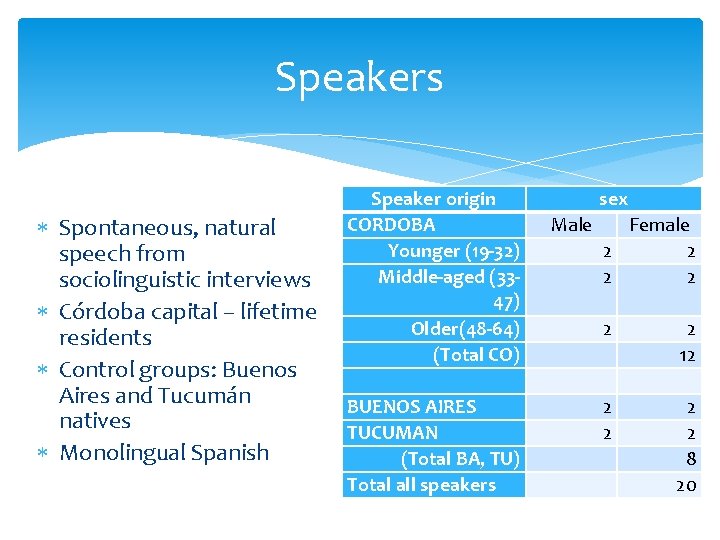
Speakers Spontaneous, natural speech from sociolinguistic interviews Córdoba capital – lifetime residents Control groups: Buenos Aires and Tucumán natives Monolingual Spanish Speaker origin CORDOBA Younger (19 -32) Middle-aged (3347) Older(48 -64) (Total CO) BUENOS AIRES TUCUMAN (Total BA, TU) Total all speakers sex Male Female 2 2 2 12 2 2 8 20
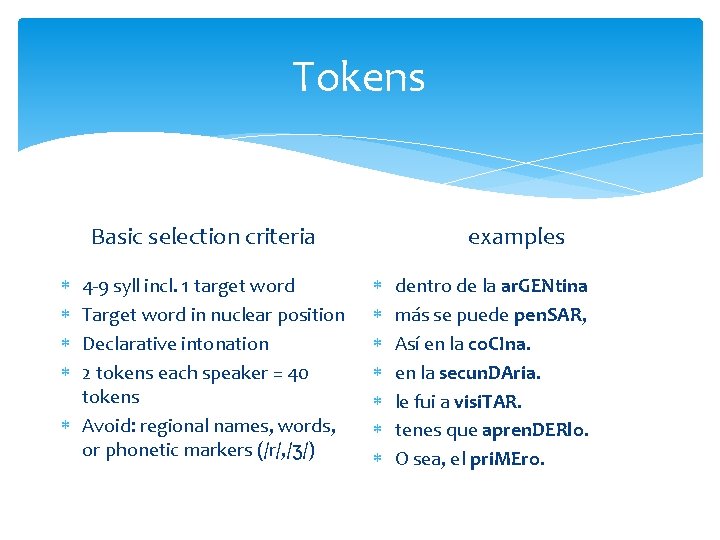
Tokens examples Basic selection criteria 4 -9 syll incl. 1 target word Target word in nuclear position Declarative intonation 2 tokens each speaker = 40 tokens Avoid: regional names, words, or phonetic markers (/r/, /ʒ/) dentro de la ar. GENtina más se puede pen. SAR, Así en la co. CIna. en la secun. DAria. le fui a visi. TAR. tenes que apren. DERlo. O sea, el pri. MEro.
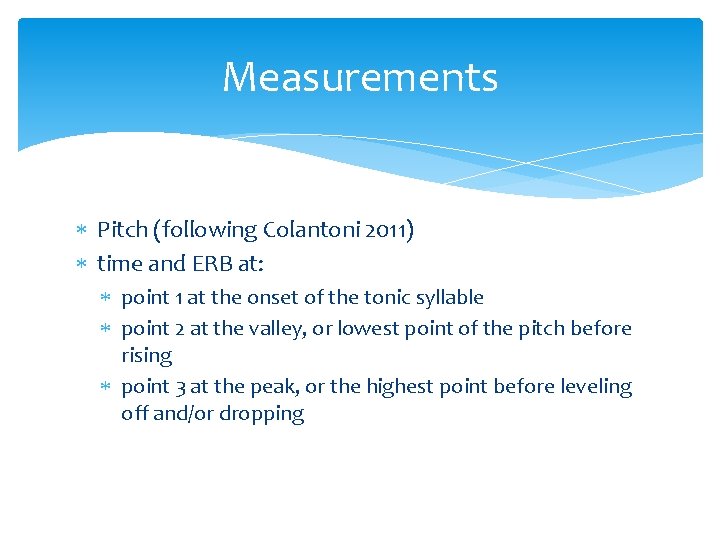
Measurements Pitch (following Colantoni 2011) time and ERB at: point 1 at the onset of the tonic syllable point 2 at the valley, or lowest point of the pitch before rising point 3 at the peak, or the highest point before leveling off and/or dropping
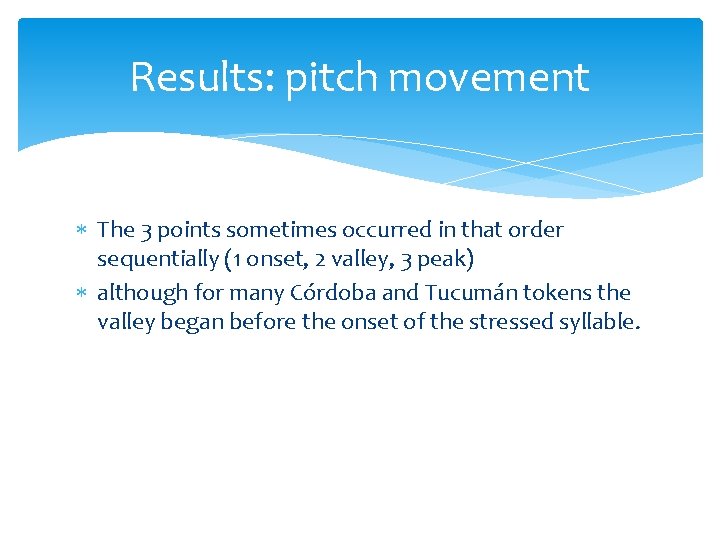
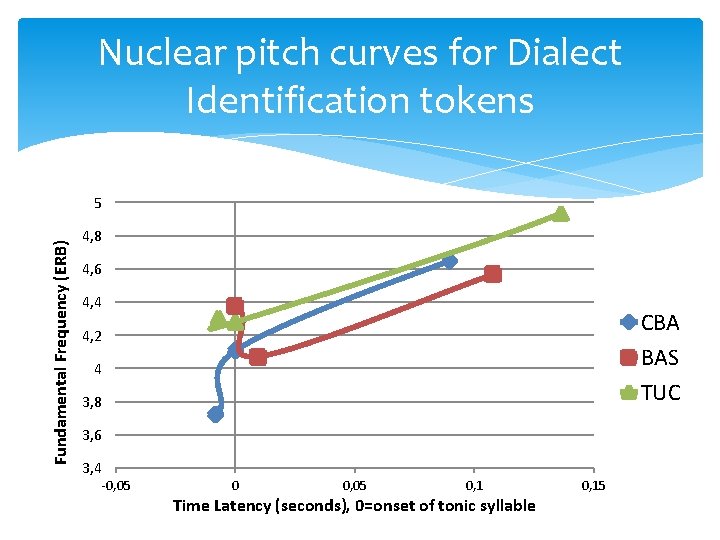
Results: pitch movement The 3 points sometimes occurred in that order sequentially (1 onset, 2 valley, 3 peak) although for many Córdoba and Tucumán tokens the valley began before the onset of the stressed syllable.
Nuclear pitch curves for Dialect Identification tokens Fundamental Frequency (ERB) 5 4, 8 4, 6 4, 4 CBA BAS TUC 4, 2 4 3, 8 3, 6 3, 4 -0, 05 0, 1 Time Latency (seconds), 0=onset of tonic syllable 0, 15
Results Córdoba tokens show the earliest valley and earliest peaks. The slope duration is about the same as that from Buenos Aires tokens, but these tonal events occur earlier. Buenos Aires token slope fits the descriptions made by previous linguists (Kaisse 2001; Colantoni & Gurlekian 2004): valley and peak are close together (likely within the same syllable), the rise is fast and peak alignment is early compared to standard Spanish for declarative neutral utterances (Hualde 2005). Tucumán: results are not surprising. This dialect has been described as having lengthened tonic syllables (Rojas 2000), which would allow time for the peak to be reached within this syllable.
Methodology 2: Positive and negative Córdoba identification
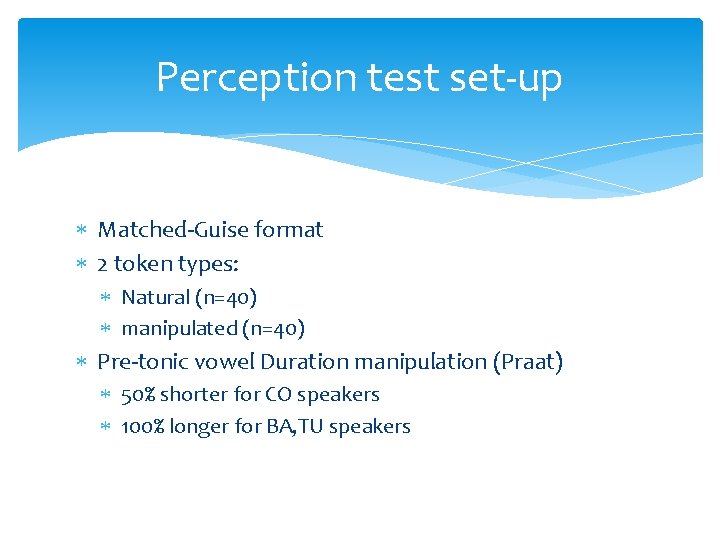
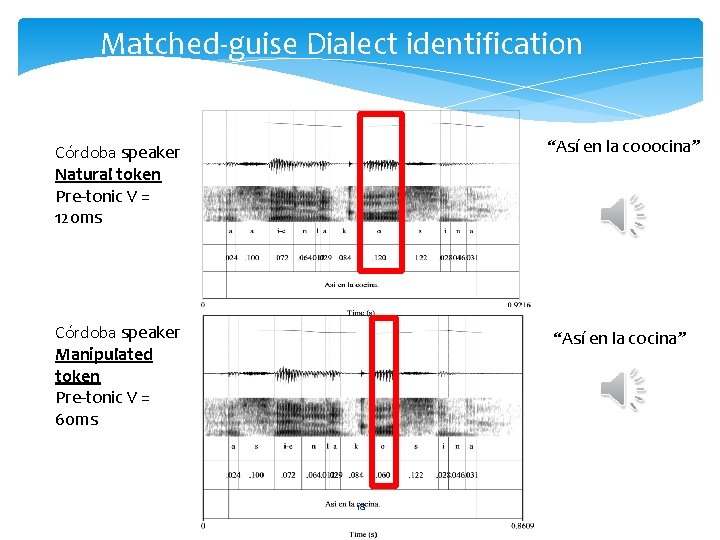
Perception test set-up Matched-Guise format 2 token types: Natural (n=40) manipulated (n=40) Pre-tonic vowel Duration manipulation (Praat) 50% shorter for CO speakers 100% longer for BA, TU speakers
Matched-guise Dialect identification Córdoba speaker Natural token Pre-tonic V = 120 ms “Así en la cooocina” Córdoba speaker Manipulated token Pre-tonic V = 60 ms “Así en la cocina” 18
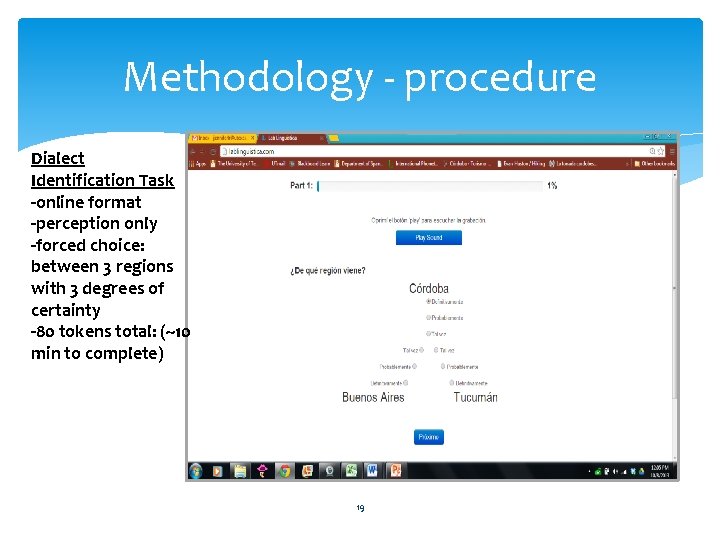
Methodology - procedure Dialect Identification Task -online format -perception only -forced choice: between 3 regions with 3 degrees of certainty -80 tokens total: (~10 min to complete) 19
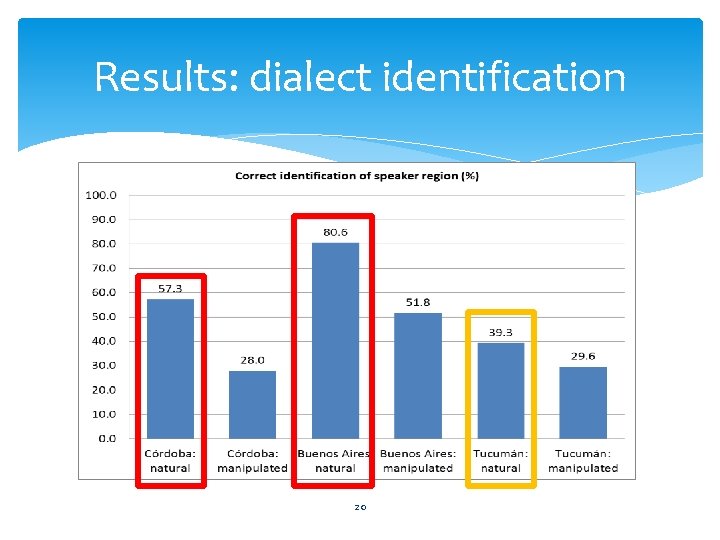
Results: dialect identification 20
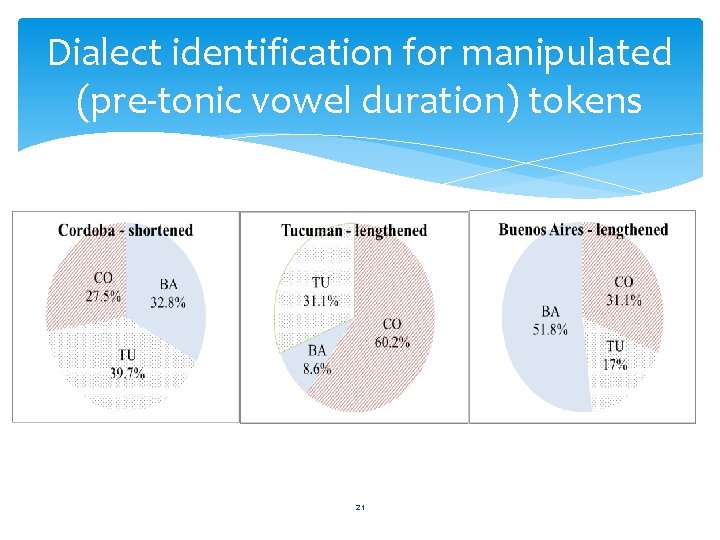
Dialect identification for manipulated (pre-tonic vowel duration) tokens 21
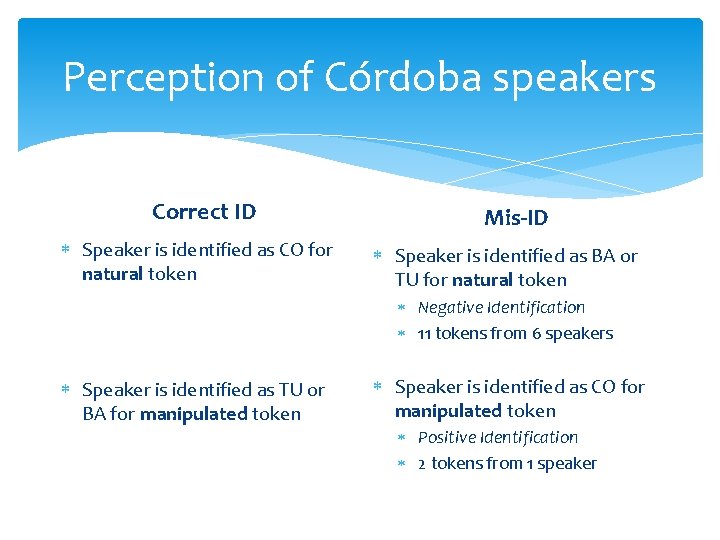
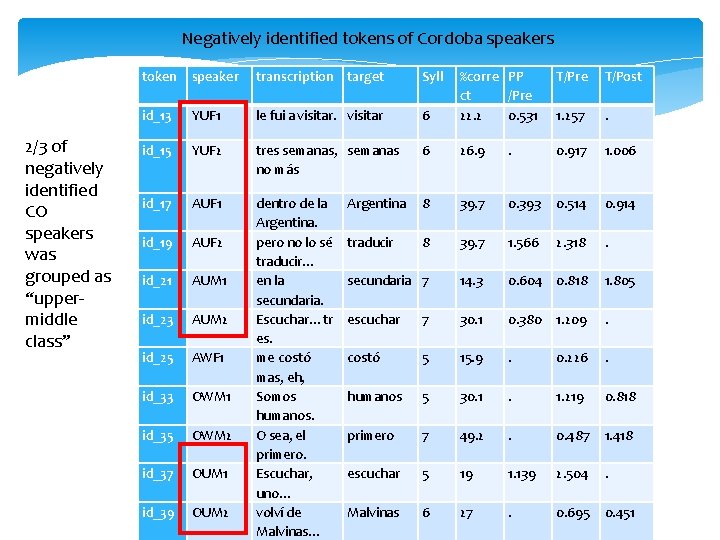
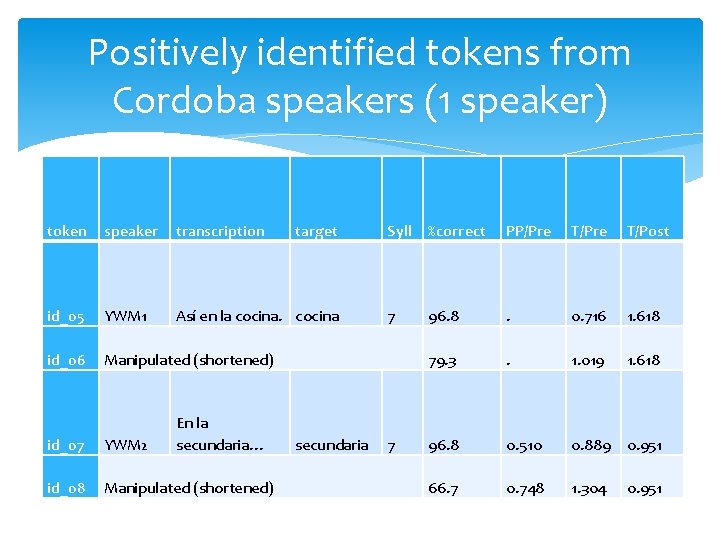
Perception of Córdoba speakers Correct ID Speaker is identified as CO for natural token Mis-ID Speaker is identified as BA or TU for natural token Negative Identification 11 tokens from 6 speakers Speaker is identified as TU or BA for manipulated token Speaker is identified as CO for manipulated token Positive Identification 2 tokens from 1 speaker
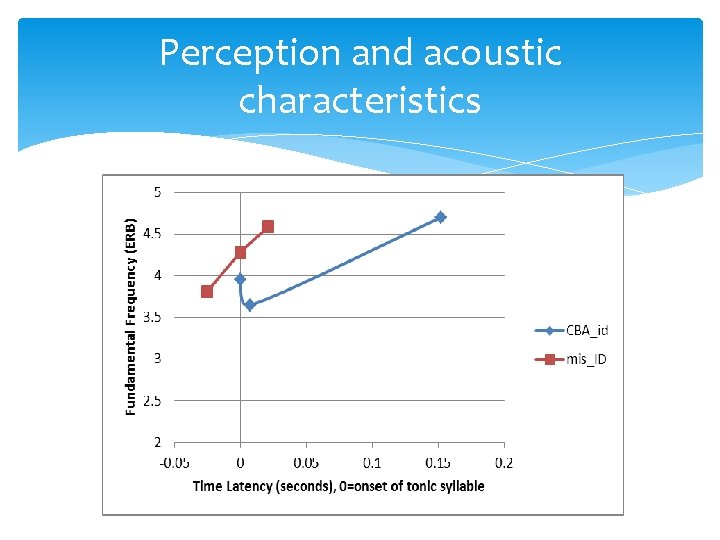
Perception and acoustic characteristics
Results the peak is reached much earlier in the misidentified speakers. the duration of the rise from valley to peak is only 46. 5 ms for these tokens, which is much faster than any other slope measured.
Discussion This unusually fast slope of mis-id Córdoba tokens may account for these tokens being misidentified, as such a contour would likely be difficult to perceive and so provide less acoustic information for the listener to determine the speaker’s dialect. It´s possible the intonational contour is in fact as important a cue for dialect identity as pre-tonic vowel duration has proven to be.
Discussion (Colantoni 2011) found that both Buenos Aires and Córdoba intonation curves showed faster rises to low peaks, which fell more steeply than the other dialects studied (Northeastern and Western Argentine varieties) in nuclear position for declarative utterances. Specifically, the Buenos Aires speakers showed early peak alignment but not early valley alignment, similar to the results reported in the present study. Both the valley and peak occurred within the tonic syllable
Conclusions Peak alignment seems to differentiate these three dialects (in addition to differing ratios of duration for pre-tonic, tonic and post-tonic syllables) No empirical evidence for a “stress-shift” in Córdoba Spanish (Malmberg 1950) No empirical for the lengthening to be accompanied by a tonal ascent or descent (Fontanella de Weinberg 1971) Stress seems to be realized on the tonic syllable for the tonada cordobesa, as indicated by pitch increase
Future directions More tokens, more controlled (but at least semispontaneous) for further tonal analysis Other suprasegmental analyses: syllable timing and rhythm Matched-guise with duration + pitch manipulation = which is more important in perceiving this dialect? And in perceiving stress?
Acknowledgments Ludovic Rigal – web development: lablinguistica. com Laura Colantoni Almeida Jacqueline Toribio Los participantes cordooobeses, tucumaaanos y porteñooos
Works cited Colantoni, L. (2011) Broad-focus declaratives in Argentine Spanish contact and non-contact varieties. In: Gabriel, Christoph and Conxita Lleó (eds. ), Intonational Phrasing in Romance and Germanic: Cross-linguistic and bilingual studies. viii, 237 pp. (pp. 183– 212) Colantoni, L. , & Gurlekian, J. (2004, August). Convergence and Intonation: Historical Evidence from Buenos Aires Spanish. Bilingualism: Language and Cognition, 7(2), 107 -119. Fontanella de Weinberg, M. B. (1971). La entonación del español de Córdoba (Argentina) Thesaurus: Boletín del Instituto Caro y Cuervo. 26(1), 11 -21 Hualde, J. I. (2005). The Sounds of Spanish. Cambridge University Press: Cambridge, UK; New York. Kaisse, E. (2001). The Long Fall: An Intonational Melody of Argentinian Spanish. In Features and Interfaces in Romance, J. Herschensohn, Mallen, E. & Zagona, K. , (147 -160) Amsterdam: John Benjamins. Lang, J. (2010, November). Prosody in Córdoba, Argentina: a sociolinguistic analysis of the tonada cordobesa. Paper presented at the annual meeting of New Ways of Analyzing Variation, San Antonio, TX. Lang-Rigal, J. (2012). Pre-tonic vowel lengthening in the Spanish of Córdoba, Argentina. Unpublished Manuscript. Rojas, E. M. 2000. El español en el noroeste. In Español de la Argentina y sus variedades regionales. (eds. ) M. B. Fontanella de Weinberg ; Donni de Mirande, N. E. ; Abadía de Quant, I. ; Rojas, E. M. ; Viramonte de Ávalos, M. ; Cubo de Severino, L. El español de la Argentina y sus variedades regionales. Edicial: Buenos Aires, Argentina. Yorio, C. Al. “Phonological style in the dialect of Spanish of Córdoba, Argentina. ” Dissertation: University of Michigan (1973).
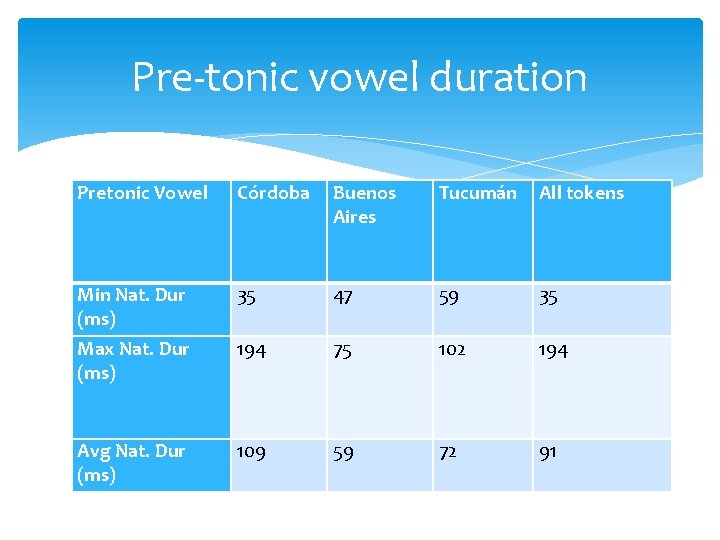
Pre-tonic vowel duration Pretonic Vowel Córdoba Buenos Aires Tucumán All tokens Min Nat. Dur (ms) Max Nat. Dur (ms) 35 47 59 35 194 75 102 194 Avg Nat. Dur (ms) 109 59 72 91
Negatively identified tokens of Cordoba speakers 2/3 of negatively identified CO speakers was grouped as “uppermiddle class” token speaker transcription target Syll T/Pre T/Post 6 %corre PP ct /Pre 22. 2 0. 531 id_13 YUF 1 le fui a visitar 1. 257 . id_15 YUF 2 tres semanas, semanas no más 6 26. 9 . 0. 917 1. 006 id_17 AUF 1 dentro de la Argentina. pero no lo sé traducir… en la secundaria. Escuchar…tr es. me costó mas, eh, Somos humanos. O sea, el primero. Escuchar, uno… volví de Malvinas… Argentina 8 39. 7 0. 393 0. 514 0. 914 id_19 AUF 2 traducir 8 39. 7 1. 566 2. 318 . id_21 AUM 1 secundaria 7 14. 3 0. 604 0. 818 1. 805 id_23 AUM 2 escuchar 7 30. 1 0. 380 1. 209 . id_25 AWF 1 costó 5 15. 9 . 0. 226 . id_33 OWM 1 humanos 5 30. 1 . 1. 219 0. 818 id_35 OWM 2 primero 7 49. 2 . 0. 487 1. 418 id_37 OUM 1 escuchar 5 19 1. 139 2. 504 . id_39 OUM 2 Malvinas 6 27 . 0. 695 0. 451
Positively identified tokens from Cordoba speakers (1 speaker) token speaker transcription id_05 YWM 1 Así en la cocina id_06 Manipulated (shortened) En la secundaria… id_07 YWM 2 id_08 Manipulated (shortened) target secundaria Syll %correct PP/Pre T/Post 7 96. 8 . 0. 716 1. 618 79. 3 . 1. 019 1. 618 96. 8 0. 510 0. 889 0. 951 66. 7 0. 748 1. 304 0. 951 7