
Using Prediction to Accelerate Coherence Protocols Shubu Mukherjee
Using Prediction to Accelerate Coherence Protocols Shubu Mukherjee, Ph. D. Principal Hardware Engineer VSSAD Labs, Alpha Development Group Compaq Computer Corporation Shrewsbury, Massachusetts Joint work Mark D. Hill at the University of Wisconsin-Madison Published in the Proceedings of the 25 th Annual International Symposium on Computer Architecture (ISCA), 1998.
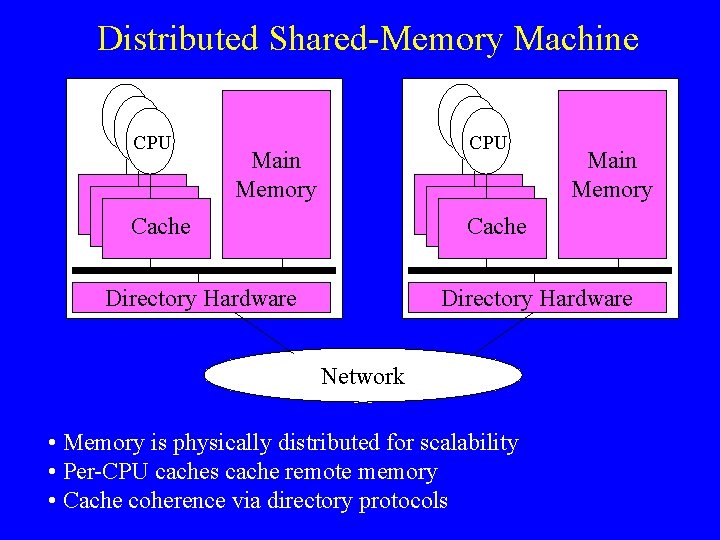
Distributed Shared-Memory Machine CPU Main Memory Cache Directory Hardware Network • Memory is physically distributed for scalability • Per-CPU caches cache remote memory • Cache coherence via directory protocols
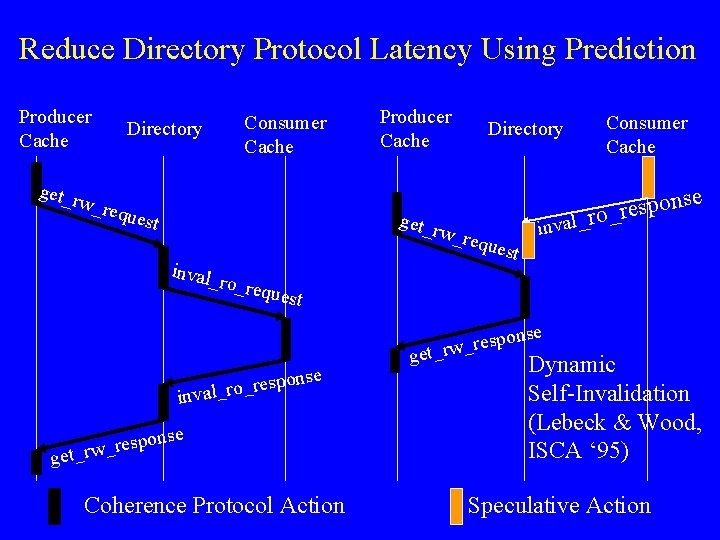
Reduce Directory Protocol Latency Using Prediction Producer Cache get_r w_re Consumer Cache Directory ques Producer Cache get_r t Directory w_re inval_ ques Consumer Cache on p s e r _ o al_r se inv t ro_req uest se pon s e r _ w t_r onse p s e r _ o r val_ in nse spo e r _ w r get_ Coherence Protocol Action ge Dynamic Self-Invalidation (Lebeck & Wood, ISCA ‘ 95) Speculative Action
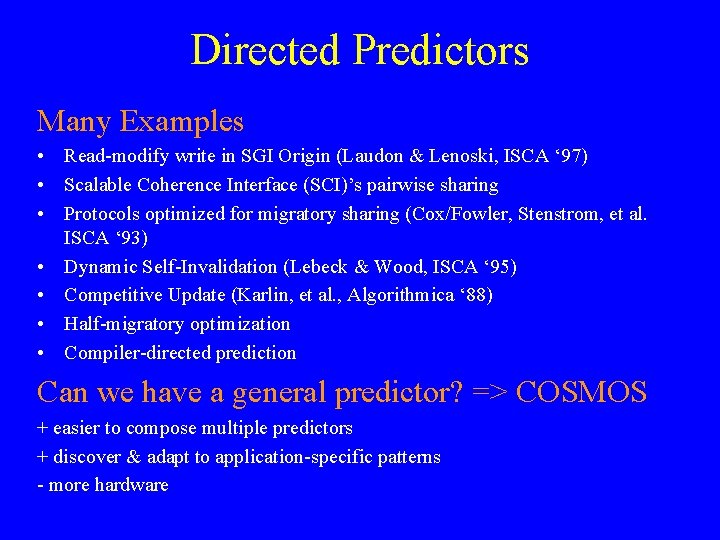
Directed Predictors Many Examples • Read-modify write in SGI Origin (Laudon & Lenoski, ISCA ‘ 97) • Scalable Coherence Interface (SCI)’s pairwise sharing • Protocols optimized for migratory sharing (Cox/Fowler, Stenstrom, et al. ISCA ‘ 93) • Dynamic Self-Invalidation (Lebeck & Wood, ISCA ‘ 95) • Competitive Update (Karlin, et al. , Algorithmica ‘ 88) • Half-migratory optimization • Compiler-directed prediction Can we have a general predictor? => COSMOS + easier to compose multiple predictors + discover & adapt to application-specific patterns - more hardware
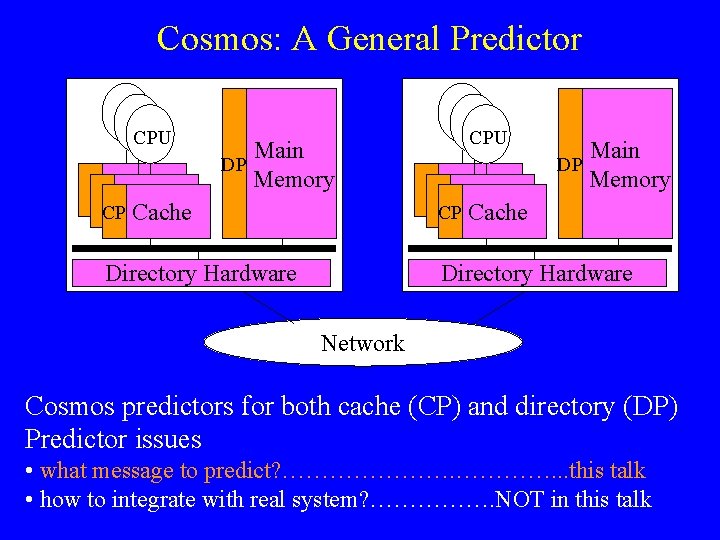
Cosmos: A General Predictor CPU DP Main Memory CP Cache Directory Hardware Network Cosmos predictors for both cache (CP) and directory (DP) Predictor issues • what message to predict? …………………. . . this talk • how to integrate with real system? ……………. NOT in this talk
Cosmos Overview Given • cache block address • history of incoming coherence messages for cache block (i. e. , source processor and message type tuples) Cosmos Predicts • next incoming coherence message for the cache block Cosmos’ Structure • two-level adaptive predictor • resembles Yeh & Patth’s PAp branch predictor (ISCA ‘ 92) Cosmos’ Prediction Accuracy • 62 - 93% for five parallel scientific applications
Outline • Motivation & Overview • Cosmos’ Structure • Cosmos Results
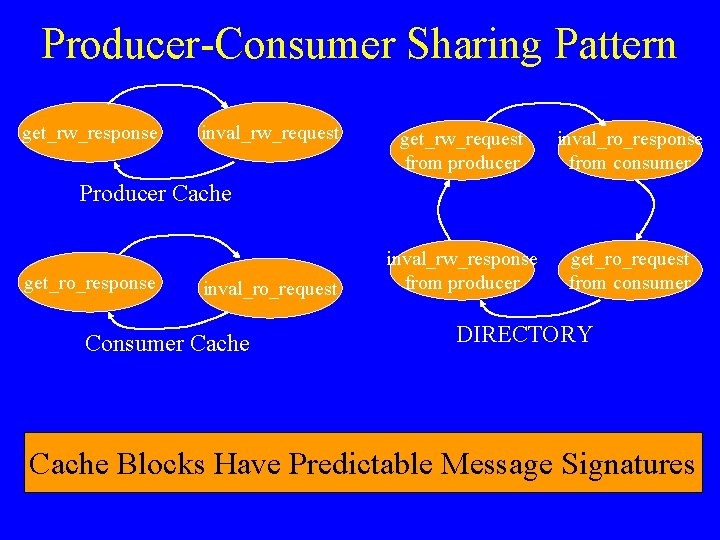
Producer-Consumer Sharing Pattern get_rw_response inval_rw_request get_rw_request from producer inval_ro_response from consumer inval_rw_response from producer get_ro_request from consumer Producer Cache get_ro_response inval_ro_request Consumer Cache DIRECTORY Cache Blocks Have Predictable Message Signatures
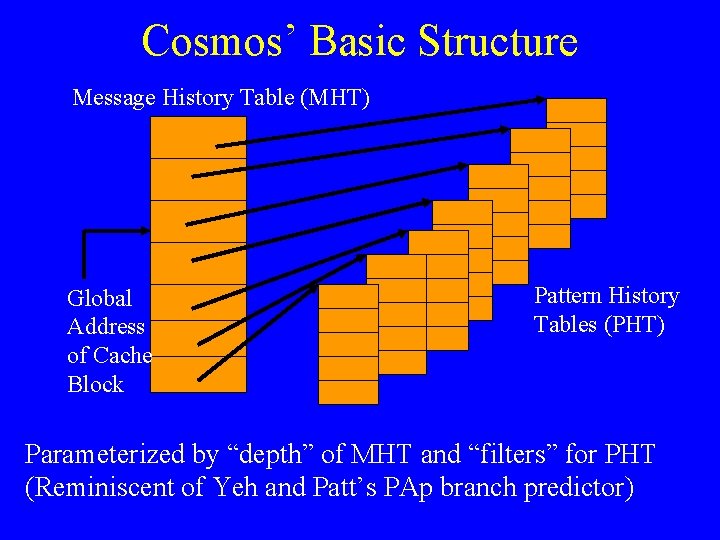
Cosmos’ Basic Structure Message History Table (MHT) Global Address of Cache Block Pattern History Tables (PHT) Parameterized by “depth” of MHT and “filters” for PHT (Reminiscent of Yeh and Patt’s PAp branch predictor)
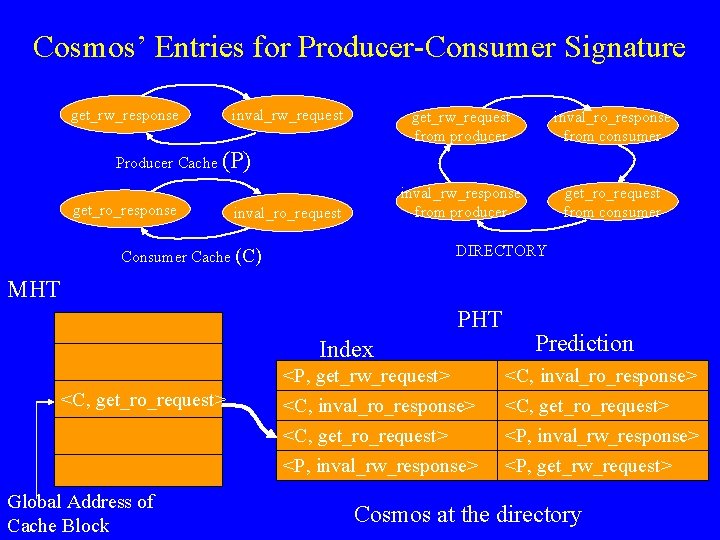
Cosmos’ Entries for Producer-Consumer Signature get_rw_response inval_rw_request get_rw_request from producer inval_ro_response from consumer inval_rw_response from producer get_ro_request from consumer Producer Cache (P) get_ro_response inval_ro_request DIRECTORY Consumer Cache (C) MHT PHT Index <C, get_ro_request> Global Address of Cache Block Prediction <P, get_rw_request> <C, inval_ro_response> <C, get_ro_request> <P, inval_rw_response> <P, get_rw_request> Cosmos at the directory
Outline • Motivation & Overview • Cosmos’ Structure • Cosmos Results
Evaluation Methodology Traces of coherence messages Simulator • Wisconsin Wind Tunnel II (Mukhejee, et al. PAID, ‘ 97) Simulated coherence protocol = Wisconsin Stache • Full-map • Simple COMA (main memory used as software cache) • Reinhardt, et al. ISCA ‘ 94 Simulated benchmarks • appbt……………………………………NAS • barnes………………………………. . . SPLASH II • dsmc, moldyn, unstructured…………. Universities of Maryland & Wisconsin
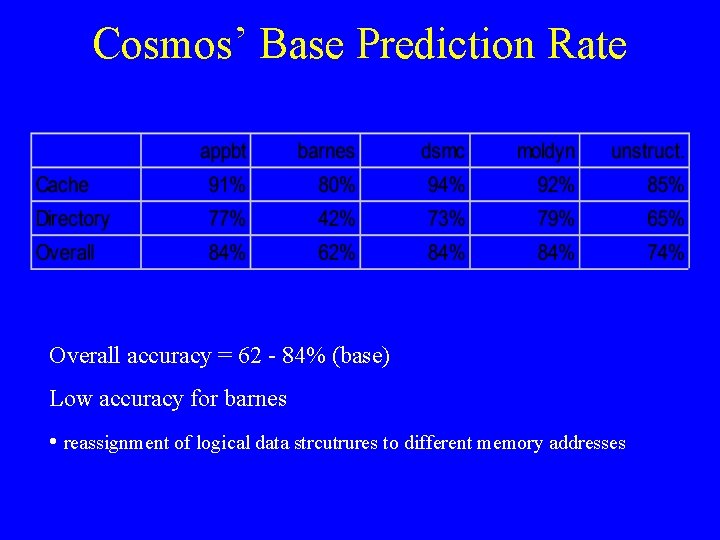
Cosmos’ Base Prediction Rate Overall accuracy = 62 - 84% (base) Low accuracy for barnes • reassignment of logical data strcutrures to different memory addresses
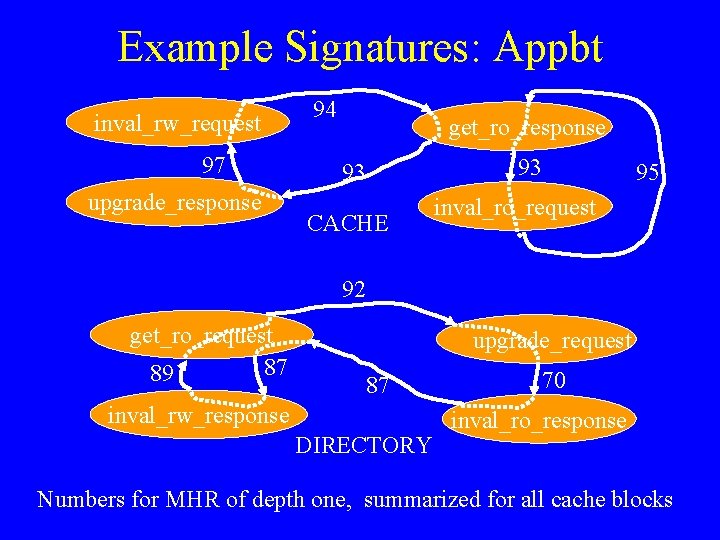
Example Signatures: Appbt inval_rw_request 97 upgrade_response 94 get_ro_response 93 CACHE 93 95 inval_ro_request 92 get_ro_request 87 89 upgrade_request 87 inval_rw_response DIRECTORY 70 inval_ro_response Numbers for MHR of depth one, summarized for all cache blocks
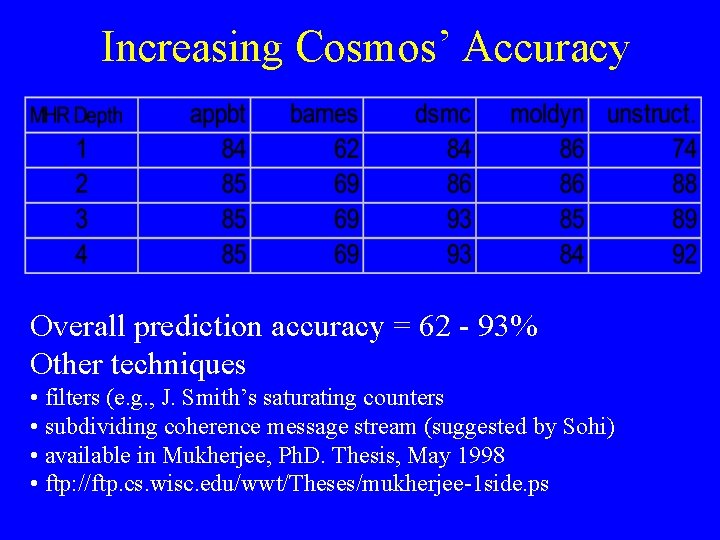
Increasing Cosmos’ Accuracy Overall prediction accuracy = 62 - 93% Other techniques • filters (e. g. , J. Smith’s saturating counters • subdividing coherence message stream (suggested by Sohi) • available in Mukherjee, Ph. D. Thesis, May 1998 • ftp: //ftp. cs. wisc. edu/wwt/Theses/mukherjee-1 side. ps
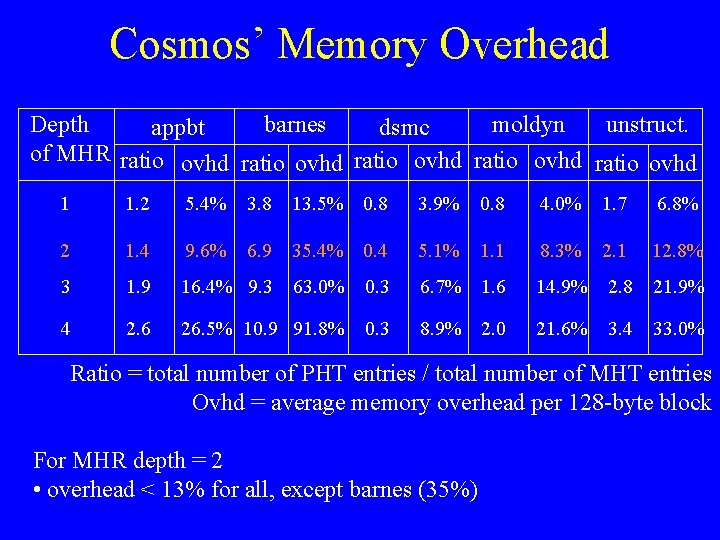
Cosmos’ Memory Overhead Depth barnes moldyn unstruct. appbt dsmc of MHR ratio ovhd ratio ovhd 1 1. 2 5. 4% 3. 8 13. 5% 0. 8 3. 9% 0. 8 4. 0% 1. 7 6. 8% 2 1. 4 9. 6% 6. 9 35. 4% 0. 4 5. 1% 1. 1 8. 3% 2. 1 12. 8% 3 1. 9 16. 4% 9. 3 63. 0% 0. 3 6. 7% 1. 6 14. 9% 2. 8 21. 9% 4 2. 6 26. 5% 10. 9 91. 8% 0. 3 8. 9% 2. 0 21. 6% 3. 4 33. 0% Ratio = total number of PHT entries / total number of MHT entries Ovhd = average memory overhead per 128 -byte block For MHR depth = 2 • overhead < 13% for all, except barnes (35%)
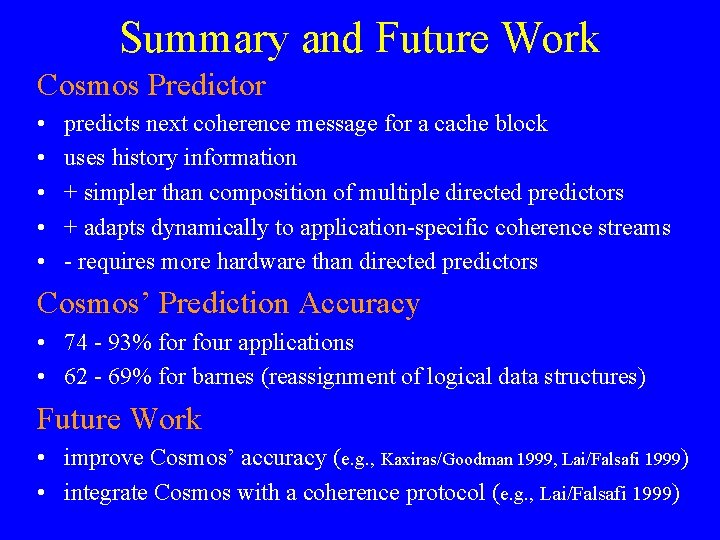
Summary and Future Work Cosmos Predictor • • • predicts next coherence message for a cache block uses history information + simpler than composition of multiple directed predictors + adapts dynamically to application-specific coherence streams - requires more hardware than directed predictors Cosmos’ Prediction Accuracy • 74 - 93% for four applications • 62 - 69% for barnes (reassignment of logical data structures) Future Work • improve Cosmos’ accuracy (e. g. , Kaxiras/Goodman 1999, Lai/Falsafi 1999) • integrate Cosmos with a coherence protocol (e. g. , Lai/Falsafi 1999)
- Slides: 17