
Using Positive Psychology to Build Resilient Children and
Using Positive Psychology to Build Resilient Children and Young People Dr Ruth M Mac. Conville SEBDA Conference 17. 03. 2016 V 2
Aims of Session: The aims of the session are to: • introduce resilience theory and the key concepts of positive psychology (PP) • explore the characteristics of a resilient mindset • consider how PP interventions can promote resilience • provide an opportunity for questions and discussion

What is Resilience? • The capacity to maintain or restore our equilibrium in the face of stress, disappointments, setbacks and challenge • Resilient individuals have staying power when the going gets tough. They do not react mechanistically like a stretched coiled spring returning to the rest position. Staying power involves action, not reaction. • Resilient individuals retain some sense of being in charge, with an adequate sense of autonomy. • They do not feel dependent on others to make things improve.
Four Waves of Resilience Science • Wave 1: scientists began to describe the phenomenon of good outcomes in the context of risk & adversity and attempted to identify the predictors of resilience. • What is resilience? • How do we measure it? • What makes a difference?
Wave 2 • Investigators shifted their attention to the processes of resilience and to how questions. • What processes lead to resilience? • How do protective /preventative influences work? • How is positive development promoted in the context of risk?
Wave 3 • Focused on promoting resilience through interventions • Testing theories from the first 2 waves about what factors promote resilience and • How can resilience be promoted?
Wave 4 • Advances in technology and knowledge in genetics, statistics, neuroscience and neuroimaging gave rise to questions such as: • How do genetics differences play a role in resilience? • Do individuals have differential sensitivity to traumatic experiences? • Are the same individuals also sensitive to positive interventions? • How is brain development protected from high levels of stress and stress hormones? • How do communities nurture resilience?
Ordinary Magic • The biggest surprise that emerges from the study of children who overcome adversity to become successful was the ordinariness of the phenomenon. • Captivating stories of resilient individuals have created perceptions that resilience is rare and results from extraordinary talents and /or resources. • Evidence strongly suggests that resilience is common and typically arises from the operation of basic protections. Most of the time children who make it have ordinary human resources and protective factors in their lives. Masten, 2014
Resilience and Stages of Development Resilience is closely linked to a child’s overall psychological, social, emotional development. Many of the skills that are critical to the development of resilience are acquired before the age of 11. The resilient child is one who can say: • I am • I can • I have • I like Grotberg, 1997
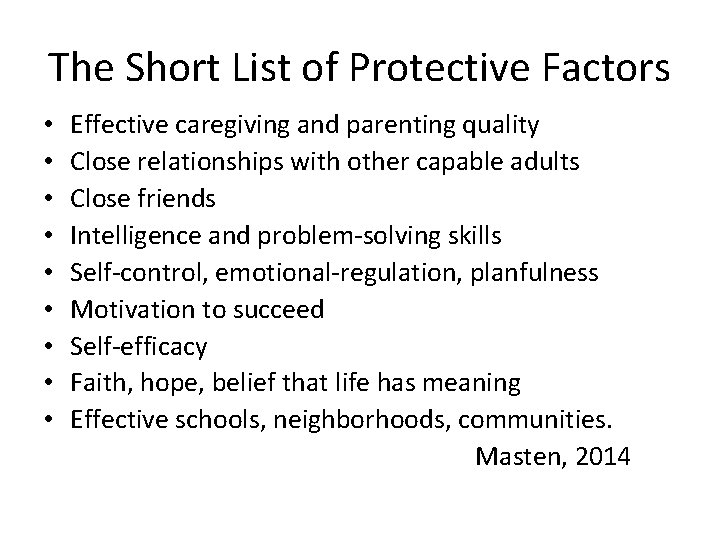
The Short List of Protective Factors • • • Effective caregiving and parenting quality Close relationships with other capable adults Close friends Intelligence and problem-solving skills Self-control, emotional-regulation, planfulness Motivation to succeed Self-efficacy Faith, hope, belief that life has meaning Effective schools, neighborhoods, communities. Masten, 2014

Generic Risk Factors • Exposure to social & economic disadvantage • Exposure to a dysfunctional child rearing environment • Exposure to parental mental health or adjustment problems • Organic /genetic factors • Peer factors • Traumatic life events
Adversity features in the life of every child • For some children adversity is predominant and pervasive feature of their day- to -day life. • Whatever the source of adversity, the ability to cope with it is critical to a child’s development and to them experiencing a productive, successful and satisfying life. Pearce, 2011
`Everyday’ Risk Factors • The increasing commercialism of childhood due to the marketing power of companies • The `hypersexualisation’ of children • Pester Power • Excessive screen time • The flight from conversation: the failing connections of the digital world
Y You Tube: Cadbury’s Crème Egg Ad. • 1985 ad, 1992 version
Risk & Protective Factors are Accumulative • The risk of poor outcomes rises as the number of risk factors increases. The specific type of risk factor (s) is less important than the no of risk factors present. • Protective factors also have a cumulative effect. The likelihood of positive and negative life outcomes depends on the balance of risk and protective factors in a child’s life.
The Characteristics of a Resilient Mindset: Resilient Children: • Feel loved and accepted • Have learnt to set realistic goals • Are able to define the aspects of their life over which they have control and to focus their energy and attention on those, rather than on factors over which they have little influence • Believe that they have the ability to solve problems and make informed decisions • Take realistic credit for their successes and achievements, but acknowledge the input and support of adults for these successes.
The Characteristics of a Resilient Mindset, Cont. • View mistakes , setbacks and obstacles as challenges to confront and master, rather than as stressors to avoid. • Recognize and accept their vulnerabilities and weaknesses, seeing these as areas for improvement, rather than as unchangeable flaws • Recognize and enjoy their `Islands of Competence’ • Feel comfortable with and relate well to peers and adults • Believe that they can make a positive difference in the lives of others. Brooks & Goldstein, 2001
The Importance of Serving as a `Charismatic’ Adult • Resilience is firmly rooted in the relationships that children experience with caring adults. • Effective practitioners and parent view each interaction with a child as an opportunity to reinforce one or more of the characteristics that create a resilient mindset.
Guideposts for Nurturing A Resilient Mindset Encourage the belief that adults are supportive and that: • we have more control over our reactions to events than we may realize • problems can be solved instead of becoming more overwhelming • we all have Islands of Competence (i. e. strengths) even when we struggle with problems • we make a positive difference in the world • mistakes are expectable and also acceptable.
Key Principles Underpinning the Functioning of a Resilient School • Caring relationships • High expectations and academic standards • Opportunities for participation and control The role of the teacher: • Challenging negative assumptions about the potential of students or groups of students • Recognising opportunities to foster resilience • Learning how to identify vulnerable students • Eliminating negative types of communication
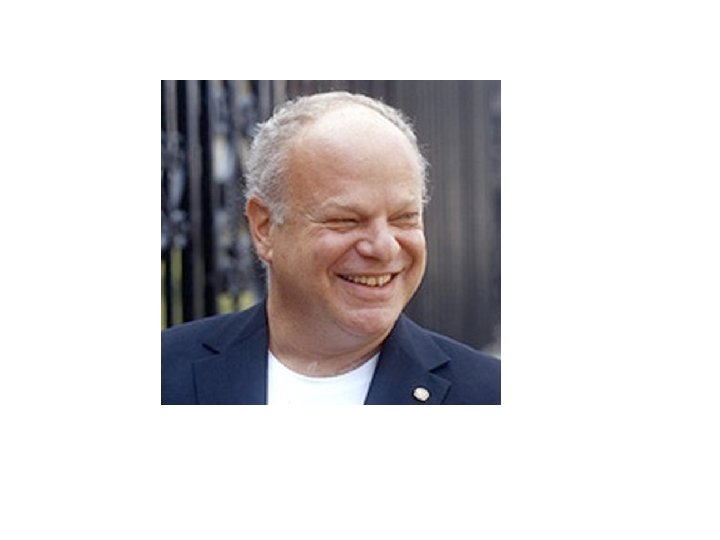
Modern psychology has been co-opted by the disease model. We’ve become too preoccupied with repairing damage when our focus should be on building strengths and resilience. Psychology is not just the study of weakness and damage but it is also the study of strength and virtue. Treatment is not just fixing what is broken, it is nurturing what is best within ourselves. The Optimistic Child, M. E. P. Seligman 1995
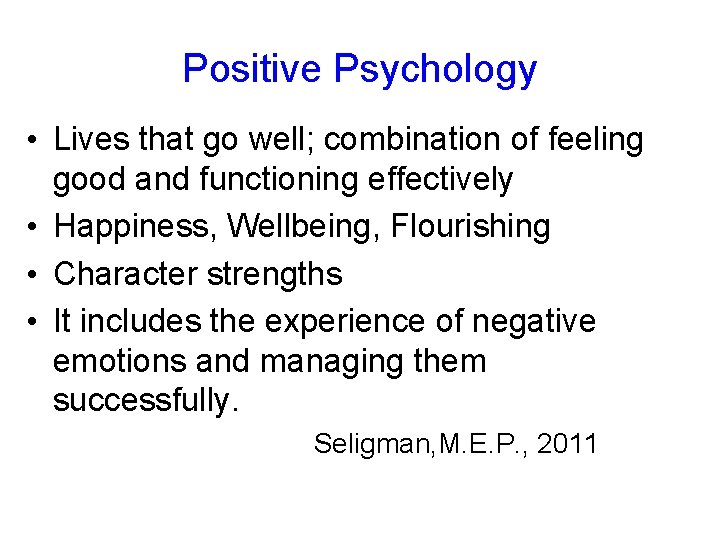
Positive Psychology • Lives that go well; combination of feeling good and functioning effectively • Happiness, Wellbeing, Flourishing • Character strengths • It includes the experience of negative emotions and managing them successfully. Seligman, M. E. P. , 2011
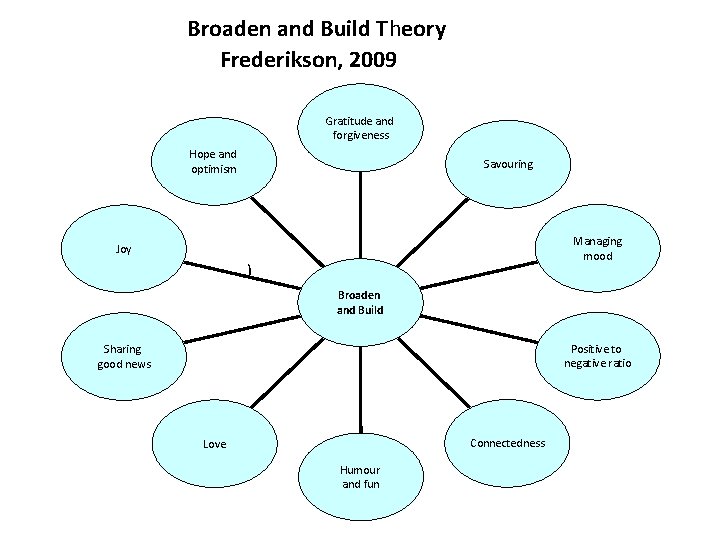
Broaden and Build Theory Frederikson, 2009 Gratitude and forgiveness Hope and optimism Savouring Managing mood Joy ) Broaden and Build Positive to negative ratio Sharing good news Connectedness Love Humour and fun
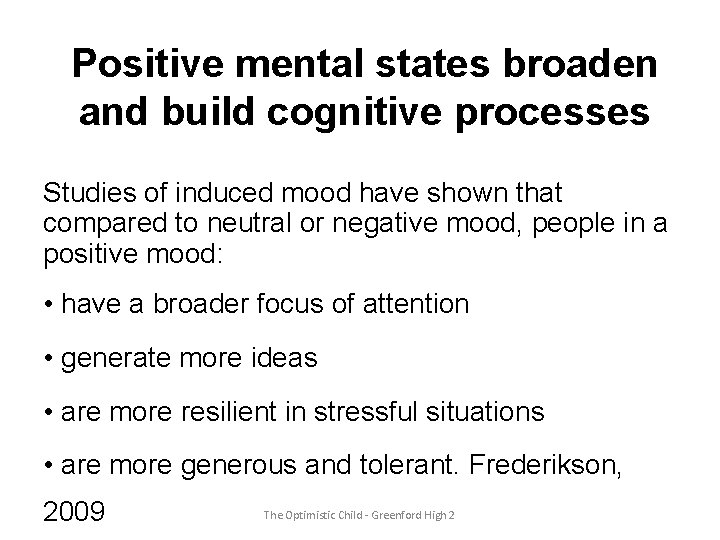
Positive mental states broaden and build cognitive processes Studies of induced mood have shown that compared to neutral or negative mood, people in a positive mood: • have a broader focus of attention • generate more ideas • are more resilient in stressful situations • are more generous and tolerant. Frederikson, 2009 The Optimistic Child - Greenford High 2
William James, 1842 - 1910 • I don’t sing because I’m happy • I’m happy because I sing
Diagnostic and Statistical Manual of Mental Disorders V Classification of Character Strengths and Virtues
Character / Signature Strengths • A set of traits that are changeable and malleable. • They can be taught, practised and learnt. • According to Seligman& Petersen (2004) , the value of the 24 character/signature strengths does not come from, their relationship to any particular system of ethics but from their practical benefits – what an individual actually gains by possessing and expressing them. Cultivating these strengths represents a reliable path to the `good life’, i. e. a life that is not simply happy but is also meaningful and fulfilling. (Mac. Conville & Rae, 2012)
Discover Your Strengths@ www. authentichappiness. com
Strengths = ability + motivation + effort + social support • They are part of our personal identity • The dynamic energy that we all have that needs to be channelled and nurtured so that we all find what works for us. • Strengths are more than natural ability which may lie dormant as a potential without being used. • Strengths are something we choose to use and we gain energy and satisfaction from doing so
A Strengths-based approach: • focuses on the development of capabilities and competencies within children and adults, to help them solve problems and live their lives in a more effective manner • does not minimise the pain a person may experience; it acknowledges the importance of fully understanding it, so as to help create effective interventions. A goal of this approach is honouring strengths without trivialising suffering. Crenshaw et al, 2010
Character/ Signature Strengths • Character can function as a substitute for the social safety net and ease that individuals from supportive backgrounds have that protects them from the consequences of social detours, mistakes and bad decisions. • If you don’t have the safety net that comes from a supportive background you need to compensate in a different way. • Character advantages can help you to succeed. Tough, 2012
The inability to own one’s strengths: • is partly responsible for our negative responses to criticism • If you can’t say what good about yourself its much harder to cope with your failures • challenges are best faced with positive self talk. Make a mistake and you can tell yourself: ` I’ll have another go. I’m smart, hardworking and determined, I can do this’. • with no balance of positive or negative in your head, the negative drowns out the positive and its much harder to pull yourself out of the mud. Simmons, 2009
We should focus on a student’s inner strengths and on the support factors they can obtain from their environment, rather than concentrating on protection and vulnerability. Carol Craig (2007) Centre for Confidence and Well-being
Cognitive Behaviour Therapy
Learnt Optimism • Learn to monitor your automatic thoughts and attitudes and dispute pessimistic explanations. • Be aware of the negative thoughts that may flit through your mind when you are feeling low. • Evaluate these thoughts and recognise that they may not be true. • Generate more accurate explanations. • Stop yourself from planning the worst. Seligman, M. E. P, 1991, Learned Optimism, 1991
Learning Your ABC’s Activating Event, Belief, Consequence • Activating event: the objective (not subjective ) facts of the situation Who, What, Where, When • Belief: your immediate belief about the situation Why it happened and what will happen next? • Consequence: Your feelings and behaviour related to these beliefs. Seligman, M. E. P. 1995
Our Thoughts Become Beliefs • When we encounter an Activating event, we react by thinking about the situation. • Our thoughts become our beliefs. • Beliefs can become habitual and unconscious; we don’t even think about them. • Beliefs have Consequences; they are the direct causes of what we feel and what we do next. Seligman, M. E. P. 1995
Beliefs cause Consequences Feelings of worthlessness or no confidence suggest that an individual believes his/her commerce with the world is going badly. When we can identify our beliefs and recognise their effects on our behaviour we can challenge them and begin to build more optimistic, and productive thought patterns. Once an individual becomes active and hopeful feelings of worth improve. Seligman, M. E. P. , 1995
Learn to Interrupt this Vicious Cycle • Learn to see the connection between the ABCs • Consider how the ABCs operate in your everyday life? • Our beliefs spell the difference between dejection and giving up or a sense of well -being and constructive action.
Our brains are wired to connect • When we are socially connected we are more resilient, happier, healthier and better citizens. • Ignoring social connections harms our individual, family, community, organizational and national well-being. • Increasing our social connections is probably the most single, powerful way to enhance our resilience. • Social support and connection can buffer us against the stress of the difficult times in our lives. • Having a poor social network is literally as bad for our health as smoking two packs of cigarettes each day. Lieberman, 2013
The importance of Social Connectedness • Resilient individuals are those who are satisfied with their social connections. • Those with friends cope better with stresses, bereavement, job loss, illness. • Individuals report greater well-being if their friends support their goals by expressing interest and offering help and encouragement. • Students who choose a high income, academic success and status above having friends are at least twice as likely to describe themselves as unhappy. Seligman, 2011
Low Social Recognition: • Being low on social recognition brings stress and imposes high psychic costs. • Inequality and feelings of social exclusion cause social pain which, in turn, lead to fewer social connections, anxiety, depression, obesity. Tough, 2012
Small Gestures: Lifelong Memories • • Power of Salutation Social Contagion Linguistic Synchrony Active Constructive Responding 3: 1 positive to negative ratio Partner Affirmation: Michelangelo Effect Ultradian rhythms Peak End Rule r. macconville@btinternet. com
Positive Psychology Interventions • • Active Gratitude Random Acts of Kindness Identify Top Strengths Use Strengths in New Ways Active Constructive Responding Practice Mindfulness, Savouring Build Happy Memories Story Editing
Spontaneous Trait Transference Social Contagion
Flow: A state of optimal experience and involvement in an activity during which we are performing at our best. During flow we are: • completely involved in what we are doing • our skill level matches the challenges of the task • we are compelled to persist at what we are doing until we get it right and we lose track of time. Flow provides an important pathway to happiness. Csikszentmihalyi, 1990
Flow • The flow experience requires Ø Ø Concentration Goals Feedback Matching of challenges with skills Mihalyi Csikszentmihalyi 1990 The Optimistic Child - Greenford High 2
Ted Talk The Power of Believing that you can Improve Carol Dweck
Fixed and Growth Mindsets Carol Dweck’s (2006) studies into `mindsets’ suggests that if we believe that our intelligence is fixed and that our attainment has a `ceiling’- then it takes a Herculean effort to exceed that expectation. The opposite is true, if we believe that our intelligence can grow that it is not fixed but `plastic’; if we praise ourselves and others for effort and persistence rather than for praising for results we will flourish. It is vital that as practitioners we are optimistic about our students or else we are in danger of creating a self-fulfilling prophecy.
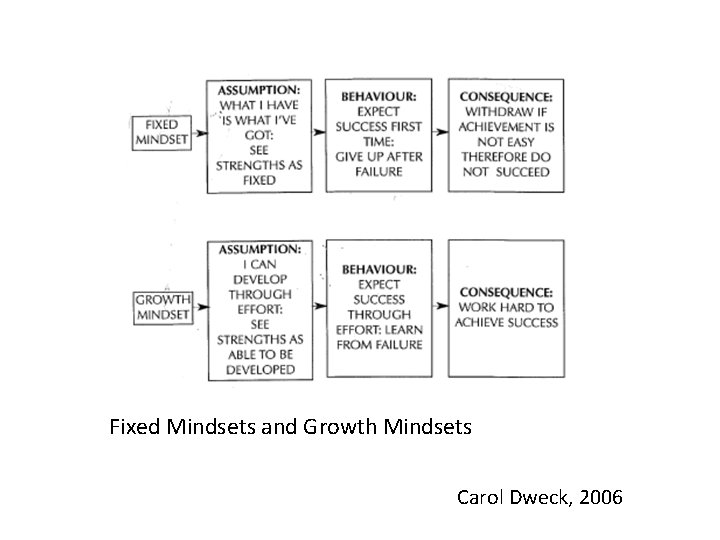
Fixed Mindsets and Growth Mindsets Carol Dweck, 2006
You Tube: • How your brains looks when you think new thoughts – SEDONAHealth
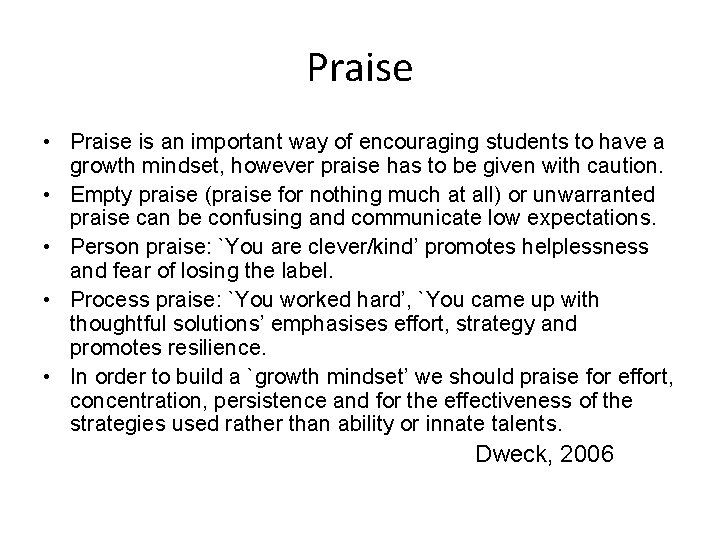
Praise • Praise is an important way of encouraging students to have a growth mindset, however praise has to be given with caution. • Empty praise (praise for nothing much at all) or unwarranted praise can be confusing and communicate low expectations. • Person praise: `You are clever/kind’ promotes helplessness and fear of losing the label. • Process praise: `You worked hard’, `You came up with thoughtful solutions’ emphasises effort, strategy and promotes resilience. • In order to build a `growth mindset’ we should praise for effort, concentration, persistence and for the effectiveness of the strategies used rather than ability or innate talents. Dweck, 2006
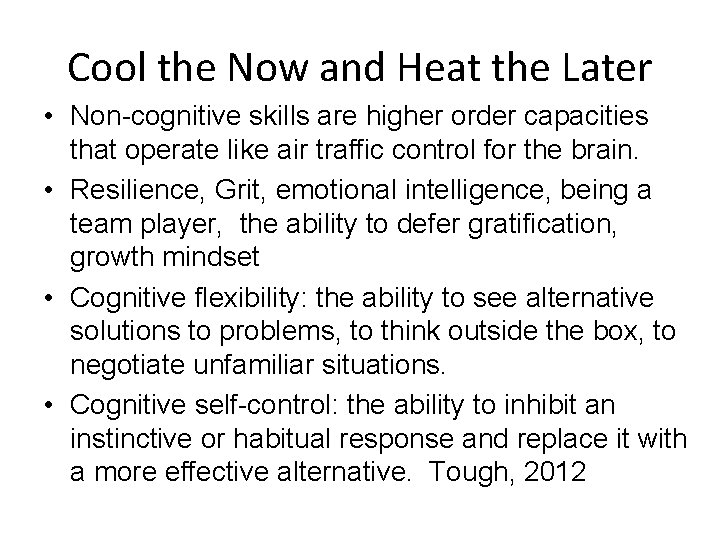
Cool the Now and Heat the Later • Non-cognitive skills are higher order capacities that operate like air traffic control for the brain. • Resilience, Grit, emotional intelligence, being a team player, the ability to defer gratification, growth mindset • Cognitive flexibility: the ability to see alternative solutions to problems, to think outside the box, to negotiate unfamiliar situations. • Cognitive self-control: the ability to inhibit an instinctive or habitual response and replace it with a more effective alternative. Tough, 2012
We are what we repeatedly do. Excellence then is not an act but a habit. Aristotle
You Tube Sleepy Bear can’t stay awake Sleepy Asian sunbear cub falling asleep
Resources • The Optimistic Child: A Proven Programme to Safeguard Children against Depression and Build Life Long Resilience Seligman, M. E. P. , et al. 1995 New York, Houghton Mifflin Harcourt Publishing • Using Positive Psychology to Enhance Student Achievement: A School Based Programme to Enhance Achievement Mac. Conville, R. M. & Rae, T. , 2013, A David Fulton Book, Routledge • Building Happiness, Motivation and Resilience in Adolescents Mac. Conville, R. M. & Rae, T. , 2014, Jessica Kingsley Publishing • Think Good- Feel Good: A Cognitive Therapy Work Book for Children and Young People Stallard, P. , 2002, John Wiley
Resources cont. • Boing, www. boing. org. uk/indexphp/resources • The Brave Program • www. youthbeyondblue. com/do-something-aboutit/treatmentsforanxietyanddepression/the-brave-program • Mindfulness http: //mindfulnessinschools. org/what-is-b/ • Penn Resiliency Program http: //howtothrive. org
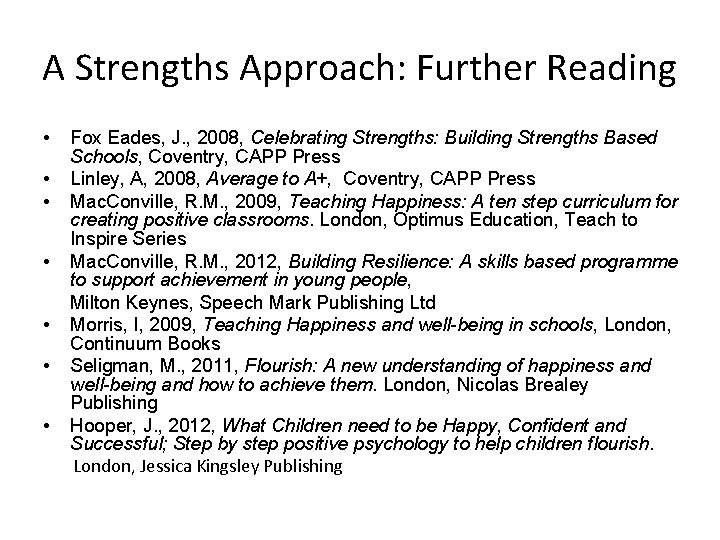
A Strengths Approach: Further Reading • • Fox Eades, J. , 2008, Celebrating Strengths: Building Strengths Based Schools, Coventry, CAPP Press Linley, A, 2008, Average to A+, Coventry, CAPP Press Mac. Conville, R. M. , 2009, Teaching Happiness: A ten step curriculum for creating positive classrooms. London, Optimus Education, Teach to Inspire Series Mac. Conville, R. M. , 2012, Building Resilience: A skills based programme to support achievement in young people, Milton Keynes, Speech Mark Publishing Ltd Morris, I, 2009, Teaching Happiness and well-being in schools, London, Continuum Books Seligman, M. , 2011, Flourish: A new understanding of happiness and well-being and how to achieve them. London, Nicolas Brealey Publishing Hooper, J. , 2012, What Children need to be Happy, Confident and Successful; Step by step positive psychology to help children flourish. London, Jessica Kingsley Publishing
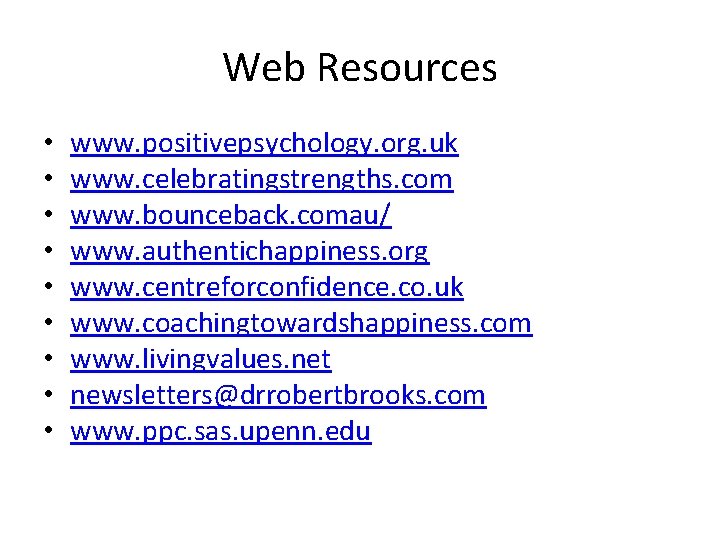
Web Resources • • • www. positivepsychology. org. uk www. celebratingstrengths. com www. bounceback. comau/ www. authentichappiness. org www. centreforconfidence. co. uk www. coachingtowardshappiness. com www. livingvalues. net newsletters@drrobertbrooks. com www. ppc. sas. upenn. edu
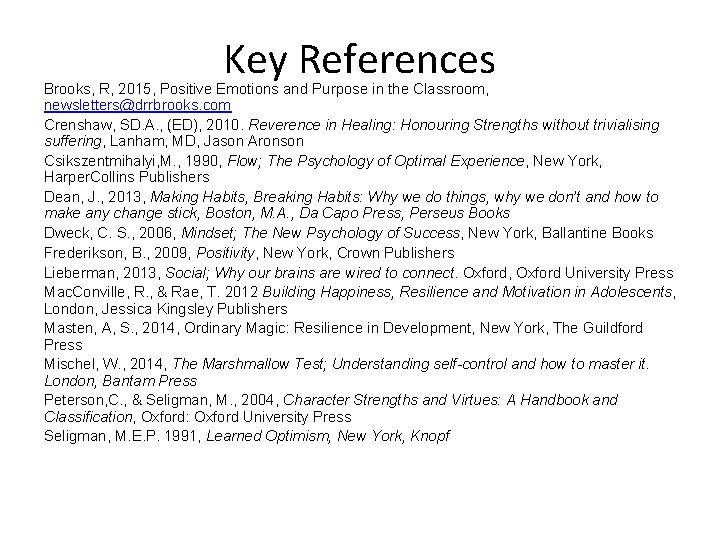
Key References Brooks, R, 2015, Positive Emotions and Purpose in the Classroom, newsletters@drrbrooks. com Crenshaw, SD. A. , (ED), 2010. Reverence in Healing: Honouring Strengths without trivialising suffering, Lanham, MD, Jason Aronson Csikszentmihalyi, M. , 1990, Flow; The Psychology of Optimal Experience, New York, Harper. Collins Publishers Dean, J. , 2013, Making Habits, Breaking Habits: Why we do things, why we don’t and how to make any change stick, Boston, M. A. , Da Capo Press, Perseus Books Dweck, C. S. , 2006, Mindset; The New Psychology of Success, New York, Ballantine Books Frederikson, B. , 2009, Positivity, New York, Crown Publishers Lieberman, 2013, Social; Why our brains are wired to connect. Oxford, Oxford University Press Mac. Conville, R. , & Rae, T. 2012 Building Happiness, Resilience and Motivation in Adolescents, London, Jessica Kingsley Publishers Masten, A, S. , 2014, Ordinary Magic: Resilience in Development, New York, The Guildford Press Mischel, W. , 2014, The Marshmallow Test; Understanding self-control and how to master it. London, Bantam Press Peterson, C. , & Seligman, M. , 2004, Character Strengths and Virtues: A Handbook and Classification, Oxford: Oxford University Press Seligman, M. E. P. 1991, Learned Optimism, New York, Knopf
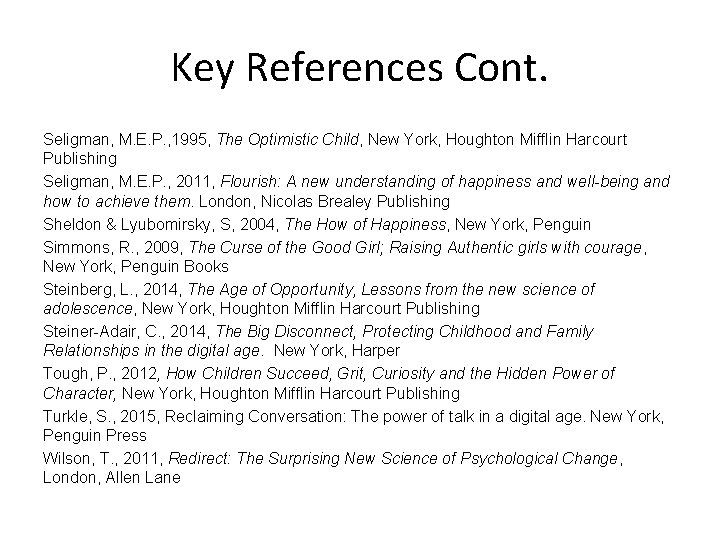
Key References Cont. Seligman, M. E. P. , 1995, The Optimistic Child, New York, Houghton Mifflin Harcourt Publishing Seligman, M. E. P. , 2011, Flourish: A new understanding of happiness and well-being and how to achieve them. London, Nicolas Brealey Publishing Sheldon & Lyubomirsky, S, 2004, The How of Happiness, New York, Penguin Simmons, R. , 2009, The Curse of the Good Girl; Raising Authentic girls with courage, New York, Penguin Books Steinberg, L. , 2014, The Age of Opportunity, Lessons from the new science of adolescence, New York, Houghton Mifflin Harcourt Publishing Steiner-Adair, C. , 2014, The Big Disconnect, Protecting Childhood and Family Relationships in the digital age. New York, Harper Tough, P. , 2012, How Children Succeed, Grit, Curiosity and the Hidden Power of Character, New York, Houghton Mifflin Harcourt Publishing Turkle, S. , 2015, Reclaiming Conversation: The power of talk in a digital age. New York, Penguin Press Wilson, T. , 2011, Redirect: The Surprising New Science of Psychological Change, London, Allen Lane

Further information: r. macconville@btinternet. com
- Slides: 63