
Using Pathetic Fallacy A Christmas Carol DO NOW

- Slides: 16
Using Pathetic Fallacy A Christmas Carol
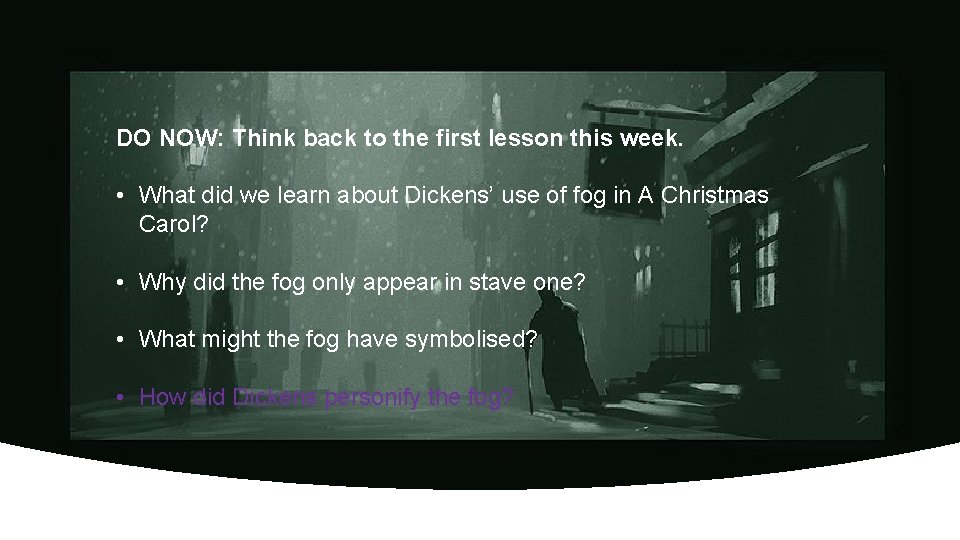
DO NOW: Think back to the first lesson this week. • What did we learn about Dickens’ use of fog in A Christmas Carol? • Why did the fog only appear in stave one? • What might the fog have symbolised? • How did Dickens personify the fog?
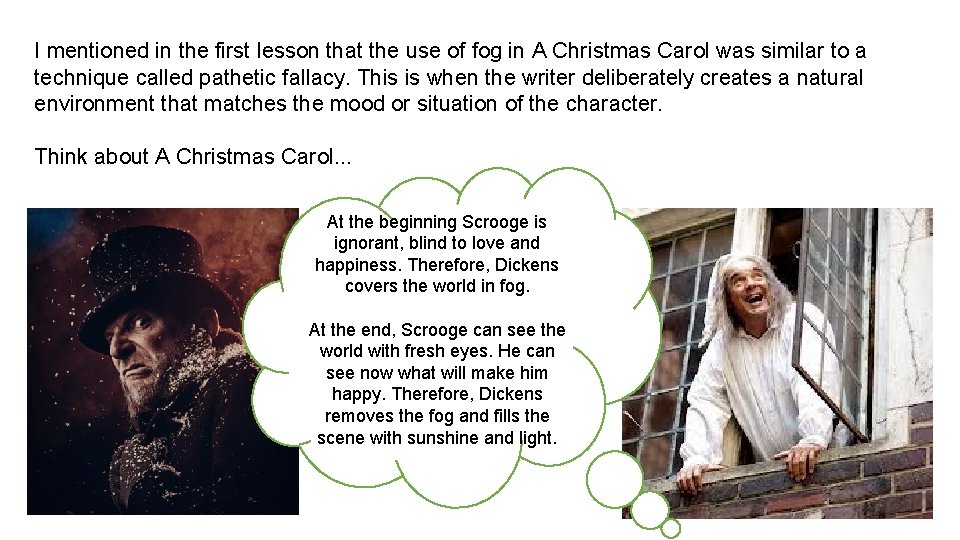
I mentioned in the first lesson that the use of fog in A Christmas Carol was similar to a technique called pathetic fallacy. This is when the writer deliberately creates a natural environment that matches the mood or situation of the character. Think about A Christmas Carol. . . At the beginning Scrooge is ignorant, blind to love and happiness. Therefore, Dickens covers the world in fog. At the end, Scrooge can see the world with fresh eyes. He can see now what will make him happy. Therefore, Dickens removes the fog and fills the scene with sunshine and light.
In A Christmas Carol, fog is used a symbol of Scrooge’s ignorance. But what other ideas could fog create? Let’s brainstorm some ideas. Can you think of. . . ? • Three nouns linked to fog? • Three adjectives linked to fog? • Two verbs linked to fog? • Two adverbs linked to fog? • Two foggy places?
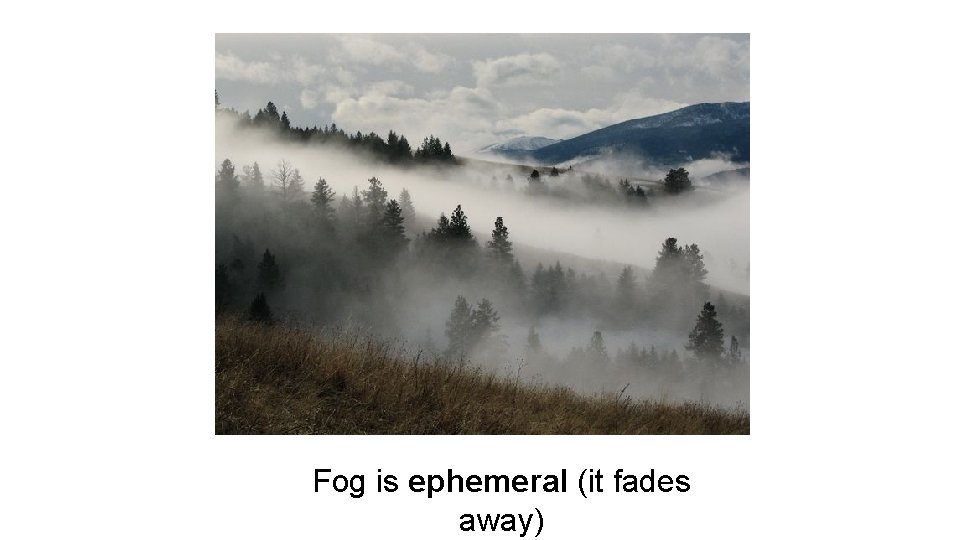
Fog is ephemeral (it fades away)
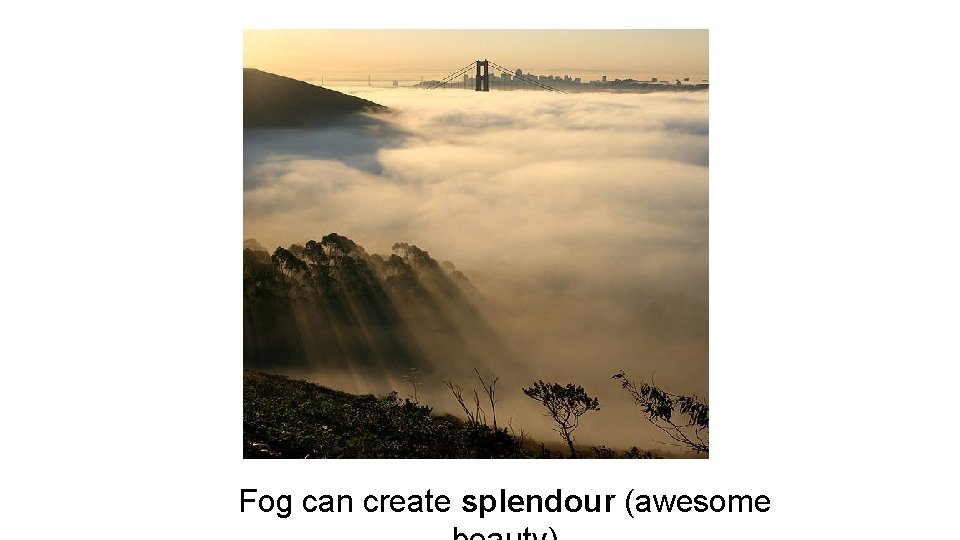
Fog can create splendour (awesome
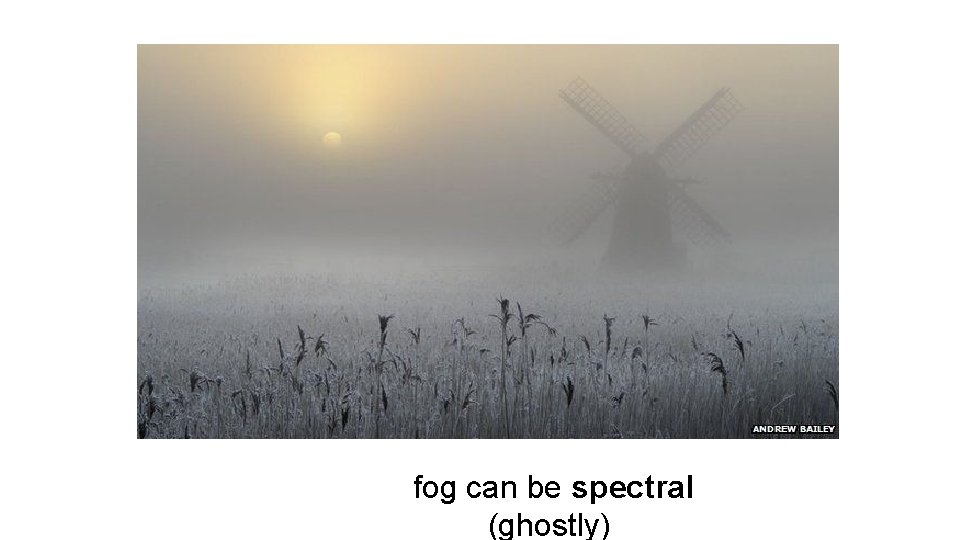
fog can be spectral (ghostly)
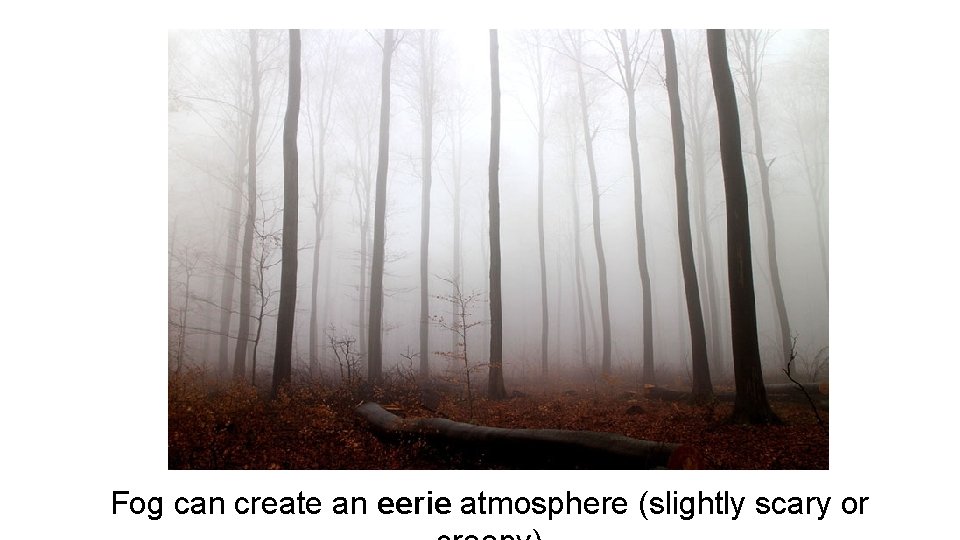
Fog can create an eerie atmosphere (slightly scary or
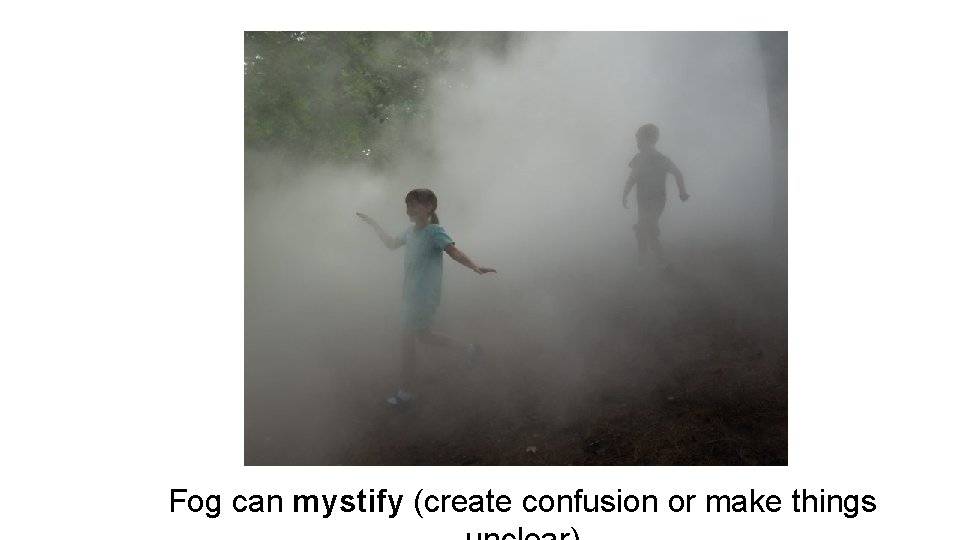
Fog can mystify (create confusion or make things
This is an extract from the novel The Woman In Black. Here the writer clearly describes the fog as though it has a life of its own, using personification and pathetic fallacy. It was a Monday afternoon in November and already growing dark, not because of the lateness of the hour - it was barely three o’clock - but because of the fog, the thickest of London pea-soupers, which had hemmed us in on all sides since dawn – if, indeed, there had been a dawn, for the fog had scarcely allowed any daylight to penetrate the foul gloom of the atmosphere. Fog was outdoors, hanging over the river, creeping in and out of alleyways and passages, swirling thickly between the bare trees of all the parks and gardens of the city, and indoors, too, seething through cracks and crannies like sour breath, gaining a sly entrance at every opening of a door. It was a yellow fog, a filthy, evil-smelling fog, a fog that choked and blinded, smeared and stained. Groping their way blindly across roads, men and women took their lives in their hands, stumbling along the pavements, they clutched at railings and at one another, for guidance. Sounds were deadened, shapes blurred. It was a fog that had come three days before, and did not seem inclined to go away and it had, I suppose, the quality of all such fogs – it was menacing and sinister, disguising the familiar world and confusing the people in it, as they were confused by having their eyes covered and being turned about, in a game of Blind Man’s Buff. TASK: Read the extract and underline any parts where the writer tries to suggest that the fog is alive (personification). How does the use of fog help to create a particular mood in this extract (pathetic fallacy)? Can you find any parts which remind you of the extract from A Christmas Carol that we looked at yesterday? Make these parts bold.
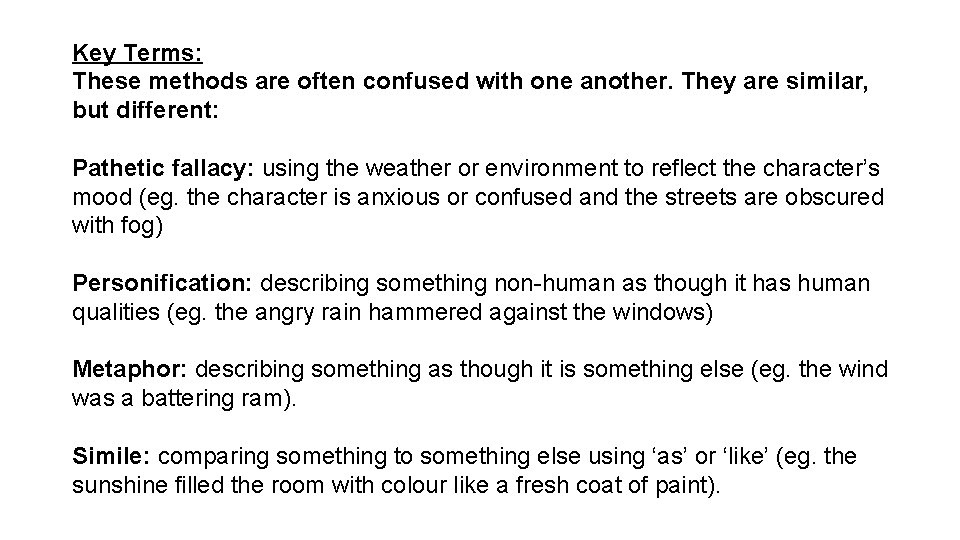
Key Terms: These methods are often confused with one another. They are similar, but different: Pathetic fallacy: using the weather or environment to reflect the character’s mood (eg. the character is anxious or confused and the streets are obscured with fog) Personification: describing something non-human as though it has human qualities (eg. the angry rain hammered against the windows) Metaphor: describing something as though it is something else (eg. the wind was a battering ram). Simile: comparing something to something else using ‘as’ or ‘like’ (eg. the sunshine filled the room with colour like a fresh coat of paint).
This is an extract from the novel The Woman In Black. Here the writer clearly describes the fog as though it has a life of its own, using personification, pathetic fallacy and metaphor. It was a Monday afternoon in November and already growing dark, not because of the lateness of the hour - it was barely three o’clock - but because of the fog, the thickest of London pea-soupers, which had hemmed us in on all sides since dawn – if, indeed, there had been a dawn, for the fog had scarcely allowed any daylight to penetrate the foul gloom of the atmosphere. Fog was outdoors, hanging over the river, creeping in and out of alleyways and passages, swirling thickly between the bare trees of all the parks and gardens of the city, and indoors, too, seething through cracks and crannies like sour breath, gaining a sly entrance at every opening of a door. It was a yellow fog, a filthy, evil-smelling fog, a fog that choked and blinded, smeared and stained. Groping their way blindly across roads, men and women took their lives in their hands, stumbling along the pavements, they clutched at railings and at one another, for guidance. Sounds were deadened, shapes blurred. It was a fog that had come three days before, and did not seem inclined to go away and it had, I suppose, the quality of all such fogs – it was menacing and sinister, disguising the familiar world and confusing the people in it, as they were confused by having their eyes covered and being turned about, in a game of Blind Man’s Buff. My analysis: In this extract, the writer personifies the fog with lines such as ‘a fog that choked and blinded’, making it sound like some violent attacker. The use of the fog in this extract contributes to the fearful, unsettling mood of the story (pathetic fallacy). This extract also seems to refer to the Dickens extract we have been studying when it mentions the time of day (3 pm, just like in A Christmas Carol) and with lines such as “seething through the cracks and crannies” (similar to “pouring through every chink and keyhole”). Is the writer copying or parodying Dickens, perpahs?
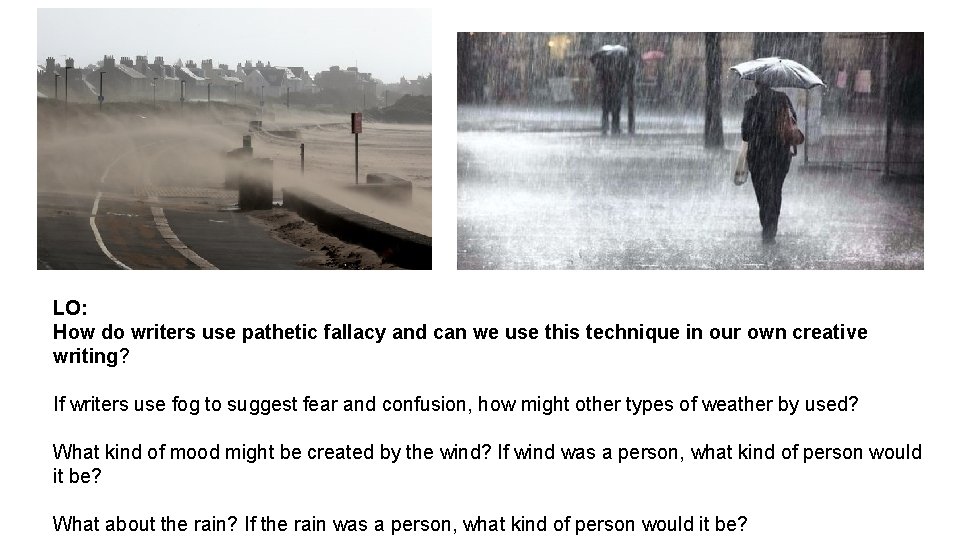
LO: How do writers use pathetic fallacy and can we use this technique in our own creative writing? If writers use fog to suggest fear and confusion, how might other types of weather by used? What kind of mood might be created by the wind? If wind was a person, what kind of person would it be? What about the rain? If the rain was a person, what kind of person would it be?
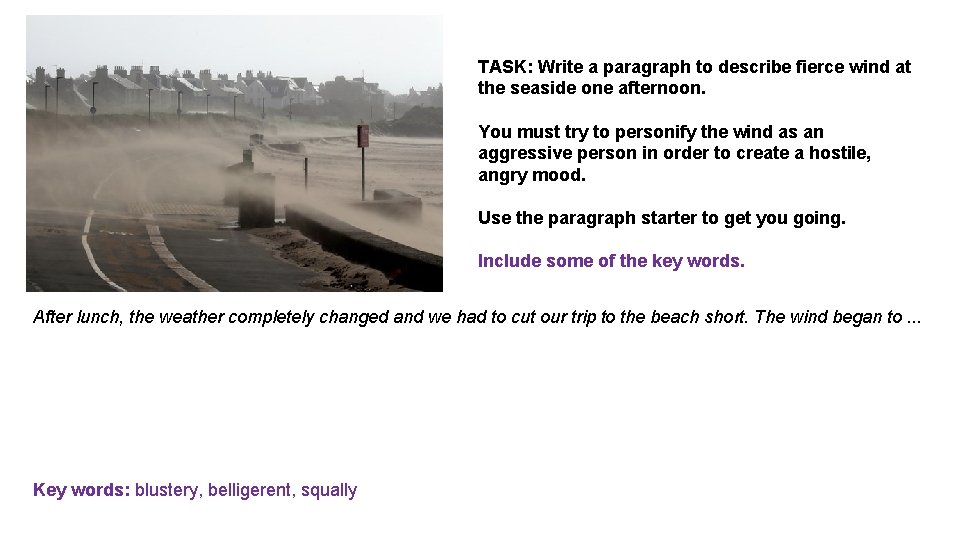
TASK: Write a paragraph to describe fierce wind at the seaside one afternoon. You must try to personify the wind as an aggressive person in order to create a hostile, angry mood. Use the paragraph starter to get you going. Include some of the key words. After lunch, the weather completely changed and we had to cut our trip to the beach short. The wind began to. . . Key words: blustery, belligerent, squally
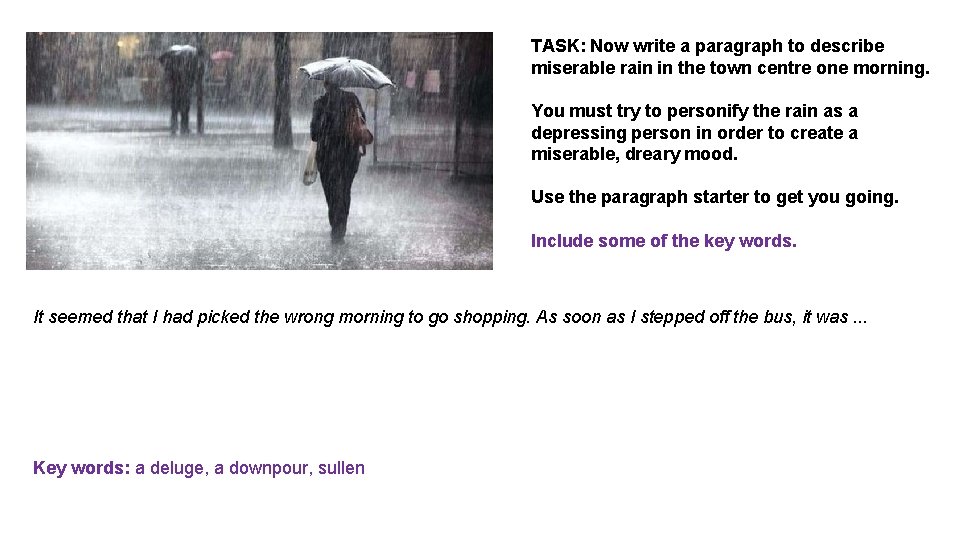
TASK: Now write a paragraph to describe miserable rain in the town centre one morning. You must try to personify the rain as a depressing person in order to create a miserable, dreary mood. Use the paragraph starter to get you going. Include some of the key words. It seemed that I had picked the wrong morning to go shopping. As soon as I stepped off the bus, it was. . . Key words: a deluge, a downpour, sullen
Once you have completed this lesson, please upload your work at the following link: https: //forms. office. com/Pages/Response. Page. aspx? id=zz 3 Xj. Xy 17 EC 3 HVb. US 2 fey 93 mom. J 3 Xl. Op 4 UM 6 Hy 4 fk 1 UM 1 oz. V 0 NUTUVPVz. RURUg 0 MFp. HWVRBNTBURSQl. QCN 0 PWcu