
Using optics to scale Internet Routers Computer Forum

- Slides: 27
Using optics to scale Internet Routers Computer Forum, May 2003 Nick Mc. Keown Professor of Electrical Engineering and Computer Science, Stanford University nickm@stanford. edu www. stanford. edu/~nickm 1
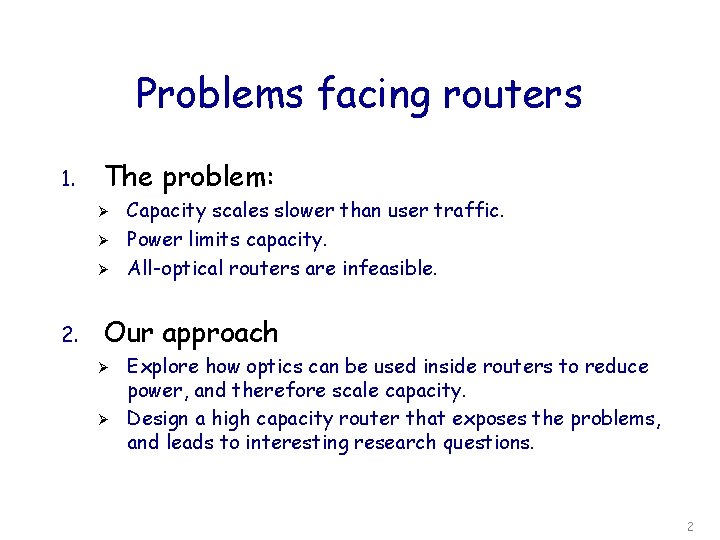
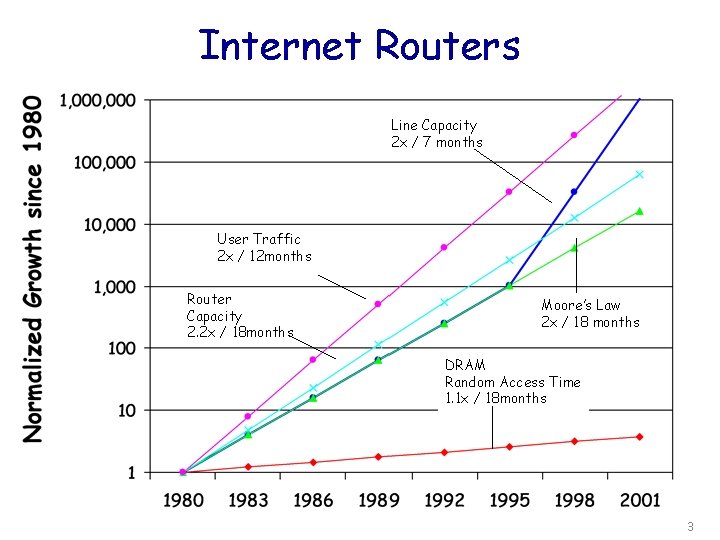
Problems facing routers 1. The problem: Ø Ø Ø 2. Capacity scales slower than user traffic. Power limits capacity. All-optical routers are infeasible. Our approach Ø Ø Explore how optics can be used inside routers to reduce power, and therefore scale capacity. Design a high capacity router that exposes the problems, and leads to interesting research questions. 2
Internet Routers Line Capacity 2 x / 7 months User Traffic 2 x / 12 months Router Capacity 2. 2 x / 18 months Moore’s Law 2 x / 18 months DRAM Random Access Time 1. 1 x / 18 months 3
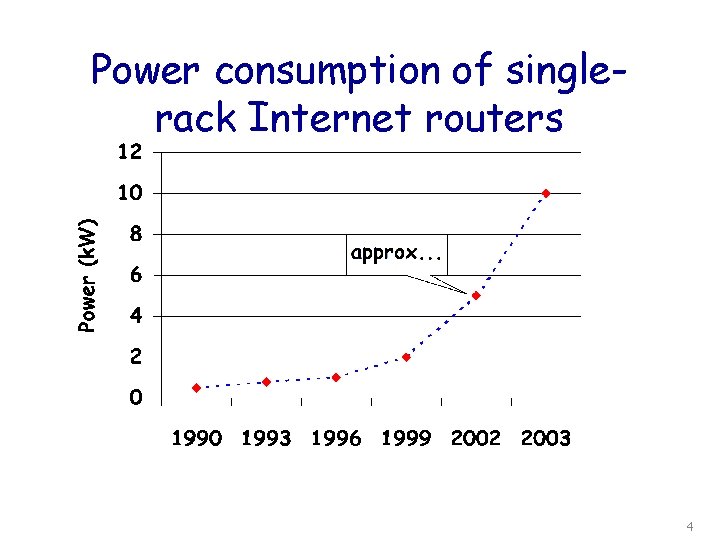
Power consumption of singlerack Internet routers 4
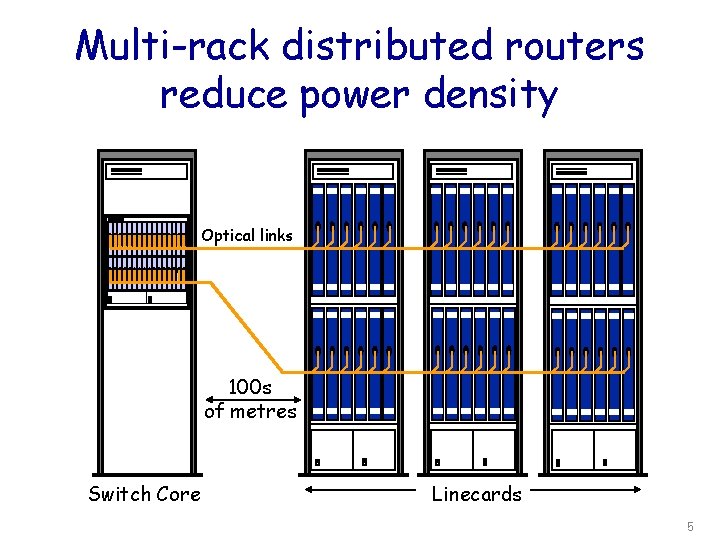
Multi-rack distributed routers reduce power density Optical links 100 s of metres Switch Core Linecards 5
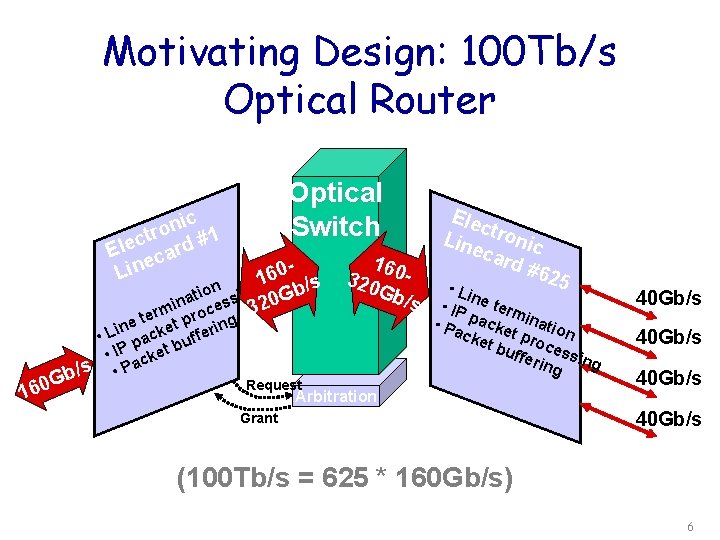
Motivating Design: 100 Tb/s Optical Router Optical Switch ic n o r ct rd #1 e l E eca n i L 60 - s 1 ion sing Gb/ t a in ces 320 rm o /s b G 0 16 e te et pr ring n i • L pack buffe • IP cket a • P Request 160 320 Gb/ s Ele c Lin tronic eca rd # 625 • Li n • IP e term • Pa packe inatio n t cke t bu proces ffer s ing Arbitration Grant 40 Gb/s (100 Tb/s = 625 * 160 Gb/s) 6
Research Groups Mark Horowitz horowitz@ee. stanford. edu v Nick Mc. Keown nickm@ee. stanford. edu v Olav Solgaard olav@ee. stanford. edu v David Miller dabm@ee. stanford. edu v v 8 -10 Ph. D students 7
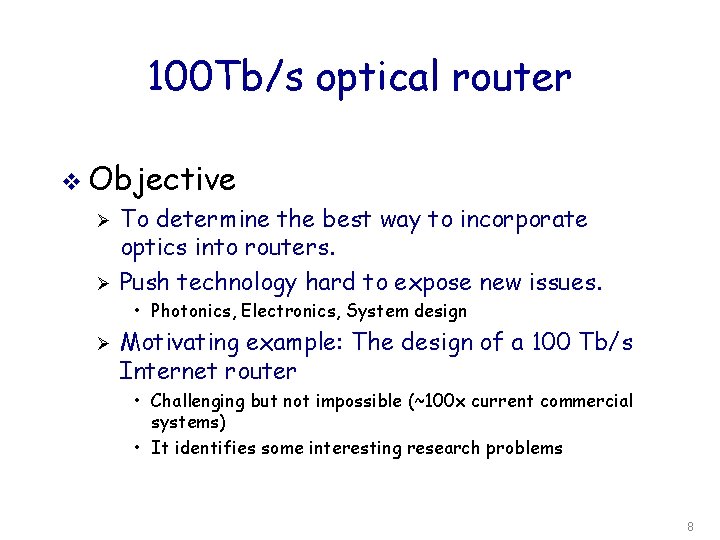
100 Tb/s optical router v Objective Ø To determine the best way to incorporate optics into routers. Ø Push technology hard to expose new issues. • Photonics, Electronics, System design Ø Motivating example: The design of a 100 Tb/s Internet router • Challenging but not impossible (~100 x current commercial systems) • It identifies some interesting research problems 8
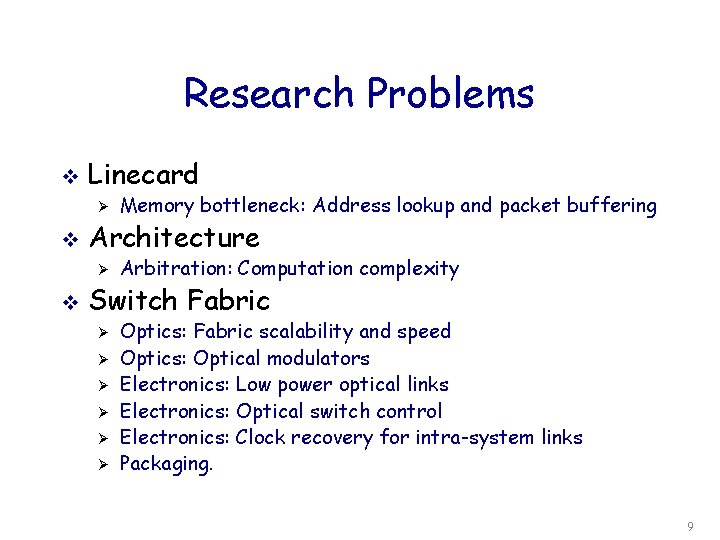
Research Problems v Linecard Ø v Architecture Ø v Memory bottleneck: Address lookup and packet buffering Arbitration: Computation complexity Switch Fabric Ø Ø Ø Optics: Fabric scalability and speed Optics: Optical modulators Electronics: Low power optical links Electronics: Optical switch control Electronics: Clock recovery for intra-system links Packaging. 9
Outline v Load-Balanced Switch Overview v Passive Mesh Paradigm v WGR-based Switch Fabric v Hybrid Optical-Electrical Switch Fabric 10
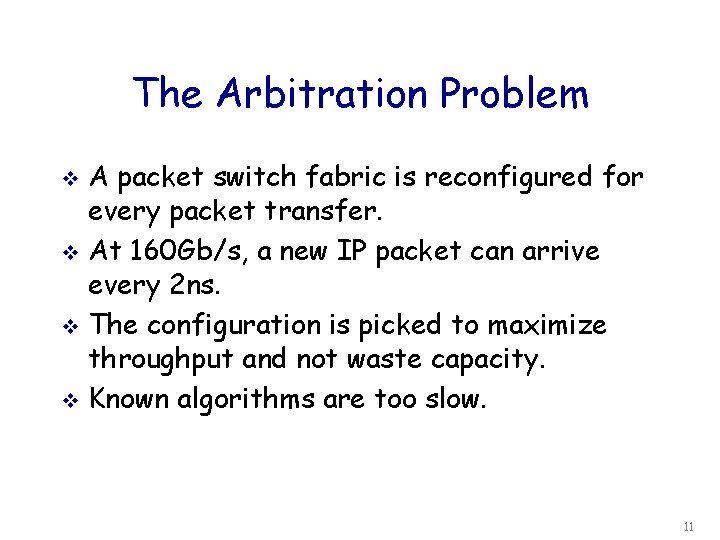
The Arbitration Problem A packet switch fabric is reconfigured for every packet transfer. v At 160 Gb/s, a new IP packet can arrive every 2 ns. v The configuration is picked to maximize throughput and not waste capacity. v Known algorithms are too slow. v 11
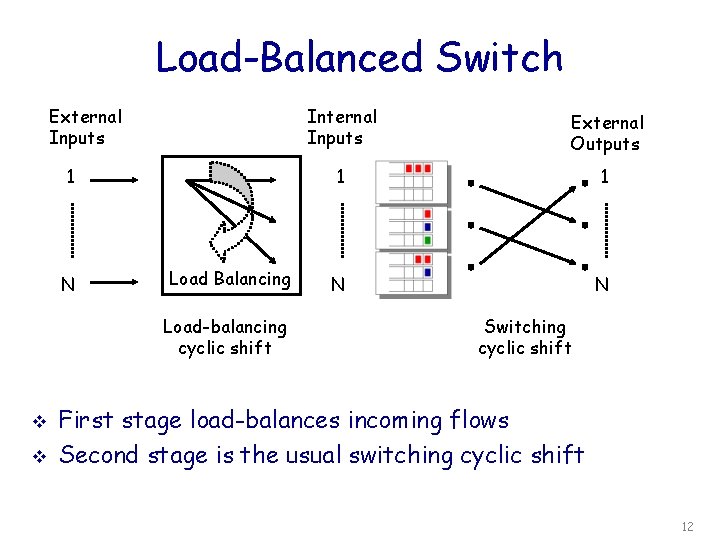
Load-Balanced Switch External Inputs 1 N Load Balancing Load-balancing cyclic shift v v Internal Inputs External Outputs 1 1 N N Switching cyclic shift First stage load-balances incoming flows Second stage is the usual switching cyclic shift 12
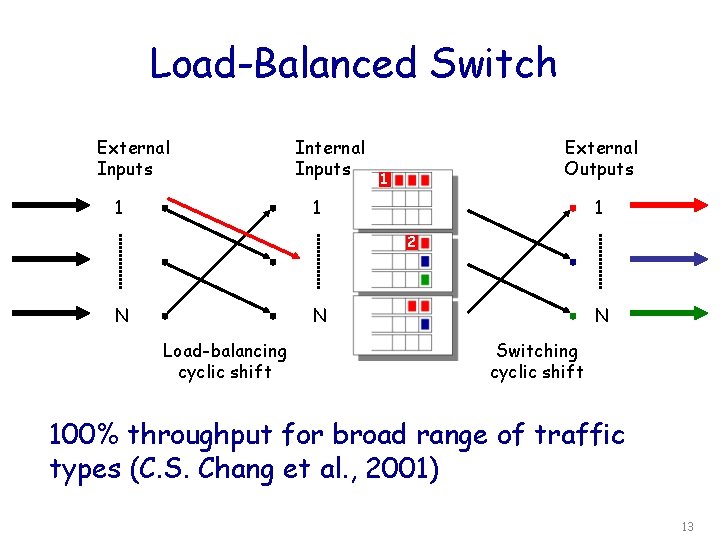
Load-Balanced Switch External Inputs 1 12 Internal Inputs External Outputs 1 1 1 2 N N Load-balancing cyclic shift N Switching cyclic shift 100% throughput for broad range of traffic types (C. S. Chang et al. , 2001) 13
Outline v Load-Balanced Switch Overview v Passive Mesh Paradigm v WGR-based Switch Fabric v Hybrid Optical-Electrical Switch Fabric 14
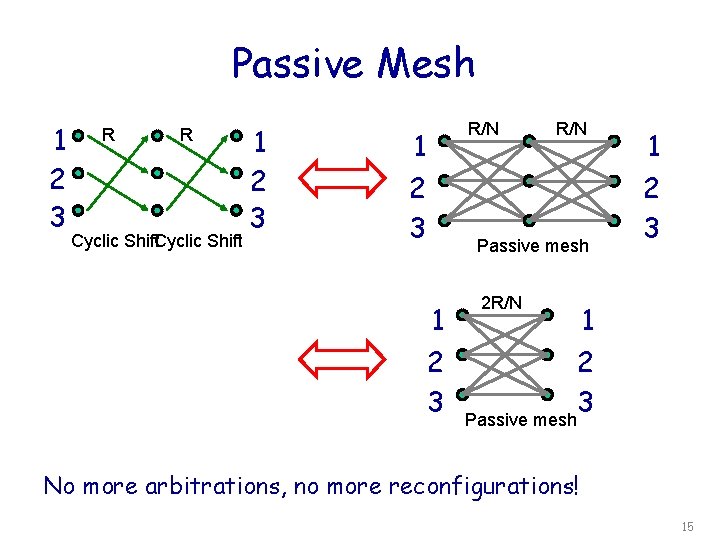
Passive Mesh 1 2 3 R R Cyclic Shift 1 2 3 R/N Passive mesh 1 2 3 2 R/N 1 2 3 Passive mesh No more arbitrations, no more reconfigurations! 15
Outline v Load-Balanced Switch Overview v Passive Mesh Paradigm v WGR-based Switch Fabric v Hybrid Optical-Electrical Switch Fabric 16
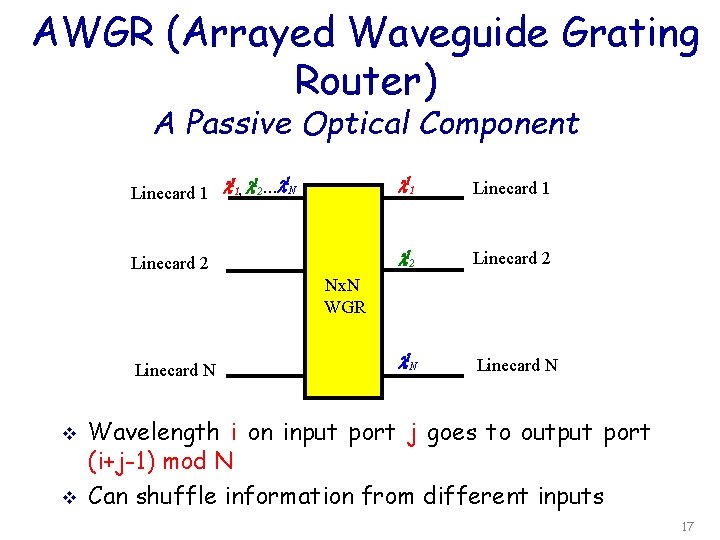
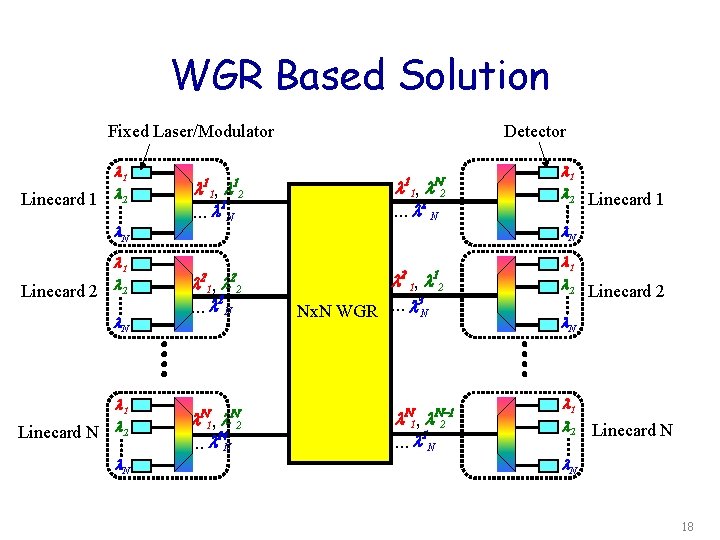
AWGR (Arrayed Waveguide Grating Router) A Passive Optical Component 1 1 1 Linecard 1 l 1, l 2 …l N l 11 Linecard 2 l 12 Linecard 2 l 1 N Linecard N Nx. N WGR Linecard N v v Wavelength i on input port j goes to output port (i+j-1) mod N Can shuffle information from different inputs 17
WGR Based Solution Fixed Laser/Modulator l 1 Linecard 1 l 2 l. N l 1 Linecard N l 2 l. N 1 1 l 1, l 2 1 …l N l 2 1 , l 2 2 2 …l N N N l 1, l 2 N …l N Detector 1 N l 1, l 2 2 …l N 2 l 1, l 3 Nx. N WGR … l N N 1 2 l 1 l 2 Linecard 1 l. N l 1 l 2 Linecard 2 l. N N-1 l 1, l 2 1 …l N l 1 l 2 Linecard N l. N 18
Switch fabric design v Design a switch fabric Ø Ø v For load-balancing and switching stages 625 ports of 2 x 160 Gbps Features: Ø Ø Flexibility: arbitrary addition and deletion of linecards (due to upgrades/failures) Scalability 19
Outline v Load-Balanced Switch Overview v Passive Mesh Paradigm v WGR-based Switch Fabric v Hybrid Optical-Electrical Switch Fabric 20
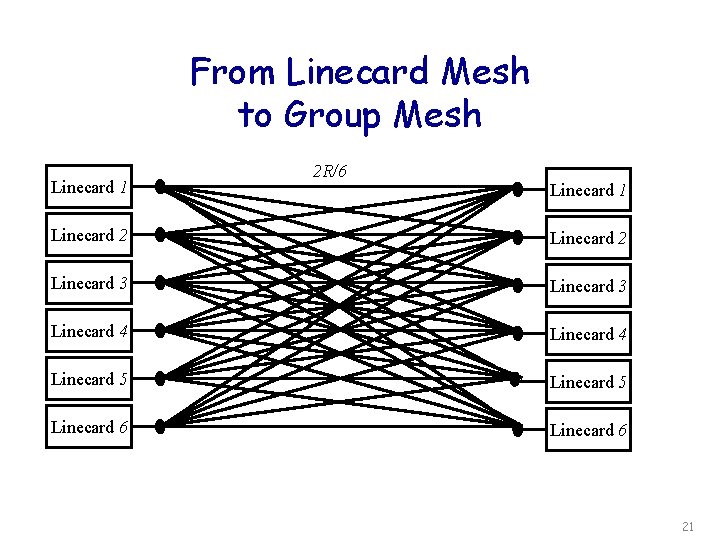
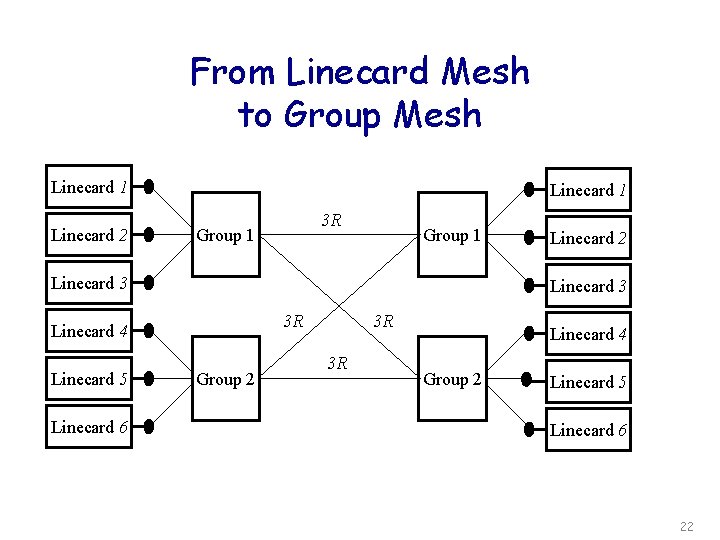
From Linecard Mesh to Group Mesh Linecard 1 2 R/6 Linecard 1 Linecard 2 Linecard 3 Linecard 4 Linecard 5 Linecard 6 21
From Linecard Mesh to Group Mesh Linecard 1 Linecard 2 Linecard 1 3 R Group 1 Linecard 3 3 R Linecard 4 Linecard 5 Linecard 6 Linecard 2 Group 2 3 R 3 R Linecard 4 Group 2 Linecard 5 Linecard 6 22
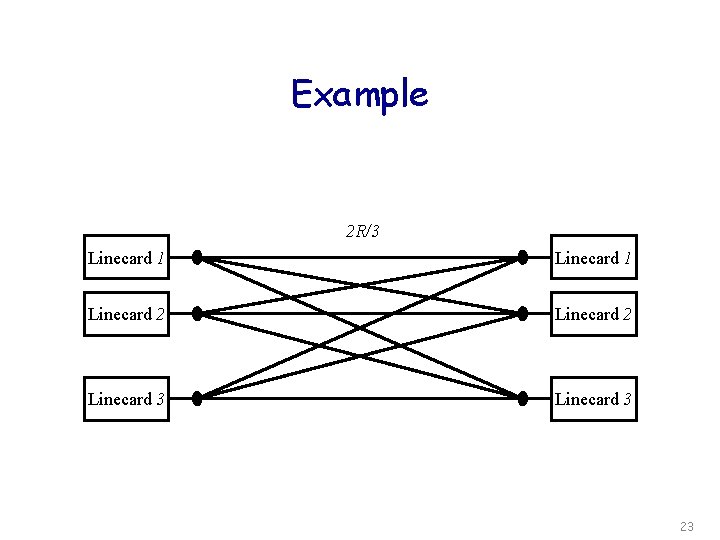
Example 2 R/3 Linecard 1 Linecard 2 Linecard 3 23
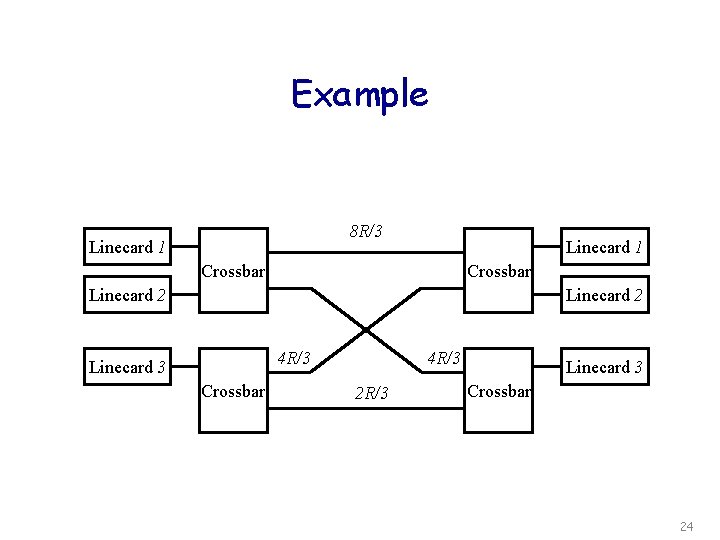
Example 8 R/3 Linecard 1 Crossbar Linecard 2 4 R/3 Linecard 3 Crossbar 4 R/3 2 R/3 Linecard 3 Crossbar 24
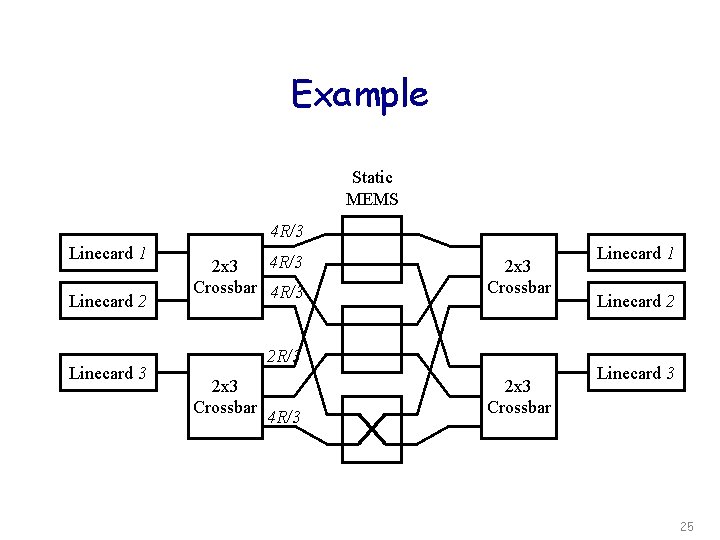
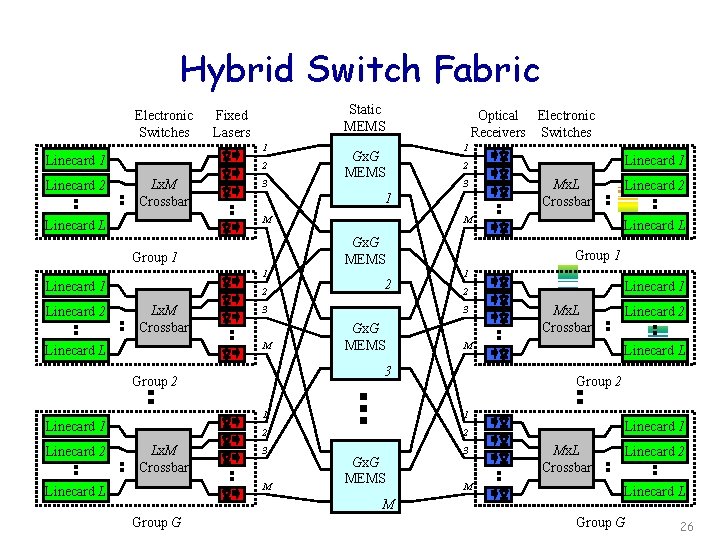
Example Static MEMS 4 R/3 Linecard 1 Linecard 2 Linecard 3 4 R/3 2 x 3 Crossbar 2 R/3 2 x 3 Crossbar 4 R/3 2 x 3 Crossbar Linecard 1 Linecard 2 Linecard 3 25
Hybrid Switch Fabric Electronic Switches 1 Linecard 2 Static MEMS Fixed Lasers 2 Lx. M Crossbar 3 1 2 Lx. M Crossbar Linecard 2 Lx. M Crossbar Group G Linecard 2 Linecard L Group 2 2 M Mx. L Crossbar M 2 Gx. G MEMS Linecard 1 2 3 Gx. G MEMS Linecard 2 Linecard L 1 1 M Linecard L 2 1 3 Mx. L Crossbar Group 1 3 Group 2 Linecard 1 3 M Linecard L Linecard 1 2 Gx. G MEMS Group 1 Linecard 1 1 1 M Linecard L Linecard 2 Gx. G MEMS Optical Electronic Receivers Switches 3 M Linecard 1 Mx. L Crossbar Linecard 2 Linecard L Group G 26
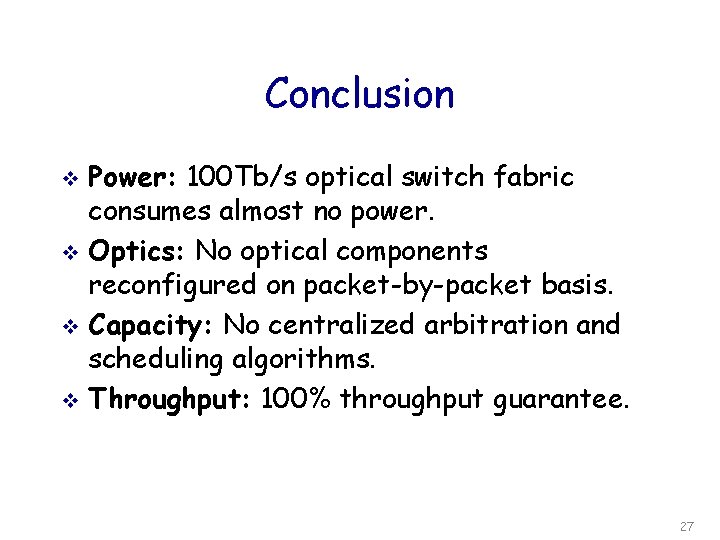
Conclusion Power: 100 Tb/s optical switch fabric consumes almost no power. v Optics: No optical components reconfigured on packet-by-packet basis. v Capacity: No centralized arbitration and scheduling algorithms. v Throughput: 100% throughput guarantee. v 27