
USING OPEN TEXTBOOKS IN YOUR TEACHING University of
USING OPEN TEXTBOOKS IN YOUR TEACHING University of Regina October 17, 2019

What’s the problem? University textbooks/course materials estimates U Regina: $1000 -$1500 U Sask: $1000 -$2000 U Alberta: $1750 UBC: $1700 Queens: $1100 York: $1000 -$1500 “In the past three decades, the costs have risen some 834%; that is more than double the rate of increase in house prices and triple the cost increases in the Consumer Price Index. ” — CBC. (2014). “Textbook Prices That Break the Bank. ”
Rising Costs of Textbooks What’s a student to do? • • • Pay for the textbook Purchase an older edition of the textbook Delay purchasing the textbook Never purchase the textbook Share textbook with other students (“part-time” access) Library access?

What are open textbooks? "Open textbooks are a way to significantly reduce student textbook costs while giving instructors the flexibility to reformat and customize their course material. They are an affordable, flexible alternative to traditionally-published textbooks. ” – BC Campus, https: //open. bccampus. ca/opentextbook-101/
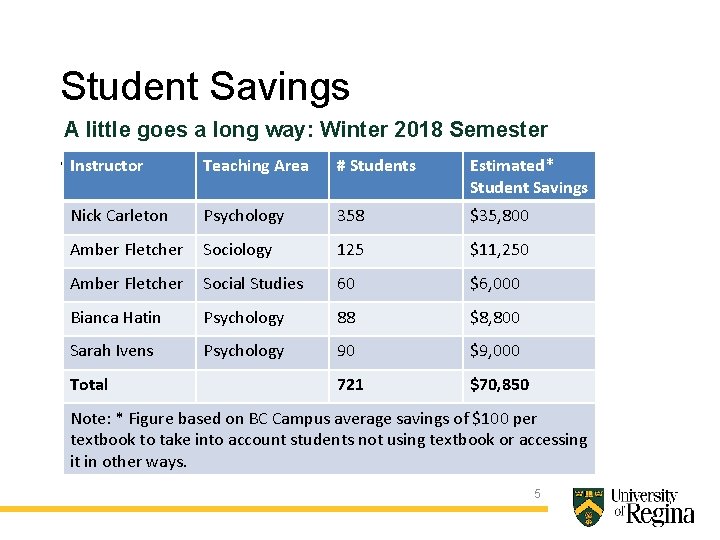
Student Savings A little goes a long way: Winter 2018 Semester Instructor Savings Teaching Area • Student # Students Estimated* Student Savings Nick Carleton Psychology 358 $35, 800 Amber Fletcher Sociology 125 $11, 250 Amber Fletcher Social Studies 60 $6, 000 Bianca Hatin Psychology 88 $8, 800 Sarah Ivens Psychology 90 $9, 000 721 $70, 850 Total Note: * Figure based on BC Campus average savings of $100 per textbook to take into account students not using textbook or accessing it in other ways. 5

Benefits of OER Use • Open license may allow instructors to customize content for their courses and support student needs • OER are free online or low cost in print versions to instructors and students • Pedagogy – OER development and use opens dialogue between students, authors and other faculty • Accessibility – multiple formats, online, option to print 6
Instructor perspective Traditional textbooks • are static so they can’t easily be mixed and matched to meet specific needs, • are subject to publication lag time (currency), and • create teaching frustration if not all students have the textbook or the same edition.
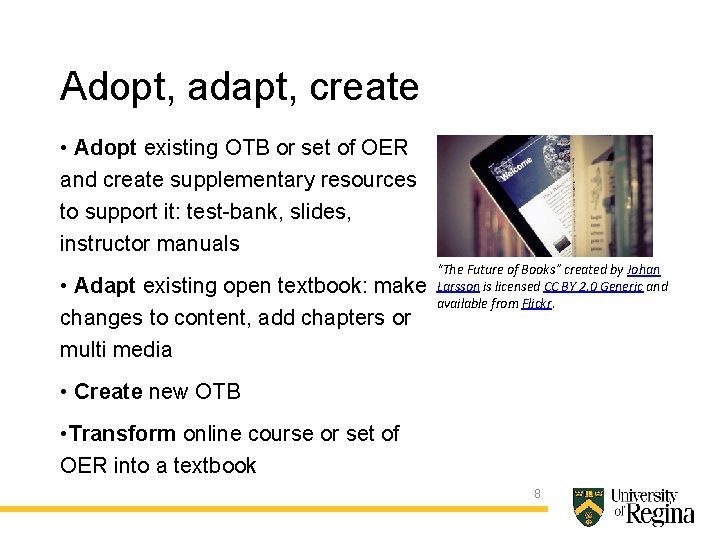
Adopt, adapt, create • Adopt existing OTB or set of OER and create supplementary resources to support it: test-bank, slides, instructor manuals • Adapt existing open textbook: make changes to content, add chapters or multi media “The Future of Books” created by Johan Larsson is licensed CC BY 2. 0 Generic and available from Flickr. • Create new OTB • Transform online course or set of OER into a textbook 8
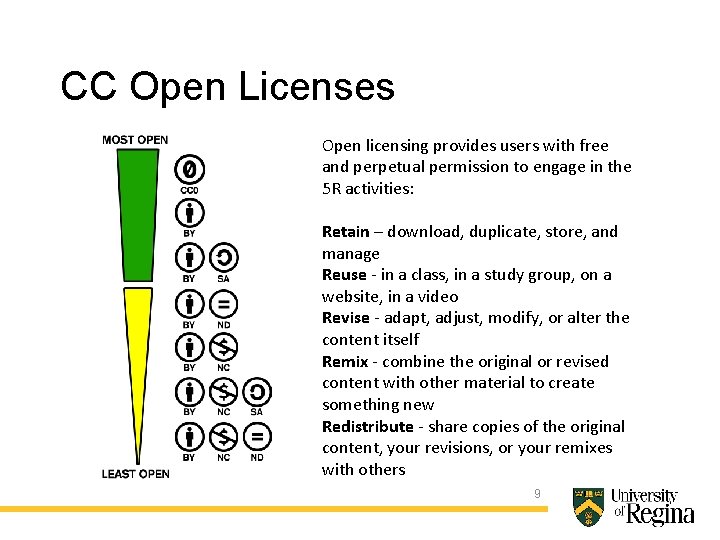
CC Open Licenses Open licensing provides users with free and perpetual permission to engage in the 5 R activities: Retain – download, duplicate, store, and manage Reuse - in a class, in a study group, on a website, in a video Revise - adapt, adjust, modify, or alter the content itself Remix - combine the original or revised content with other material to create something new Redistribute - share copies of the original content, your revisions, or your remixes with others 9
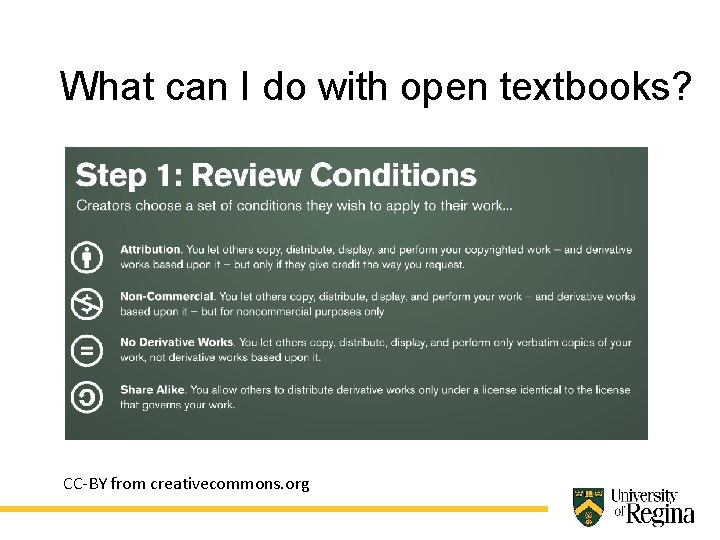
What can I do with open textbooks? CC-BY from creativecommons. org
Adoption Process Adopting existing material • Time frame: immediate use to several months, depending on the fit of the chosen book • Variations: - use existing open textbook as-is - mix and match sections from more than one existing open textbook or other open resource - modify content in existing textbook to match your course - add new section(s) or chapter(s) to expand coverage of specific topics 11
Publication Process New creation or major adaptation (approximately 2 years) • Author contracts, open license, instructional design • Author writing and literature review • Peer review process • Editing and rewriting (if necessary) • Editorial process (copy edit, proofread) • Production (video, images, tables, online platform) • Testing and promotion 12
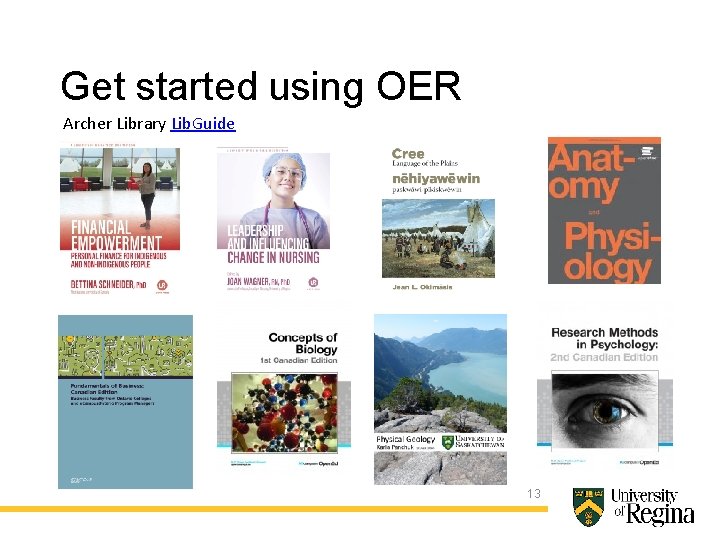
Get started using OER Archer Library Lib. Guide 13
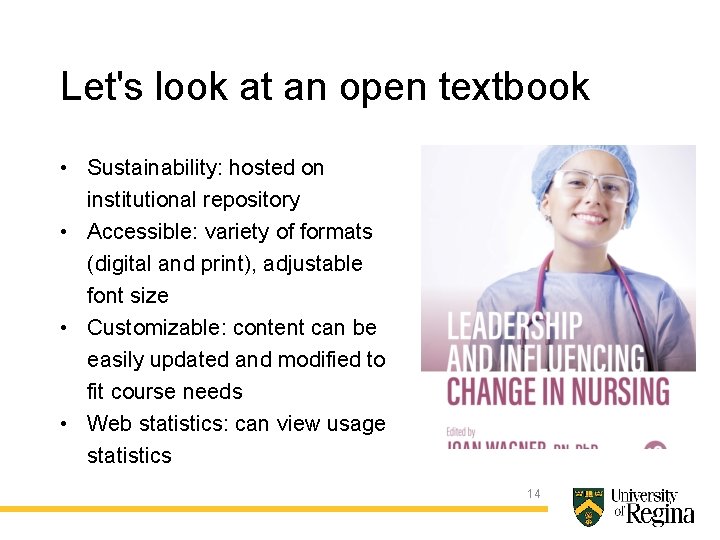
Let's look at an open textbook • Sustainability: hosted on institutional repository • Accessible: variety of formats (digital and print), adjustable font size • Customizable: content can be easily updated and modified to fit course needs • Web statistics: can view usage statistics 14
How do I find an open textbook? Open Textbook Repositories/Collections • University of Regina OER Lib. Guide • BC Campus Collection and OER by Discipline Directory • e. Campus Ontario Open Library • Open Stax CNX • Merlot Collection • Libre. Texts Online Platform
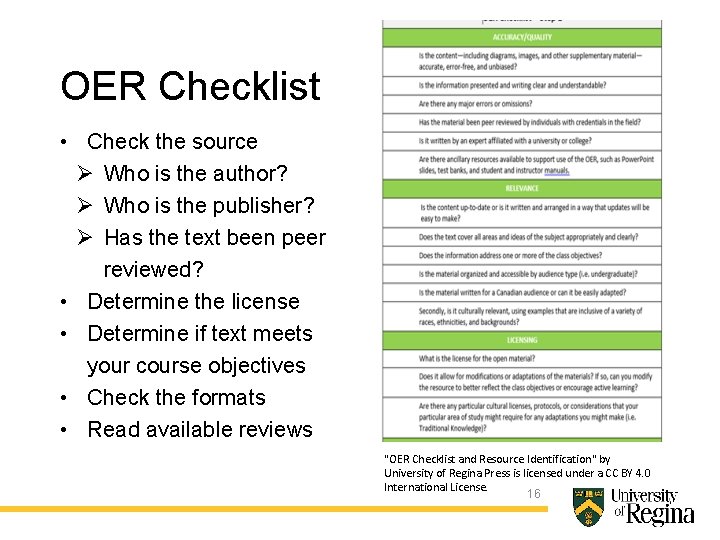
OER Checklist • Check the source Ø Who is the author? Ø Who is the publisher? Ø Has the text been peer reviewed? • Determine the license • Determine if text meets your course objectives • Check the formats • Read available reviews "OER Checklist and Resource Identification" by University of Regina Press is licensed under a CC BY 4. 0 International License. 16
Presented by Elsa Johnston Program Manager, Open Textbook Publishing Program open. textbooks@uregina. ca Cara Bradley Research and Scholarship Librarian, John Archer Library cara. bradley@uregina. ca THIS PRESENTATION IS RELEASED UNDER A CREATIVE COMMONS ATTRIBUTION 4. 0 INTERNATIONAL LICENSE EXCEPT WHERE OTHERWISE NOTED. THE UNIVERSITY OF REGINA LOGO IS A REGISTERED TRADEMARK. October 17, 2019
- Slides: 17