
Using Open Stack In A Traditional Hosting Environment
- Slides: 22
Using Open. Stack In A Traditional Hosting Environment Jun Park (Ph. D. ), Sr. Systems Architect Mike Wilson, Sr. Systems Architect EIG/Bluehost Open. Stack Summit 2013
• • • Scale @10 x what we were in about a year’s time Needed a system to manage it all Provisioning these systems had to be automated System had to scale to multiple data centers Btw, we have 2 months to come up with this EIG/Bluehost 2
High level requirements • Centralized management, horizontal scalability. • Abstractions for physical and logical deployments of devices and resources. • Open-source project with lots of support and momentum • Typical Cloud features (migration, imaging, provisioning, etc. ) Easy transition into future cloud offering with support for industry standard APIs = Open. Stack! EIG/Bluehost 3
Bluehost Environment • Scale – More than 10, 000 physical servers – Adding hundreds of nodes per day • Network – Public network directly attached to VMs – Plan on adding private network later • Open. Stack/Folsom Components – – Nova (compute, api, scheduler) Quantum (network) AMQP: Qpid (messaging) Mysql (db) EIG/Bluehost 4
Outline • Scalability/Stability • Rethink Quantum Network • Operational Issues • Wrap-up/Conclusions EIG/Bluehost 5
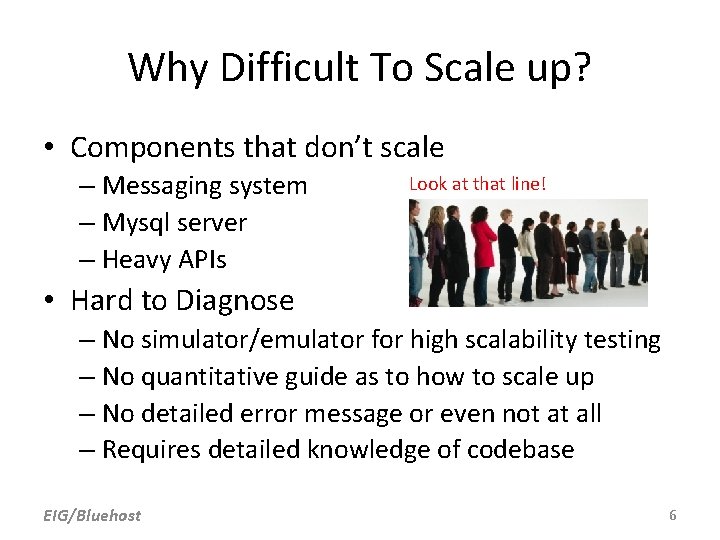
Why Difficult To Scale up? • Components that don’t scale – Messaging system – Mysql server – Heavy APIs Look at that line! • Hard to Diagnose – No simulator/emulator for high scalability testing – No quantitative guide as to how to scale up – No detailed error message or even not at all – Requires detailed knowledge of codebase EIG/Bluehost 6
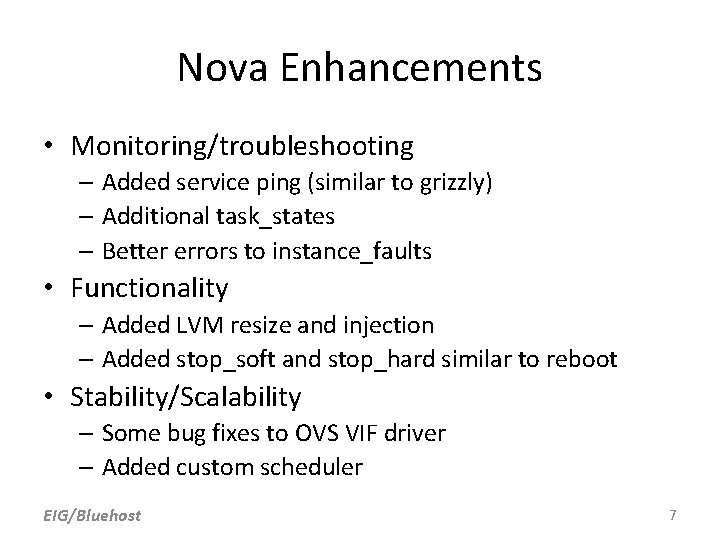
Nova Enhancements • Monitoring/troubleshooting – Added service ping (similar to grizzly) – Additional task_states – Better errors to instance_faults • Functionality – Added LVM resize and injection – Added stop_soft and stop_hard similar to reboot • Stability/Scalability – Some bug fixes to OVS VIF driver – Added custom scheduler EIG/Bluehost 7
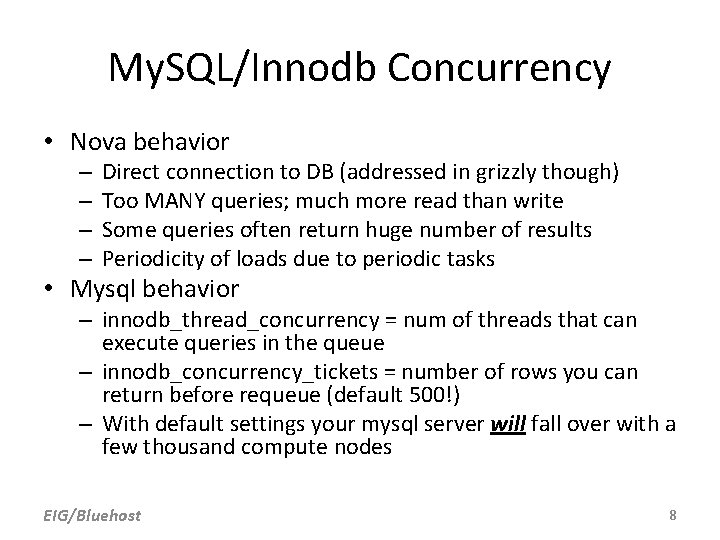
My. SQL/Innodb Concurrency • Nova behavior – – Direct connection to DB (addressed in grizzly though) Too MANY queries; much more read than write Some queries often return huge number of results Periodicity of loads due to periodic tasks • Mysql behavior – innodb_thread_concurrency = num of threads that can execute queries in the queue – innodb_concurrency_tickets = number of rows you can return before requeue (default 500!) – With default settings your mysql server will fall over with a few thousand compute nodes EIG/Bluehost 8
So the answer is just increase concurrency and tickets right? Sadly, no. Tuning concurrency and tickets is a must! But we still requeue. We don’t know why, but we have a workaround. Our workaround: Send most read queries to a cluster of mysql slaves. I say most because many queries would be sensitive to possible slave replication lag EIG/Bluehost 9
Messaging System • Qpid Chosen – – Speed and easy cluster ability Incredibly unstable at large scale (Even at small scale) Possibly poorly configured Older release in Cent. OS 6 • Problem – Broker bottleneck – Unnecessarily complex • Recommendation – AVOID BROKER! – Zero. MQ as replacement EIG/Bluehost 10
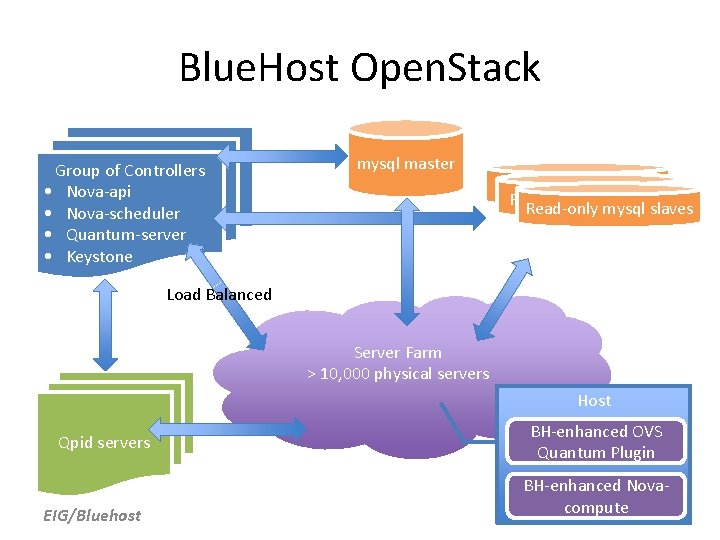
Blue. Host Open. Stack Group of Controllers • Nova-api • Nova-scheduler • Quantum-server • Keystone mysql master Read-only mysql slaves Load Balanced Server Farm > 10, 000 physical servers Host Qpid servers EIG/Bluehost BH-enhanced OVS Quantum Plugin BH-enhanced Novacompute
Rethink Quantum Network • Problem – Quantum API only for DB; no efficient API for Nova – No API-around design for actual network objects – Premature Openv. Switch (OVS) quantum plugin • Our approach – Adding intelligence to OVS plugin – Optimizing API • E. g. , get_instance_nw_info() in nova; Python-level join operation – Expand current implicit communication with novacompute (although not ideal) EIG/Bluehost 12
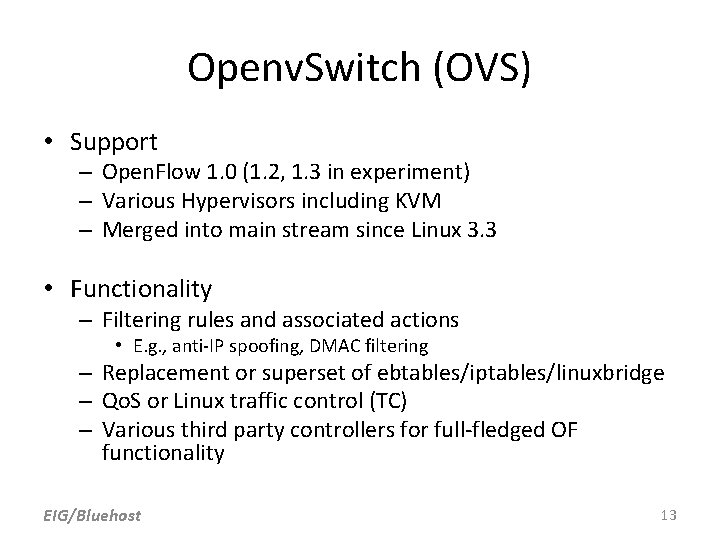
Openv. Switch (OVS) • Support – Open. Flow 1. 0 (1. 2, 1. 3 in experiment) – Various Hypervisors including KVM – Merged into main stream since Linux 3. 3 • Functionality – Filtering rules and associated actions • E. g. , anti-IP spoofing, DMAC filtering – Replacement or superset of ebtables/iptables/linuxbridge – Qo. S or Linux traffic control (TC) – Various third party controllers for full-fledged OF functionality EIG/Bluehost 13
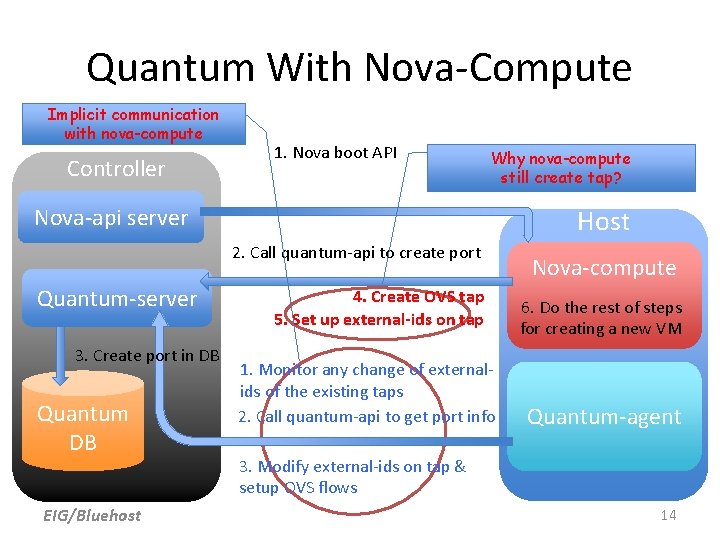
Quantum With Nova-Compute Implicit communication with nova-compute Controller 1. Nova boot API Why nova-compute still create tap? Nova-api server Host 2. Call quantum-api to create port Quantum-server 3. Create port in DB Quantum DB EIG/Bluehost 4. Create OVS tap 5. Set up external-ids on tap 1. Monitor any change of externalids of the existing taps 2. Call quantum-api to get port info Nova-compute 6. Do the rest of steps for creating a new VM Quantum-agent 3. Modify external-ids on tap & setup OVS flows 14
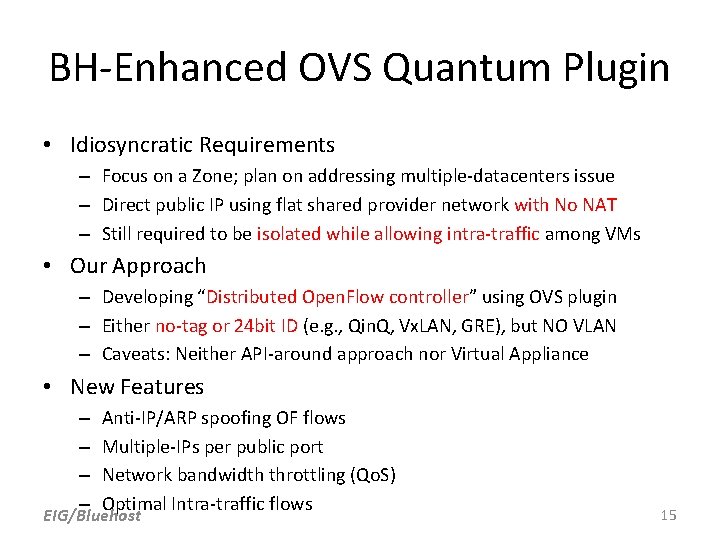
BH-Enhanced OVS Quantum Plugin • Idiosyncratic Requirements – Focus on a Zone; plan on addressing multiple-datacenters issue – Direct public IP using flat shared provider network with No NAT – Still required to be isolated while allowing intra-traffic among VMs • Our Approach – Developing “Distributed Open. Flow controller” using OVS plugin – Either no-tag or 24 bit ID (e. g. , Qin. Q, Vx. LAN, GRE), but NO VLAN – Caveats: Neither API-around approach nor Virtual Appliance • New Features – – Anti-IP/ARP spoofing OF flows Multiple-IPs per public port Network bandwidth throttling (Qo. S) Optimal Intra-traffic flows EIG/Bluehost 15
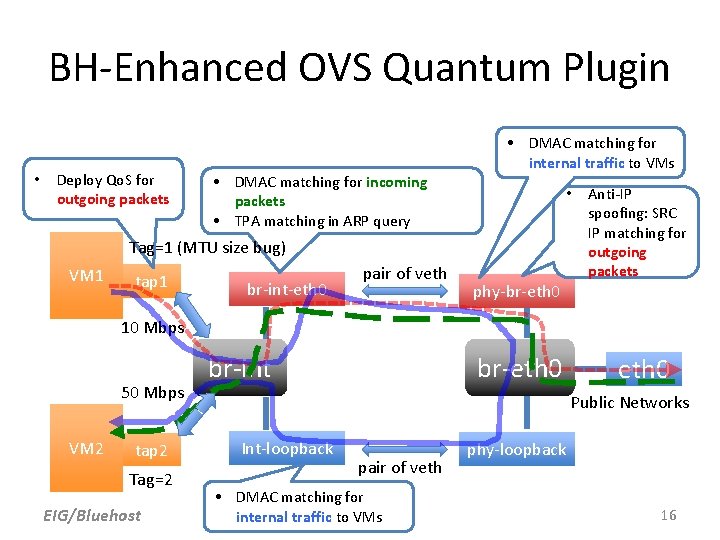
BH-Enhanced OVS Quantum Plugin • Deploy Qo. S for outgoing packets • DMAC matching for incoming packets • TPA matching in ARP query • DMAC matching for internal traffic to VMs • Tag=1 (MTU size bug) VM 1 tap 1 br-int-eth 0 pair of veth phy-br-eth 0 Anti-IP spoofing: SRC IP matching for outgoing packets 10 Mbps 50 Mbps VM 2 tap 2 Tag=2 EIG/Bluehost br-int br-eth 0 Public Networks Int-loopback pair of veth • DMAC matching for internal traffic to VMs phy-loopback 16
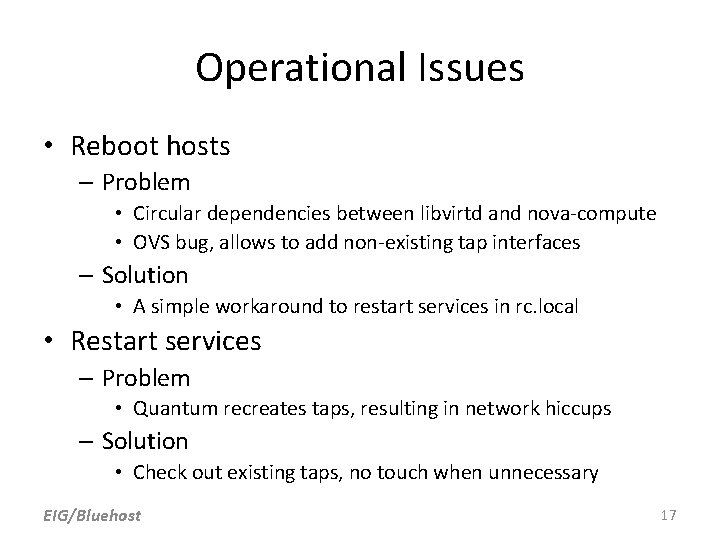
Operational Issues • Reboot hosts – Problem • Circular dependencies between libvirtd and nova-compute • OVS bug, allows to add non-existing tap interfaces – Solution • A simple workaround to restart services in rc. local • Restart services – Problem • Quantum recreates taps, resulting in network hiccups – Solution • Check out existing taps, no touch when unnecessary EIG/Bluehost 17
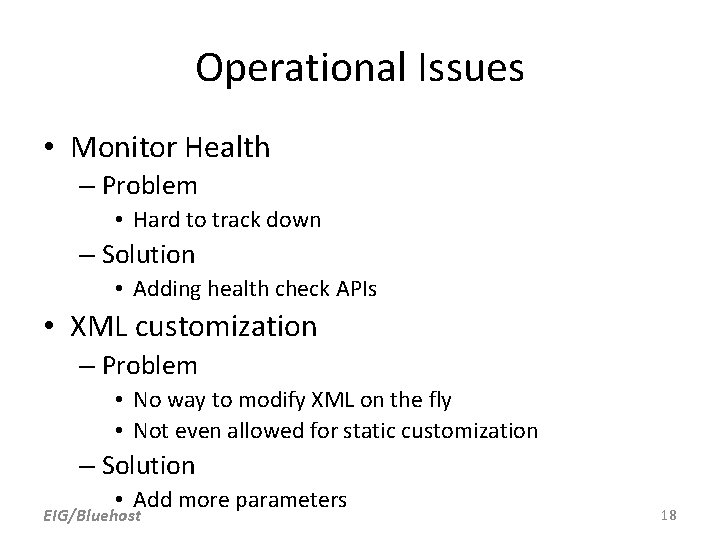
Operational Issues • Monitor Health – Problem • Hard to track down – Solution • Adding health check APIs • XML customization – Problem • No way to modify XML on the fly • Not even allowed for static customization – Solution • Add more parameters EIG/Bluehost 18
Wrap-up/Conclusions EIG/Bluehost 19
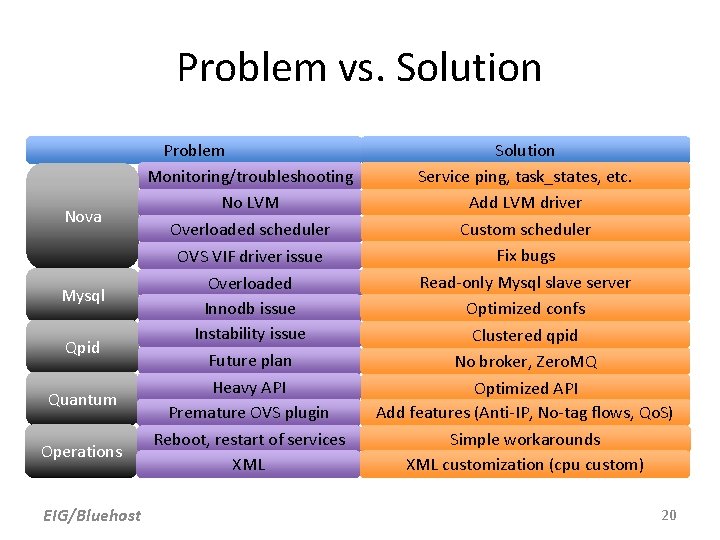
Problem vs. Solution Nova Mysql Qpid Quantum Operations EIG/Bluehost Problem Monitoring/troubleshooting No LVM Overloaded scheduler OVS VIF driver issue Overloaded Innodb issue Instability issue Future plan Heavy API Premature OVS plugin Reboot, restart of services XML Solution Service ping, task_states, etc. Add LVM driver Custom scheduler Fix bugs Read-only Mysql slave server Optimized confs Clustered qpid No broker, Zero. MQ Optimized API Add features (Anti-IP, No-tag flows, Qo. S) Simple workarounds XML customization (cpu custom) 20
For True Open. Stack Success Scalability Scalable Messaging System & DB Infra Networks Good Networks Abstraction So … We don’t do live demo until … EIG/Bluehost 21
We’re sorry, we haven’t had time to contribute a whole lot YET. But here’s some code: https: //github. com/upoopoo for BH nova https: //github. com/Jun. Park for BH Quantum (as in live production) Browse the branches, many have to do with features discussed today EIG/Bluehost 22