
Using NFFI Web Services on the tactical level
Using NFFI Web Services on the tactical level: An evaluation of compression techniques 13 th ICCRTS: C 2 for Complex Endeavors 2008 -06 -18 Frank T. Johnsen Trude Hafsøe
Outline • • Motivation NFFI XML / binary XML Reducing overhead – compression • Evaluation • Summary
Motivation • The aim of NEC is to increase mission effectiveness – networking military entities – enhancing information sharing and situational awareness • Blue force tracking is recognized as one of the most important aspects of NEC. – NATO friendly force tracking information; NFFI • Part of the specification is an XML schema; • allows using a Web service
Motivation • Interoperability at all levels – Use XML at the tactical level • bandwidth is scarce, use compression • NATO CWID 2007 – We have evaluated different compression techniques • NFFI XML tracks was our experiment case
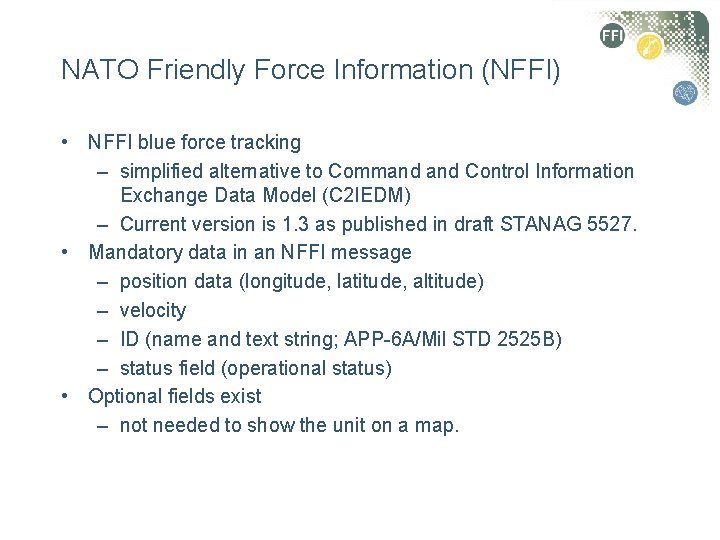
NATO Friendly Force Information (NFFI) • NFFI blue force tracking – simplified alternative to Command Control Information Exchange Data Model (C 2 IEDM) – Current version is 1. 3 as published in draft STANAG 5527. • Mandatory data in an NFFI message – position data (longitude, latitude, altitude) – velocity – ID (name and text string; APP-6 A/Mil STD 2525 B) – status field (operational status) • Optional fields exist – not needed to show the unit on a map.
The importance of XML • XML is a simple, very flexible text format • Multiple XML standards, the two most are XML itself, and XML Schema. • XML Schema – Enables validation of XML documents. – NFFI defines an XML schema, allowing track information to be represented in a standardized way for exchange. • In its basic form, XML can be seen as a structured, human readable way to organize data.
Towards a standard for binary XML • Sacrifice human readability for more efficient encoding • Use another representation of the XML document – “binary” or “efficient XML” • So far there is no standard for efficient XML • Standardization process – W 3 C working group; Efficient XML Interchange (EXI) – Objective: • Develop a specification for an encoding format • Illustrate effective implementations of that encoding – The group has so far released a working draft.
Reducing communication overhead • Different means to reduce communication overhead: – changing the representation (e. g. the XML schema) – discarding information – compression • Our case study was NFFI – XML schema defined in the standard • keep it as-is and remain compliant – NFFI has some mandatory and a lot of optional fields. • We removed all optional fields – The remaining information was compressed
Compression • Lossless compression – retain the exact representation • Lossy compression – used on data that can tolerate some loss – allowed to modify the data – higher compression rates than lossless compression • XML documents – All the information must be intact – lossless compression should be used
Lossless XML compression • We tested several combinations of lossless compression methods: – Generic compression • GZIP – XML conscious compression methods • EFX – generic vs schema specific • XMLPPM • We only looked at compression ratio and not other resource use (memory and CPU usage). – bandwidth is the most limited resource in tactical networks
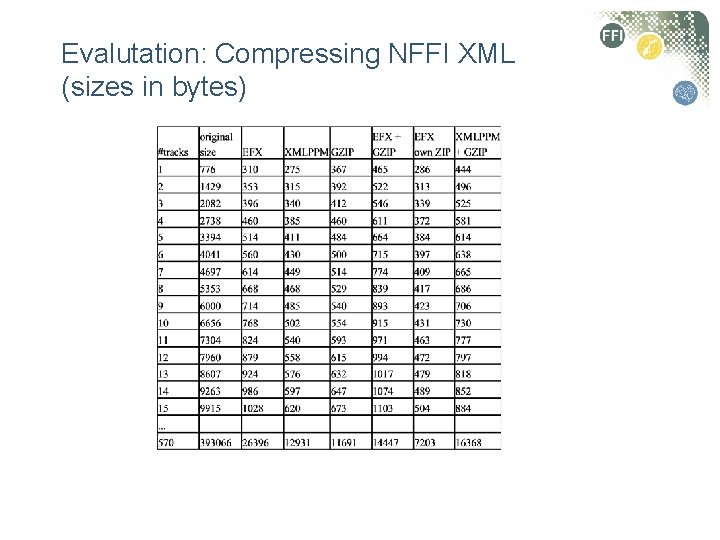
Evalutation: Compressing NFFI XML (sizes in bytes)
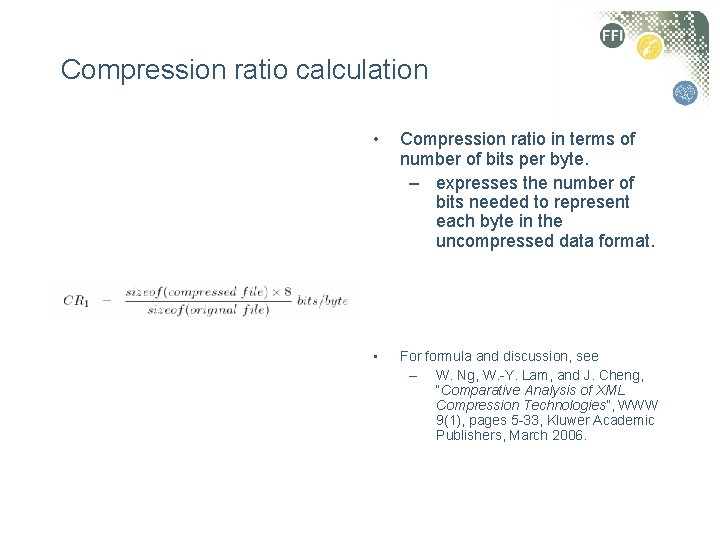
Compression ratio calculation • Compression ratio in terms of number of bits per byte. – expresses the number of bits needed to represent each byte in the uncompressed data format. • For formula and discussion, see – W. Ng, W. -Y. Lam, and J. Cheng, “Comparative Analysis of XML Compression Technologies”, WWW 9(1), pages 5 -33, Kluwer Academic Publishers, March 2006.
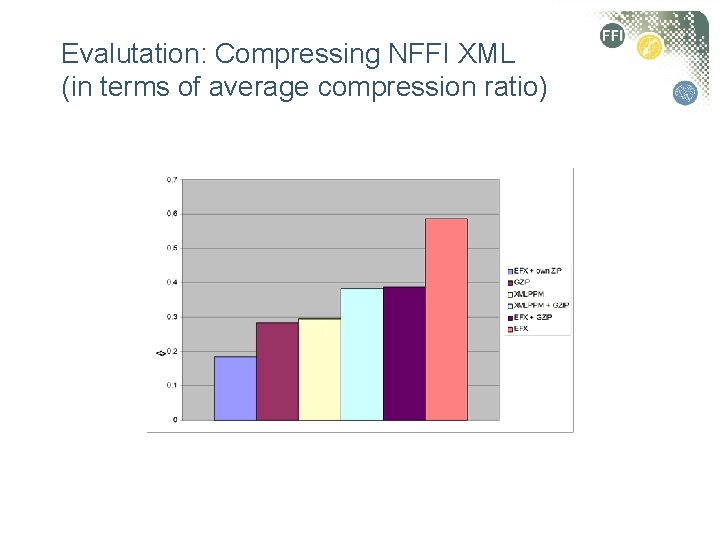
Evalutation: Compressing NFFI XML (in terms of average compression ratio)
Summary • There are significant gains when using compression of XML data. • Tactical networks – compression of some form should be employed – Using the emerging standard for XML compression is probably a good idea. • Standards based COTS products will be available. – (However, all the algorithms we tested reduced the XML document size significantly. )
- Slides: 14