
Using National Disaster Recovery Framework Concepts to Support
- Slides: 42
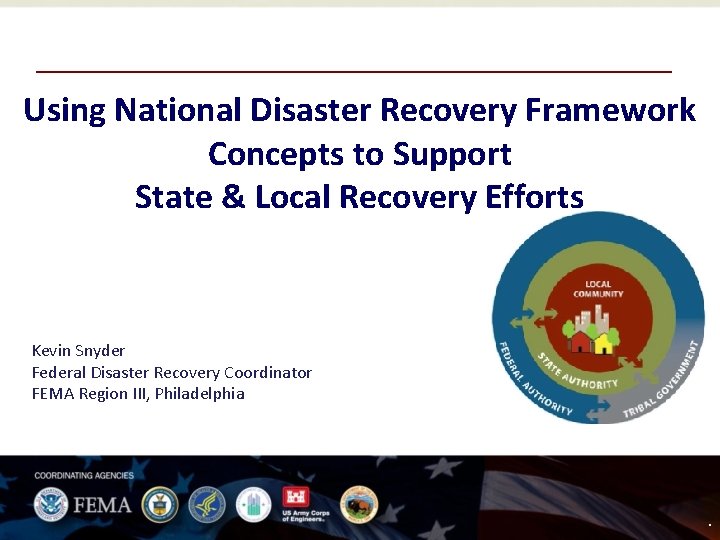
Using National Disaster Recovery Framework Concepts to Support State & Local Recovery Efforts Kevin Snyder Federal Disaster Recovery Coordinator FEMA Region III, Philadelphia .
Central themes for today • Revisit the National Disaster Recovery Framework and its three key concepts • Discuss the benefits of Pre-Disaster Recovery Planning • Discuss examples of recent and ongoing recovery efforts • Present tools and guidance to support state and local government 2
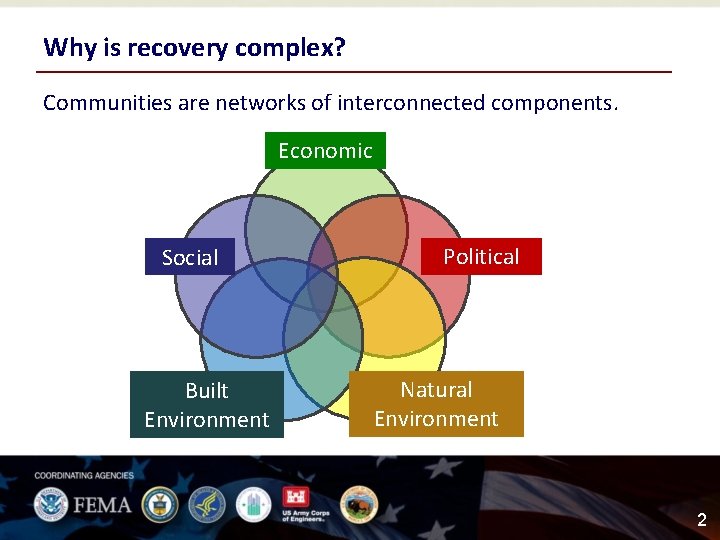
Why is recovery complex? Communities are networks of interconnected components. Economic Social Built Environment Political Natural Environment 2
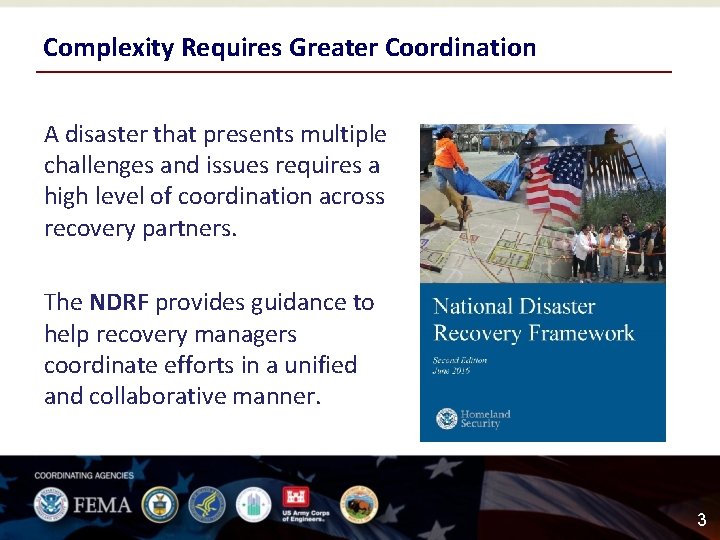
Complexity Requires Greater Coordination A disaster that presents multiple challenges and issues requires a high level of coordination across recovery partners. The NDRF provides guidance to help recovery managers coordinate efforts in a unified and collaborative manner. 3
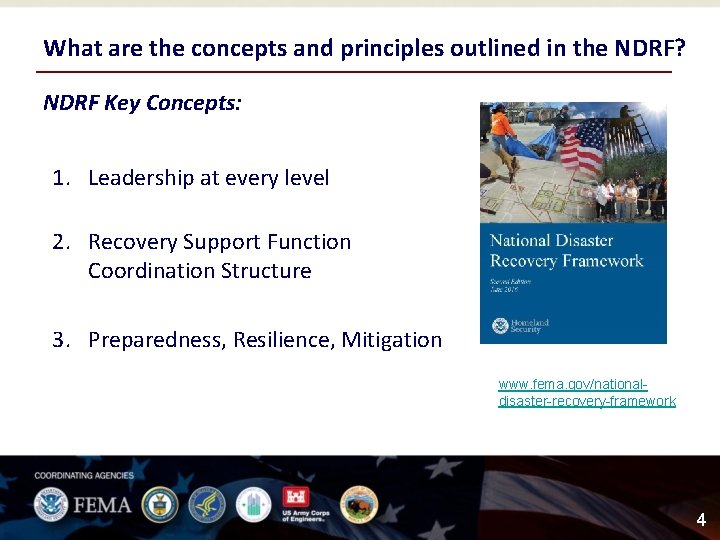
What are the concepts and principles outlined in the NDRF? NDRF Key Concepts: 1. Leadership at every level 2. Recovery Support Function Coordination Structure 3. Preparedness, Resilience, Mitigation www. fema. gov/nationaldisaster-recovery-framework 4
Key Concept #1: Leadership Designated Position: • Federal Disaster Recovery Coordinator (FDRC) Recommended Positions: • Tribal Disaster Recovery Coordinator (TDRC) • State Disaster Recovery Coordinator (SDRC) • Local Disaster Recovery Manager (LDRM) 6
Key Concept #2: Recovery Support Functions • The Recovery Support Functions (RSFs) are the NDRF’s coordinating structure for providing recovery support. • The RSFs are organized into six components and led by designated Federal coordinating agencies at the national level. 7
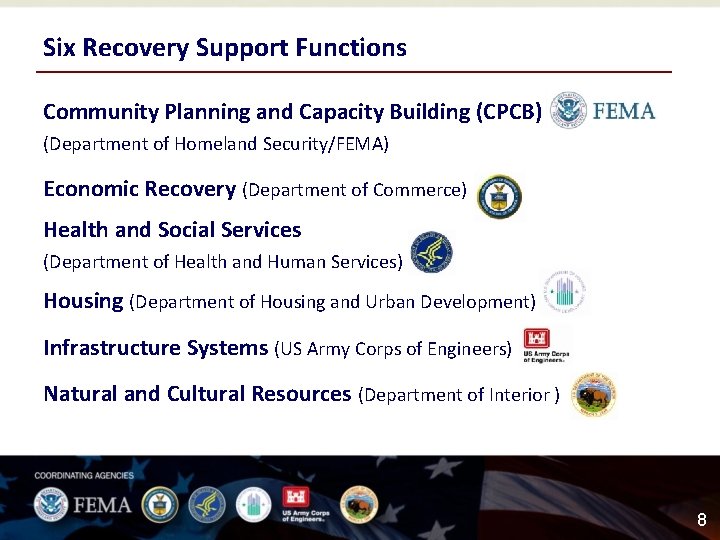
Six Recovery Support Functions Community Planning and Capacity Building (CPCB) (Department of Homeland Security/FEMA) Economic Recovery (Department of Commerce) Health and Social Services (Department of Health and Human Services) Housing (Department of Housing and Urban Development) Infrastructure Systems (US Army Corps of Engineers) Natural and Cultural Resources (Department of Interior ) 8
Key Concept #3: Pre/Post-Disaster Recovery Planning The NDRF promotes the importance of both pre- and post-disaster recovery planning as a key to a wellorchestrated recovery process at the local, state and tribal levels. Pre-disaster recovery planning enables effective coordination of recovery activities and expedites a unified recovery effort Post-disaster recovery planning forms the foundation for allocating resources and provides the benchmark for progress 9
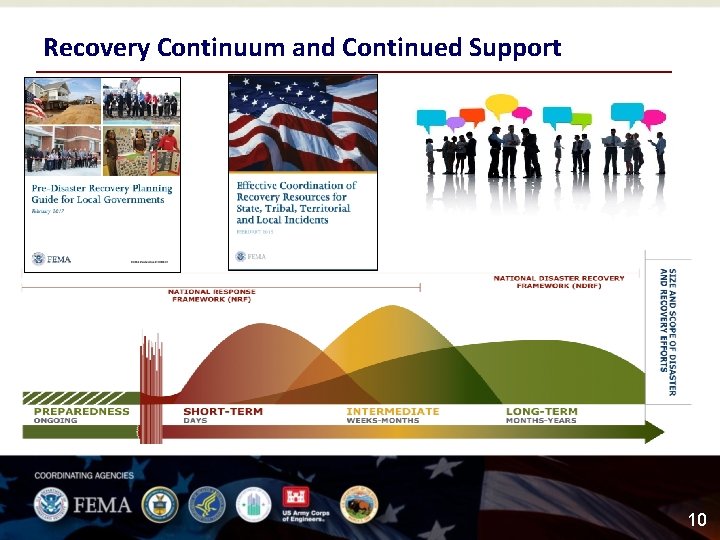
Recovery Continuum and Continued Support • This slide shows a continuum of recovery activity from preparedness (ongoing) to short term (days), intermediate (weeks-months) to long term (months-years). The graphic shows overlapping timelines for short-term, intermediate and long term recovery activities. Along the top of the graphic, there are two lines: one that shows the timeframe covered by the National Response Framework (NRF), the other showing the timeframe covered by the National Disaster Recovery Framework (NDRF). The NRF covers preparedness to intermediate recovery activities. The NDRF covers the entire spectrum of activities. 10
Why Prepare a Pre-Disaster Recovery Plan? • Establish roles for more decisive & early post-disaster recovery leadership • Avoid ad hoc processes • Gain support from whole community partners • Improve public engagement • Facilitate access to and maximize resources • Maximize opportunities to build resilience
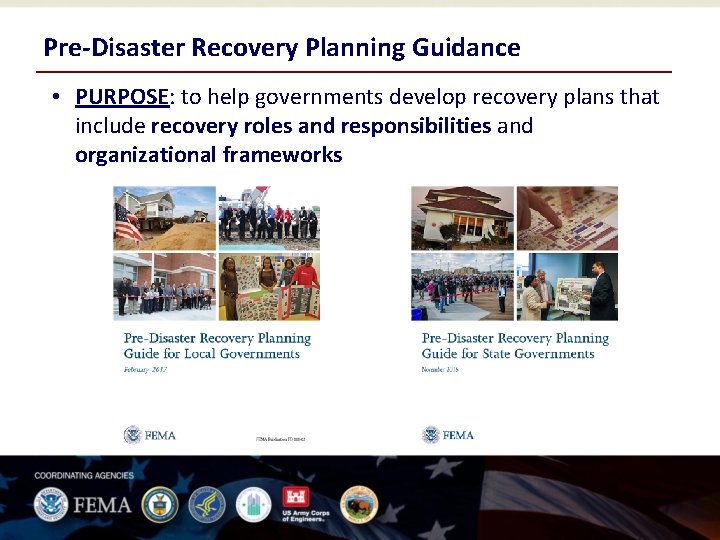
Pre-Disaster Recovery Planning Guidance • PURPOSE: to help governments develop recovery plans that include recovery roles and responsibilities and organizational frameworks
Benefits of a Pre-Disaster Plan? The guides allow State, territorial and local leaders to: § Establish clear leadership roles pre- and post-disaster, allowing for smooth transition into recovery. § Speed identification of needs and resources and ultimately reduce costs that result from ad hoc allocation of resources. § Maximize opportunities to build resilience and risk reduction into all aspects of rebuilding and pro-actively confront recovery § Improve coordination between Local, State, and Federal RSS 13
Key Concepts • Disaster This slide. Recovery shows a continuum of recovery Planning Is: activity from preparedness (ongoing) to short term (days), intermediate (weeks-months) to long term (months-years). The §graphic A Broad, Inclusivetimelines Processfor short-term, intermediate and long term shows overlapping activities. Along the top of the graphic, there are two lines: one that §recovery Integrated with Other Community Plans shows the timeframe covered by the National Response Framework (NRF), the showing. Aligned the timeframe by Mitigation the National Disaster Recovery §other Closely withcovered Hazard (NDRF). The NRF covers preparedness to §Framework Goal Oriented recovery activities. The NDRF covers the entire §intermediate Scalable spectrum of activities. § Comprehensive and Long-term in Scope § Focused on Resilience and Sustainability
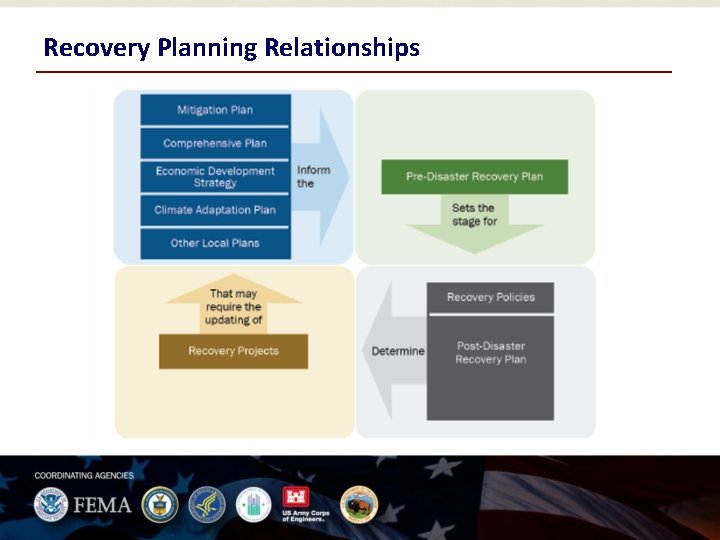
Recovery Planning Relationships
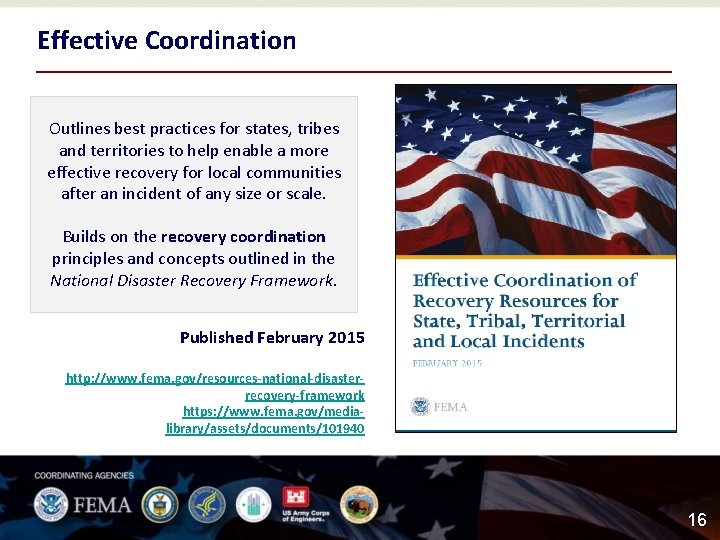
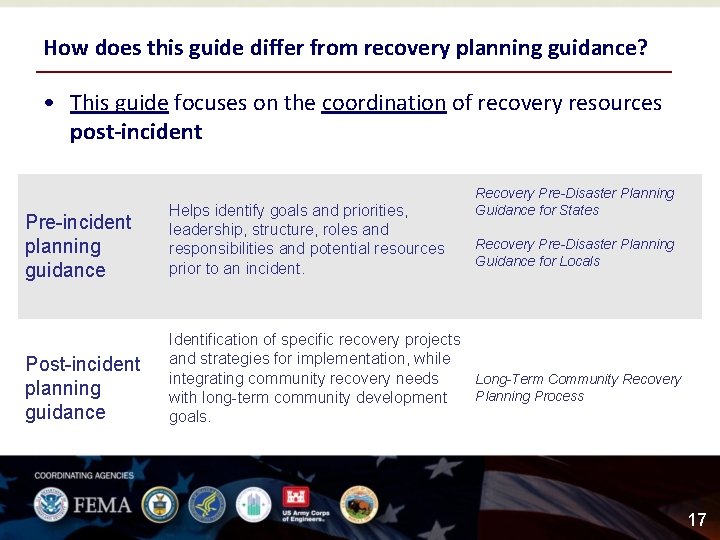
Effective Coordination Outlines best practices for states, tribes and territories to help enable a more effective recovery for local communities after an incident of any size or scale. Builds on the recovery coordination principles and concepts outlined in the National Disaster Recovery Framework. Published February 2015 http: //www. fema. gov/resources-national-disasterrecovery-framework https: //www. fema. gov/medialibrary/assets/documents/101940 16
How does this guide differ from recovery planning guidance? • This guide focuses on the coordination of recovery resources post-incident Recovery Pre-Disaster Planning Guidance for States Pre-incident planning guidance Helps identify goals and priorities, leadership, structure, roles and responsibilities and potential resources prior to an incident. Post-incident planning guidance Identification of specific recovery projects and strategies for implementation, while integrating community recovery needs Long-Term Community Recovery Planning Process with long-term community development goals. Recovery Pre-Disaster Planning Guidance for Locals 17
How is this guide useful? • State, tribal, territorial and local leaders will be better able to: § Lead the recovery coordination process through the identification of leadership and a coordination structure; § Assess and evaluate current and anticipated issues to identify priorities; § Identify and coordinate key resources through understanding various types of resources and the engagement of whole community partners; and § Understand the importance of building resilience into recovery. 18
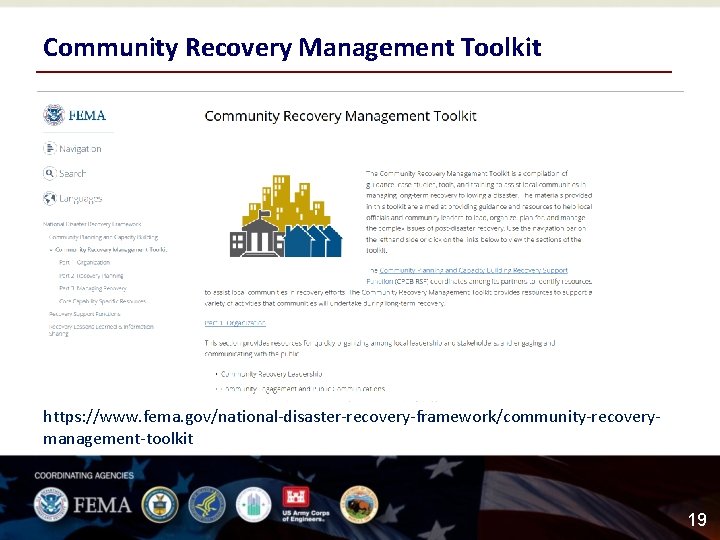
Community Recovery Management Toolkit https: //www. fema. gov/national-disaster-recovery-framework/community-recoverymanagement-toolkit 19
What is it? • Online toolkit with around 200 varied resources with recovery information for local disaster recovery leaders, stakeholders, and staff • Composed of guidance documents, case studies, tools, and training, templates, and examples • Information Geared towards organizing, planning, and managing recovery 20
The NDRF in Action Non Stafford Act Connecticut Public Assistance Only Maryland – Ellicott City Individual and Public Assistance Louisiana West Virginia New York-New Jersey (post-Sandy) 21
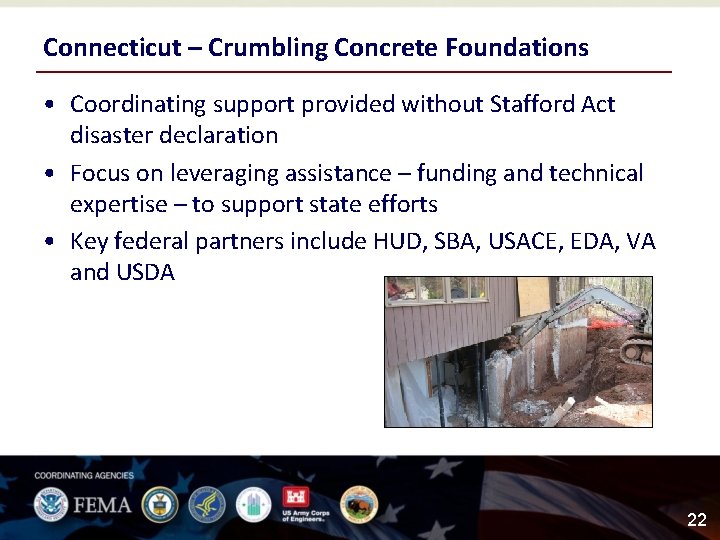
Connecticut – Crumbling Concrete Foundations • Coordinating support provided without Stafford Act disaster declaration • Focus on leveraging assistance – funding and technical expertise – to support state efforts • Key federal partners include HUD, SBA, USACE, EDA, VA and USDA 22
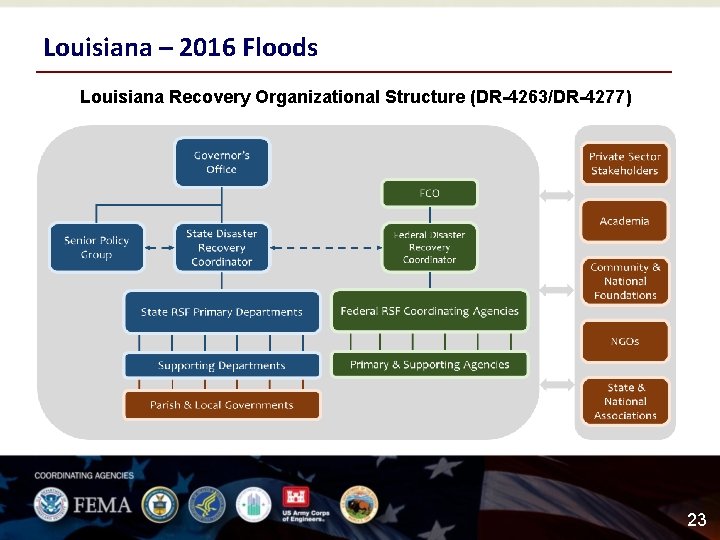
Louisiana – 2016 Floods Louisiana Recovery Organizational Structure (DR-4263/DR-4277) 23
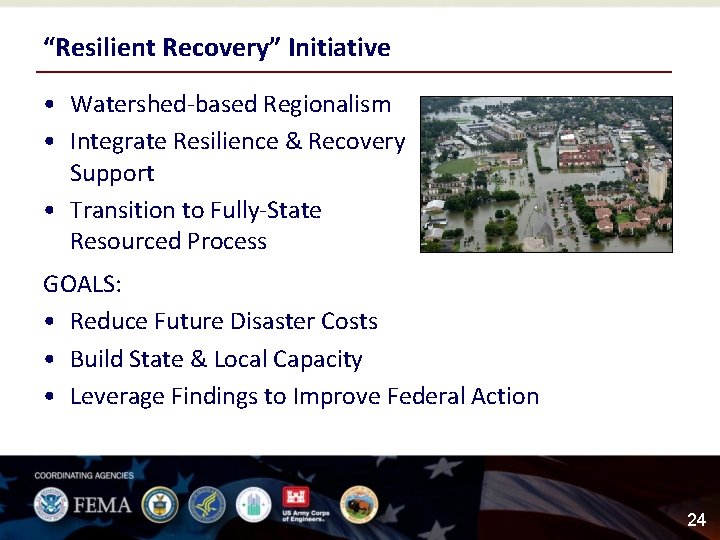
“Resilient Recovery” Initiative • Watershed-based Regionalism • Integrate Resilience & Recovery Support • Transition to Fully-State Resourced Process GOALS: • Reduce Future Disaster Costs • Build State & Local Capacity • Leverage Findings to Improve Federal Action 24
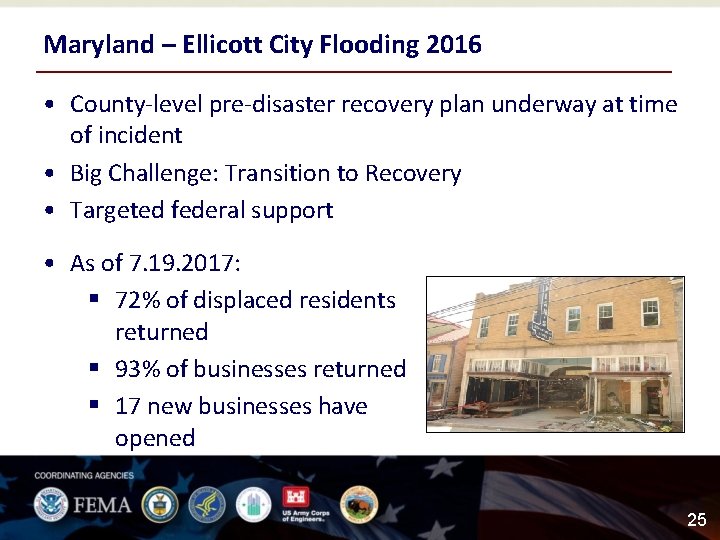
Maryland – Ellicott City Flooding 2016 • County-level pre-disaster recovery plan underway at time of incident • Big Challenge: Transition to Recovery • Targeted federal support • As of 7. 19. 2017: § 72% of displaced residents returned § 93% of businesses returned § 17 new businesses have opened 25
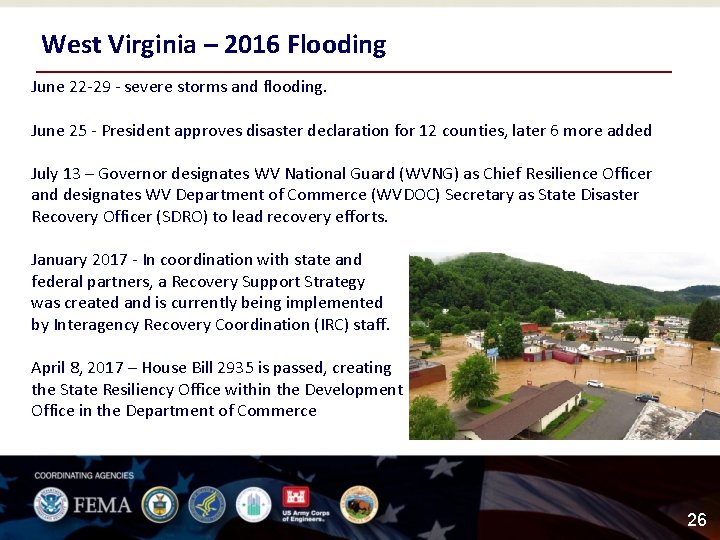
West Virginia – 2016 Flooding June 22 -29 - severe storms and flooding. June 25 - President approves disaster declaration for 12 counties, later 6 more added July 13 – Governor designates WV National Guard (WVNG) as Chief Resilience Officer and designates WV Department of Commerce (WVDOC) Secretary as State Disaster Recovery Officer (SDRO) to lead recovery efforts. January 2017 - In coordination with state and federal partners, a Recovery Support Strategy was created and is currently being implemented by Interagency Recovery Coordination (IRC) staff. April 8, 2017 – House Bill 2935 is passed, creating the State Resiliency Office within the Development Office in the Department of Commerce 26
State Resiliency Office Board 1. Secretary of the Department of Commerce (Chair) 2. Director of the Division of Natural Resources 3. Secretary of the Department of Environmental Protection 4. Executive Director of the State Conservation Agency 5. Secretary of the Department of Military Affairs and Public Safety 6. Secretary of Transportation 7. Adjutant General of the West Virginia National Guard 8. Director of the Division of Homeland Security and Emergency Management within the Department of Military Affairs and Public Safety 27
State Resiliency Office • Recipient of disaster recovery and resiliency funds, excluding federal Stafford Act funds • Coordinating agency of recovery and resiliency efforts, including matching funds for other disaster recovery programs • Excludes those funds and efforts under the direct control of the State Coordinating Officer designated by the Governor for a particular event 28
State Resiliency Office The creation of the SRO will make the state more resilient and better prepared for future disaster by: § Annually reviewing the state flood protection plan and updating biannually. § Recommending legislation to reduce or mitigate flood damage. § Coordinating flood projects with federal and local entities. § Providing education and outreach to the public regarding flooding issues. § Monitoring funding opportunities to improve disaster recovery and resilience. § Expanding and improving planning efforts in hazard mitigation and longterm disaster recovery. 29
Establishment of the Resiliency Framework A resiliency framework provides a collaborative forum to assess current risks, plans and practices, and to build resiliency into policies, actions and investments across multiple sectors. It is meant to build on existing plans, policies and investments through the assessment of existing conditions in the community. Critical components includes: • A common understanding of resiliency and how it relates to state values; • An analysis of baseline existing conditions in the state and the shocks and stresses that it faces; • An inclusive engagement process that informs the public about the importance of resiliency, and informs the planning team as it develops the Framework; • A vision for the state that is supported by the forward-looking goals, actionable strategies, and projects for action; and • An articulated roadmap for ongoing coordination and action. 30
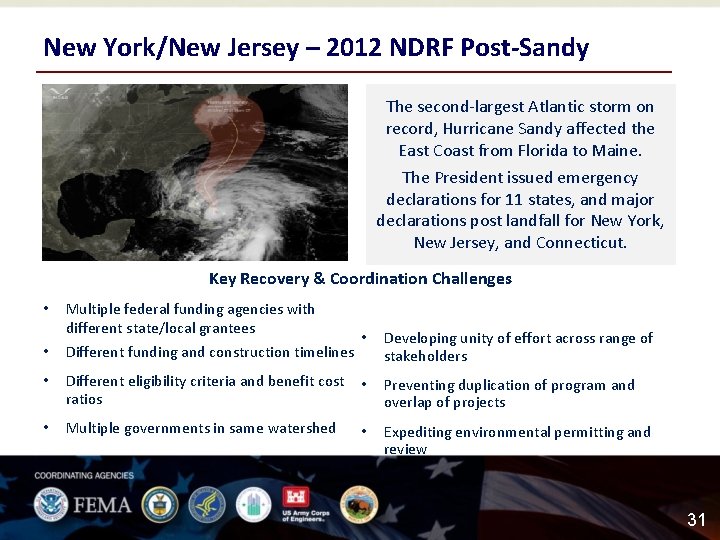
New York/New Jersey – 2012 NDRF Post-Sandy The second-largest Atlantic storm on record, Hurricane Sandy affected the East Coast from Florida to Maine. The President issued emergency declarations for 11 states, and major declarations post landfall for New York, New Jersey, and Connecticut. Key Recovery & Coordination Challenges Multiple federal funding agencies with different state/local grantees • Different funding and construction timelines Developing unity of effort across range of stakeholders • Different eligibility criteria and benefit cost ratios • Preventing duplication of program and overlap of projects • Multiple governments in same watershed • Expediting environmental permitting and review • • 31
Post-Sandy Regional Infrastructure Investments The scale of the disaster across multiple states led to over $51 billion in federal aid through the Disaster Relief Appropriations Act/Sandy Recovery Improvement Act of 2013 (Public Law 113 -2) as well as utilization of appropriate existing programs. Key Federal Programs for Resilient Infrastructure in the Region DOI: Hurricane Sandy Coastal Resiliency Competitive Grant Program DOT: FHWA Emergency Relief Program; FTA Emergency Relief Program; Sandy Competitive Resilience Grant Program EPA: Clean Water State Revolving Fund (annual + Sandy Supplemental); Drinking Water State Revolving Fund (annual + Sandy Supplemental) FEMA: Public Assistance; Hazard Mitigation Grant Program HUD: Community Development Block Grant - Disaster Recovery (CDBG-DR) NOAA: Coastal Resilience Networks; Cooperative Institute of North American Research USACE: Civil Works Program; Regulatory Program; Sandy Supplemental appropriations USDA: Natural Resources Conservation Service Emergency Watershed Protection Program 32
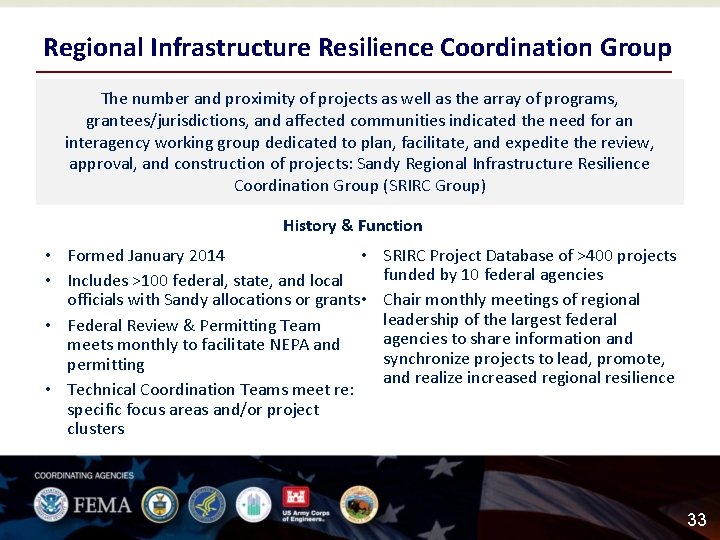
Regional Infrastructure Resilience Coordination Group The number and proximity of projects as well as the array of programs, grantees/jurisdictions, and affected communities indicated the need for an interagency working group dedicated to plan, facilitate, and expedite the review, approval, and construction of projects: Sandy Regional Infrastructure Resilience Coordination Group (SRIRC Group) History & Function • • Formed January 2014 • Includes >100 federal, state, and local officials with Sandy allocations or grants • • Federal Review & Permitting Team meets monthly to facilitate NEPA and permitting • Technical Coordination Teams meet re: specific focus areas and/or project clusters SRIRC Project Database of >400 projects funded by 10 federal agencies Chair monthly meetings of regional leadership of the largest federal agencies to share information and synchronize projects to lead, promote, and realize increased regional resilience 33
Questions and Discussion Kevin Snyder Federal Disaster Recovery Coordinator FEMA Region III kevin. snyder@fema. dhs. gov 34
BACKUP SLIDES 35
Pennsylvania Case Study Seven major disaster declarations since 2007 led the Commonwealth to identify the need for a new approach to disaster recovery and preparedness. Two main goals: 1. Develop an established coordination structure 2. Create a Commonwealth Disaster Recovery Plan In 2012 an EDA grant issued to the PA Department of Economic Development (DCED) provided PA with the capacity to set up the Recovery Resources Team and formalize a recovery plan. 36
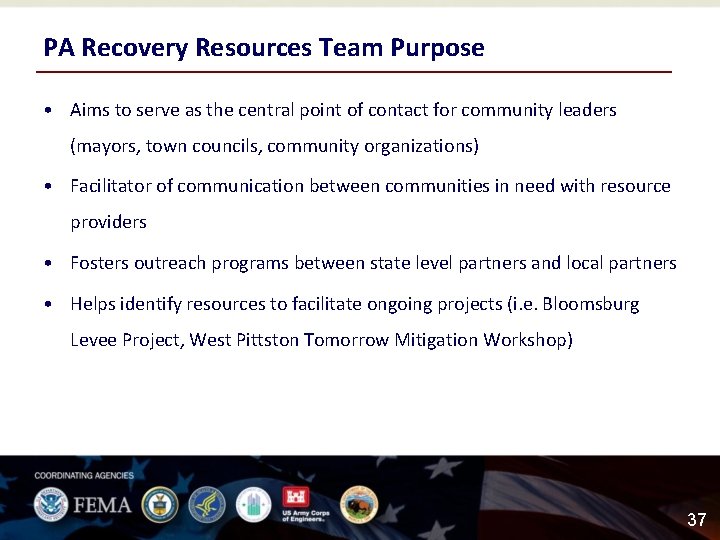
PA Recovery Resources Team Purpose • Aims to serve as the central point of contact for community leaders (mayors, town councils, community organizations) • Facilitator of communication between communities in need with resource providers • Fosters outreach programs between state level partners and local partners • Helps identify resources to facilitate ongoing projects (i. e. Bloomsburg Levee Project, West Pittston Tomorrow Mitigation Workshop) 37
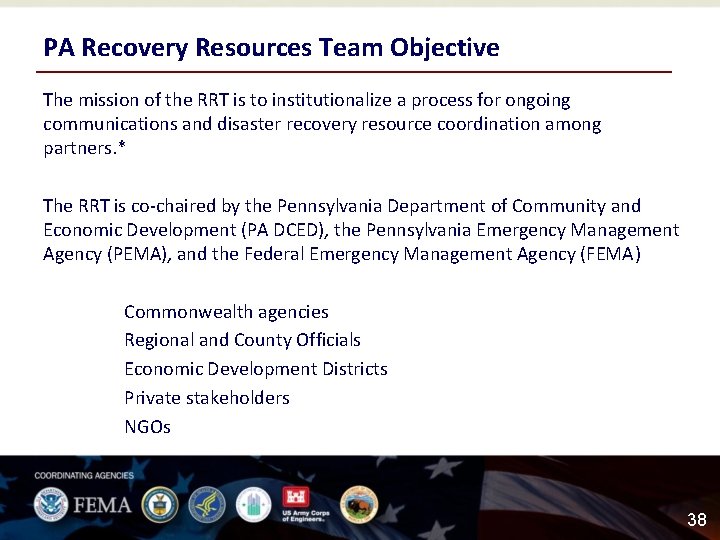
PA Recovery Resources Team Objective The mission of the RRT is to institutionalize a process for ongoing communications and disaster recovery resource coordination among partners. * The RRT is co-chaired by the Pennsylvania Department of Community and Economic Development (PA DCED), the Pennsylvania Emergency Management Agency (PEMA), and the Federal Emergency Management Agency (FEMA) Commonwealth agencies Regional and County Officials Economic Development Districts Private stakeholders NGOs 38
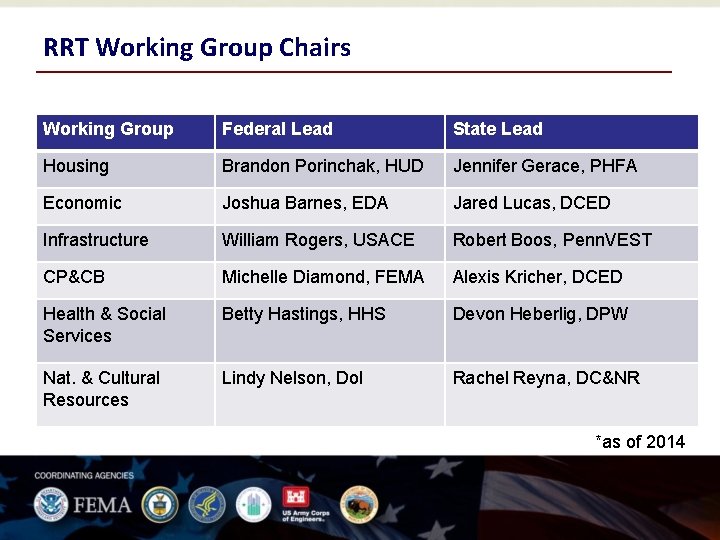
RRT Working Group Chairs Working Group Federal Lead State Lead Housing Brandon Porinchak, HUD Jennifer Gerace, PHFA Economic Joshua Barnes, EDA Jared Lucas, DCED Infrastructure William Rogers, USACE Robert Boos, Penn. VEST CP&CB Michelle Diamond, FEMA Alexis Kricher, DCED Health & Social Services Betty Hastings, HHS Devon Heberlig, DPW Nat. & Cultural Resources Lindy Nelson, Do. I Rachel Reyna, DC&NR *as of 2014
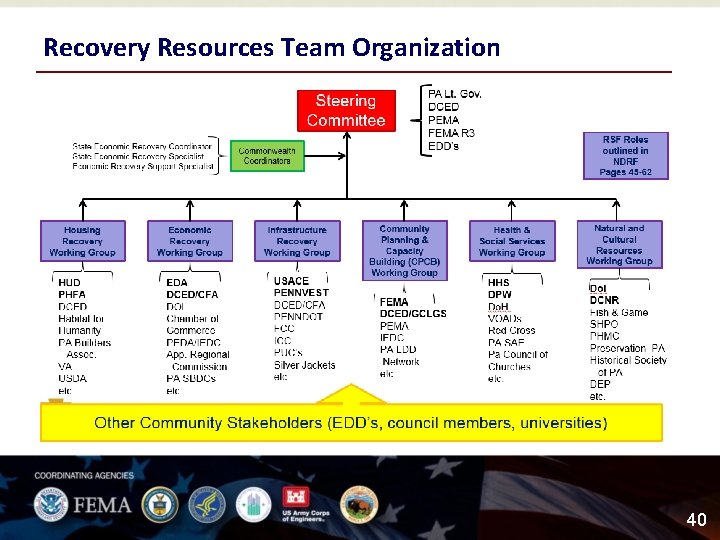
Recovery Resources Team Organization 40
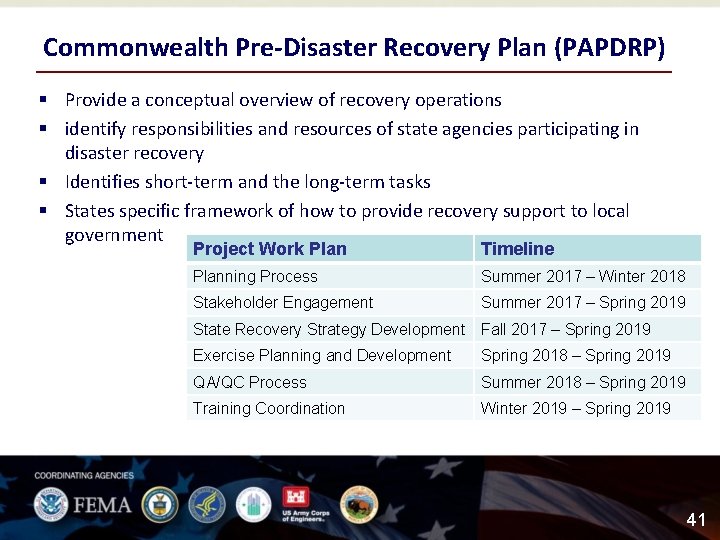
Commonwealth Pre-Disaster Recovery Plan (PAPDRP) § Provide a conceptual overview of recovery operations § identify responsibilities and resources of state agencies participating in disaster recovery § Identifies short-term and the long-term tasks § States specific framework of how to provide recovery support to local government Project Work Plan Timeline Planning Process Summer 2017 – Winter 2018 Stakeholder Engagement Summer 2017 – Spring 2019 State Recovery Strategy Development Fall 2017 – Spring 2019 Exercise Planning and Development Spring 2018 – Spring 2019 QA/QC Process Summer 2018 – Spring 2019 Training Coordination Winter 2019 – Spring 2019 41
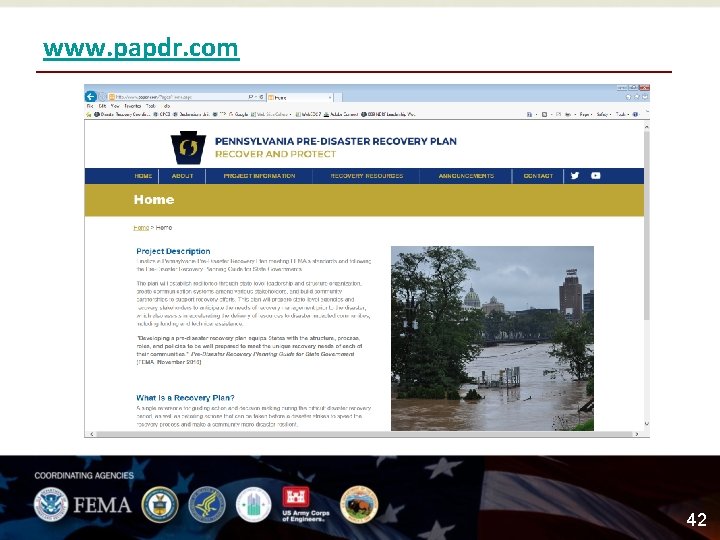
www. papdr. com 42