
Using NASA Remote Sensing Data to Reduce Uncertainty
- Slides: 6
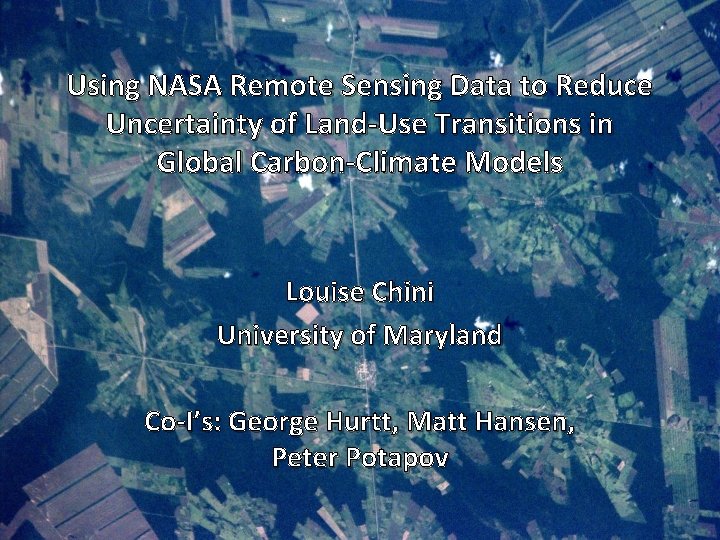
Using NASA Remote Sensing Data to Reduce Uncertainty of Land-Use Transitions in Global Carbon-Climate Models Louise Chini University of Maryland Co-I’s: George Hurtt, Matt Hansen, Peter Potapov
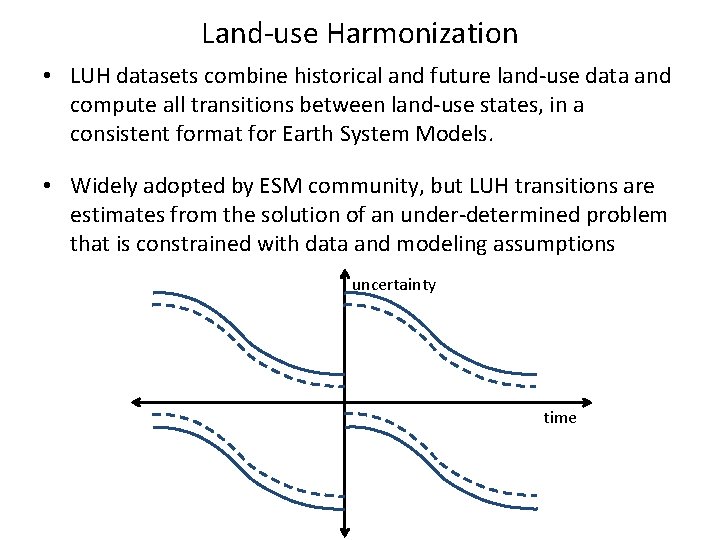
Land-use Harmonization • LUH datasets combine historical and future land-use data and compute all transitions between land-use states, in a consistent format for Earth System Models. • Widely adopted by ESM community, but LUH transitions are estimates from the solution of an under-determined problem that is constrained with data and modeling assumptions uncertainty time
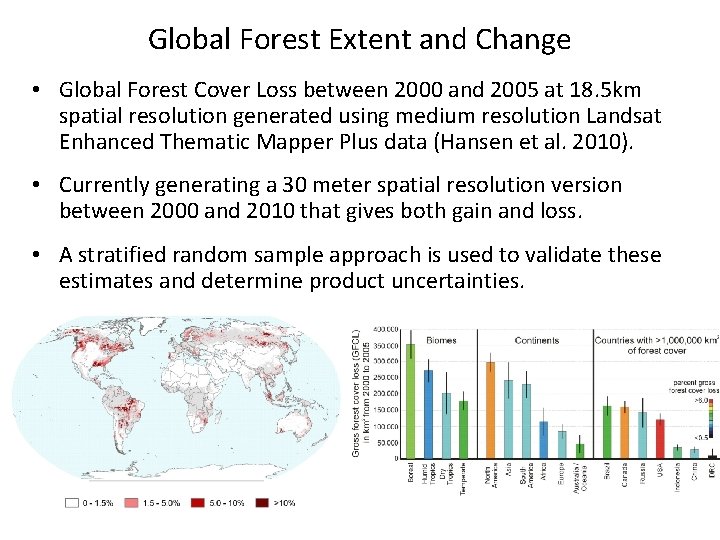
Global Forest Extent and Change • Global Forest Cover Loss between 2000 and 2005 at 18. 5 km spatial resolution generated using medium resolution Landsat Enhanced Thematic Mapper Plus data (Hansen et al. 2010). • Currently generating a 30 meter spatial resolution version between 2000 and 2010 that gives both gain and loss. • A stratified random sample approach is used to validate these estimates and determine product uncertainties.
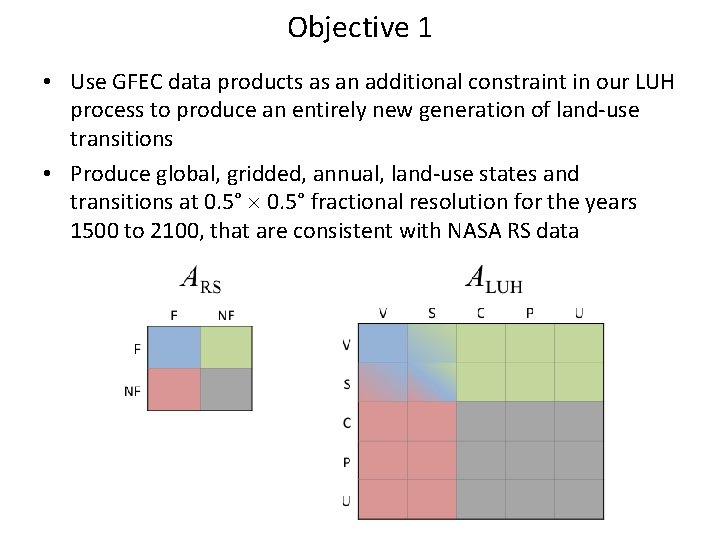
Objective 1 • Use GFEC data products as an additional constraint in our LUH process to produce an entirely new generation of land-use transitions • Produce global, gridded, annual, land-use states and transitions at 0. 5° fractional resolution for the years 1500 to 2100, that are consistent with NASA RS data
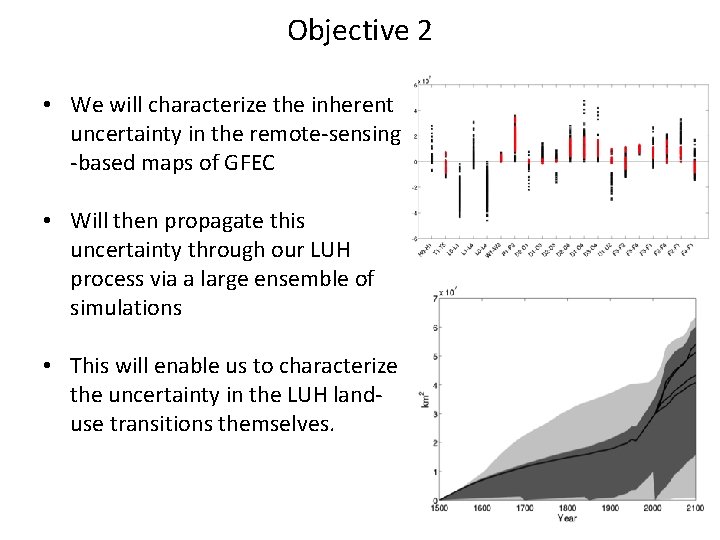
Objective 2 • We will characterize the inherent uncertainty in the remote-sensing -based maps of GFEC • Will then propagate this uncertainty through our LUH process via a large ensemble of simulations • This will enable us to characterize the uncertainty in the LUH landuse transitions themselves.
Expected Outcomes • Will generate new, improved LUH datasets • Will characterize and reduce uncertainty in these datasets • Data will be available to scientific community – expect it to be rapidly employed by ESMs for coupled climate carbon simulations • Data will be archived at ORNL DAAC. Will follow best practices for producing metadata and preparing datasets for public dissemination • New GLM framework should enable us to use additional layers of RS data in future to further constraint LU transitions