
Using Monitoring Strategies to Plan and Build Comprehensive
Using Monitoring Strategies to Plan and Build Comprehensive and Balanced Water Monitoring Programs
Discussion Topics • What is a Monitoring Strategy (functions, goals) • Why Monitoring Strategies are Needed • The Role Strategies Can Play in Achieving our National Vision for Monitoring • Strategy Implementation Issues • Evaluating Monitoring Strategies, How and Why – (including the 10 elements) • Region 7’s Steps Toward Constructing a Monitoring Strategy
What is a Monitoring Strategy? • A planning and coordination document that: – 1) Describes the current monitoring program – 2) Identifies and prioritizes the resource monitoring gaps and weaknesses of the current monitoring program – 3) Lays out a long-term plan for building an adequate water monitoring program to achieve the following: – national strategy goals: • • comprehensive coverage of all resources good monitoring and assessment science create a balanced program address all 10 elements of an adequate program
Why Monitoring Strategies are Needed 1 Inadequate resources (gap = 150 million) to meet a variety of competing CWA monitoring and assessment needs: 305 b, 303 d, WQ Standards, NPDES, 319, permits, etc. 2 Imperfect and incomplete set of monitoring and assessment tools to meet all these objectives. 3 Communications and strategic planning challenges. Implementation of good strategies almost forces us to overcome these nearly lethal organizational and personal challenges that, also stand in the way of achieving our vision for monitoring.
Vision for the Future • We have adequate monitoring data to assess water quality and make sound management decisions • Actions we take are effective to protect and restore water quality
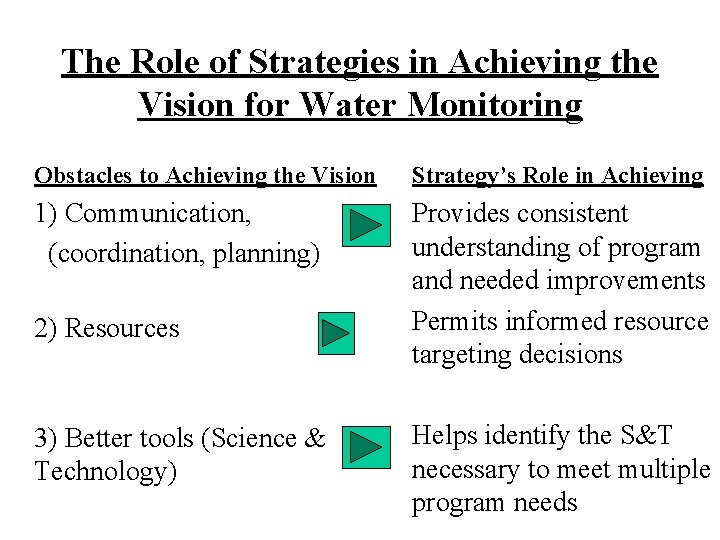
The Role of Strategies in Achieving the Vision for Water Monitoring Obstacles to Achieving the Vision Strategy’s Role in Achieving 1) Communication, (coordination, planning) Provides consistent understanding of program and needed improvements Permits informed resource targeting decisions 2) Resources 3) Better tools (Science & Technology) Helps identify the S&T necessary to meet multiple program needs
Important Points about Strategies and Building Monitoring Programs • A strategy is only a plan. Nothing is accomplished if it is not communicated or implemented. • Implementing the strategy may be more difficult than drafting it as implementation requires resources, and processes for communication and strategic planning regarding meeting monitoring needs.

Strategy Implementation Issues • Linking the Strategy to Resources (106, PPG, 319, etc. ) • How to Prioritize Among Gaps, Weaknesses, 10 Elements • Timing and Responsibility for Updates and Revisions • Communication / Coordination: – You must provide and deliver a strategy and, create processes that insure a consistent understanding between staff and management, (EPA and states) of the monitoring program’s condition and its needs? It’s not enough to e-mail a copy of the strategy and expect people to read and understand it.
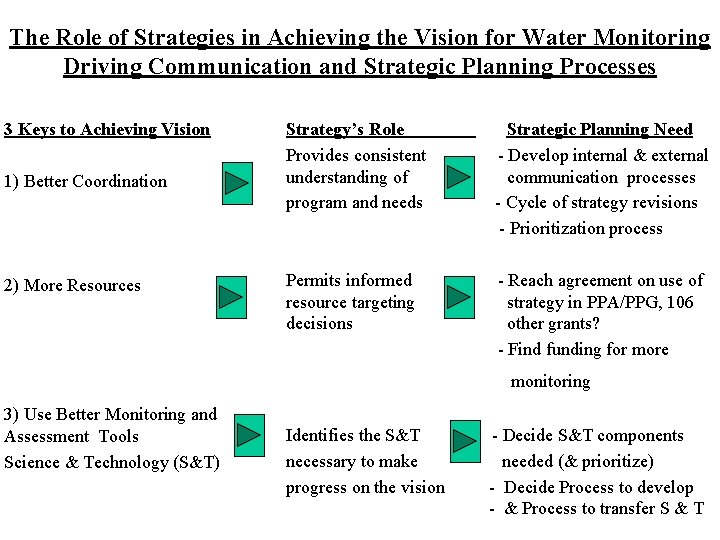
The Role of Strategies in Achieving the Vision for Water Monitoring Driving Communication and Strategic Planning Processes 3 Keys to Achieving Vision 1) Better Coordination 2) More Resources Strategy’s Role Provides consistent understanding of program and needs Strategic Planning Need - Develop internal & external communication processes - Cycle of strategy revisions - Prioritization process Permits informed resource targeting decisions - Reach agreement on use of strategy in PPA/PPG, 106 other grants? - Find funding for more monitoring 3) Use Better Monitoring and Assessment Tools Science & Technology (S&T) Identifies the S&T necessary to make progress on the vision - Decide S&T components needed (& prioritize) - Decide Process to develop - & Process to transfer S & T
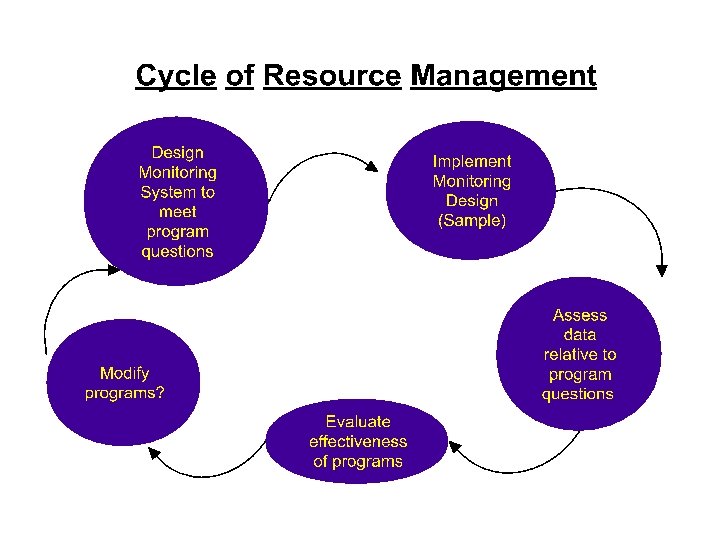
Strategy Implementation Issues (continued) • Lack of experience and process to evaluate monitoring programs (element #9) “The state must conduct periodic reviews of each aspect of the monitoring program to determine how well the program serves its water quality decision needs” • Lack of experience and process to evaluate our resource protection programs and, to complete the “Cycle of Resource Management”
Evaluating Monitoring Programs • Why are program evaluations necessary? – We need good, consistent national, Regional and state level information about the strengths and weaknesses of our monitoring programs so that effective decisions can be made about how to best improve monitoring. • How are programs evaluated? – For consistency with the 10 elements guidance using a nationally consistent measuring system. • Who does the evaluation? – Your Regional EPA Monitoring Coordinator • Recommendation: – Work with your EPA Monitoring Coordinator to develop a good strategy
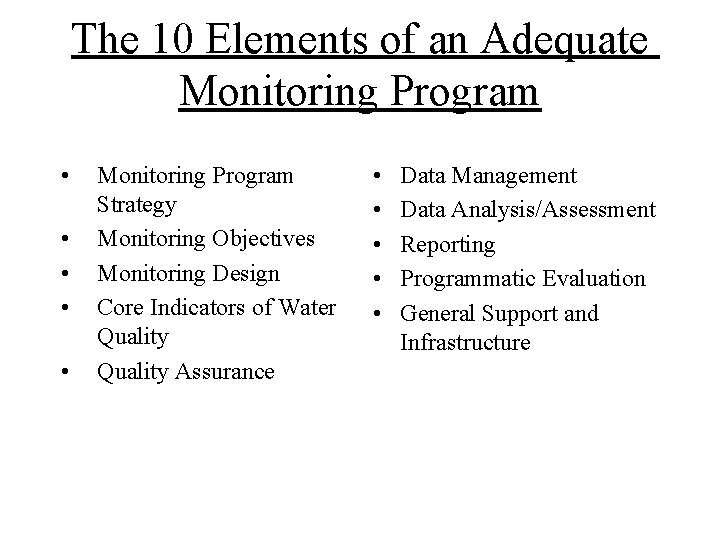
The 10 Elements of an Adequate Monitoring Program • • • Monitoring Program Strategy Monitoring Objectives Monitoring Design Core Indicators of Water Quality Assurance • • • Data Management Data Analysis/Assessment Reporting Programmatic Evaluation General Support and Infrastructure
Region 7’s Steps for Constructing a Strategy • Describe the state’s program (+ understand what other agencies are doing to monitor in the state) • Identify and lay out all program objectives • Inventory all water resource classes (How much of each kind) • Examine the monitoring of design for each class to identify the resource coverage gaps or design (science) issues. • Examine the monitoring system for ability to meet program objectives and other science issues (program weaknesses) such as inadequate indicators or reference condition, etc. • Evaluate the system against the remainder of the 10 elements. • Develop a strategy to address each gap and weakness (include what other agencies are doing) • Prioritize the gaps and weaknesses • Address the implementation issues early and often
Iowa Strategy as a Region 7 Model • Features: – Complete description of the current monitoring program – A Description of all the following: • gaps = primarily unmonitored or unassessed resource classes • weaknesses = assessment deficiency (e. g. , lack of appropriately defined reference conditions and/or indicators) • opportunities to improve the program (e. g. , coordination) – A discussion of Root Causes of the gaps and weaknesses – A detailed plan to address each gap and weakness (including timeline, costs, priority, etc. )
- Slides: 15