
Using Modifiers STANDARD W 1 2 SWBAT USE
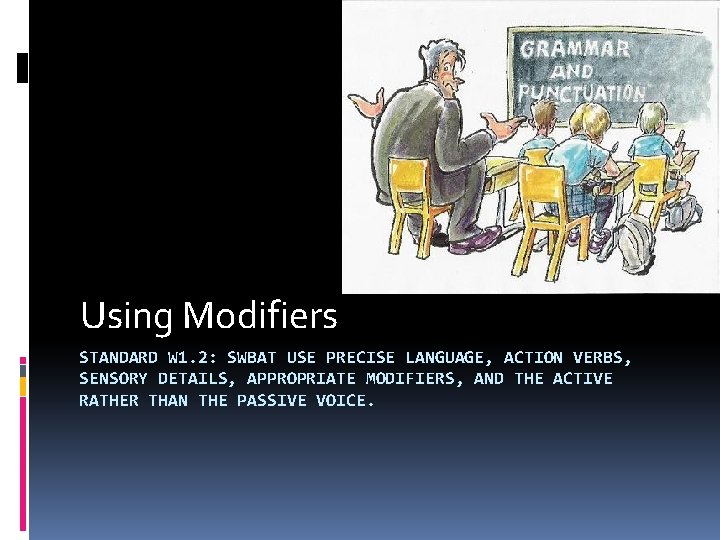
Using Modifiers STANDARD W 1. 2: SWBAT USE PRECISE LANGUAGE, ACTION VERBS, SENSORY DETAILS, APPROPRIATE MODIFIERS, AND THE ACTIVE RATHER THAN THE PASSIVE VOICE.
What is a Modifier? Modifiers are adjectives and adverbs; they modify nouns and verbs by describing them. A common problem in writing is with comparisons made using modifiers. Comparative Degree: compares two people, places, or things (one is better or more than the other) Superlative Degree: compares three or more people, places, things (one is the best out of all the others)
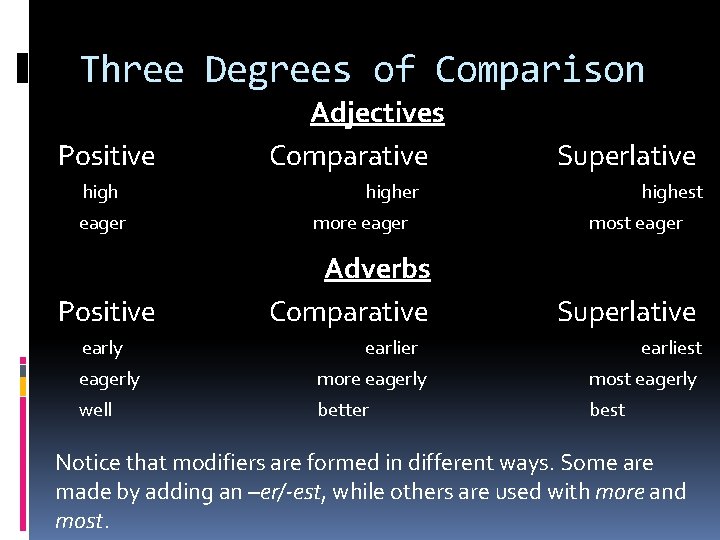
Three Degrees of Comparison Positive high eager Positive early Adjectives Comparative Superlative higher more eager Adverbs Comparative highest most eager Superlative earlier earliest eagerly more eagerly most eagerly well better best Notice that modifiers are formed in different ways. Some are made by adding an –er/-est, while others are used with more and most.
Regular and Irregular Forms Regular Modifiers are usually formed by adding an –er to the comparative degree, and an –est to the superlative degree. Ex: green dark greener greenest darkerdarkest Regular Modifiers that sound awkward with an –er or –est use more and most instead. Ex: crisp humid more crisp more humid most crisp most Adverbs that end in –ly use more and most. Ex: quickly more quickly most quickly
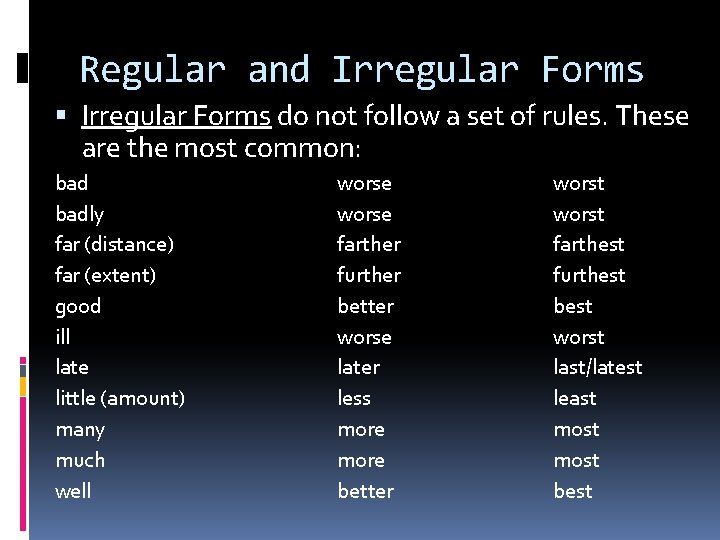
Regular and Irregular Forms do not follow a set of rules. These are the most common: badly far (distance) far (extent) good ill late little (amount) many much well worse farther further better worse later less more better worst farthest furthest best worst last/latest least most best
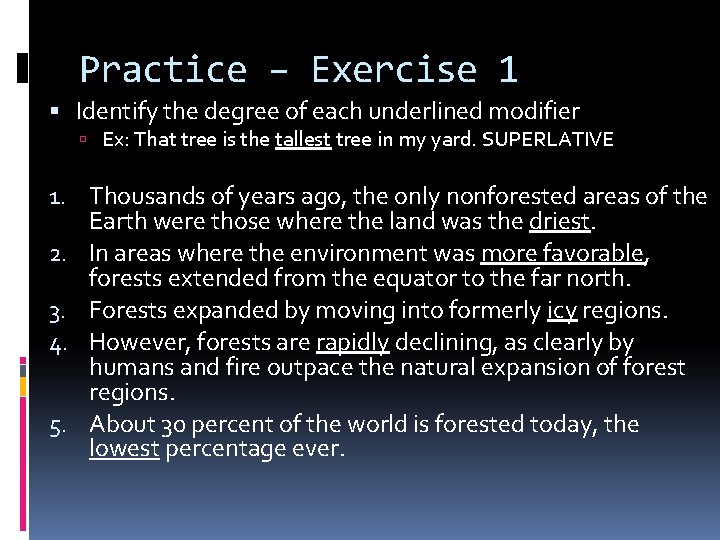
Practice – Exercise 1 Identify the degree of each underlined modifier Ex: That tree is the tallest tree in my yard. SUPERLATIVE 1. Thousands of years ago, the only nonforested areas of the Earth were those where the land was the driest. 2. In areas where the environment was more favorable, forests extended from the equator to the far north. 3. Forests expanded by moving into formerly icy regions. 4. However, forests are rapidly declining, as clearly by humans and fire outpace the natural expansion of forest regions. 5. About 30 percent of the world is forested today, the lowest percentage ever.
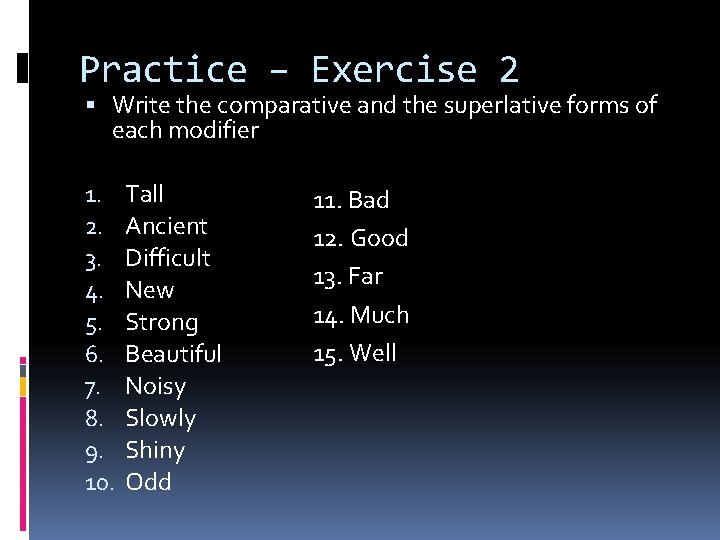
Practice – Exercise 2 Write the comparative and the superlative forms of each modifier 1. 2. 3. 4. 5. 6. 7. 8. 9. 10. Tall Ancient Difficult New Strong Beautiful Noisy Slowly Shiny Odd 11. Bad 12. Good 13. Far 14. Much 15. Well
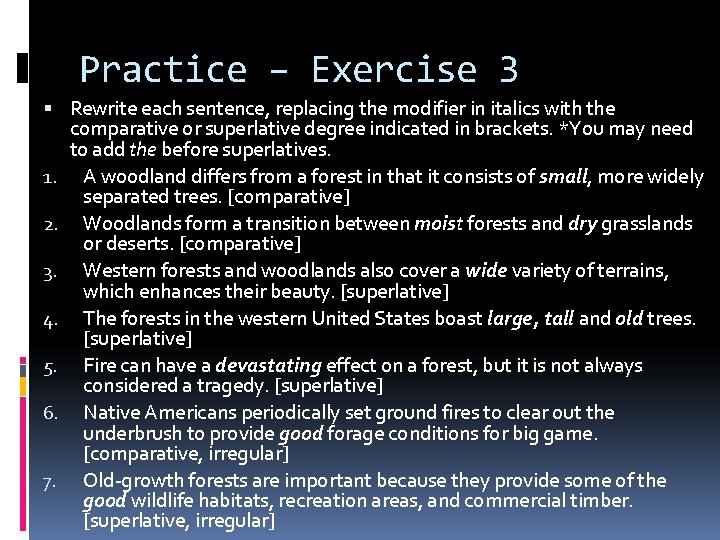
Practice – Exercise 3 Rewrite each sentence, replacing the modifier in italics with the comparative or superlative degree indicated in brackets. *You may need to add the before superlatives. 1. A woodland differs from a forest in that it consists of small, more widely separated trees. [comparative] 2. Woodlands form a transition between moist forests and dry grasslands or deserts. [comparative] 3. Western forests and woodlands also cover a wide variety of terrains, which enhances their beauty. [superlative] 4. The forests in the western United States boast large, tall and old trees. [superlative] 5. Fire can have a devastating effect on a forest, but it is not always considered a tragedy. [superlative] 6. Native Americans periodically set ground fires to clear out the underbrush to provide good forage conditions for big game. [comparative, irregular] 7. Old-growth forests are important because they provide some of the good wildlife habitats, recreation areas, and commercial timber. [superlative, irregular]
- Slides: 8