
Using MIS 10 th Edition Chapter 9 Business
Using MIS 10 th Edition Chapter 9 Business Intelligence Systems Copyright © 2018, 2017, 2016 Pearson Education, Inc. All Rights Reserved 9 -1
“Data Analysis, Where You Don’t Know the Second Question to Ask Until You See the Answer to the First One. ” • Having great success with employers interested in tracking exercise data. • Wants to match users to personal trainers in same locale. • Earn referral fee. • How to track them? Mailing address? IP address? • Got data and Excel to start. • Serious data mining needs a data mart. Copyright © 2018, 2017, 2016 Pearson Education, Inc. All Rights Reserved 9 -2
Study Questions Q 9 -1 How do organizations use business intelligence (BI) systems? Q 9 -2 What are three primary activities in the BI process? Q 9 -3 How do organizations use data warehouses and data marts to acquire data? Q 9 -4 How do organizations use reporting applications? Q 9 -5 How do organizations use data mining applications? Q 9 -6 How do organizations use Big Data applications? Q 9 -7 What is the role of knowledge management systems? Q 9 -8 What are the alternatives for publishing BI? Q 9 -9 2027? Copyright © 2018, 2017, 2016 Pearson Education, Inc. All Rights Reserved 9 -3
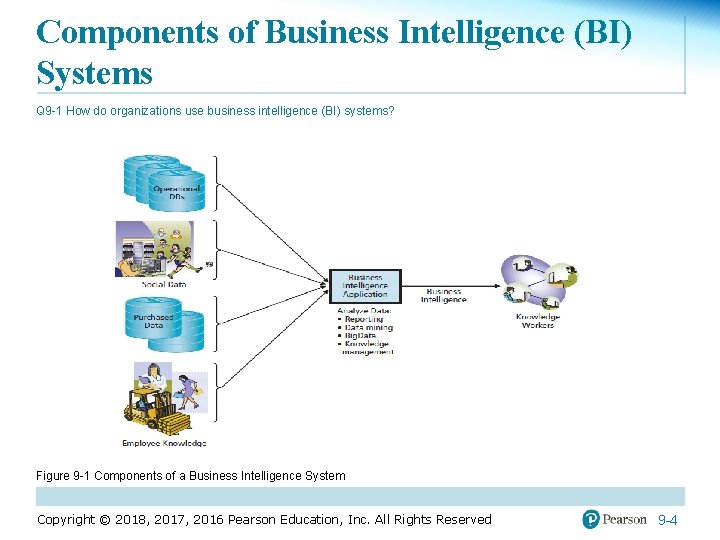
Components of Business Intelligence (BI) Systems Q 9 -1 How do organizations use business intelligence (BI) systems? Figure 9 -1 Components of a Business Intelligence System Copyright © 2018, 2017, 2016 Pearson Education, Inc. All Rights Reserved 9 -4
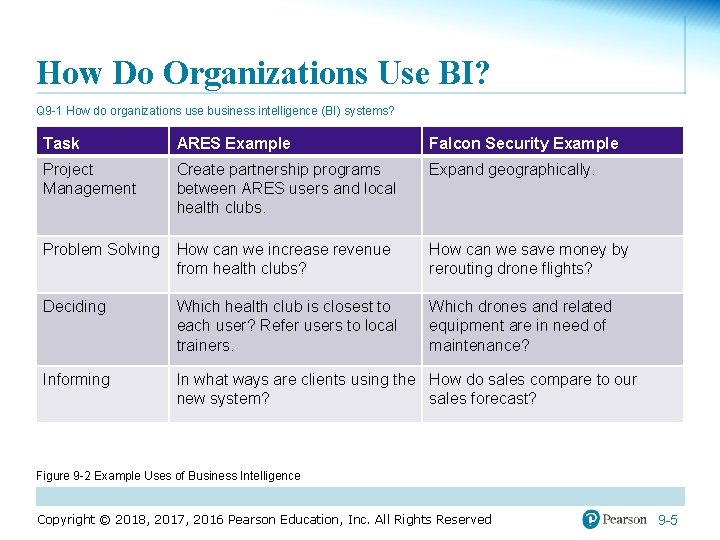
How Do Organizations Use BI? Q 9 -1 How do organizations use business intelligence (BI) systems? Task ARES Example Falcon Security Example Project Management Create partnership programs between ARES users and local health clubs. Expand geographically. Problem Solving How can we increase revenue from health clubs? How can we save money by rerouting drone flights? Deciding Which health club is closest to each user? Refer users to local trainers. Which drones and related equipment are in need of maintenance? Informing In what ways are clients using the How do sales compare to our new system? sales forecast? Figure 9 -2 Example Uses of Business Intelligence Copyright © 2018, 2017, 2016 Pearson Education, Inc. All Rights Reserved 9 -5
What Are Typical Uses for BI? Q 9 -1 How do organizations use business intelligence (BI) systems? • Identifying changes in purchasing patterns – Important life events change what customers buy. • Entertainment – Netflix has data on watching, listening, and rental habits. – Classify customers by viewing patterns. • Predictive policing – Analyze data on past crimes - location, date, time, day of week, type of crime, and related data. Copyright © 2018, 2017, 2016 Pearson Education, Inc. All Rights Reserved 9 -6
Just-in-Time Medical Reporting Q 9 -1 How do organizations use business intelligence (BI) systems? • Example of real time data mining and reporting. • Injection notification services – Software analyzes patient’s records; if injections needed, recommends as exam progresses. • Blurry edge of medical ethics. Copyright © 2018, 2017, 2016 Pearson Education, Inc. All Rights Reserved 9 -7
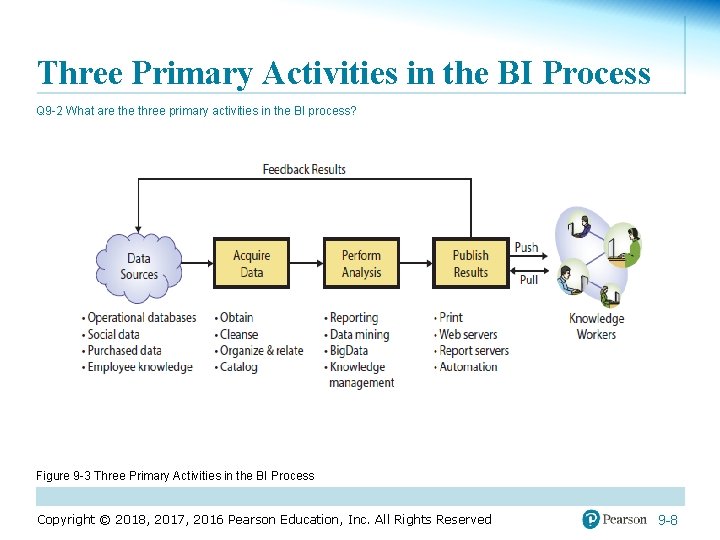
Three Primary Activities in the BI Process Q 9 -2 What are three primary activities in the BI process? Figure 9 -3 Three Primary Activities in the BI Process Copyright © 2018, 2017, 2016 Pearson Education, Inc. All Rights Reserved 9 -8
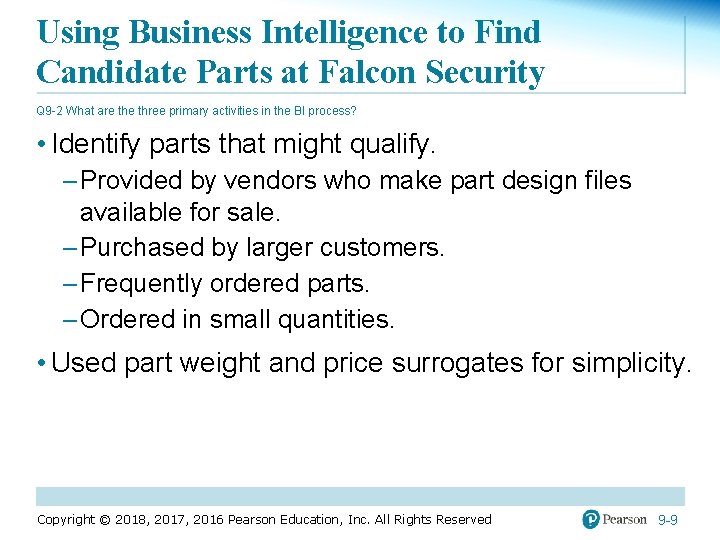
Using Business Intelligence to Find Candidate Parts at Falcon Security Q 9 -2 What are three primary activities in the BI process? • Identify parts that might qualify. – Provided by vendors who make part design files available for sale. – Purchased by larger customers. – Frequently ordered parts. – Ordered in small quantities. • Used part weight and price surrogates for simplicity. Copyright © 2018, 2017, 2016 Pearson Education, Inc. All Rights Reserved 9 -9
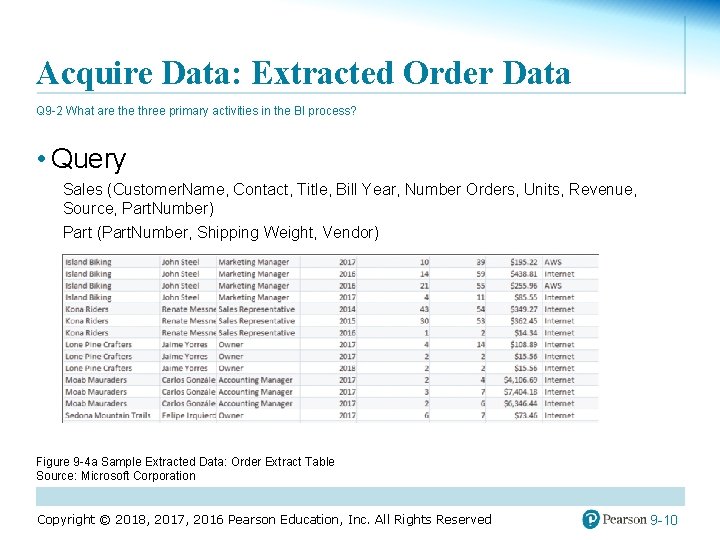
Acquire Data: Extracted Order Data Q 9 -2 What are three primary activities in the BI process? • Query Sales (Customer. Name, Contact, Title, Bill Year, Number Orders, Units, Revenue, Source, Part. Number) Part (Part. Number, Shipping Weight, Vendor) Figure 9 -4 a Sample Extracted Data: Order Extract Table Source: Microsoft Corporation Copyright © 2018, 2017, 2016 Pearson Education, Inc. All Rights Reserved 9 -10
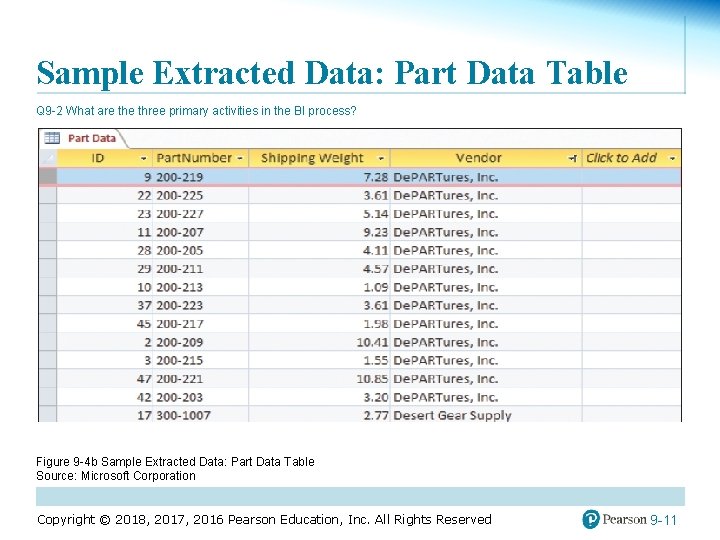
Sample Extracted Data: Part Data Table Q 9 -2 What are three primary activities in the BI process? Figure 9 -4 b Sample Extracted Data: Part Data Table Source: Microsoft Corporation Copyright © 2018, 2017, 2016 Pearson Education, Inc. All Rights Reserved 9 -11
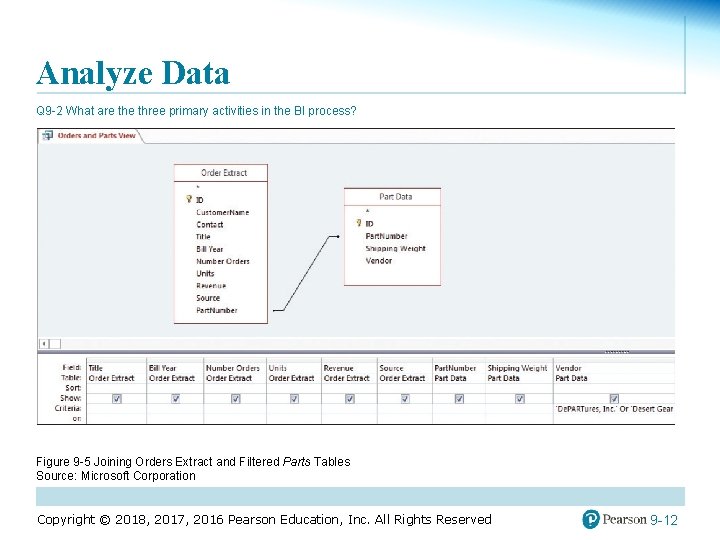
Analyze Data Q 9 -2 What are three primary activities in the BI process? Figure 9 -5 Joining Orders Extract and Filtered Parts Tables Source: Microsoft Corporation Copyright © 2018, 2017, 2016 Pearson Education, Inc. All Rights Reserved 9 -12
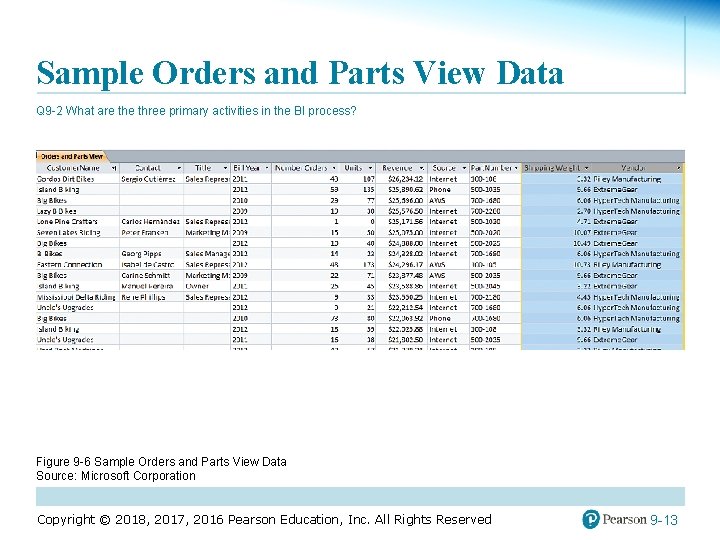
Sample Orders and Parts View Data Q 9 -2 What are three primary activities in the BI process? Figure 9 -6 Sample Orders and Parts View Data Source: Microsoft Corporation Copyright © 2018, 2017, 2016 Pearson Education, Inc. All Rights Reserved 9 -13
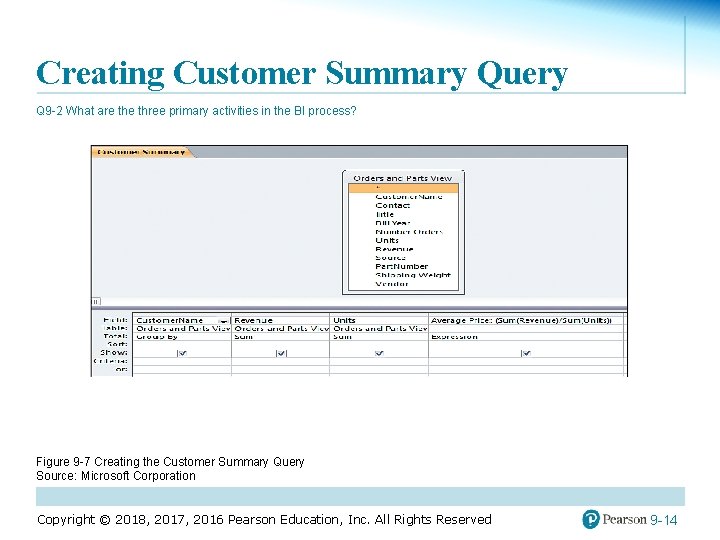
Creating Customer Summary Query Q 9 -2 What are three primary activities in the BI process? Figure 9 -7 Creating the Customer Summary Query Source: Microsoft Corporation Copyright © 2018, 2017, 2016 Pearson Education, Inc. All Rights Reserved 9 -14
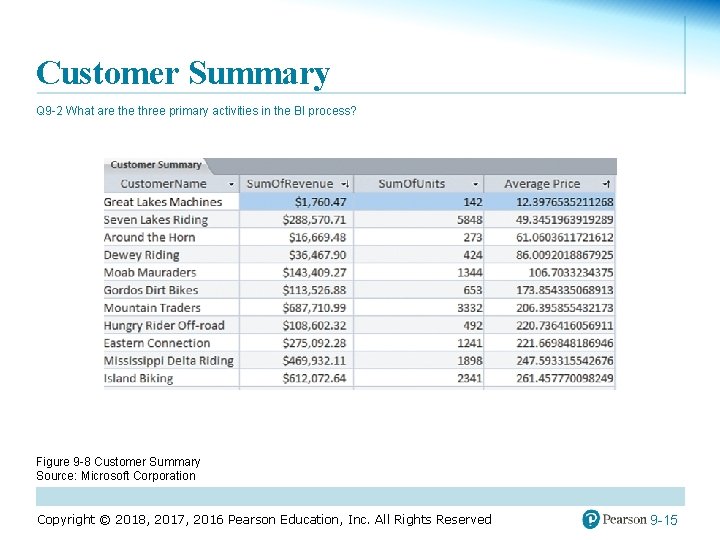
Customer Summary Q 9 -2 What are three primary activities in the BI process? Figure 9 -8 Customer Summary Source: Microsoft Corporation Copyright © 2018, 2017, 2016 Pearson Education, Inc. All Rights Reserved 9 -15
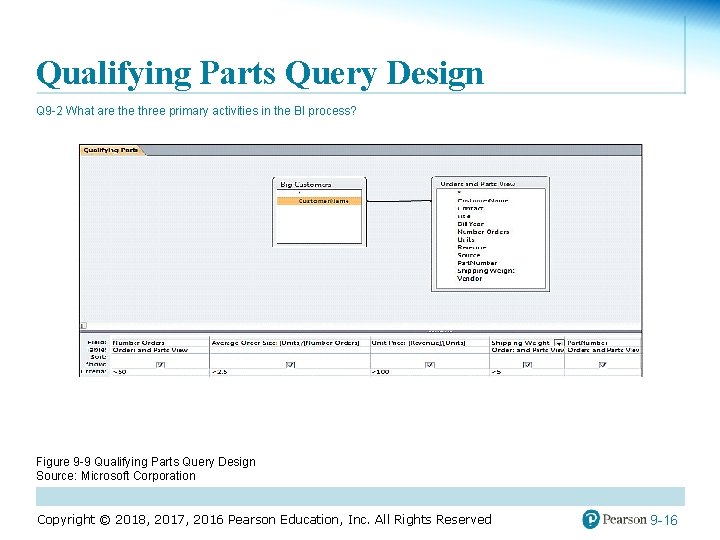
Qualifying Parts Query Design Q 9 -2 What are three primary activities in the BI process? Figure 9 -9 Qualifying Parts Query Design Source: Microsoft Corporation Copyright © 2018, 2017, 2016 Pearson Education, Inc. All Rights Reserved 9 -16
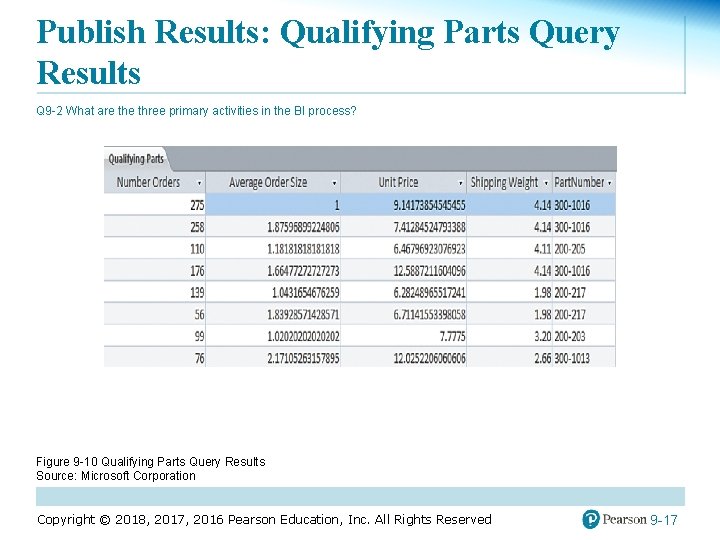
Publish Results: Qualifying Parts Query Results Q 9 -2 What are three primary activities in the BI process? Figure 9 -10 Qualifying Parts Query Results Source: Microsoft Corporation Copyright © 2018, 2017, 2016 Pearson Education, Inc. All Rights Reserved 9 -17
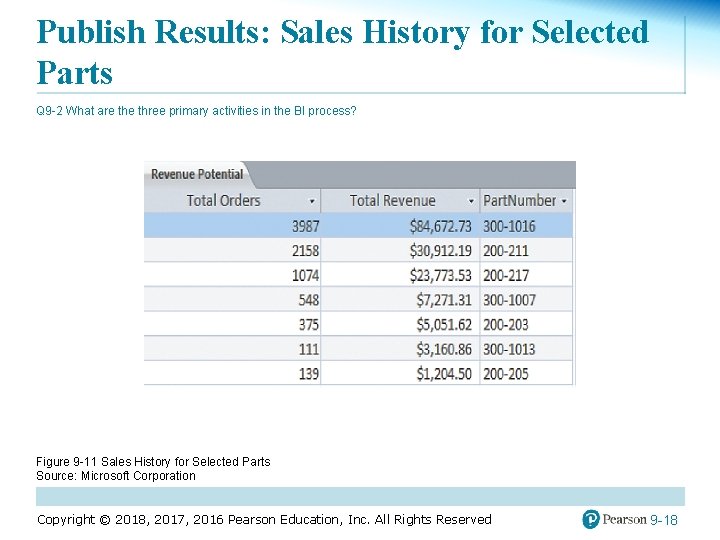
Publish Results: Sales History for Selected Parts Q 9 -2 What are three primary activities in the BI process? Figure 9 -11 Sales History for Selected Parts Source: Microsoft Corporation Copyright © 2018, 2017, 2016 Pearson Education, Inc. All Rights Reserved 9 -18
MIS-Diagnosis Ethics Guide • Doctors are relying more and more on artificial intelligence (AI)-driven expert systems to select the most appropriate medications and treatments. • Ordered to improve the system’s “perception” of the company’s drugs. • Minor modifications to the drug’s profile made a big difference. – But some of the numbers he used to modify the profile were not accurate. – The changes would warrant a regulatory review. Copyright © 2018, 2017, 2016 Pearson Education, Inc. All Rights Reserved 9 -19
MIS-Diagnosis (cont’d) Ethics Guide • Suppose the company alters the drug profile. • Would the company be liable if something happened to a patient who took the drug based on altered information? • Do you think that manipulating the recommendation of an AI system even though the new recommendation may be for the better drug is ethical according to the categorical imperative, and utilitarian perspective? Copyright © 2018, 2017, 2016 Pearson Education, Inc. All Rights Reserved 9 -20
Using Data Warehouses and Data Marts to Acquire Data Q 9 -3 How do organizations use data warehouses and data marts to acquire data? • Functions of a data warehouse – Obtain data from operational, internal and external databases. – Cleanse data. – Organize and relate data. – Catalog data using metadata. Copyright © 2018, 2017, 2016 Pearson Education, Inc. All Rights Reserved 9 -21
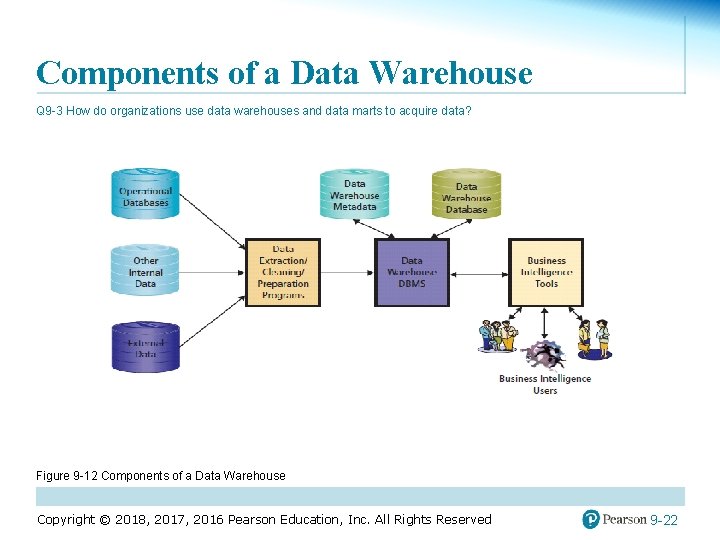
Components of a Data Warehouse Q 9 -3 How do organizations use data warehouses and data marts to acquire data? Figure 9 -12 Components of a Data Warehouse Copyright © 2018, 2017, 2016 Pearson Education, Inc. All Rights Reserved 9 -22
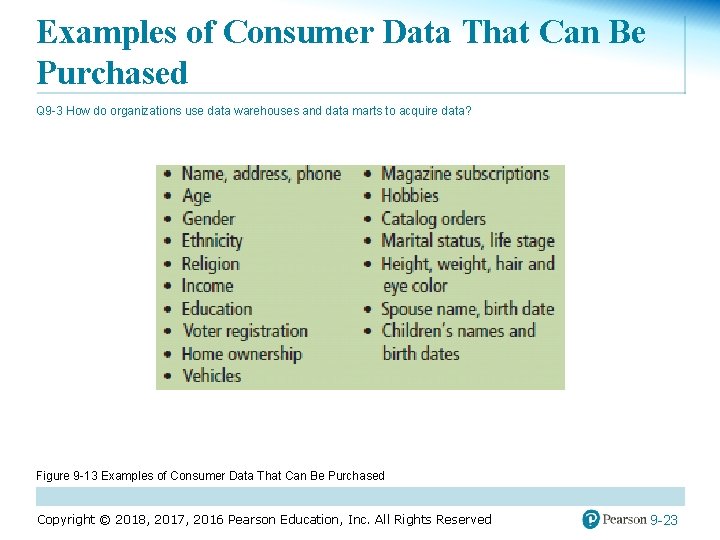
Examples of Consumer Data That Can Be Purchased Q 9 -3 How do organizations use data warehouses and data marts to acquire data? Figure 9 -13 Examples of Consumer Data That Can Be Purchased Copyright © 2018, 2017, 2016 Pearson Education, Inc. All Rights Reserved 9 -23
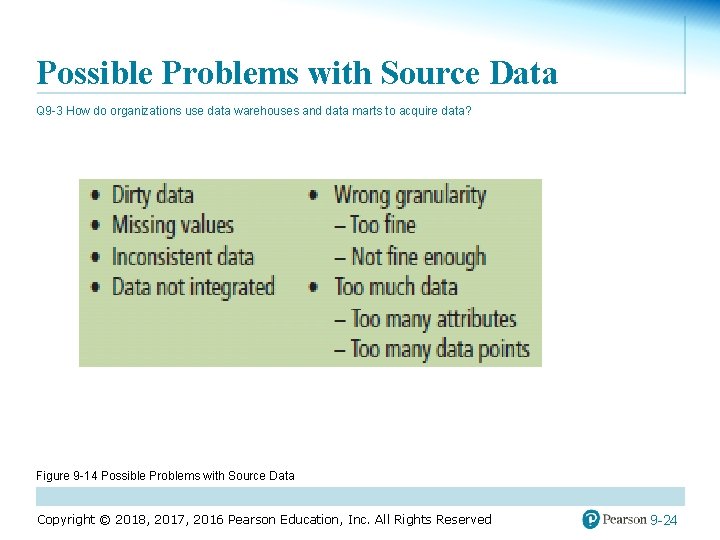
Possible Problems with Source Data Q 9 -3 How do organizations use data warehouses and data marts to acquire data? Figure 9 -14 Possible Problems with Source Data Copyright © 2018, 2017, 2016 Pearson Education, Inc. All Rights Reserved 9 -24
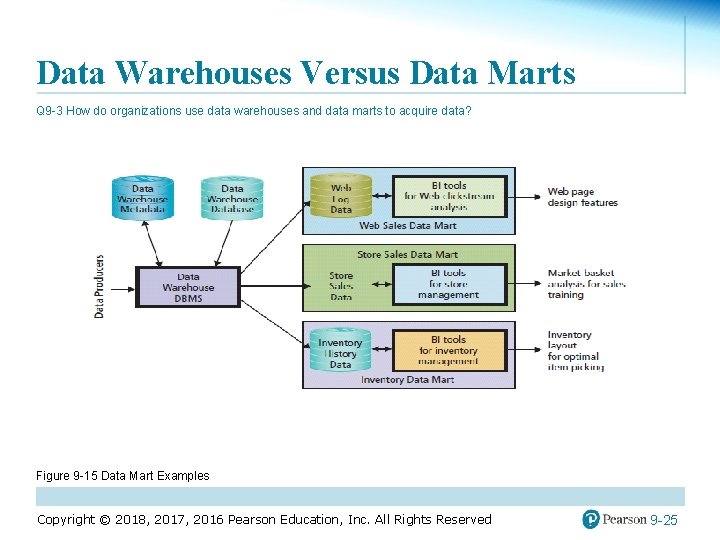
Data Warehouses Versus Data Marts Q 9 -3 How do organizations use data warehouses and data marts to acquire data? Figure 9 -15 Data Mart Examples Copyright © 2018, 2017, 2016 Pearson Education, Inc. All Rights Reserved 9 -25
Reporting Applications Q 9 -4 How do organizations use reporting applications? • Create meaningful information from disparate data sources. • Deliver information to user on time. • Basic operations: 1. 2. 3. 4. 5. Sorting Filtering Grouping Calculating Formatting Copyright © 2018, 2017, 2016 Pearson Education, Inc. All Rights Reserved 9 -26
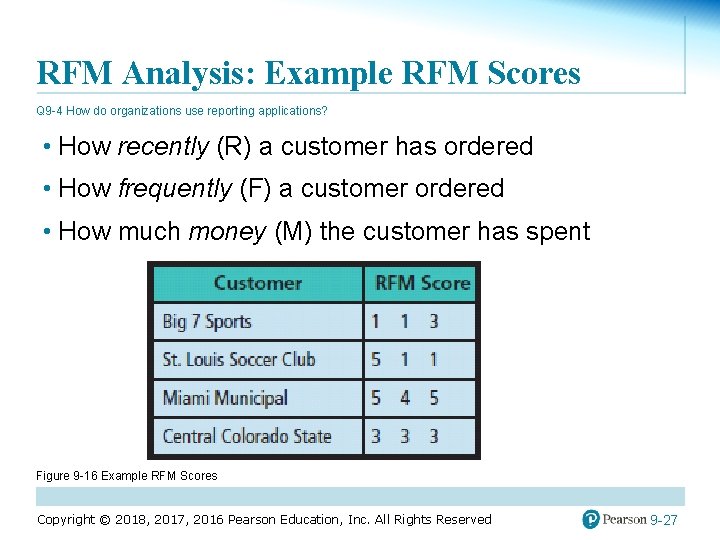
RFM Analysis: Example RFM Scores Q 9 -4 How do organizations use reporting applications? • How recently (R) a customer has ordered • How frequently (F) a customer ordered • How much money (M) the customer has spent Figure 9 -16 Example RFM Scores Copyright © 2018, 2017, 2016 Pearson Education, Inc. All Rights Reserved 9 -27
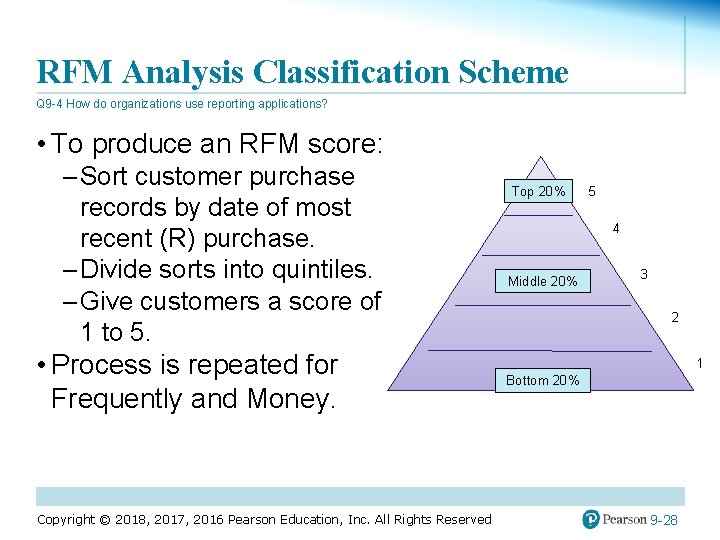
RFM Analysis Classification Scheme Q 9 -4 How do organizations use reporting applications? • To produce an RFM score: – Sort customer purchase records by date of most recent (R) purchase. – Divide sorts into quintiles. – Give customers a score of 1 to 5. • Process is repeated for Frequently and Money. Copyright © 2018, 2017, 2016 Pearson Education, Inc. All Rights Reserved Top 20% 5 4 Middle 20% 3 2 1 Bottom 20% 9 -28
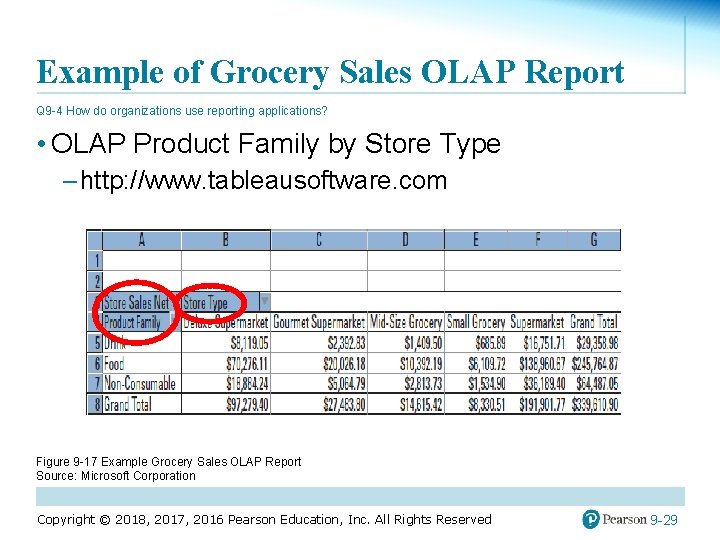
Example of Grocery Sales OLAP Report Q 9 -4 How do organizations use reporting applications? • OLAP Product Family by Store Type – http: //www. tableausoftware. com Figure 9 -17 Example Grocery Sales OLAP Report Source: Microsoft Corporation Copyright © 2018, 2017, 2016 Pearson Education, Inc. All Rights Reserved 9 -29
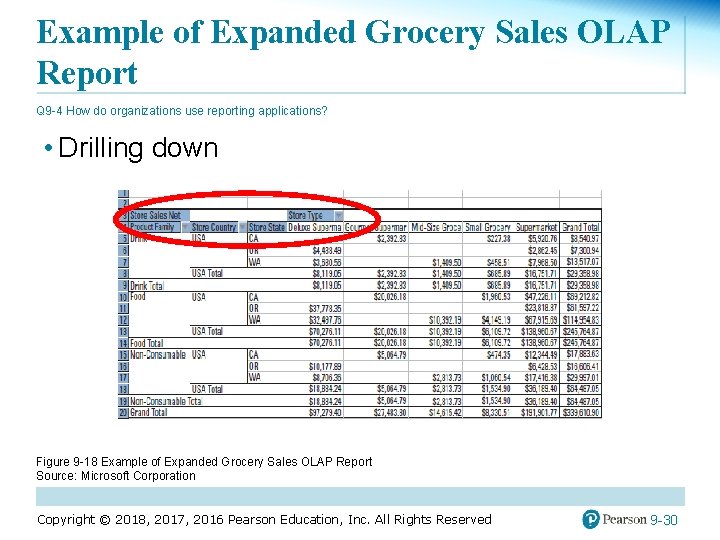
Example of Expanded Grocery Sales OLAP Report Q 9 -4 How do organizations use reporting applications? • Drilling down Figure 9 -18 Example of Expanded Grocery Sales OLAP Report Source: Microsoft Corporation Copyright © 2018, 2017, 2016 Pearson Education, Inc. All Rights Reserved 9 -30
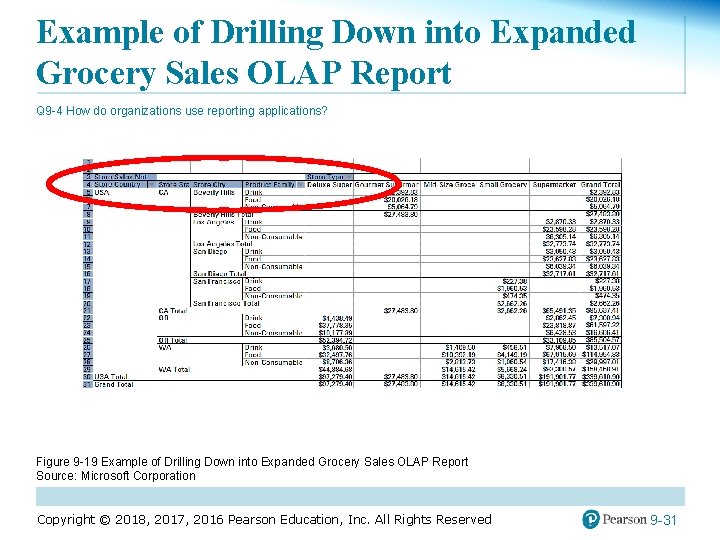
Example of Drilling Down into Expanded Grocery Sales OLAP Report Q 9 -4 How do organizations use reporting applications? Figure 9 -19 Example of Drilling Down into Expanded Grocery Sales OLAP Report Source: Microsoft Corporation Copyright © 2018, 2017, 2016 Pearson Education, Inc. All Rights Reserved 9 -31
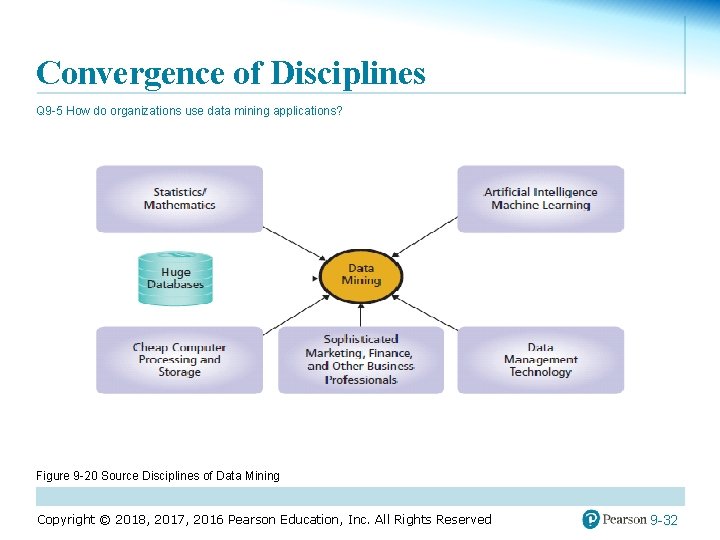
Convergence of Disciplines Q 9 -5 How do organizations use data mining applications? Figure 9 -20 Source Disciplines of Data Mining Copyright © 2018, 2017, 2016 Pearson Education, Inc. All Rights Reserved 9 -32
Unsupervised Data Mining Q 9 -5 How do organizations use data mining applications? • No a priori hypothesis or model. • Findings obtained solely by data analysis. • Hypothesized model created to explain patterns found. • Example: Cluster analysis. Copyright © 2018, 2017, 2016 Pearson Education, Inc. All Rights Reserved 9 -33
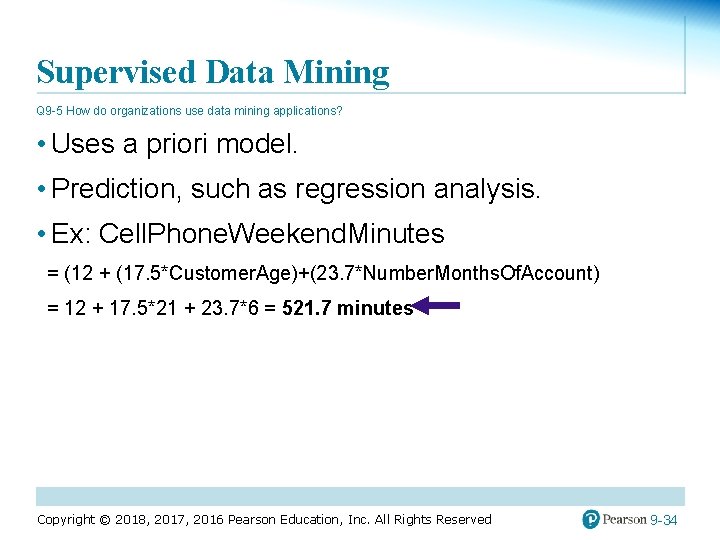
Supervised Data Mining Q 9 -5 How do organizations use data mining applications? • Uses a priori model. • Prediction, such as regression analysis. • Ex: Cell. Phone. Weekend. Minutes = (12 + (17. 5*Customer. Age)+(23. 7*Number. Months. Of. Account) = 12 + 17. 5*21 + 23. 7*6 = 521. 7 minutes Copyright © 2018, 2017, 2016 Pearson Education, Inc. All Rights Reserved 9 -34
Market-Basket Analysis Q 9 -5 How do organizations use data mining applications? • Market-basket analysis – Identify sales patterns in large volumes of data. – Identify what products customers tend to buy together. – Computes probabilities of purchases. – Identify cross-selling opportunities. § Customers who bought fins also bought a mask. Copyright © 2018, 2017, 2016 Pearson Education, Inc. All Rights Reserved 9 -35
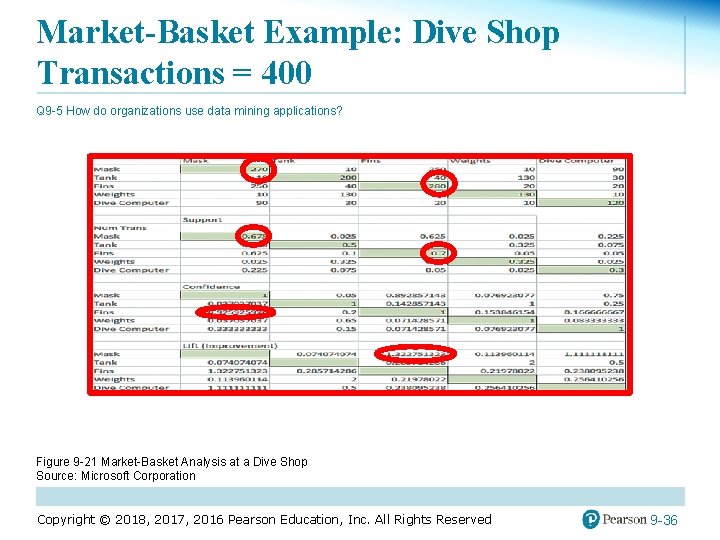
Market-Basket Example: Dive Shop Transactions = 400 Q 9 -5 How do organizations use data mining applications? Figure 9 -21 Market-Basket Analysis at a Dive Shop Source: Microsoft Corporation Copyright © 2018, 2017, 2016 Pearson Education, Inc. All Rights Reserved 9 -36
Decision Trees Q 9 -5 How do organizations use data mining applications? • Unsupervised data mining technique. • Hierarchical arrangement of criteria to predict a value or classification. • Basic idea – Select attributes most useful for classifying “pure groups. ” – Creates decision rules. Copyright © 2018, 2017, 2016 Pearson Education, Inc. All Rights Reserved 9 -37
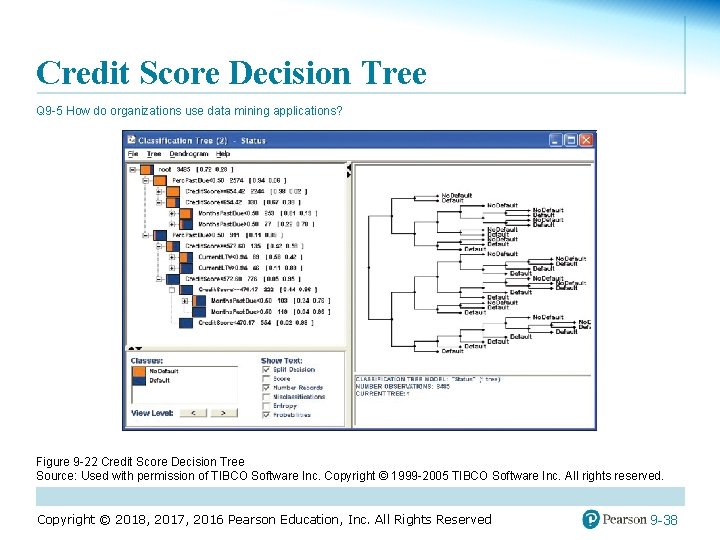
Credit Score Decision Tree Q 9 -5 How do organizations use data mining applications? Figure 9 -22 Credit Score Decision Tree Source: Used with permission of TIBCO Software Inc. Copyright © 1999 -2005 TIBCO Software Inc. All rights reserved. Copyright © 2018, 2017, 2016 Pearson Education, Inc. All Rights Reserved 9 -38
Decision Rules for Accepting or Rejecting Offer to Purchase Loans Q 9 -5 How do organizations use data mining applications? • If percent past due is less than 50 percent, then accept loan. § If percent past due is greater than 50 percent and § If Credit. Score is greater than 572. 6 and § If Current. LTV is less than. 94, then accept loan. • Otherwise, reject loan. Copyright © 2018, 2017, 2016 Pearson Education, Inc. All Rights Reserved 9 -39
BI for Securities Trading? So What? • Quantitative applications using Big Data and BI. – Analyze immense amounts of data over a broad spectrum of sources. – Build and evaluate investment strategies. • Two Sigma (www. twosigma. com) – Analyzes financial statements, developing news, Twitter activity, weather reports, other sources. – Develops and tests investment strategies. Copyright © 2018, 2017, 2016 Pearson Education, Inc. All Rights Reserved 9 -40
Two Sigma’s Five-Step Process Q 9 -5 How do organizations use data mining applications? 1. Acquire data 2. Create models 3. Evaluate models 4. Analyze risks 5. Place trades • Does it work? Two Sigma and other firms claim it does. Copyright © 2018, 2017, 2016 Pearson Education, Inc. All Rights Reserved 9 -41
Using Big Data Applications Q 9 -6 How do organizations use Big Data applications? • Huge volume – petabyte and larger. • Rapid velocity – generated rapidly. • Great variety – Structured data, free-form text, log files, graphics, audio, and video. Copyright © 2018, 2017, 2016 Pearson Education, Inc. All Rights Reserved 9 -42
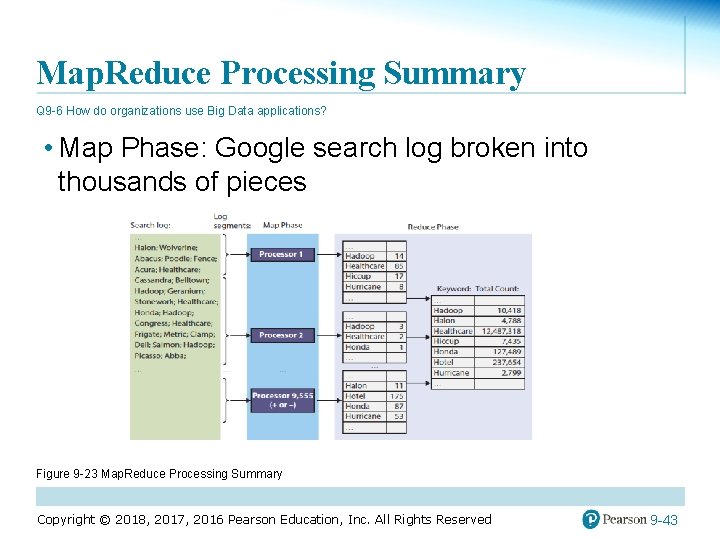
Map. Reduce Processing Summary Q 9 -6 How do organizations use Big Data applications? • Map Phase: Google search log broken into thousands of pieces Figure 9 -23 Map. Reduce Processing Summary Copyright © 2018, 2017, 2016 Pearson Education, Inc. All Rights Reserved 9 -43
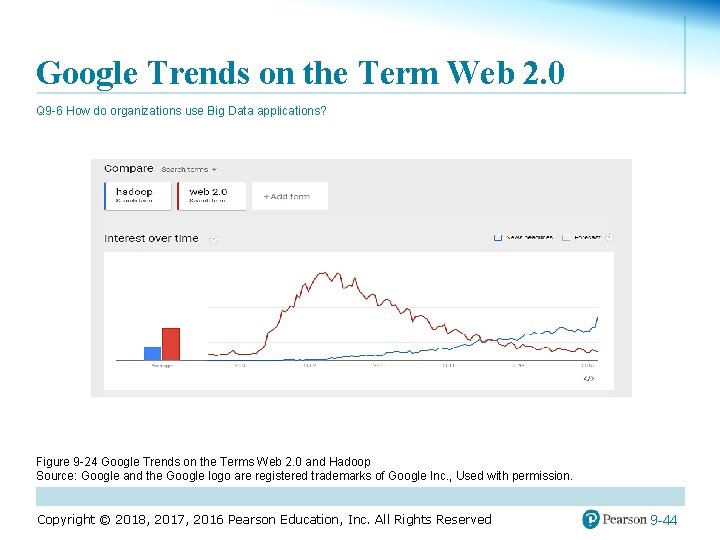
Google Trends on the Term Web 2. 0 Q 9 -6 How do organizations use Big Data applications? Reduce phase: results combined Figure 9 -24 Google Trends on the Terms Web 2. 0 and Hadoop Source: Google and the Google logo are registered trademarks of Google Inc. , Used with permission. Copyright © 2018, 2017, 2016 Pearson Education, Inc. All Rights Reserved 9 -44
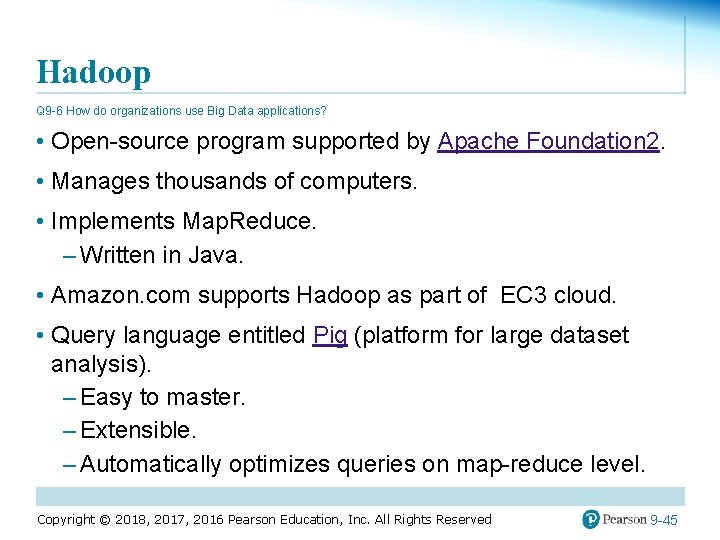
Hadoop Q 9 -6 How do organizations use Big Data applications? • Open-source program supported by Apache Foundation 2. • Manages thousands of computers. • Implements Map. Reduce. – Written in Java. • Amazon. com supports Hadoop as part of EC 3 cloud. • Query language entitled Pig (platform for large dataset analysis). – Easy to master. – Extensible. – Automatically optimizes queries on map-reduce level. Copyright © 2018, 2017, 2016 Pearson Education, Inc. All Rights Reserved 9 -45
Knowledge Management Systems Q 9 -7 What is the role of knowledge management systems? • Knowledge Management (KM) – Creating value from intellectual capital and sharing knowledge with those who need that capital. • Preserving organizational memory – Capturing and storing lessons learned and best practices of key employees. • Scope of KM same as SM in hyper-social organizations. Copyright © 2018, 2017, 2016 Pearson Education, Inc. All Rights Reserved 9 -46
Benefits of Knowledge Management Q 9 -7 What is the role of knowledge management systems? • Improve process quality. • Increase team strength. • Goal: – Enable employees to use organization’s collective knowledge. Copyright © 2018, 2017, 2016 Pearson Education, Inc. All Rights Reserved 9 -47
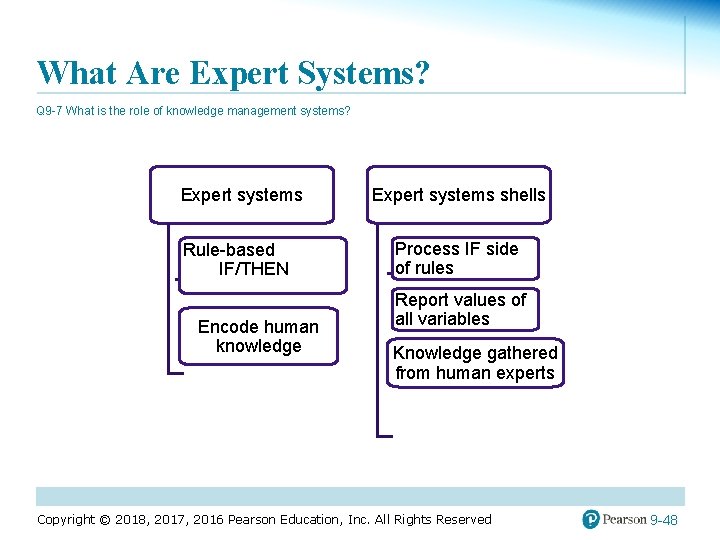
What Are Expert Systems? Q 9 -7 What is the role of knowledge management systems? Expert systems Rule-based IF/THEN Encode human knowledge Expert systems shells Process IF side of rules Report values of all variables Knowledge gathered from human experts Copyright © 2018, 2017, 2016 Pearson Education, Inc. All Rights Reserved 9 -48
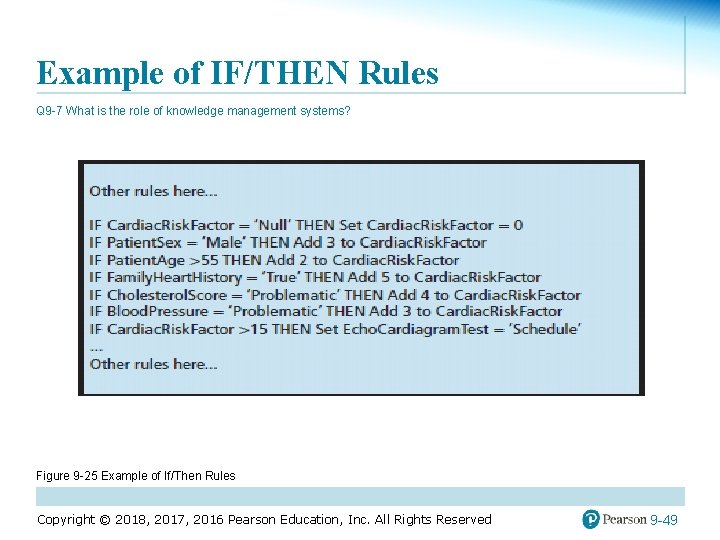
Example of IF/THEN Rules Q 9 -7 What is the role of knowledge management systems? Figure 9 -25 Example of If/Then Rules Copyright © 2018, 2017, 2016 Pearson Education, Inc. All Rights Reserved 9 -49
Drawbacks of Expert Systems Q 9 -7 What is the role of knowledge management systems? 1. Difficult and expensive to develop. – Labor intensive. – Ties up domain experts. 2. Difficult to maintain. – Changes cause unpredictable outcomes. – Constantly need expensive changes. 3. Don’t live up to expectations. – Can’t duplicate diagnostic abilities of humans. Copyright © 2018, 2017, 2016 Pearson Education, Inc. All Rights Reserved 9 -50
What Are Content Management Systems (CMS)? Q 9 -7 What is the role of knowledge management systems? • Support management and delivery of documents, other expressions of employee knowledge. • Challenges of Content Management – Huge databases. – Dynamic content. – Documents refer to one another. – Perishable contents. – In many languages. Copyright © 2018, 2017, 2016 Pearson Education, Inc. All Rights Reserved 9 -51
What are CMS Application Alternatives? Q 9 -7 What is the role of knowledge management systems? • In-house custom development – Customer support develops in-house database applications to track customer problems. • Off-the-shelf – Horizontal market products (Share. Point). – Vertical market applications. • Public search engine – Google, Bing. Copyright © 2018, 2017, 2016 Pearson Education, Inc. All Rights Reserved 9 -52
How Do Hyper-Social Organizations Manage Knowledge? Q 9 -7 What is the role of knowledge management systems? • Hyper-social knowledge management – Social media, and related applications, for management and delivery of organizational knowledge resources. • Hyper-organization theory – Framework for understanding KM. – Focus shifts from knowledge and content to fostering authentic relationships among knowledge creators and users. Copyright © 2018, 2017, 2016 Pearson Education, Inc. All Rights Reserved 9 -53
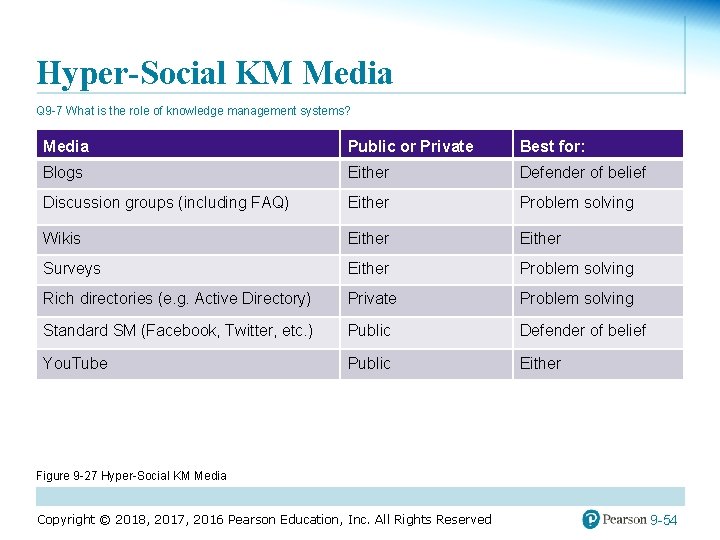
Hyper-Social KM Media Q 9 -7 What is the role of knowledge management systems? Media Public or Private Best for: Blogs Either Defender of belief Discussion groups (including FAQ) Either Problem solving Wikis Either Surveys Either Problem solving Rich directories (e. g. Active Directory) Private Problem solving Standard SM (Facebook, Twitter, etc. ) Public Defender of belief You. Tube Public Either Figure 9 -27 Hyper-Social KM Media Copyright © 2018, 2017, 2016 Pearson Education, Inc. All Rights Reserved 9 -54
Resistance to Knowledge Sharing Q 9 -7 What is the role of knowledge management systems? • Employees reluctant to exhibit their ignorance. • Employee competition. • Remedy – Strong management endorsement. – Strong positive feedback. – “Nothing wrong with praise or cash. . . especially cash. ” Copyright © 2018, 2017, 2016 Pearson Education, Inc. All Rights Reserved 9 -55
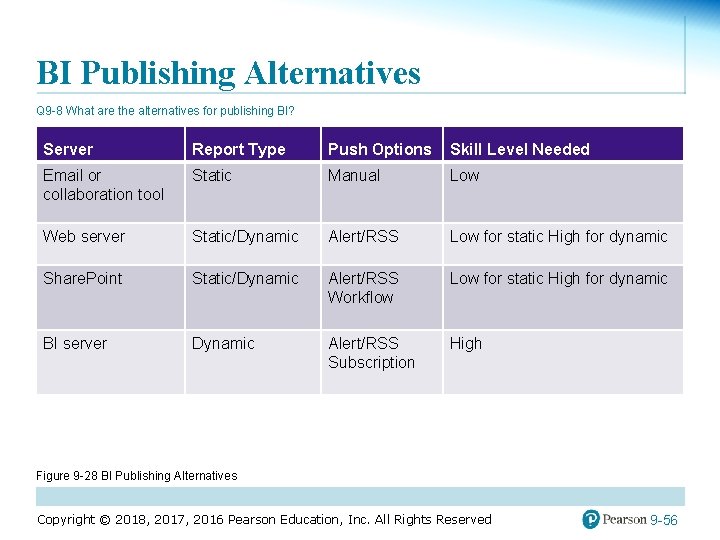
BI Publishing Alternatives Q 9 -8 What are the alternatives for publishing BI? Server Report Type Push Options Skill Level Needed Email or collaboration tool Static Manual Low Web server Static/Dynamic Alert/RSS Low for static High for dynamic Share. Point Static/Dynamic Alert/RSS Workflow Low for static High for dynamic BI server Dynamic Alert/RSS Subscription High Figure 9 -28 BI Publishing Alternatives Copyright © 2018, 2017, 2016 Pearson Education, Inc. All Rights Reserved 9 -56
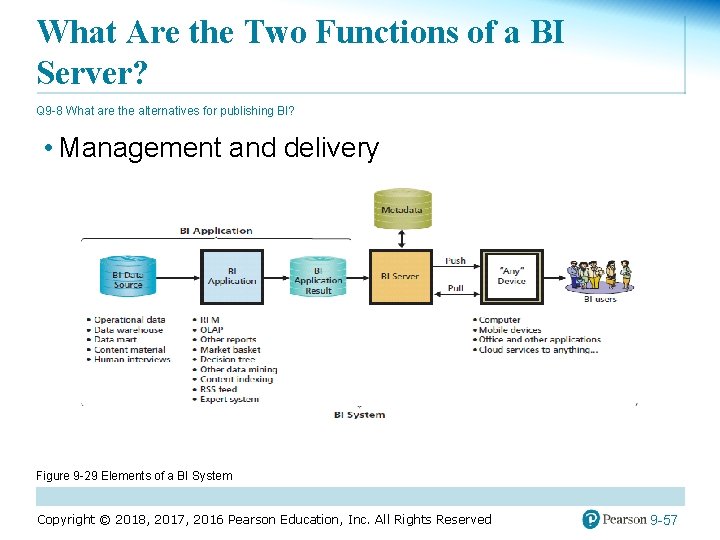
What Are the Two Functions of a BI Server? Q 9 -8 What are the alternatives for publishing BI? • Management and delivery Figure 9 -29 Elements of a BI System Copyright © 2018, 2017, 2016 Pearson Education, Inc. All Rights Reserved 9 -57
Business Intelligence Systems in 2027 Q 9 -9 2027? • Exponentially more information about customers, better data mining techniques. • Companies buy and sell your purchasing habits and psyche. • Singularity – Computer systems adapt and create their own software without human assistance. – Machines will possess and create information for themselves. – Will we know what the machines will know? Copyright © 2018, 2017, 2016 Pearson Education, Inc. All Rights Reserved 9 -58
Semantic Security Guide 1. Unauthorized access to protected data and information. § Physical security – Passwords and permissions. – Delivery system must be secure. 2. Unintended release of protected information through reports and documents. 3. What, if anything, can be done to prevent what Megan did? Copyright © 2018, 2017, 2016 Pearson Education, Inc. All Rights Reserved 9 -59
Manager, Data and Analytics Career Guide Lindsey Tsuya at American Express Company Q. What attracted you to this field? A. “As a college student, I worked in the service industry. When I was selecting my degree, I knew I wanted two things. First, I wanted a degree that made money. Second, I wanted a job that did not involve direct provision of service to the public. By choosing information systems, I knew I would be doing more of a behind-the -scenes job. ” Q. What advice would you give to someone who is considering working in your field? A. “No matter what field you choose, make sure it is something you are passionate about because if you are not passionate about it, work will feel like… work. ” Copyright © 2018, 2017, 2016 Pearson Education, Inc. All Rights Reserved 9 -60
Active Review Q 9 -1 How do organizations use business intelligence (BI) systems? Q 9 -2 What are three primary activities in the BI process? Q 9 -3 How do organizations use data warehouses and data marts to acquire data? Q 9 -4 How do organizations use reporting applications? Q 9 -5 How do organizations use data mining applications? Q 9 -6 How do organizations use Big Data applications? Q 9 -7 What is the role of knowledge management systems? Q 9 -8 What are the alternatives for publishing BI? Q 9 -9 2027? Copyright © 2018, 2017, 2016 Pearson Education, Inc. All Rights Reserved 9 -61
Hadoop the Cookie Cutter Case Study 9 • Third-party cookie created by site other than one you visited. • Most commonly occurs when a Web page includes content from multiple sources. • Double. Click – IP address where content was delivered. § Double. Click instructs your browser to store a Double. Click cookie. – Records data in cookie log on Double. Click’s server. Copyright © 2018, 2017, 2016 Pearson Education, Inc. All Rights Reserved 9 -62
Hadoop the Cookie Cutter (cont’d) Case Study 9 • Third-party cookie owner has history of what was shown, what ads you clicked, and intervals between interactions. • Cookie log shows how you respond to ads and your pattern of visiting various Web sites where ads placed. • Firefox Lightbeam tracks and graphs cookies on your computer. Copyright © 2018, 2017, 2016 Pearson Education, Inc. All Rights Reserved 9 -63
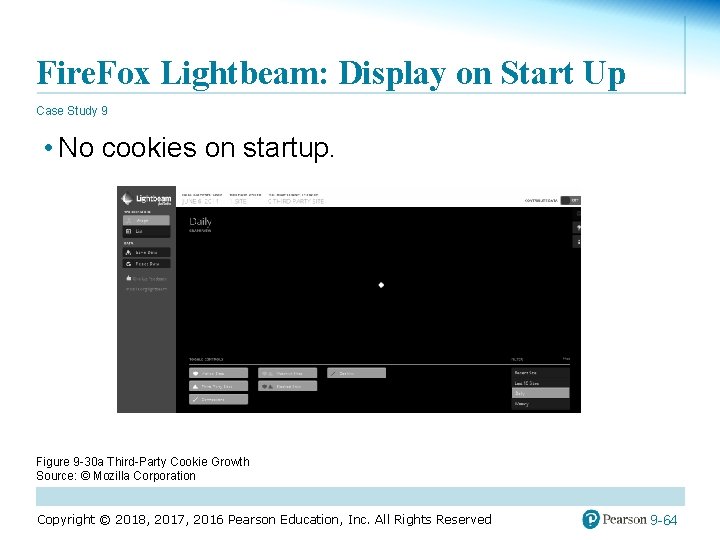
Fire. Fox Lightbeam: Display on Start Up Case Study 9 • No cookies on startup. Figure 9 -30 a Third-Party Cookie Growth Source: © Mozilla Corporation Copyright © 2018, 2017, 2016 Pearson Education, Inc. All Rights Reserved 9 -64
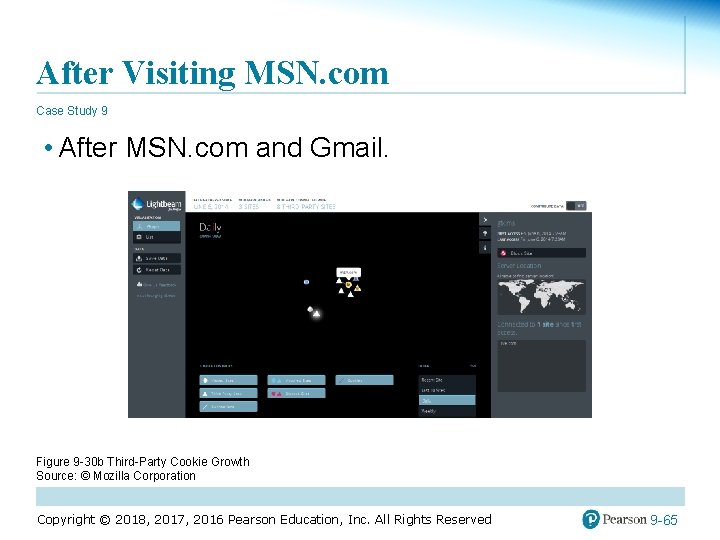
After Visiting MSN. com Case Study 9 • After MSN. com and Gmail. Figure 9 -30 b Third-Party Cookie Growth Source: © Mozilla Corporation Copyright © 2018, 2017, 2016 Pearson Education, Inc. All Rights Reserved 9 -65
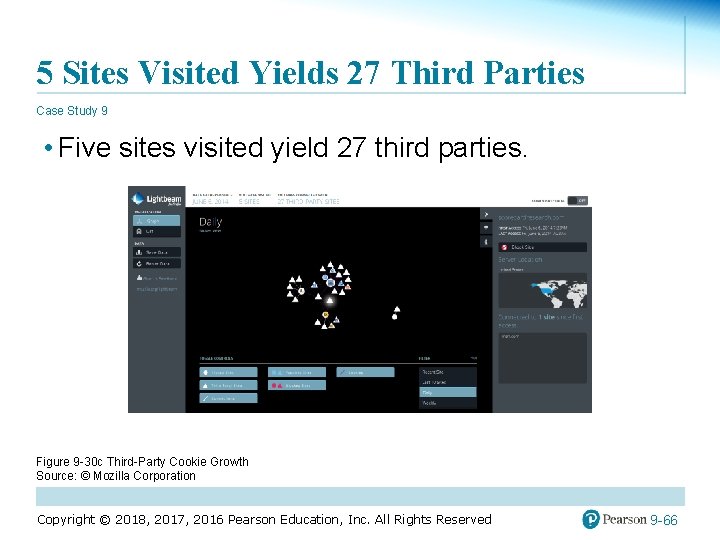
5 Sites Visited Yields 27 Third Parties Case Study 9 • Five sites visited yield 27 third parties. Figure 9 -30 c Third-Party Cookie Growth Source: © Mozilla Corporation Copyright © 2018, 2017, 2016 Pearson Education, Inc. All Rights Reserved 9 -66
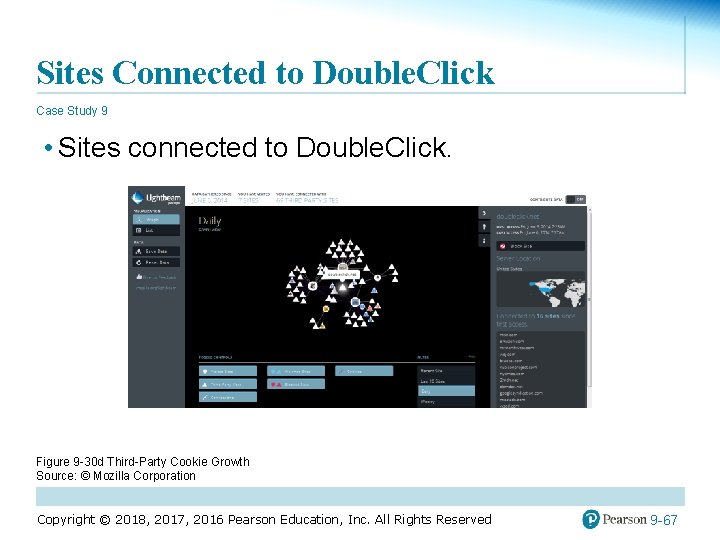
Sites Connected to Double. Click Case Study 9 • Sites connected to Double. Click. Figure 9 -30 d Third-Party Cookie Growth Source: © Mozilla Corporation Copyright © 2018, 2017, 2016 Pearson Education, Inc. All Rights Reserved 9 -67
- Slides: 68