
Using Minkowski Functionals to Analyze CMB Lensing Yuqi

Using Minkowski Functionals to Analyze CMB Lensing Yuqi Kang Jan Hamann
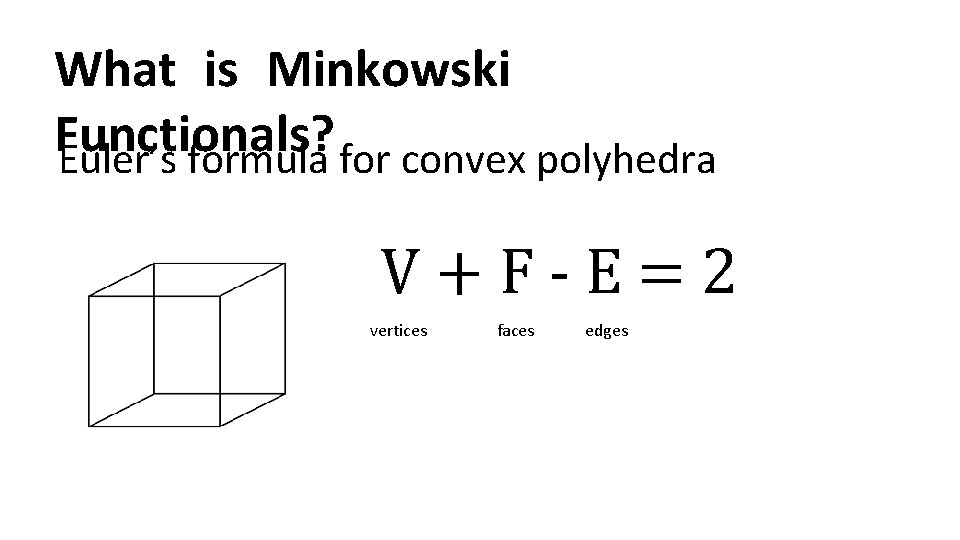
What is Minkowski Functionals? Euler’s formula for convex polyhedra V+F-E=2 vertices faces edges
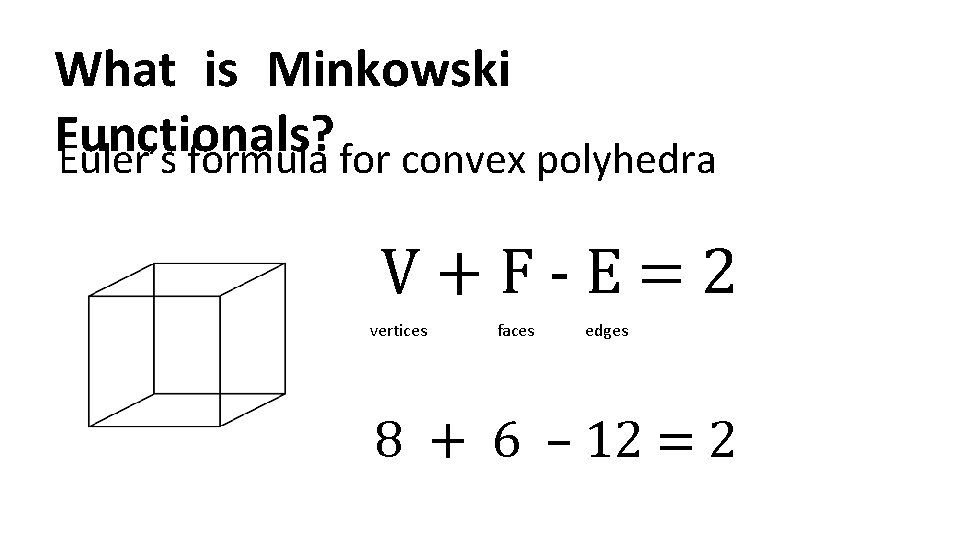
What is Minkowski Functionals? Euler’s formula for convex polyhedra V+F-E=2 vertices faces edges 8 + 6 – 12 = 2
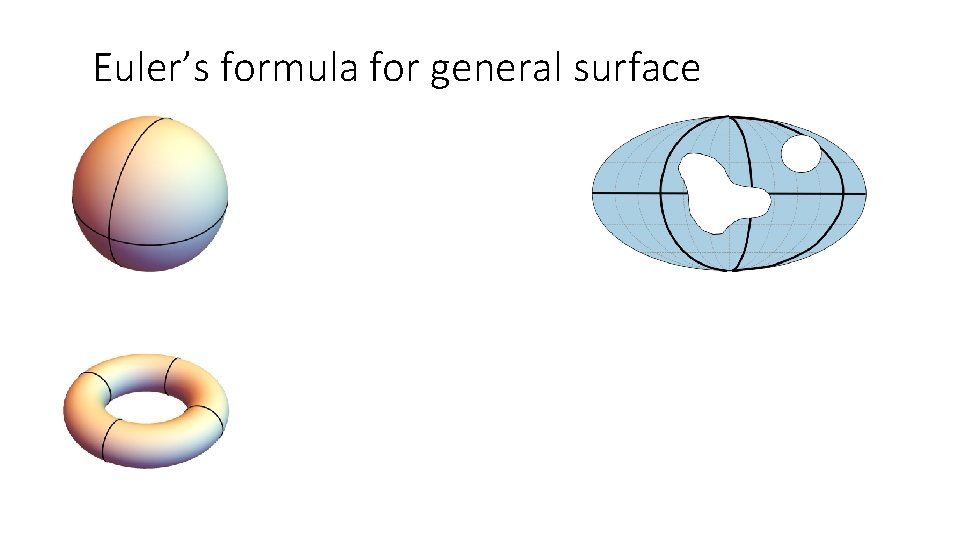
Euler’s formula for general surface
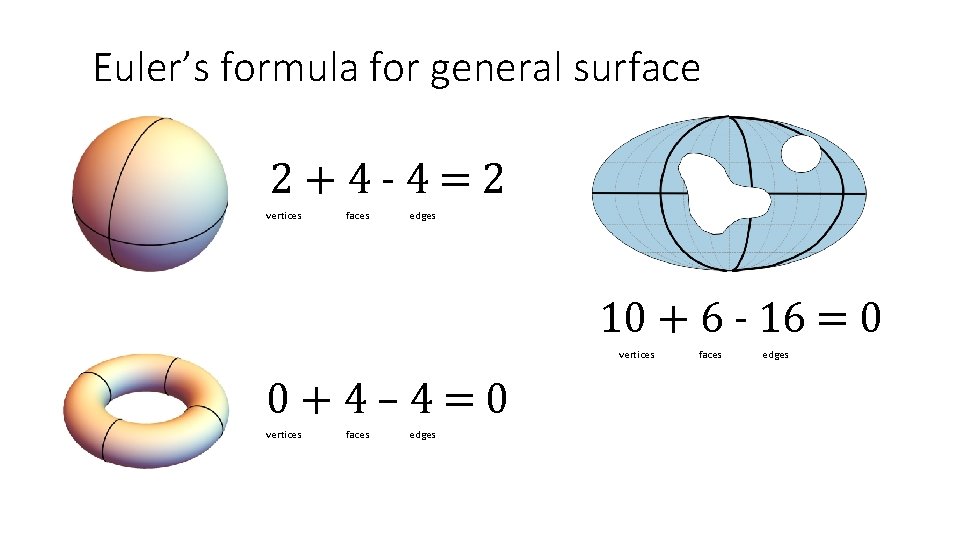
Euler’s formula for general surface 2+4 -4=2 vertices faces edges 10 + 6 - 16 = 0 vertices 0+4– 4=0 vertices faces edges
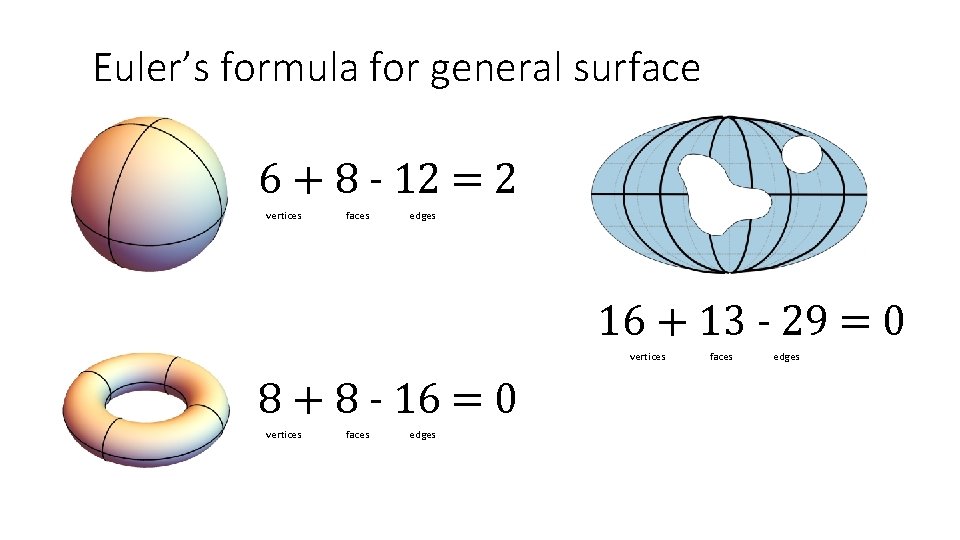
Euler’s formula for general surface 6 + 8 - 12 = 2 vertices faces edges 16 + 13 - 29 = 0 vertices 8 + 8 - 16 = 0 vertices faces edges
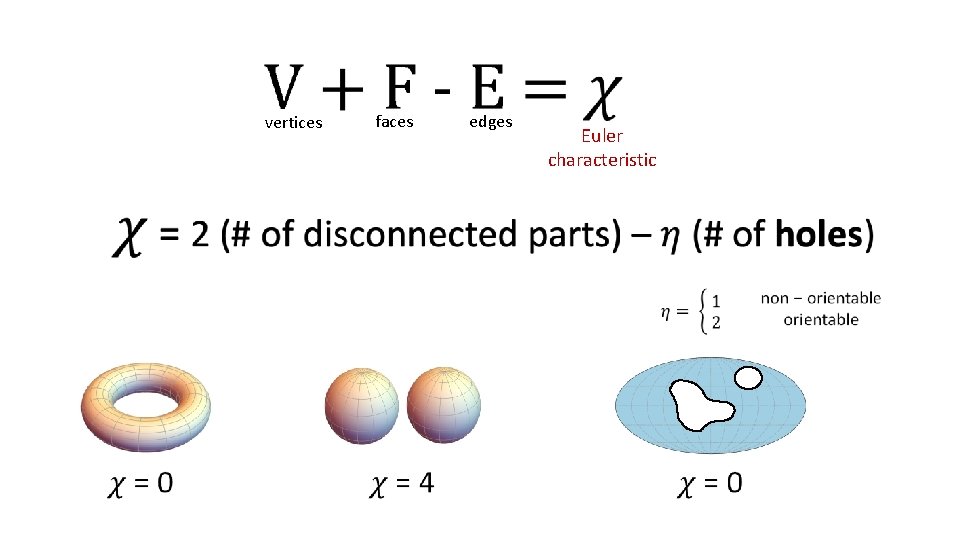
faces vertices edges Euler characteristic
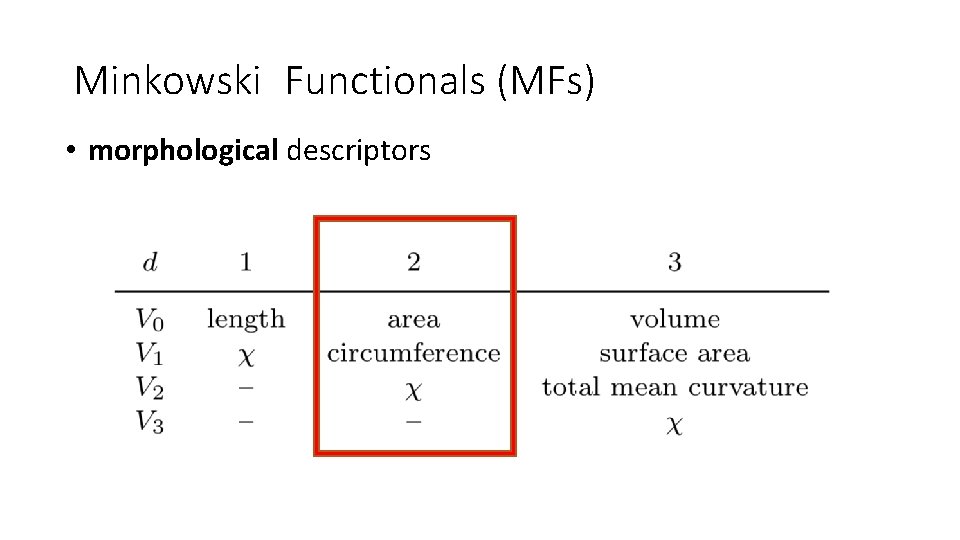
Minkowski Functionals (MFs) • morphological descriptors
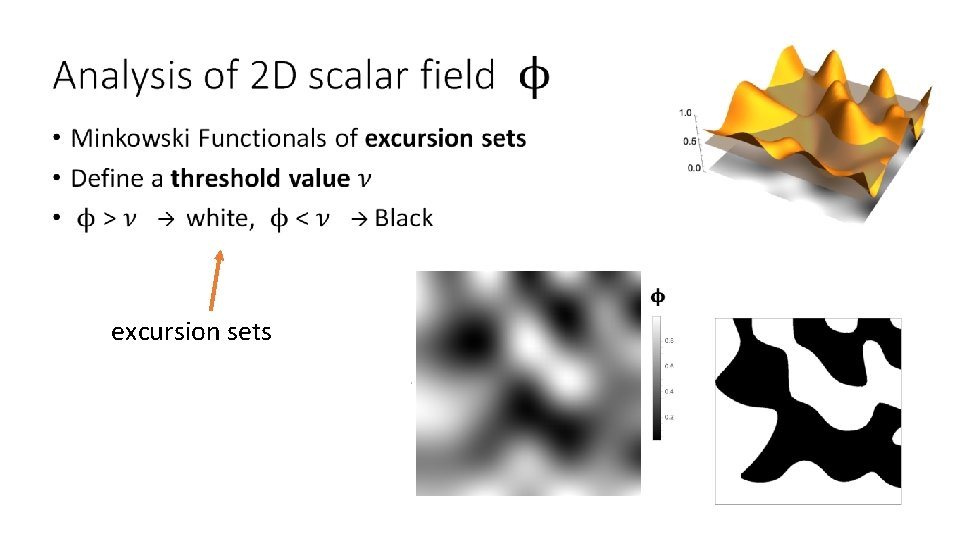
• excursion sets
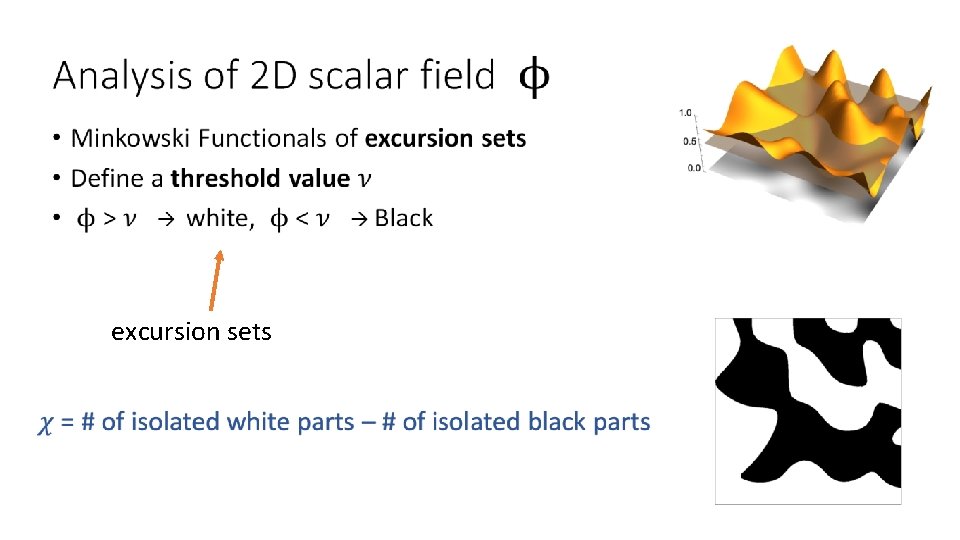
• excursion sets
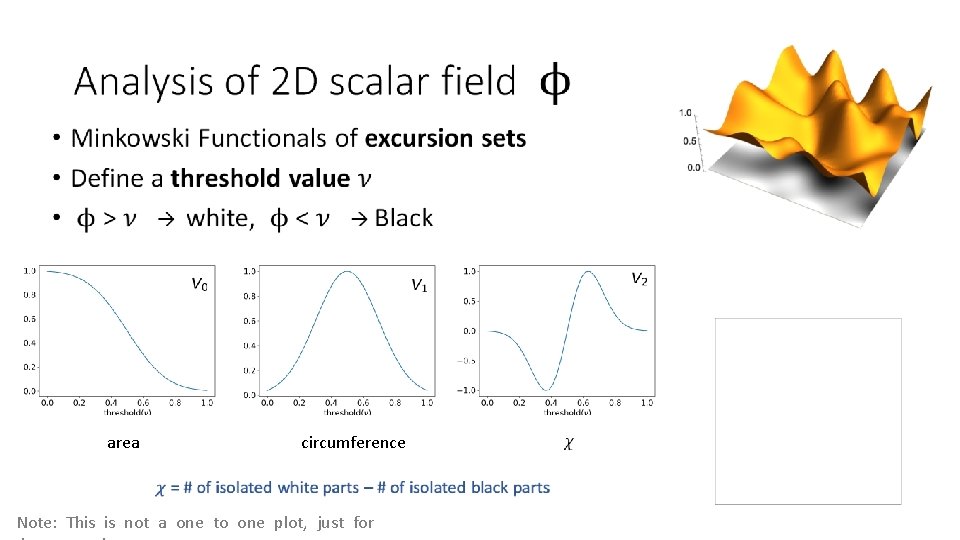
• area circumference Note: This is not a one to one plot, just for
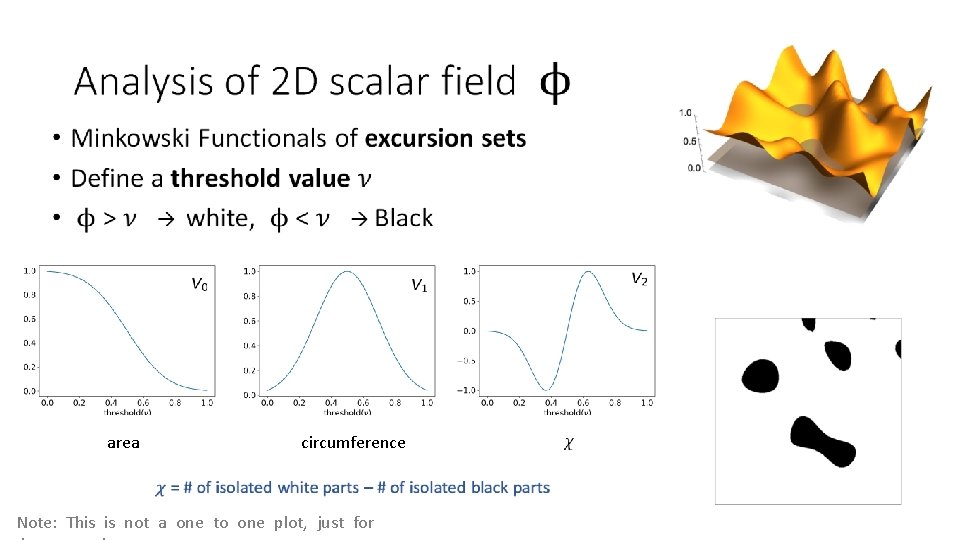
• area circumference Note: This is not a one to one plot, just for
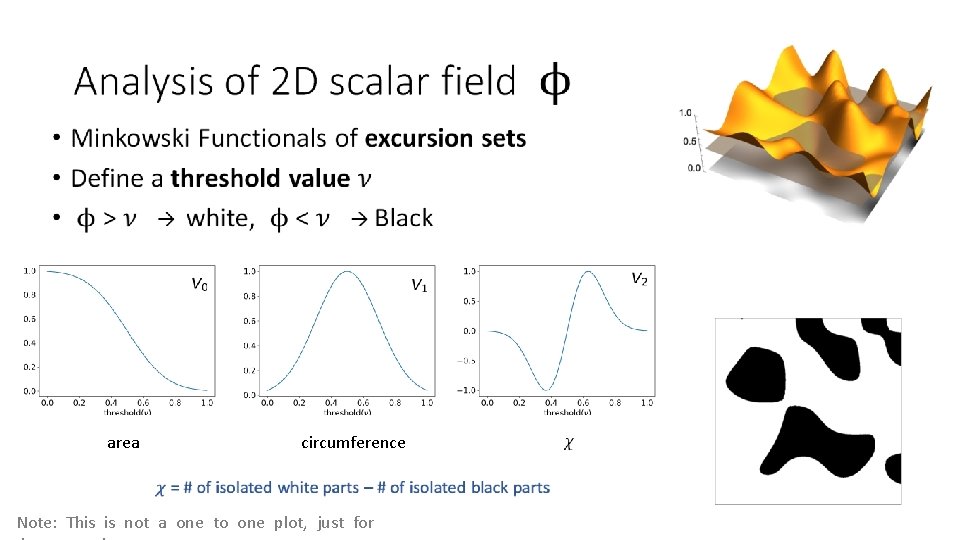
• area circumference Note: This is not a one to one plot, just for
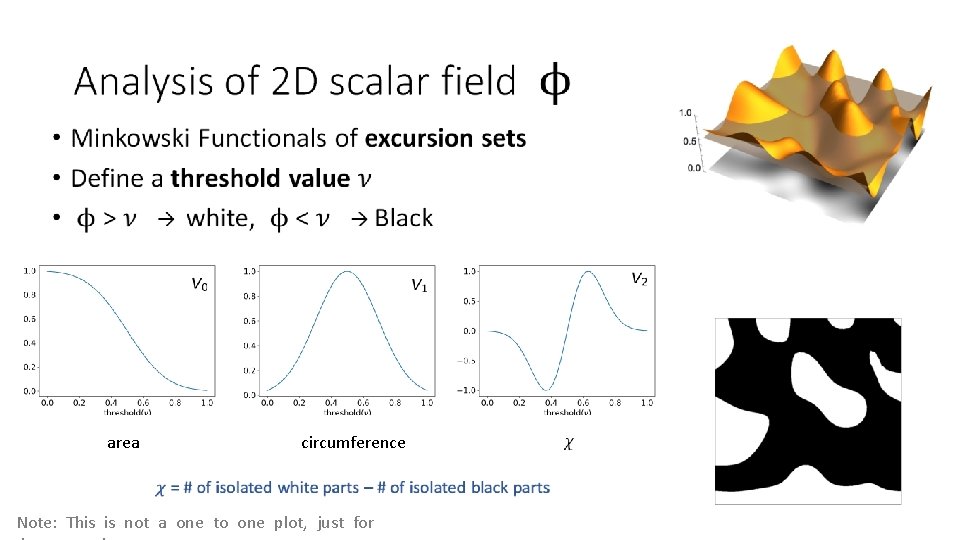
• area circumference Note: This is not a one to one plot, just for
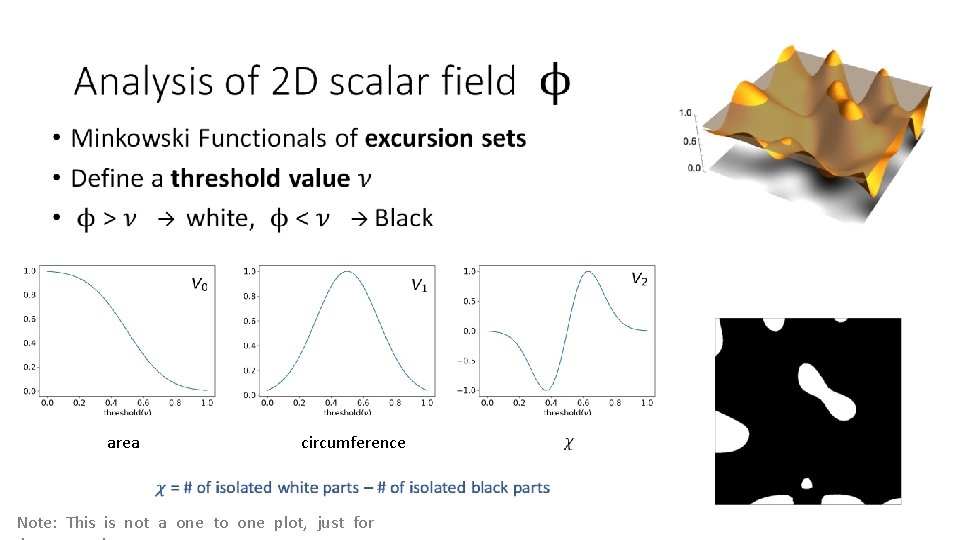
• area circumference Note: This is not a one to one plot, just for
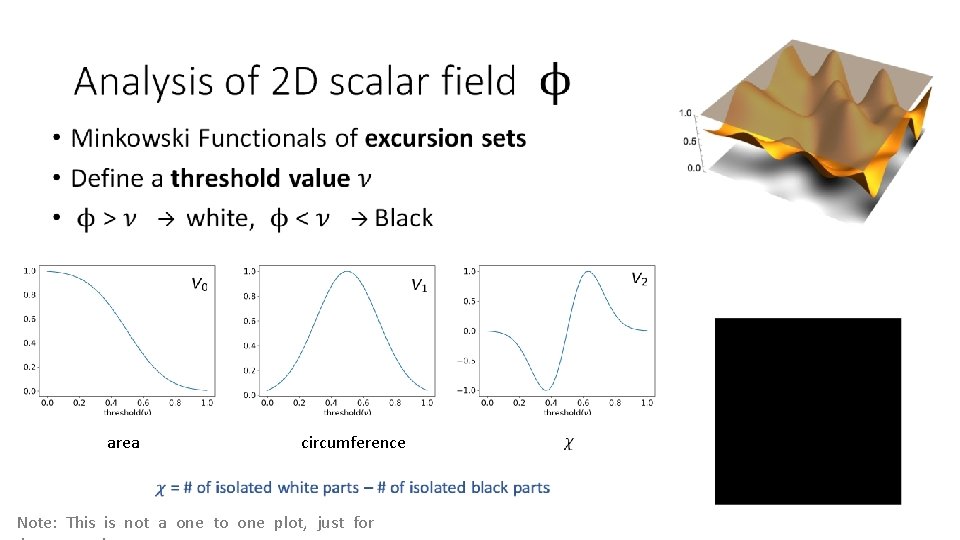
• area circumference Note: This is not a one to one plot, just for
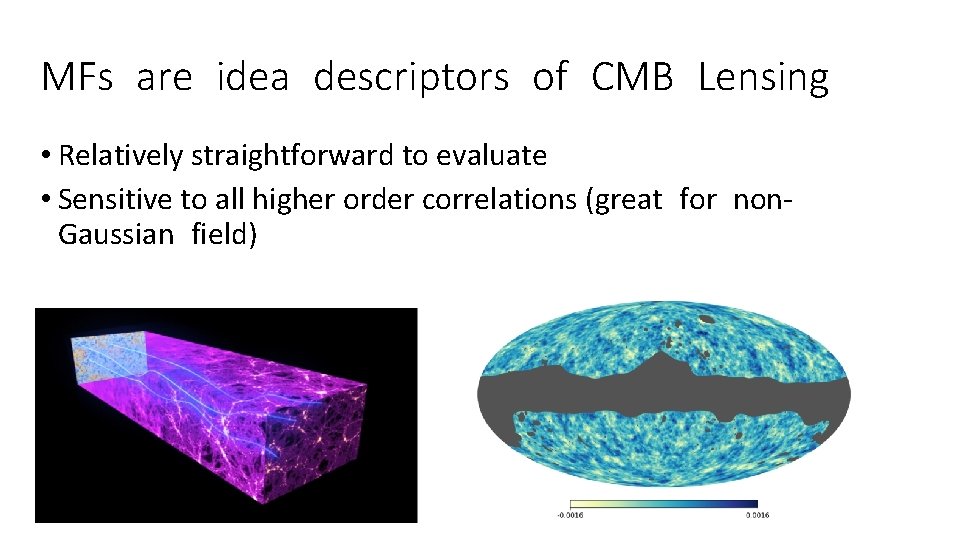
MFs are idea descriptors of CMB Lensing • Relatively straightforward to evaluate • Sensitive to all higher order correlations (great for non. Gaussian field)
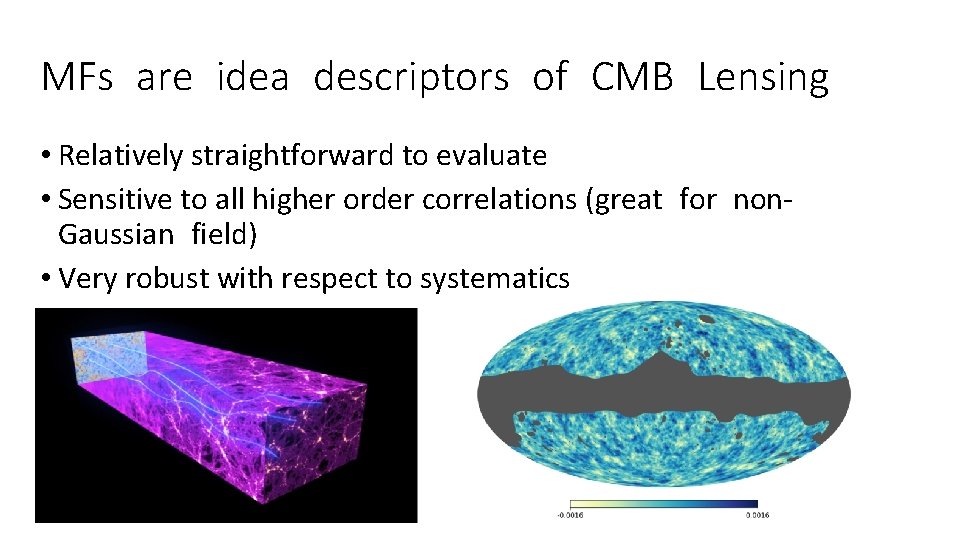
MFs are idea descriptors of CMB Lensing • Relatively straightforward to evaluate • Sensitive to all higher order correlations (great for non. Gaussian field) • Very robust with respect to systematics
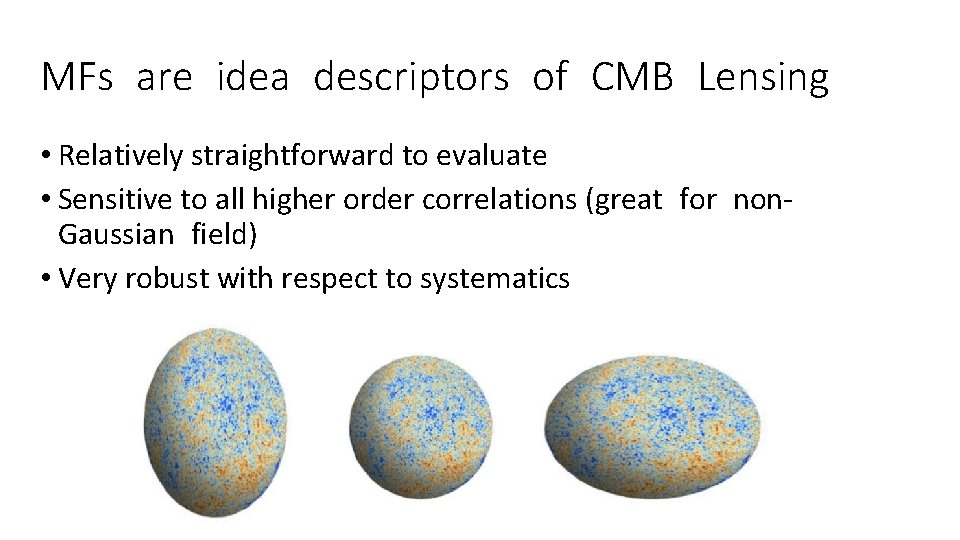
MFs are idea descriptors of CMB Lensing • Relatively straightforward to evaluate • Sensitive to all higher order correlations (great for non. Gaussian field) • Very robust with respect to systematics
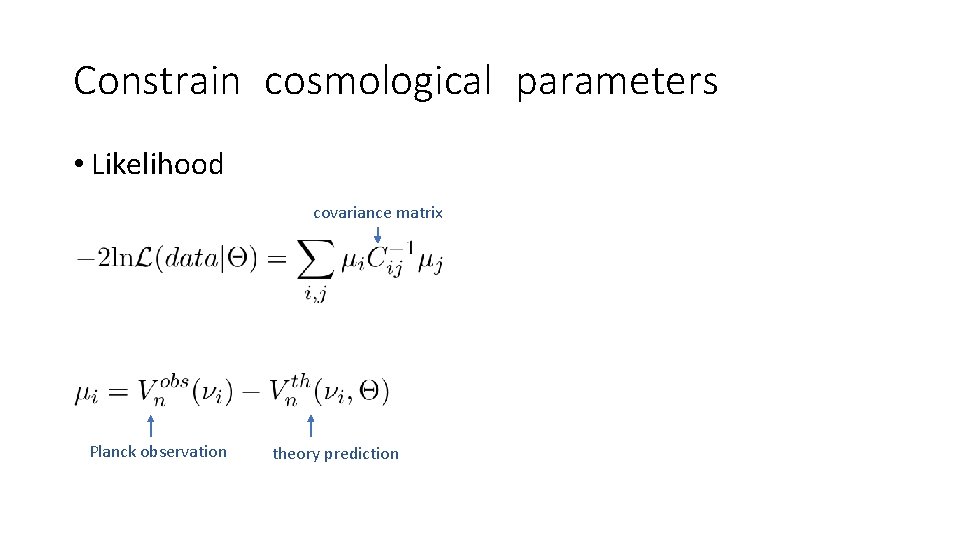
Constrain cosmological parameters • Likelihood covariance matrix Planck observation theory prediction
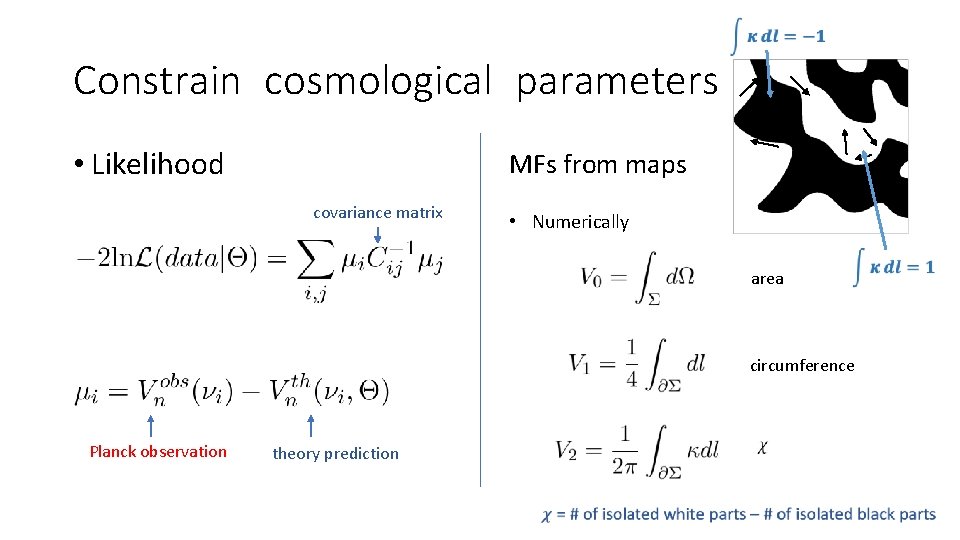
Constrain cosmological parameters • Likelihood MFs from maps covariance matrix • Numerically area circumference Planck observation theory prediction
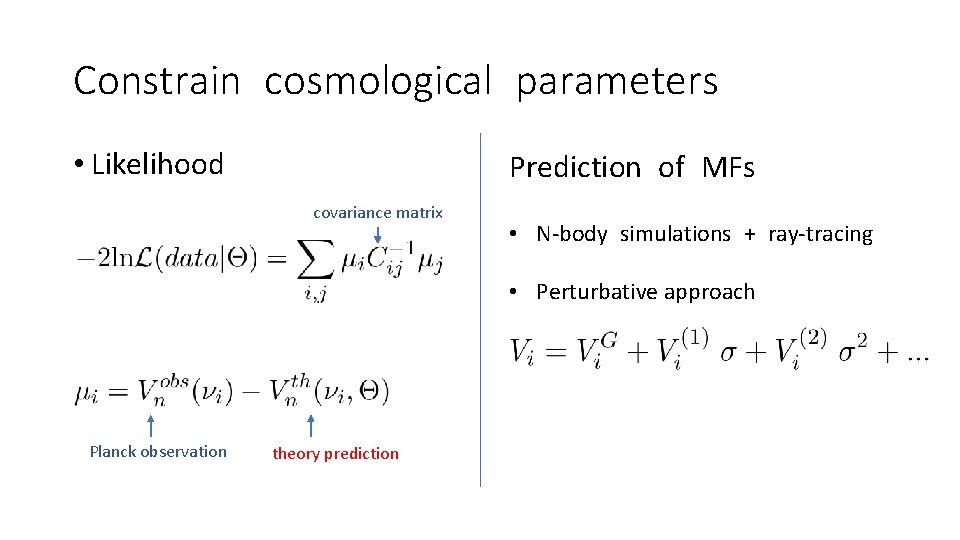
Constrain cosmological parameters • Likelihood Prediction of MFs covariance matrix • N-body simulations + ray-tracing • Perturbative approach Planck observation theory prediction
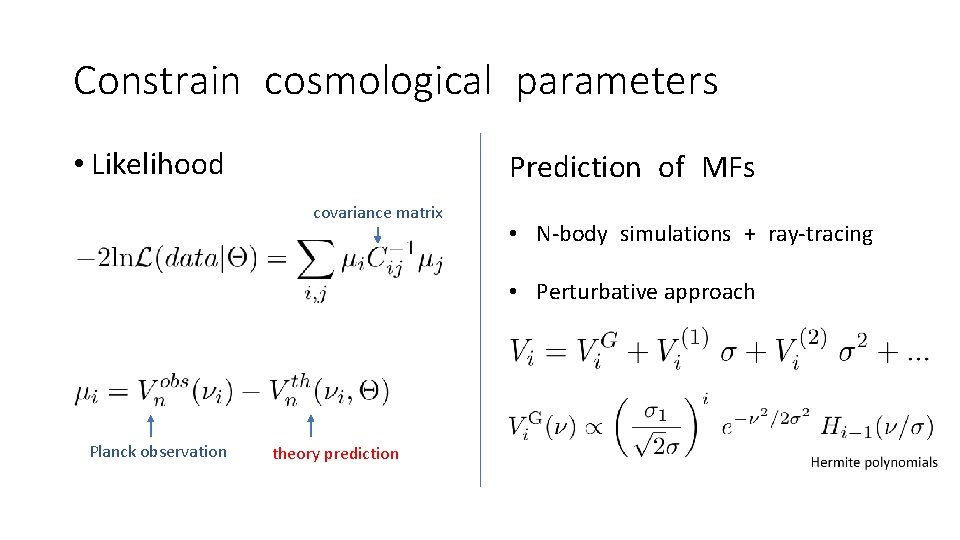
Constrain cosmological parameters • Likelihood Prediction of MFs covariance matrix • N-body simulations + ray-tracing • Perturbative approach Planck observation theory prediction
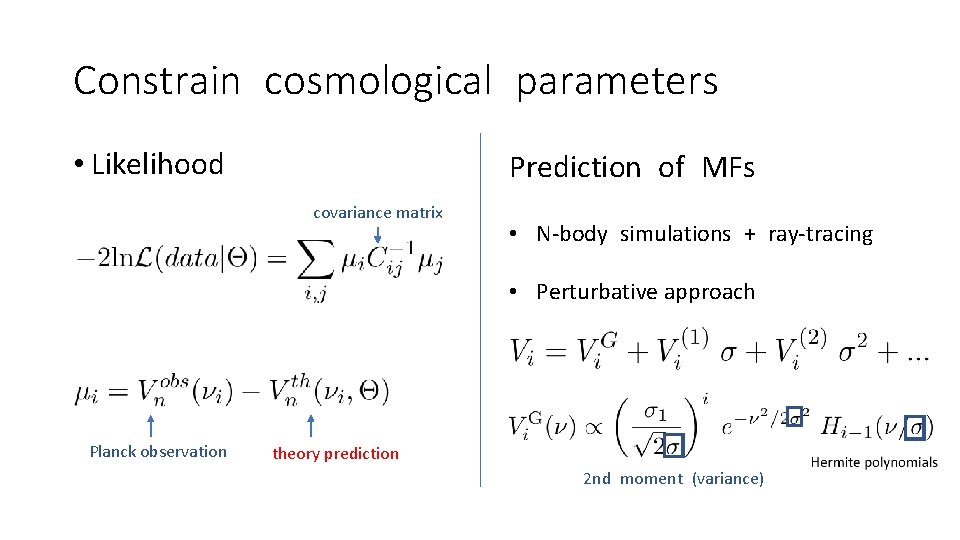
Constrain cosmological parameters • Likelihood Prediction of MFs covariance matrix • N-body simulations + ray-tracing • Perturbative approach Planck observation theory prediction 2 nd moment (variance)
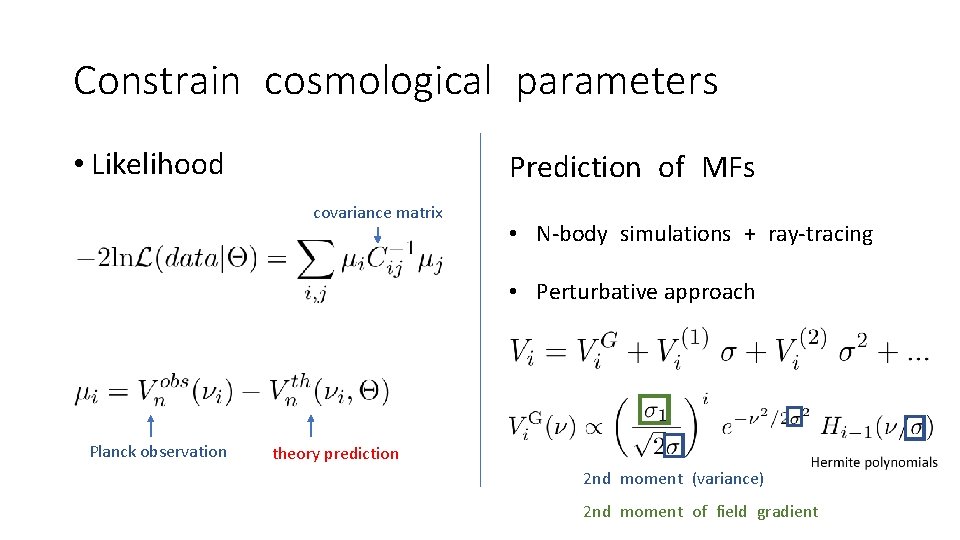
Constrain cosmological parameters • Likelihood Prediction of MFs covariance matrix • N-body simulations + ray-tracing • Perturbative approach Planck observation theory prediction 2 nd moment (variance) 2 nd moment of field gradient
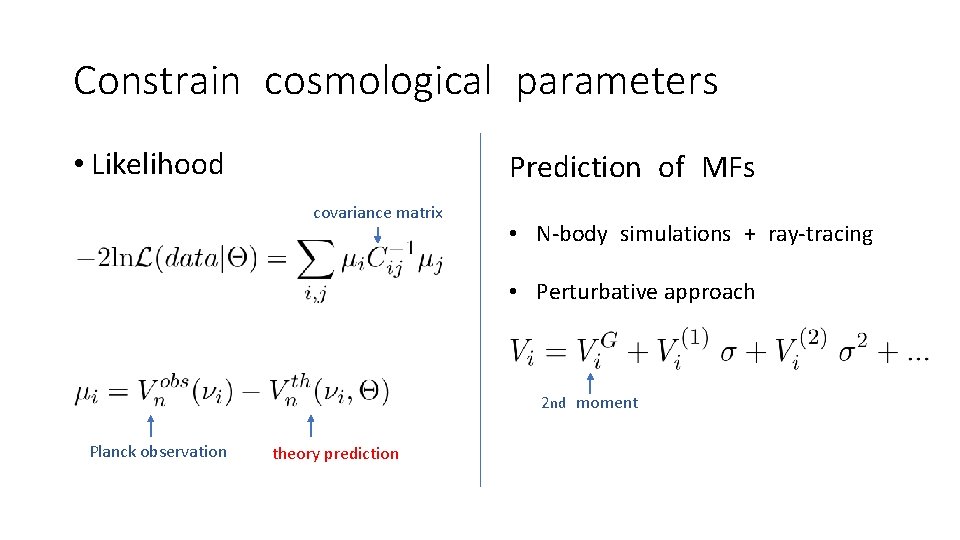
Constrain cosmological parameters • Likelihood Prediction of MFs covariance matrix • N-body simulations + ray-tracing • Perturbative approach 2 nd moment Planck observation theory prediction
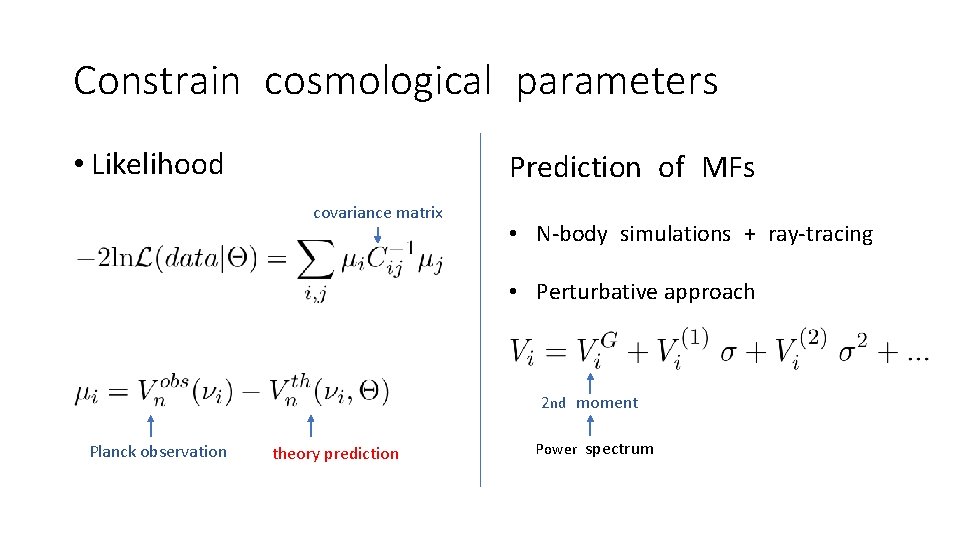
Constrain cosmological parameters • Likelihood Prediction of MFs covariance matrix • N-body simulations + ray-tracing • Perturbative approach 2 nd moment Planck observation theory prediction Power spectrum
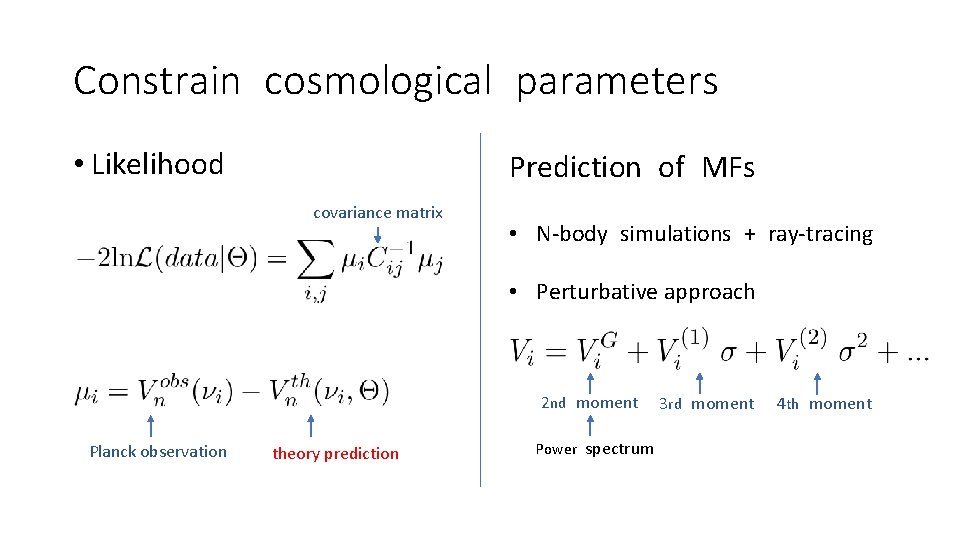
Constrain cosmological parameters • Likelihood Prediction of MFs covariance matrix • N-body simulations + ray-tracing • Perturbative approach 2 nd moment Planck observation theory prediction Power spectrum 3 rd moment 4 th moment
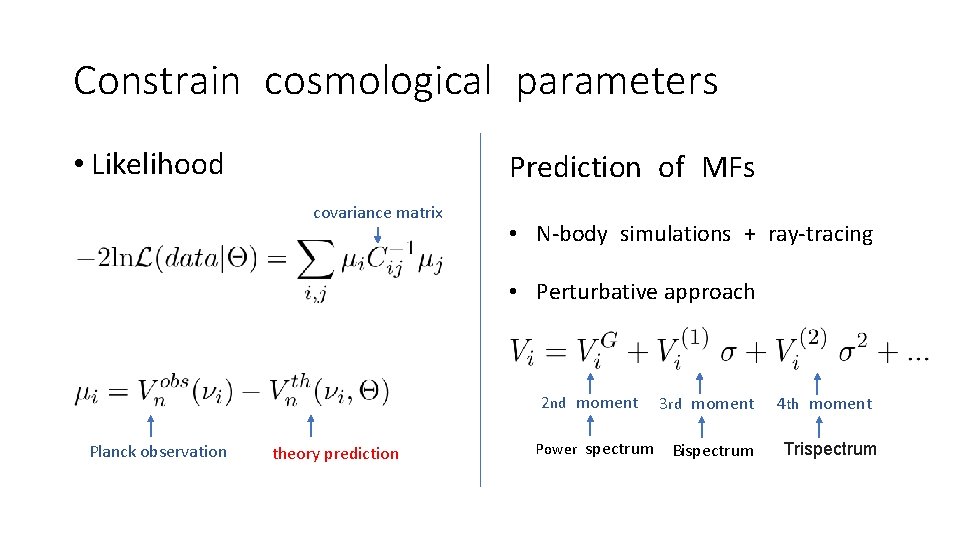
Constrain cosmological parameters • Likelihood Prediction of MFs covariance matrix • N-body simulations + ray-tracing • Perturbative approach 2 nd moment Planck observation theory prediction Power spectrum 3 rd moment Bispectrum 4 th moment Trispectrum
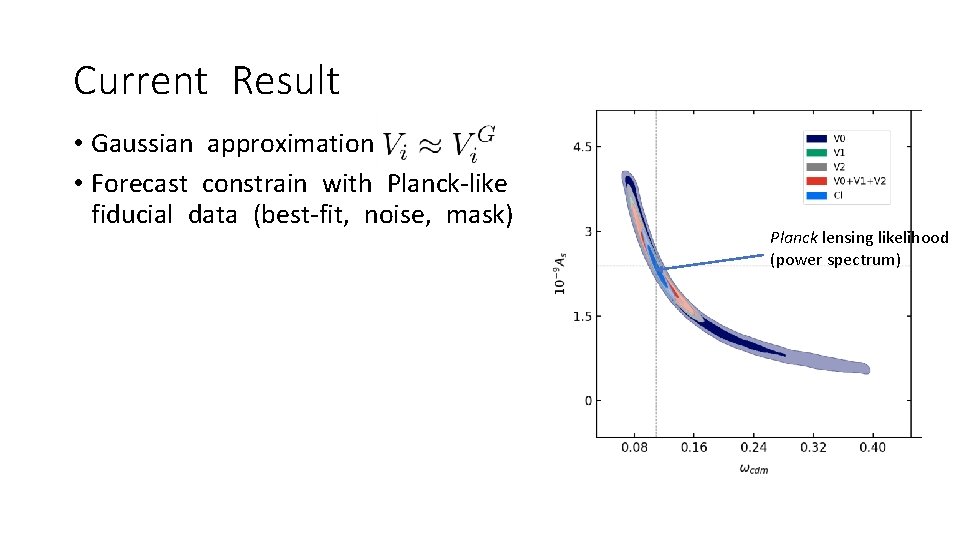
Current Result • Gaussian approximation • Forecast constrain with Planck-like fiducial data (best-fit, noise, mask) Planck lensing likelihood (power spectrum)
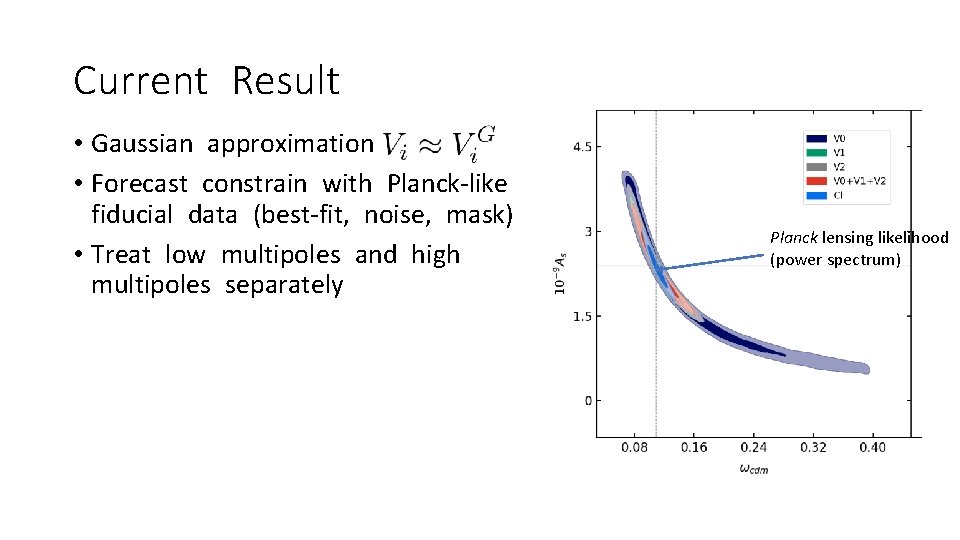
Current Result • Gaussian approximation • Forecast constrain with Planck-like fiducial data (best-fit, noise, mask) • Treat low multipoles and high multipoles separately Planck lensing likelihood (power spectrum)
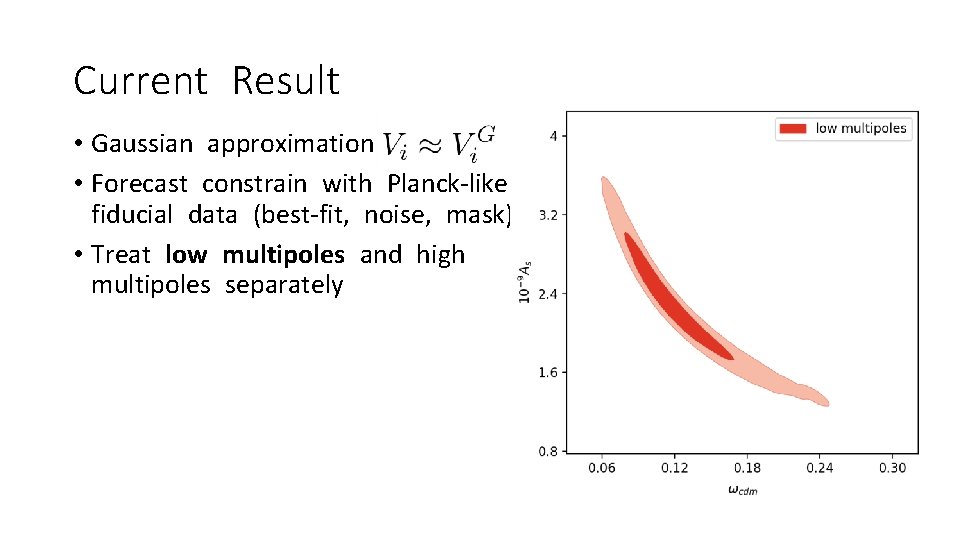
Current Result • Gaussian approximation • Forecast constrain with Planck-like fiducial data (best-fit, noise, mask) • Treat low multipoles and high multipoles separately
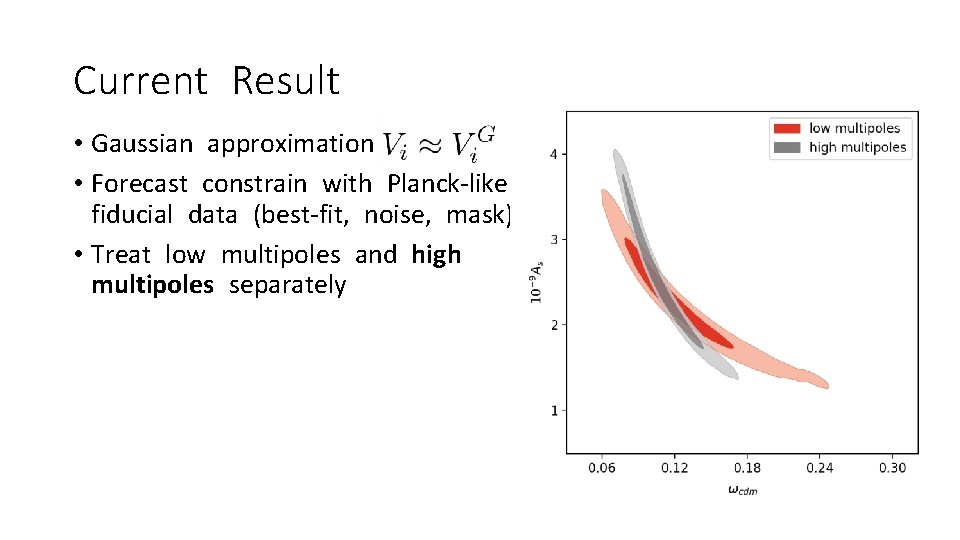
Current Result • Gaussian approximation • Forecast constrain with Planck-like fiducial data (best-fit, noise, mask) • Treat low multipoles and high multipoles separately
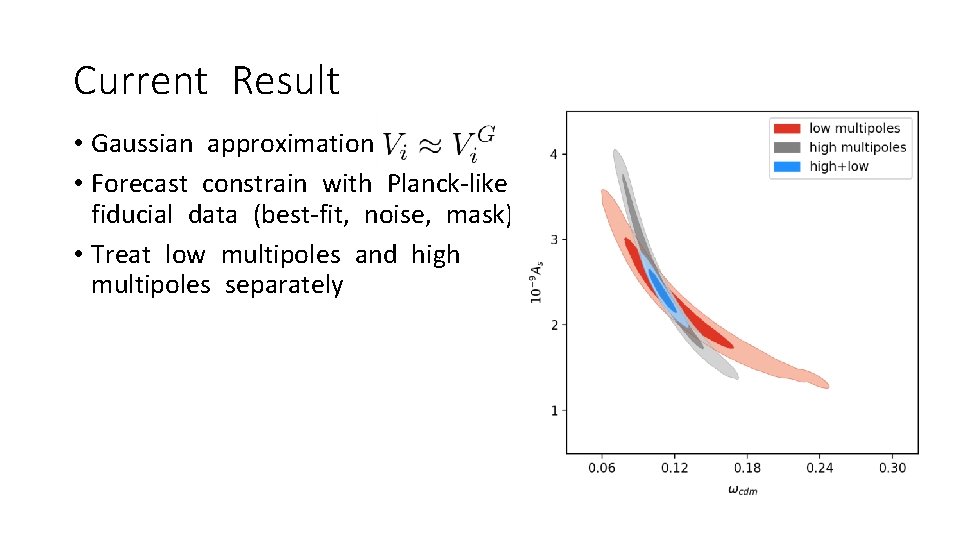
Current Result • Gaussian approximation • Forecast constrain with Planck-like fiducial data (best-fit, noise, mask) • Treat low multipoles and high multipoles separately
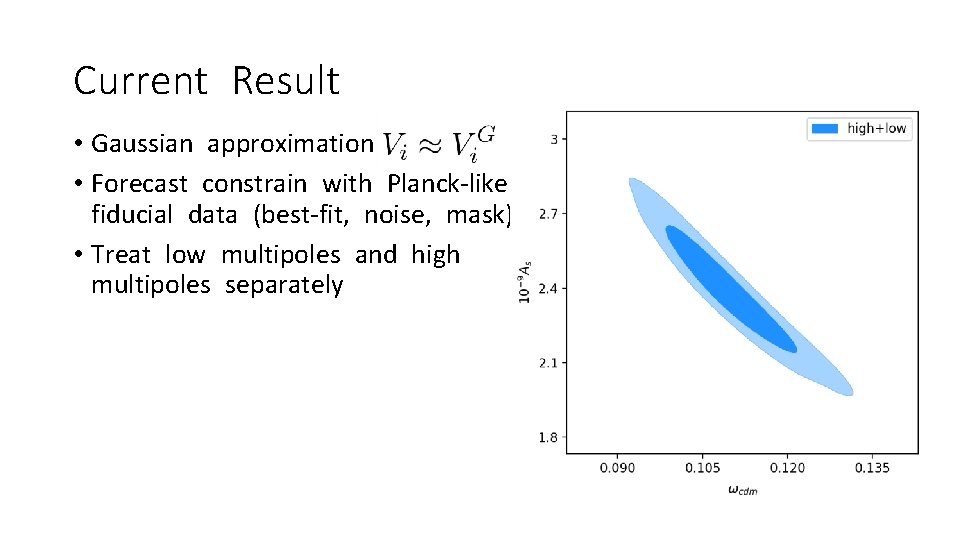
Current Result • Gaussian approximation • Forecast constrain with Planck-like fiducial data (best-fit, noise, mask) • Treat low multipoles and high multipoles separately
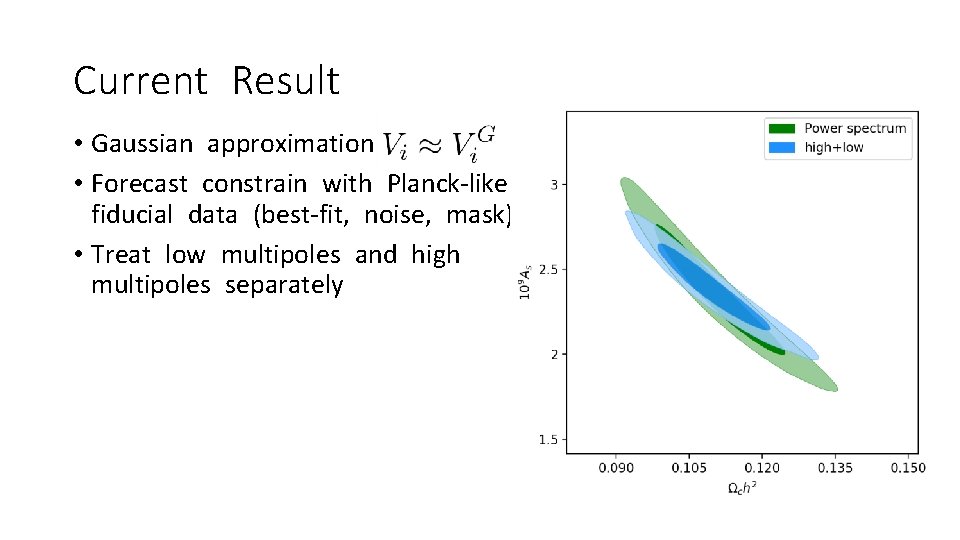
Current Result • Gaussian approximation • Forecast constrain with Planck-like fiducial data (best-fit, noise, mask) • Treat low multipoles and high multipoles separately
Summary • Minkowski functionals describe topological and morphological properties of maps • For non-Gaussian maps, MFs can add information that is missed by the power spectrum • MFs are promising tools for current and future CMB lensing observations

Back up Slides
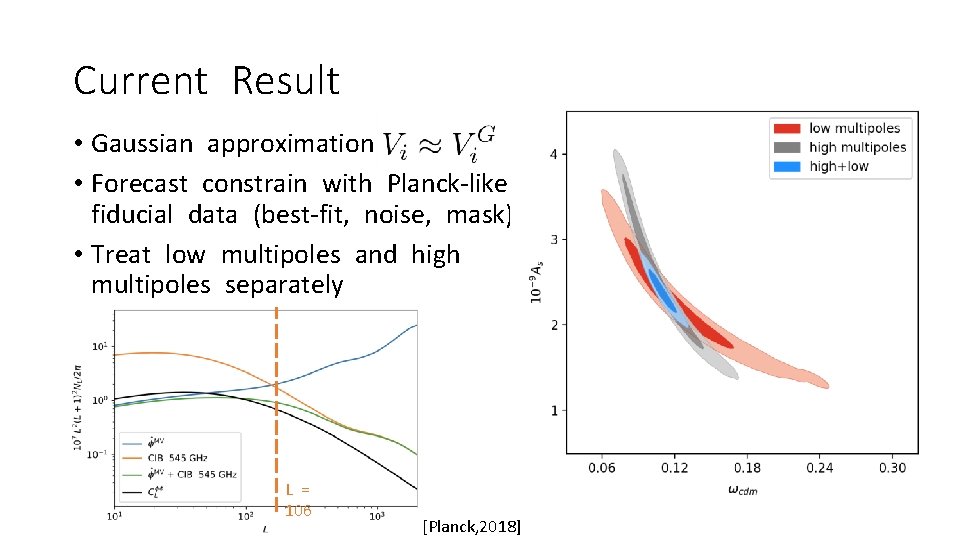
Current Result • Gaussian approximation • Forecast constrain with Planck-like fiducial data (best-fit, noise, mask) • Treat low multipoles and high multipoles separately L = 106 [Planck, 2018]

Covariance Matrix
- Slides: 40