
Using Mathematics Think Alouds A FieldIdentified Teaching Strategy







- Slides: 18
Using Mathematics Think Alouds: A Field-Identified Teaching Strategy for English Language Learners with Disabilities Martha Thurlow, Manuel Barrera, Kristi Liu National Center on Educational Outcomes
Welcome and Introduction Martha Thurlow, Director National Center on Educational Outcomes
What Do We Know About ELLs with Disabilities? An estimated 357, 325 students K-12 in 2001 -2002 9% of all ELLs have disabilities Roughly 80% identified with a learning disability or a speech language impairment Spanish language speakers highly represented National Center on Educational Outcomes (NCEO)
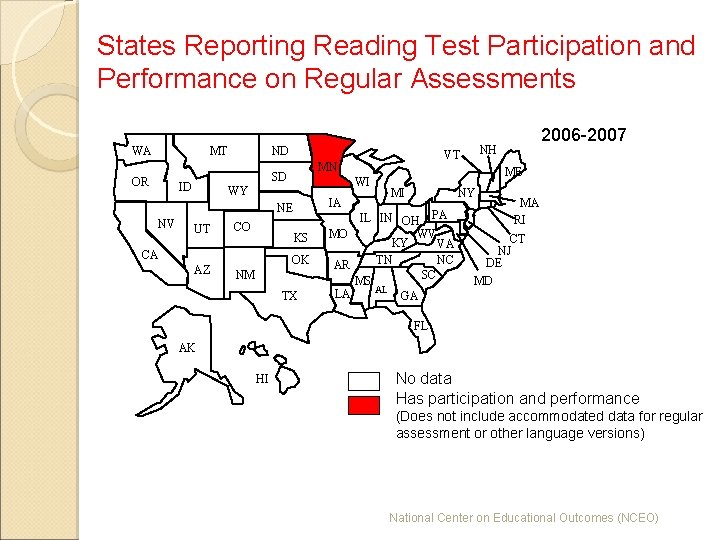
States Reporting Reading Test Participation and Performance on Regular Assessments WA MT OR ND SD ID WY UT CO AZ MI IA KS CA ME WI NE NV VT MN OK NM TX NY PA IL IN OH MO WV KY VA TN NC AR SC MS LA 2006 -2007 NH AL MA RI CT NJ DE MD GA FL AK HI No data Has participation and performance (Does not include accommodated data for regular assessment or other language versions) National Center on Educational Outcomes (NCEO)
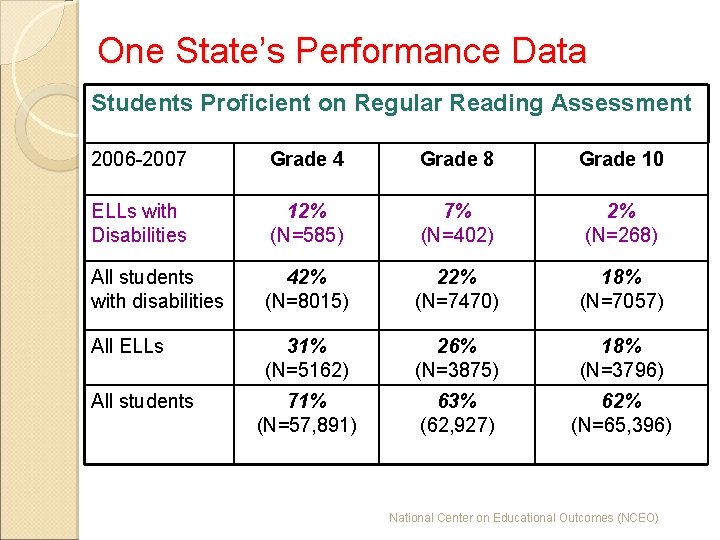
One State’s Performance Data Students Proficient on Regular Reading Assessment 2006 -2007 Grade 4 Grade 8 Grade 10 ELLs with Disabilities 12% (N=585) 7% (N=402) 2% (N=268) All students with disabilities 42% (N=8015) 22% (N=7470) 18% (N=7057) All ELLs 31% (N=5162) 26% (N=3875) 18% (N=3796) 71% (N=57, 891) 63% (62, 927) 62% (N=65, 396) All students National Center on Educational Outcomes (NCEO)
Kristi Liu National Center on Educational Outcomes
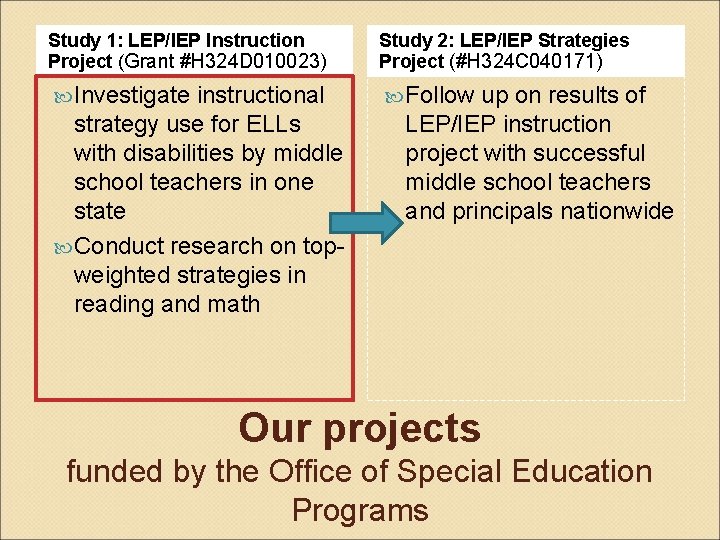
Study 1: LEP/IEP Instruction Project (Grant #H 324 D 010023) Study 2: LEP/IEP Strategies Project (#H 324 C 040171) Investigate Follow instructional strategy use for ELLs with disabilities by middle school teachers in one state Conduct research on topweighted strategies in reading and math up on results of LEP/IEP instruction project with successful middle school teachers and principals nationwide Our projects funded by the Office of Special Education Programs
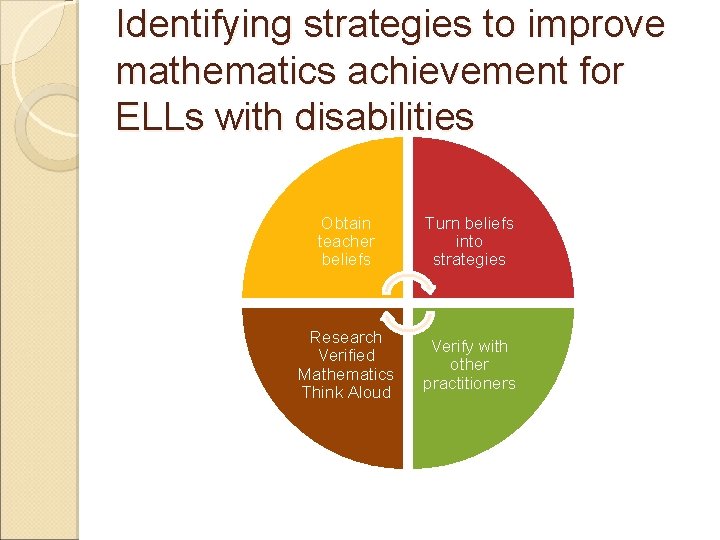
Identifying strategies to improve mathematics achievement for ELLs with disabilities Obtain teacher beliefs Turn beliefs into strategies Research Verified Mathematics Think Aloud Verify with other practitioners
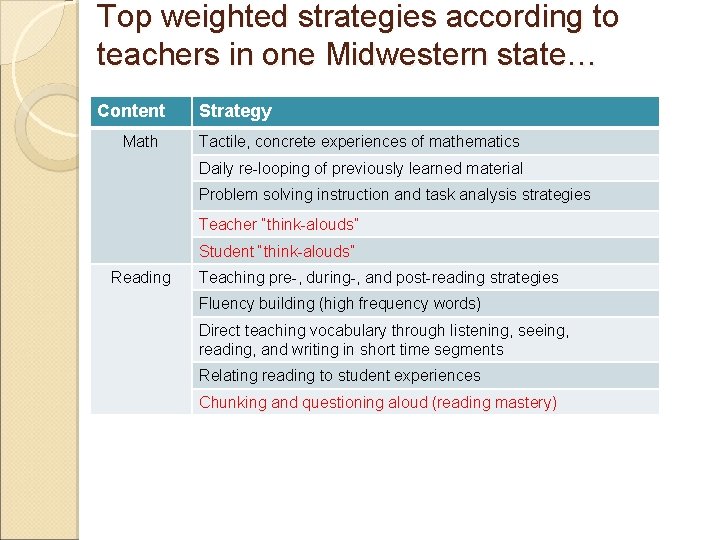
Top weighted strategies according to teachers in one Midwestern state… Content Math Strategy Tactile, concrete experiences of mathematics Daily re-looping of previously learned material Problem solving instruction and task analysis strategies Teacher “think-alouds” Student “think-alouds” Reading Teaching pre-, during-, and post-reading strategies Fluency building (high frequency words) Direct teaching vocabulary through listening, seeing, reading, and writing in short time segments Relating reading to student experiences Chunking and questioning aloud (reading mastery)
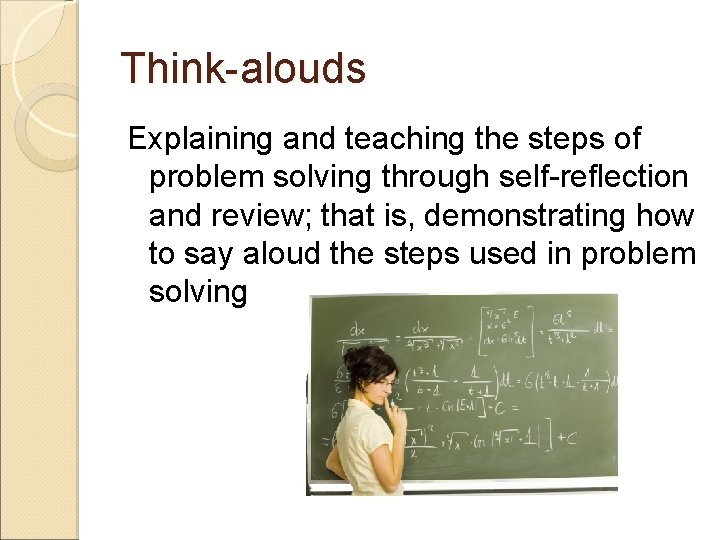
Think-alouds Explaining and teaching the steps of problem solving through self-reflection and review; that is, demonstrating how to say aloud the steps used in problem solving
Related Research Single-subject research with general think aloud procedures for students with disabilities in mathematics (Braten & Throndsen, 1998; Case, Harris, & Graham, 1992; Davis & Hajicek, 1985; Leon & Pepe, 1983; ) Research on “Self-instructional strategy development” (SI) or “self-regulated learning” (SRL) (Leon and Pepe, 1983; Moore, Reith, & Ebeling, 1993)
Students in Math Think Aloud Study Student Grade Age Ethnicity/ Oral English Reading Language Proficiency Level Math Level M 8 15 Hmong 2. 5 Low T 1 6 13 Mexican- Proficient America n/Spanis h 4 4 T 2 6 13 Mexican- Proficient America n/Spanis h 3 3 T 3 6 12 Mexican- Beginning America n/Spanis h Did not meet standard Intermediat e
Manuel Barrera National Center on Educational Outcomes Metropolitan State University
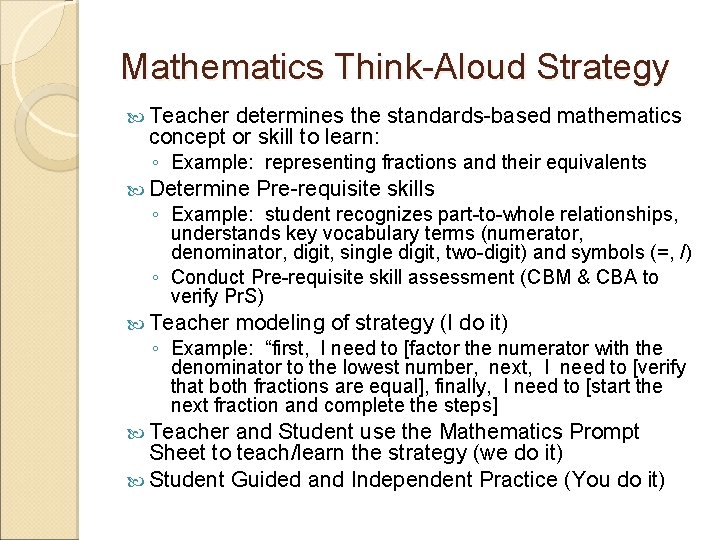
Mathematics Think-Aloud Strategy Teacher determines the standards-based mathematics concept or skill to learn: ◦ Example: representing fractions and their equivalents Determine Pre-requisite skills ◦ Example: student recognizes part-to-whole relationships, understands key vocabulary terms (numerator, denominator, digit, single digit, two-digit) and symbols (=, /) ◦ Conduct Pre-requisite skill assessment (CBM & CBA to verify Pr. S) Teacher modeling of strategy (I do it) ◦ Example: “first, I need to [factor the numerator with the denominator to the lowest number, next, I need to [verify that both fractions are equal], finally, I need to [start the next fraction and complete the steps] Teacher and Student use the Mathematics Prompt Sheet to teach/learn the strategy (we do it) Student Guided and Independent Practice (You do it)
Monitor and Evaluate Strategy Use, Progress, and Student Check-in Use of systematic teaching process ◦ ◦ ◦ Explain what will be done and why Determine and verify vocabulary needed Describe strategy steps Modeling and Prompting of steps Provide exemplars & visuals Collect strategy and achievement during instruction & practice Provide student opportunities to verify comprehension of strategy and process (student check-in) See http: //cehd. umn. edu/NCEO/Online. Pubs/ELLs. Dis 16/default. html for published descriptions
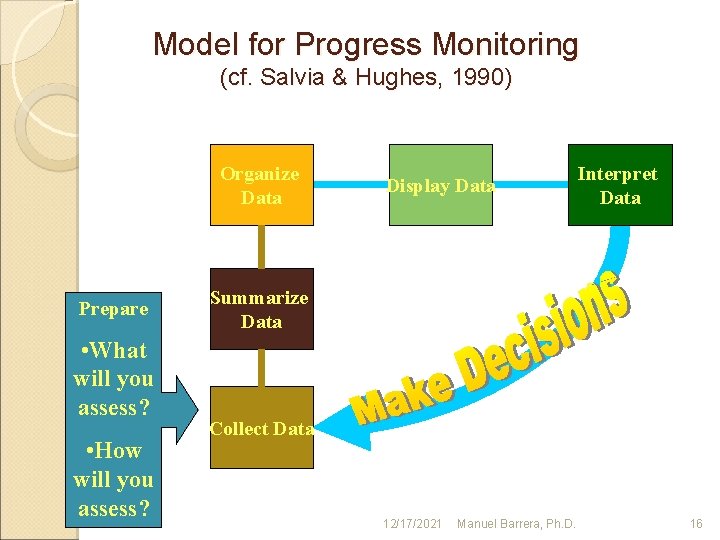
Model for Progress Monitoring (cf. Salvia & Hughes, 1990) Organize Data Prepare • What will you assess? • How will you assess? Display Data Interpret Data Summarize Data Collect Data 12/17/2021 Manuel Barrera, Ph. D. 16
Applications for ELLs with disabilities in Group and ESL Settings Evidence for use of think-alouds with ELLs in ESL settings ◦ Use in conjunction with the CALLA (Chamot, Dale, O’Malley, & Spanos, 1992) For review of Chamot, et al. , paper go to http: //citeseerx. ist. psu. edu/viewdoc/summary? doi=10. 1. 1. 20. 9610 ◦ A think-aloud procedure was used as a step in preparing for understanding the problem-solving steps, as a guide during problem solving and as a reflective (“retrospective”) process after solving the problem ◦ Students with language and mathematics ability challenges (“low ability”) had more difficulty and could benefit from procedures used in our study (cf. Liu, Barrera, & Thurlow, 2009)
References Thurlow, M. , Albus, D. , Shyyan, V. , Liu, K. , & Barrera, M. (2004). Educator perceptions of instructional strategies for standardsbased education of English language learners with disabilities (ELLs with Disabilities Report 7) http: //cehd. umn. edu/nceo/Online. Pubs/ELLs. Dis. Rpt 7. pdf Barrera, M. Liu, K. , Thurlow, M. , Shyyan, V. , Yan, M. , & Chamberlain, S. (2006). Math Strategy Instruction for Students with Disabilities who are Learning English-ELLs with Disabilities Report 16 http: //cehd. umn. edu/NCEO/Online. Pubs/ELLs. Dis 16/default. html Chamot, A. U. , Dale, M. , O'Malley, J. M. , & Spanos, G. A. (1992). Learning and Problem Solving Strategies of ESL Students, http: //www. ncbe. gwu. edu/library/. . /miscpubs/nabe/brj/v 16/16_34_chamo t. pdf For additional NCEO research reports on strategies for ELLs with Disabilities, please visit our website: http: //www. nceo. info Go to “publications” and look for “ELLs with Disabilities” series