
Using math withmirrors and ray diagrams Mirror equation
- Slides: 16
Using math withmirrors and ray diagrams
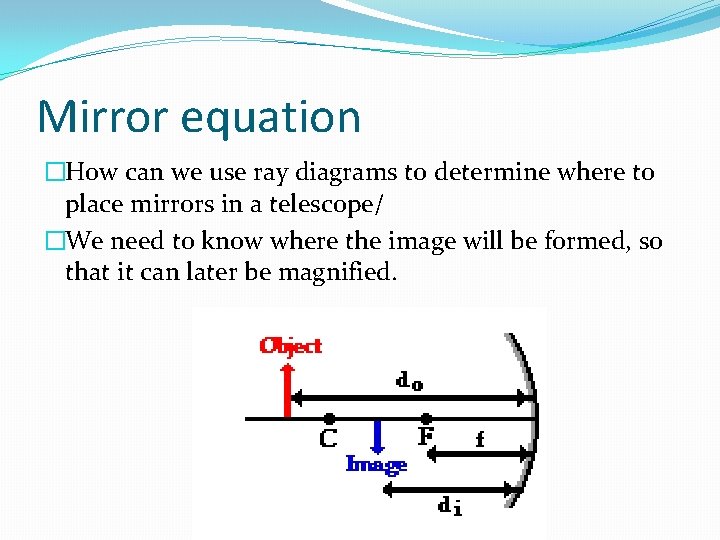
Mirror equation �How can we use ray diagrams to determine where to place mirrors in a telescope/ �We need to know where the image will be formed, so that it can later be magnified.
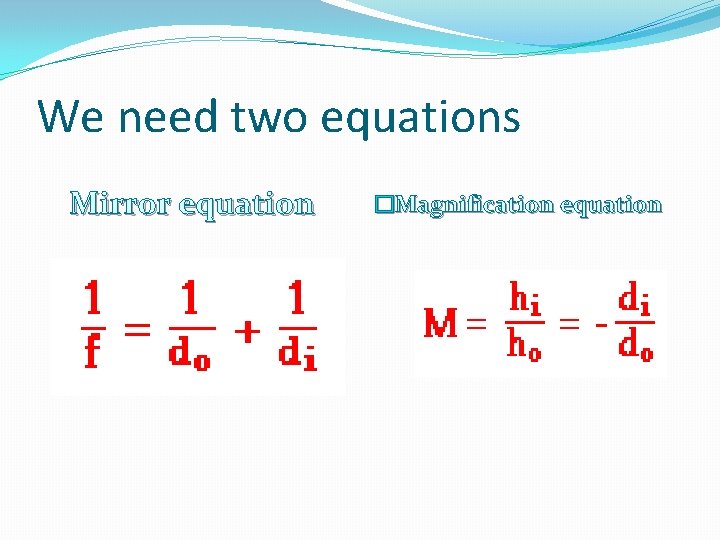
We need two equations Mirror equation �Magnification equation
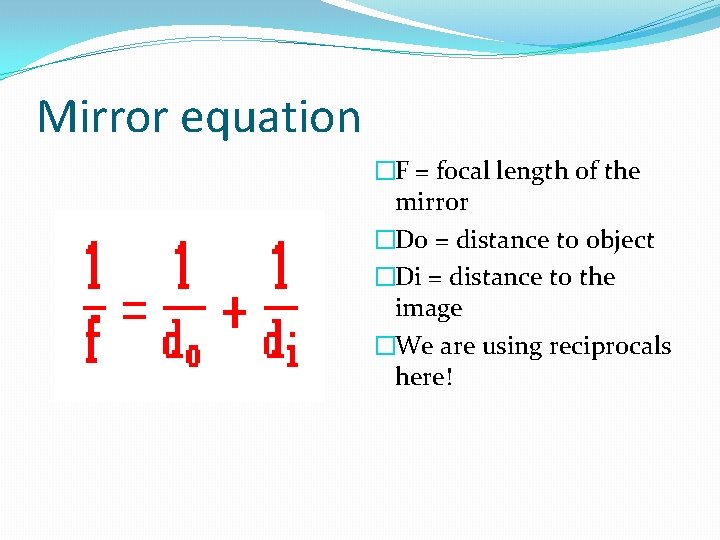
Mirror equation �F = focal length of the mirror �Do = distance to object �Di = distance to the image �We are using reciprocals here!
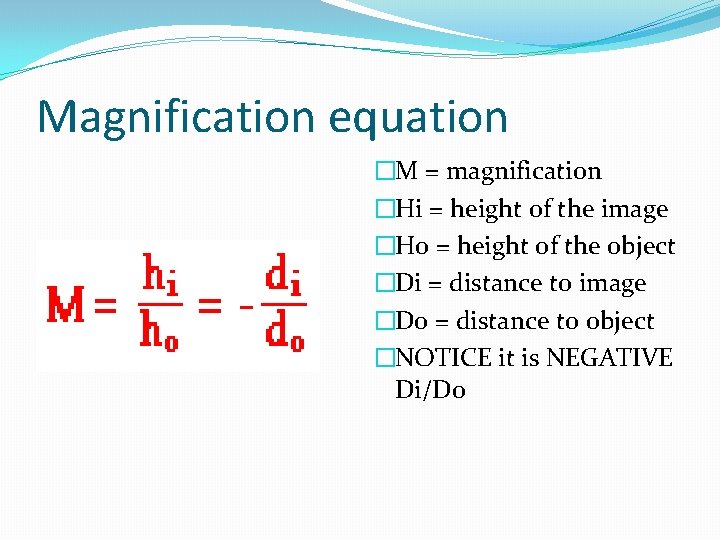
Magnification equation �M = magnification �Hi = height of the image �Ho = height of the object �Di = distance to image �Do = distance to object �NOTICE it is NEGATIVE Di/Do
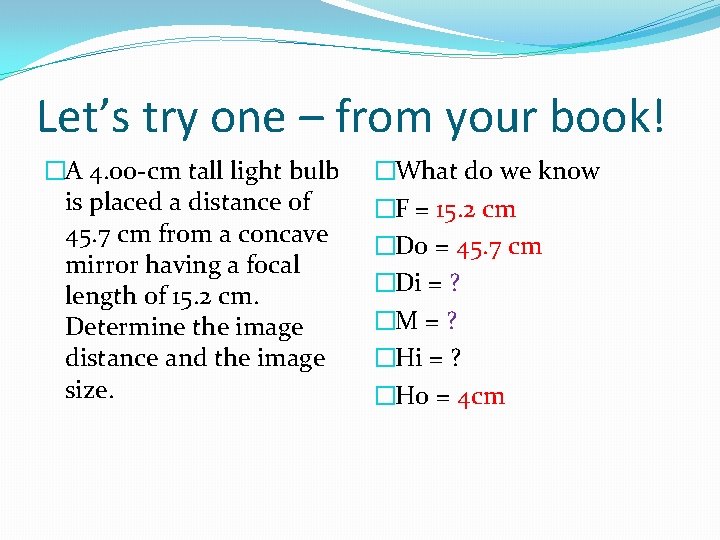
Let’s try one – from your book! �A 4. 00 -cm tall light bulb is placed a distance of 45. 7 cm from a concave mirror having a focal length of 15. 2 cm. Determine the image distance and the image size. �What do we know �F = 15. 2 cm �Do = 45. 7 cm �Di = ? �M = ? �Hi = ? �Ho = 4 cm
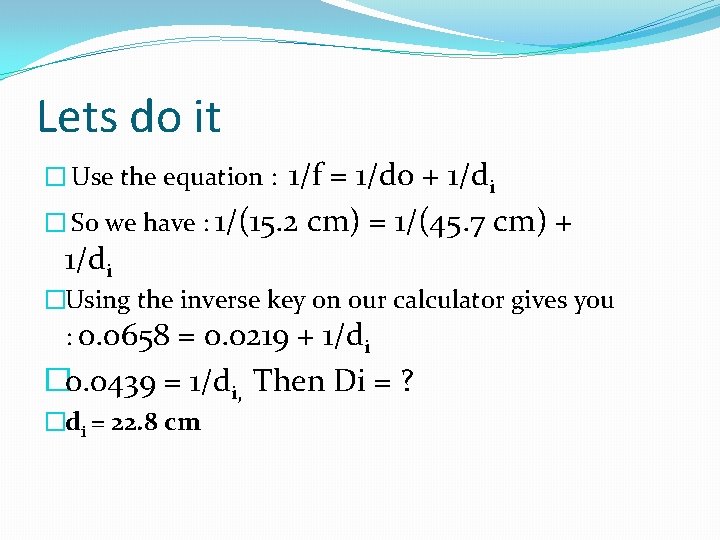
Lets do it 1/f = 1/do + 1/di � So we have : 1/(15. 2 cm) = 1/(45. 7 cm) + 1/di � Use the equation : �Using the inverse key on our calculator gives you : 0. 0658 = 0. 0219 + 1/di � 0. 0439 = 1/di, Then Di = ? �di = 22. 8 cm
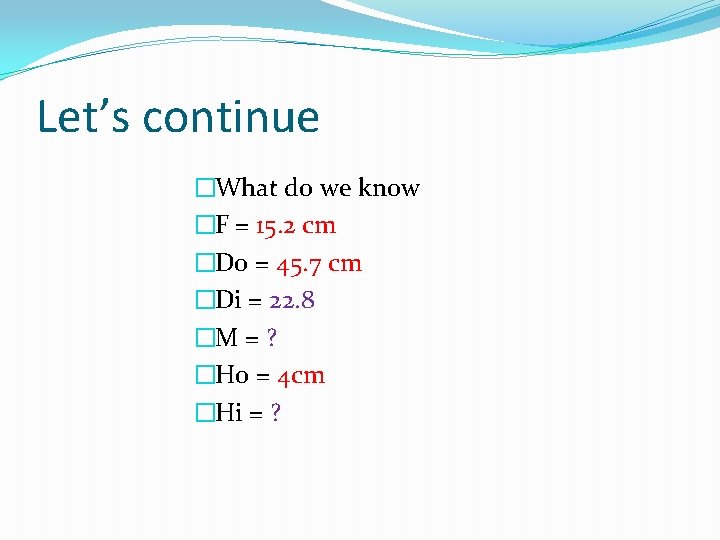
Let’s continue �What do we know �F = 15. 2 cm �Do = 45. 7 cm �Di = 22. 8 �M = ? �Ho = 4 cm �Hi = ?
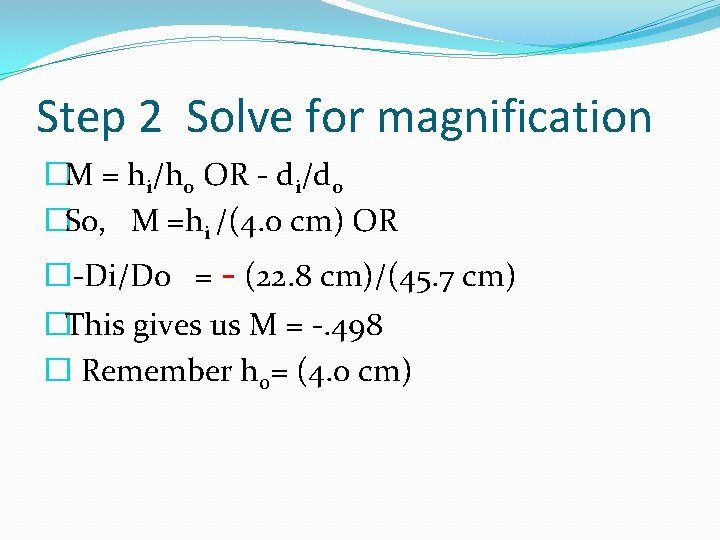
Step 2 Solve for magnification �M = hi/ho OR - di/do �So, M =hi /(4. 0 cm) OR �-Di/Do = - (22. 8 cm)/(45. 7 cm) �This gives us M = -. 498 � Remember h 0= (4. 0 cm)
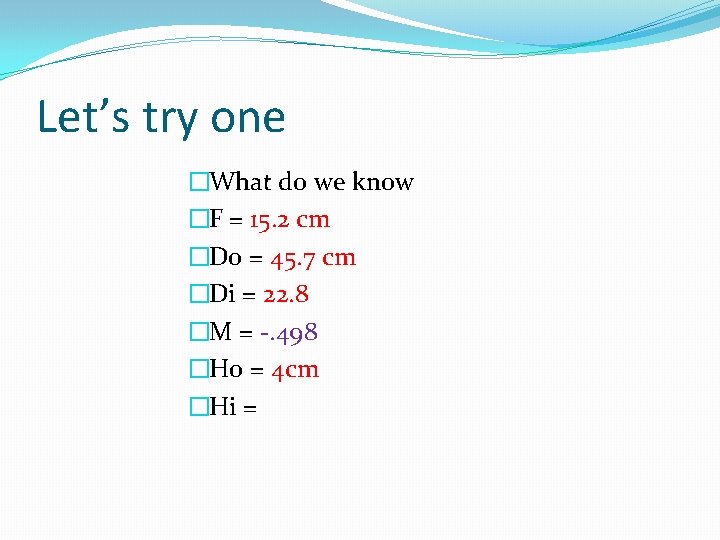
Let’s try one �What do we know �F = 15. 2 cm �Do = 45. 7 cm �Di = 22. 8 �M = -. 498 �Ho = 4 cm �Hi =
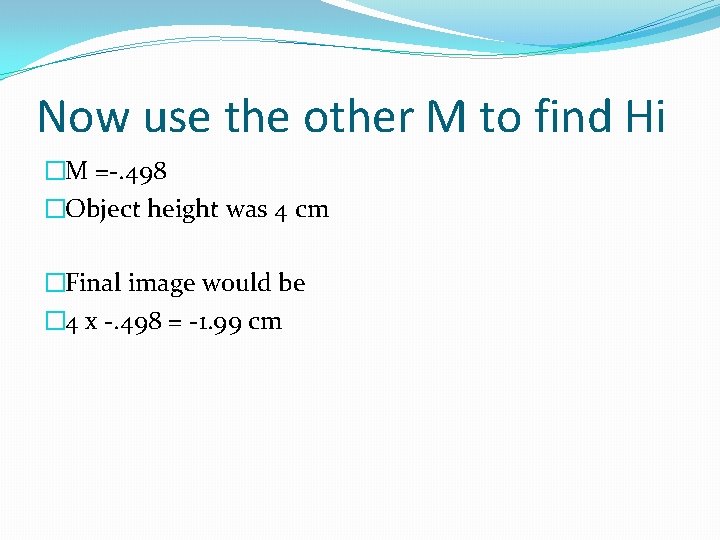
Now use the other M to find Hi �M =-. 498 �Object height was 4 cm �Final image would be � 4 x -. 498 = -1. 99 cm
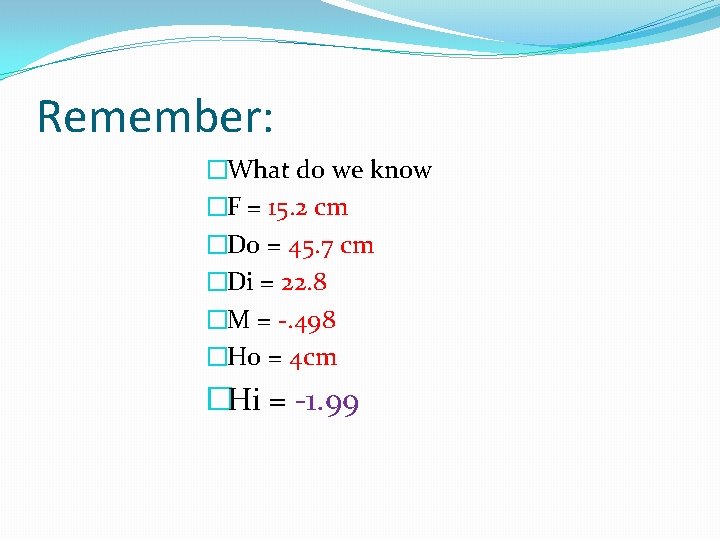
Remember: �What do we know �F = 15. 2 cm �Do = 45. 7 cm �Di = 22. 8 �M = -. 498 �Ho = 4 cm �Hi = -1. 99
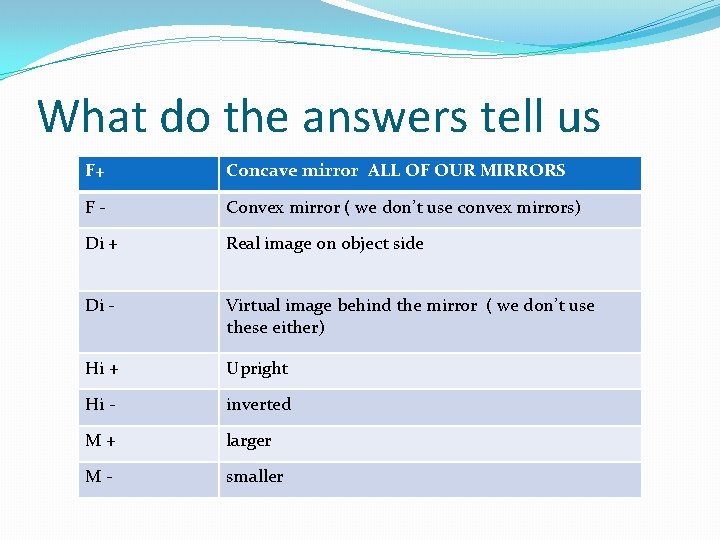
What do the answers tell us F+ Concave mirror ALL OF OUR MIRRORS F- Convex mirror ( we don’t use convex mirrors) Di + Real image on object side Di - Virtual image behind the mirror ( we don’t use these either) Hi + Upright Hi - inverted M+ larger M- smaller
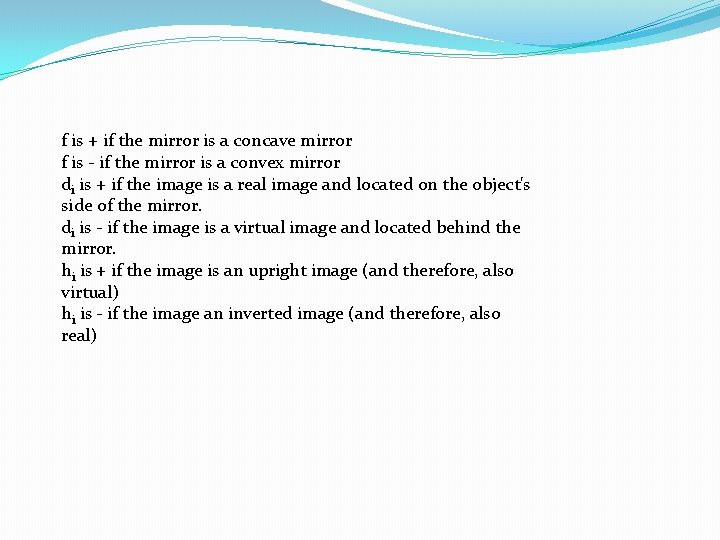
f is + if the mirror is a concave mirror f is - if the mirror is a convex mirror di is + if the image is a real image and located on the object's side of the mirror. di is - if the image is a virtual image and located behind the mirror. hi is + if the image is an upright image (and therefore, also virtual) hi is - if the image an inverted image (and therefore, also real)
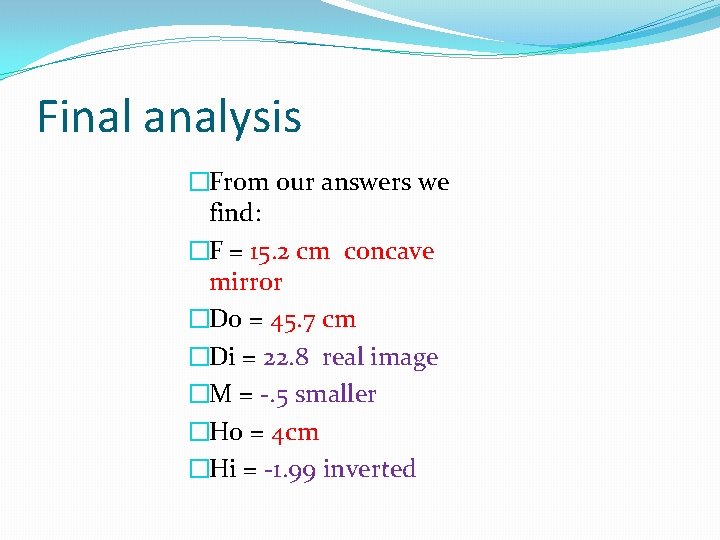
Final analysis �From our answers we find: �F = 15. 2 cm concave mirror �Do = 45. 7 cm �Di = 22. 8 real image �M = -. 5 smaller �Ho = 4 cm �Hi = -1. 99 inverted
Note: �What we have done so far applies only to mirrors �When we add lenses we will use the same q equations but the �LOST part will be much different