
Using Magnetism to Induce an Electric Current Electromagnetic
- Slides: 10
Using Magnetism to Induce an Electric Current Electromagnetic Induction is used to generate most of the electrical energy used today
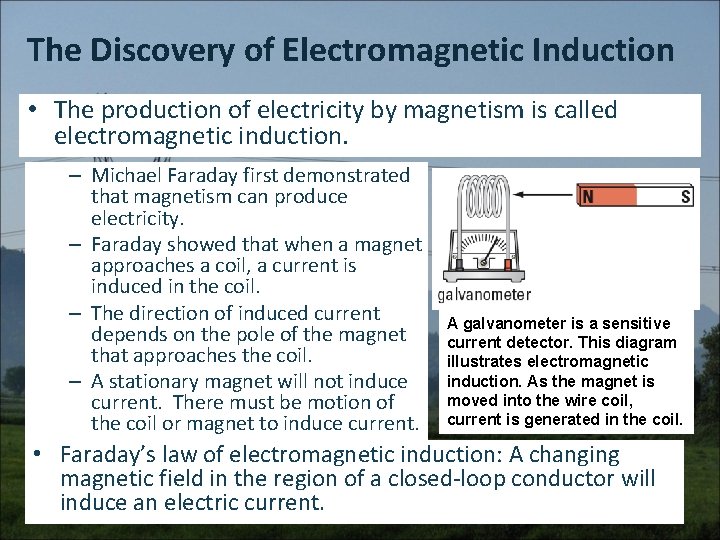
The Discovery of Electromagnetic Induction • The production of electricity by magnetism is called electromagnetic induction. – Michael Faraday first demonstrated that magnetism can produce electricity. – Faraday showed that when a magnet approaches a coil, a current is induced in the coil. – The direction of induced current depends on the pole of the magnet that approaches the coil. – A stationary magnet will not induce current. There must be motion of the coil or magnet to induce current. A galvanometer is a sensitive current detector. This diagram illustrates electromagnetic induction. As the magnet is moved into the wire coil, current is generated in the coil. • Faraday’s law of electromagnetic induction: A changing magnetic field in the region of a closed-loop conductor will induce an electric current.
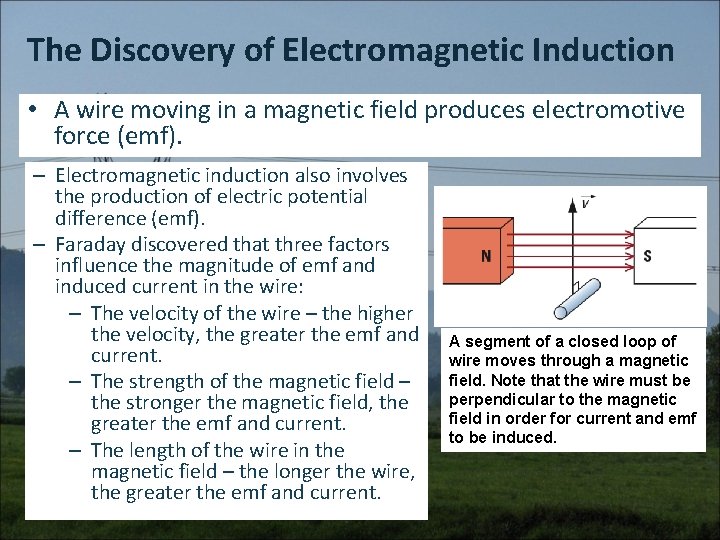
The Discovery of Electromagnetic Induction • A wire moving in a magnetic field produces electromotive force (emf). – Electromagnetic induction also involves the production of electric potential difference (emf). – Faraday discovered that three factors influence the magnitude of emf and induced current in the wire: – The velocity of the wire – the higher the velocity, the greater the emf and current. – The strength of the magnetic field – the stronger the magnetic field, the greater the emf and current. – The length of the wire in the magnetic field – the longer the wire, the greater the emf and current. A segment of a closed loop of wire moves through a magnetic field. Note that the wire must be perpendicular to the magnetic field in order for current and emf to be induced.
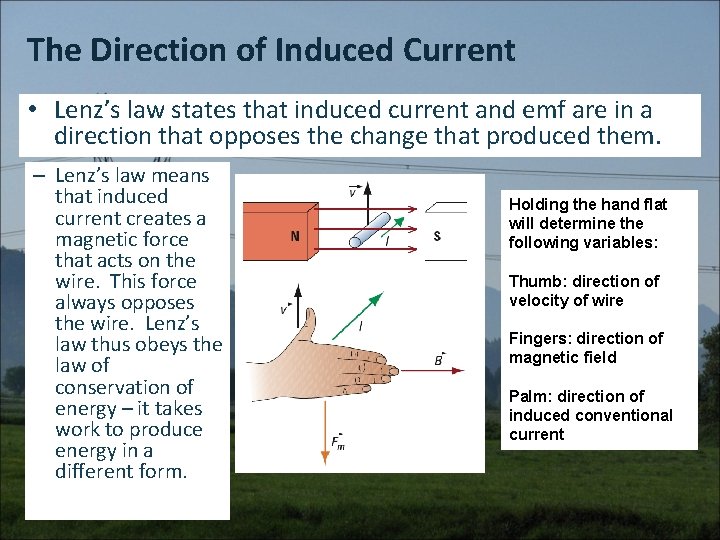
The Direction of Induced Current • Lenz’s law states that induced current and emf are in a direction that opposes the change that produced them. – Lenz’s law means that induced current creates a magnetic force that acts on the wire. This force always opposes the wire. Lenz’s law thus obeys the law of conservation of energy – it takes work to produce energy in a different form. Holding the hand flat will determine the following variables: Thumb: direction of velocity of wire Fingers: direction of magnetic field Palm: direction of induced conventional current
The Direction of Induced Current • Lenz knew the cardinal rule… – That nature likes to conserve things (like energy) – you can’t get something for free • So he reasoned that… “The induced current is such as to OPPOSE the CHANGE in applied magnetic field. ” This is Lenz’s Law
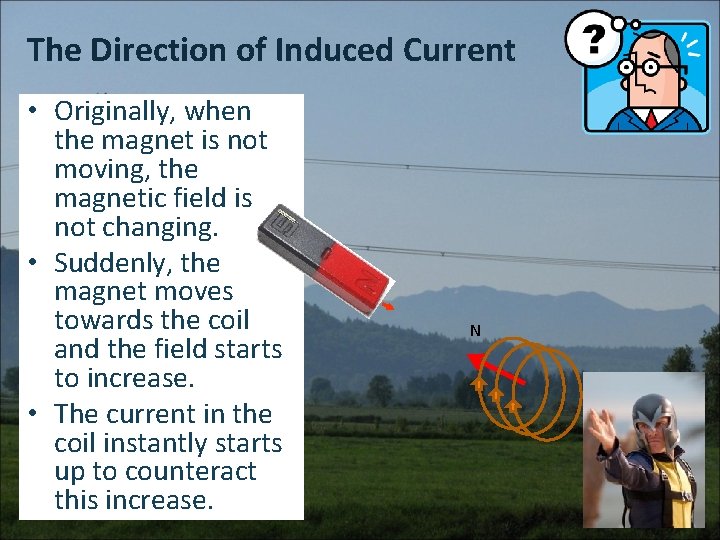
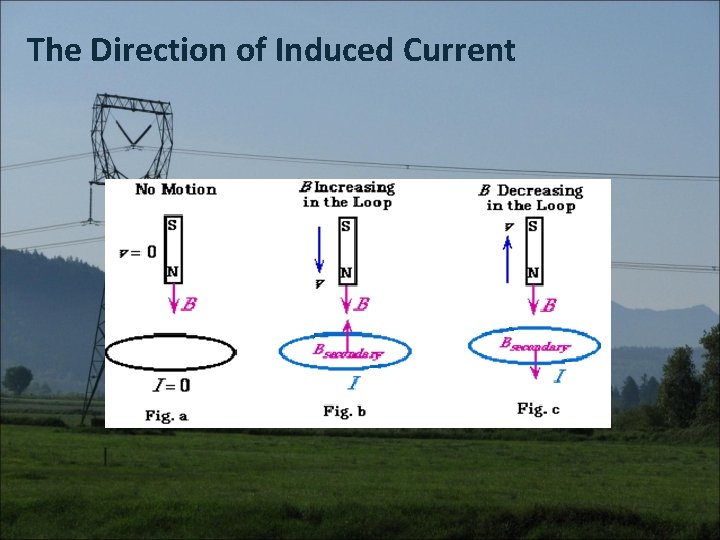
The Direction of Induced Current • Originally, when the magnet is not moving, the magnetic field is not changing. • Suddenly, the magnet moves towards the coil and the field starts to increase. • The current in the coil instantly starts up to counteract this increase. N
The Direction of Induced Current
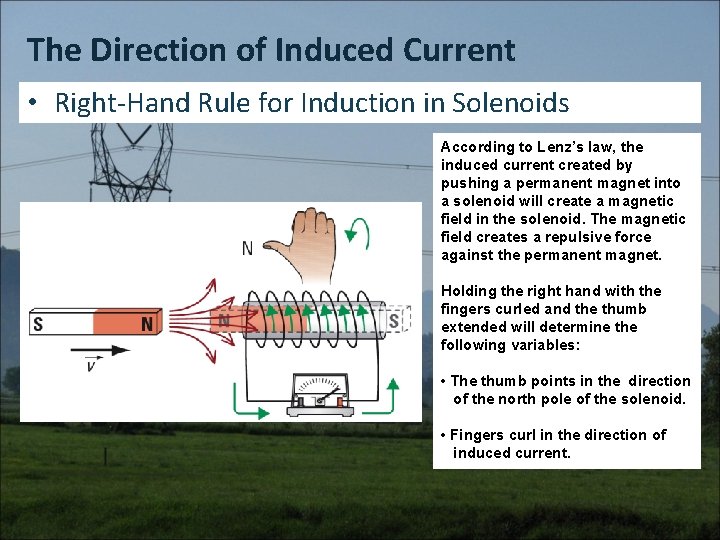
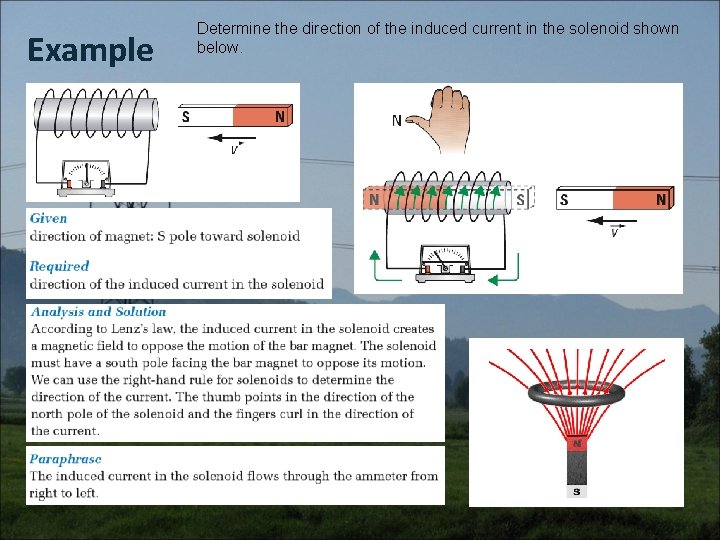
The Direction of Induced Current • Right-Hand Rule for Induction in Solenoids According to Lenz’s law, the induced current created by pushing a permanent magnet into a solenoid will create a magnetic field in the solenoid. The magnetic field creates a repulsive force against the permanent magnet. Holding the right hand with the fingers curled and the thumb extended will determine the following variables: • The thumb points in the direction of the north pole of the solenoid. • Fingers curl in the direction of induced current.
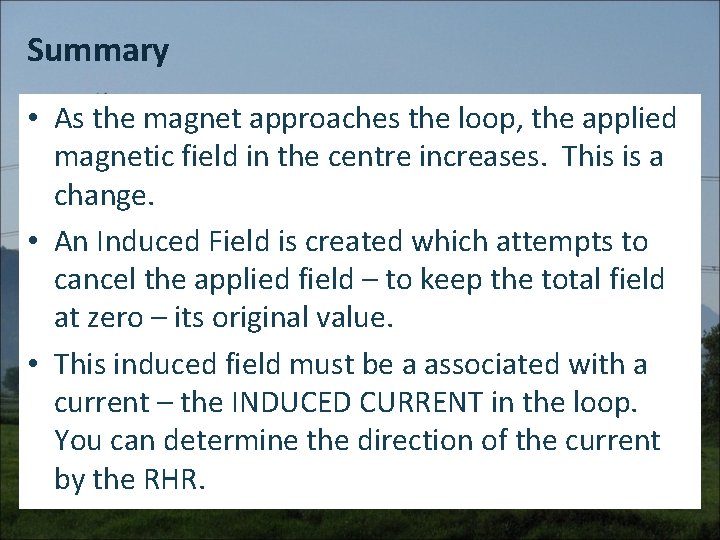
Summary • As the magnet approaches the loop, the applied magnetic field in the centre increases. This is a change. • An Induced Field is created which attempts to cancel the applied field – to keep the total field at zero – its original value. • This induced field must be a associated with a current – the INDUCED CURRENT in the loop. You can determine the direction of the current by the RHR.
Example Determine the direction of the induced current in the solenoid shown below.