
USING LOOP LEARNING AND CRITICAL DIALOGUE IN DEVELOPING



- Slides: 28
USING LOOP LEARNING AND CRITICAL DIALOGUE IN DEVELOPING INNOVATIVE LITERATURE REVIEWS Presenter: Marilyn K. Simon, Ph. D Co-Author: Jim Goes, Ph. D.
Li Literature Review (LR) • Historically, formal syntheses of research can be traced to the 17 th and 18 th centuries (Booth, Papaioannou, & Sutton, 2012). • In the 20 th and 21 st century LR tended to be narrative in nature, and often written to support an argument proposed by the author (Kennedy, 2007; Tranfield, Denyer, & Smart, 2003 • LR establishes that the existing literature is lacking in some way with respect to the specific questions that guide the review (Denyer & Pilbeam, 2013).
Graduate Studies • Old Adage: More and more about less and less • Eventually know everything about nothing. • Good news/Bad news – The amount of information available online is mindboggling. The global Internet population now represents 2. 1 billion people, and with every website browsed, status shared, and photo uploaded, we leave a digital trail that continually grows the hulking mass of big data. The NSB estimated ≈ 1. 5 million peer-reviewed papers were published in the U. S. in 2010. in 2015 this was closer to 2 million. • A good literature review requires the ability to critically assess, integrate, and synthesize peerreviewed research.
New data available each minute
The Scholarly Literature Review • A comprehensive, fully developed literature review is the foundation and starting point for scholarly research, and one of the most important tasks in dissertation development and in scholarly research. • Literature reviews often suffer from bounded, linear or wikipedia-like thinking, limited scope, and little effort to go outside of the existing literature on a topic, in content, analysis, and synthesis. • Little attention is dedicated in grad schools regarding how to put together a lit review. • Extensive, not exhaustive • Challenging in all doctoral programs and particularly for Novice researchers.
Emphasis in Grad School Most doctoral programs focus on • Methodology • APA formatting • Avoiding Plagiarism • Data Analyses • School mission Does that lead to advancing the literature and field?
Purpose of a Literature Review What should the literature review provide? • Justification • Substantiation of a gap in the existing literature. • Analysis/synthesis of scholarly literature • ROC bottom test justification. A researcher cannot perform significant research without first understanding the literature in the field (Boote & Biele, 2005).
Expectations of a Credible Literature Review • The literature review: – Demonstrates the ability to critically assess, integrate, and synthesize peerreviewed research and make an original contribution to the professional literature. – It provides a path from prior studies to the current study, integrates knowledge, and stimulates new ideas. – Every heading needs to be descriptive of the content and related to the problem. – Includes a contextual framework within which the research design is situated. – Includes an academic foundation for the methods, theory, and the research design chosen. – Identifies and explores the gaps in the literature the proposed study intends to fill. – In most dissertations, the literature review is around 40 pages.
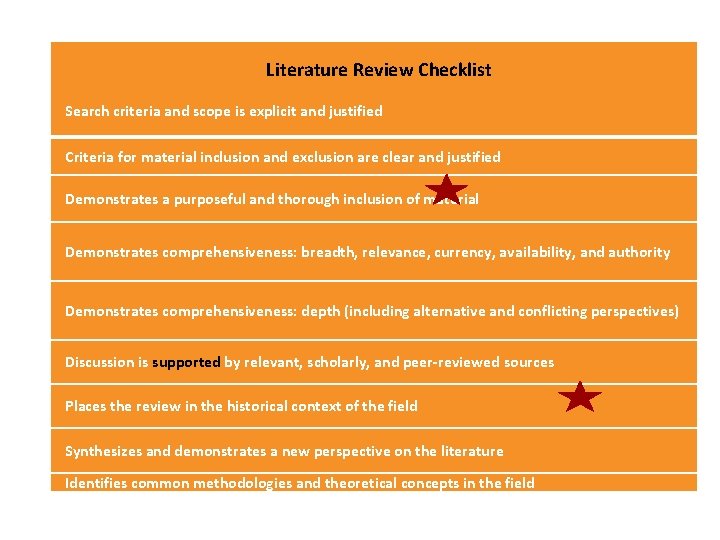
Quality Literature review: Literature Review Checklist Search criteria and scope is explicit and justified Criteria for material inclusion and exclusion are clear and justified Demonstrates a purposeful and thorough inclusion of material Demonstrates comprehensiveness: breadth, relevance, currency, availability, and authority Demonstrates comprehensiveness: depth (including alternative and conflicting perspectives) Discussion is supported by relevant, scholarly, and peer-reviewed sources Places the review in the historical context of the field Synthesizes and demonstrates a new perspective on the literature Identifies common methodologies and theoretical concepts in the field
Mind-mapping First Step – Key word search
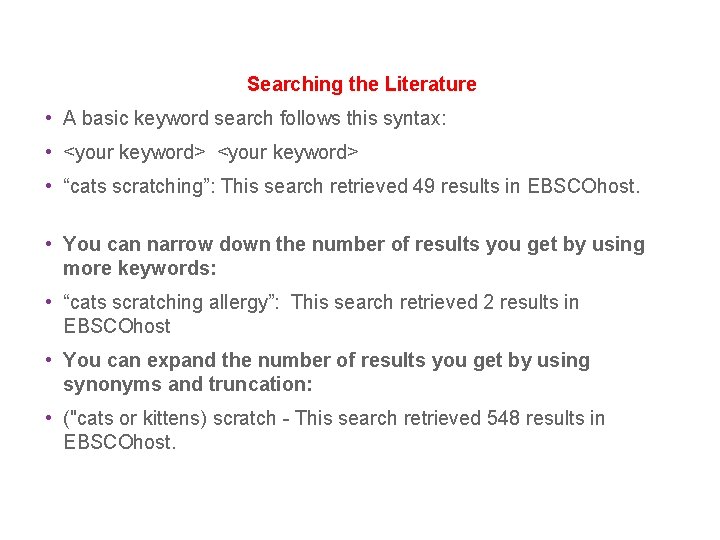
Keyword Searching the Literature • A basic keyword search follows this syntax: • <your keyword> • “cats scratching”: This search retrieved 49 results in EBSCOhost. • You can narrow down the number of results you get by using more keywords: • “cats scratching allergy”: This search retrieved 2 results in EBSCOhost • You can expand the number of results you get by using synonyms and truncation: • ("cats or kittens) scratch - This search retrieved 548 results in EBSCOhost.
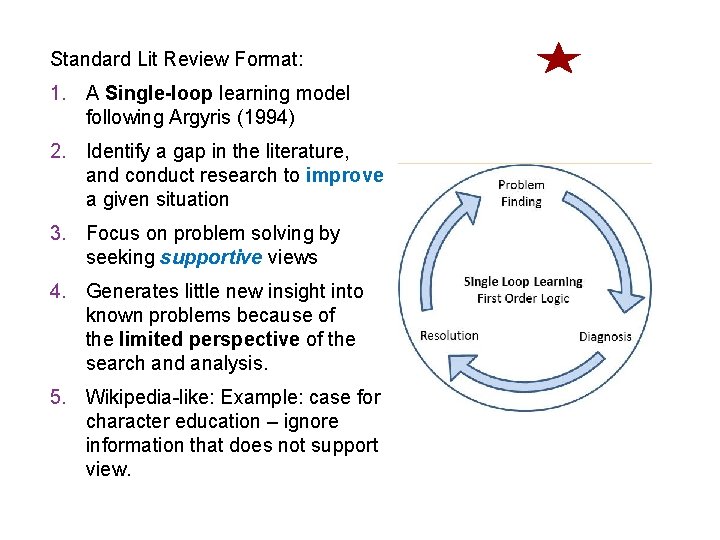
Single Loop Literature Review Standard Lit Review Format: 1. A Single-loop learning model following Argyris (1994) 2. Identify a gap in the literature, and conduct research to improve a given situation 3. Focus on problem solving by seeking supportive views 4. Generates little new insight into known problems because of the limited perspective of the search and analysis. 5. Wikipedia-like: Example: case for character education – ignore information that does not support view.
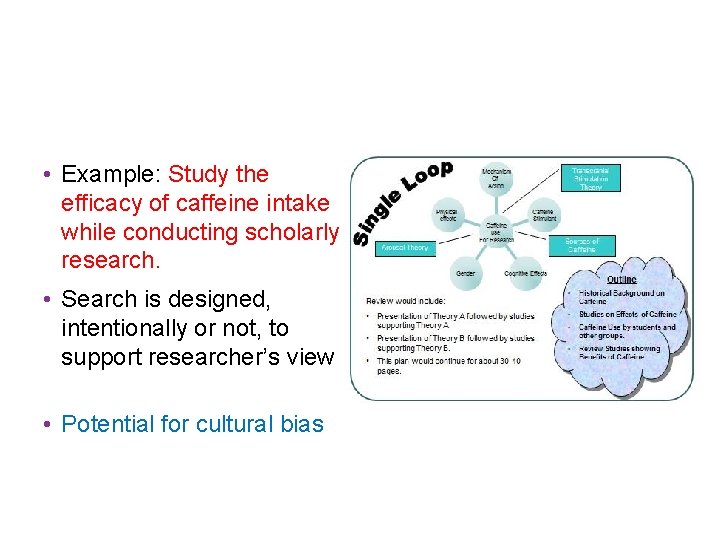
Single Loop Example • Example: Study the efficacy of caffeine intake while conducting scholarly research. • Search is designed, intentionally or not, to support researcher’s view • Potential for cultural bias
An Annotated Bibliography is not a Lit Review • Concise summaries • Little integration • Presented in a linear or chronological fashion • Literature connections support the study
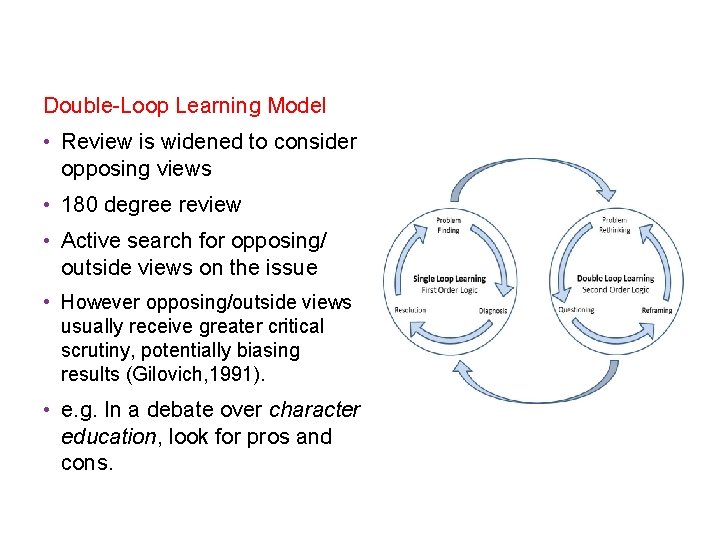
Scholarly Debate and Double Loop Learning Double-Loop Learning Model • Review is widened to consider opposing views • 180 degree review • Active search for opposing/ outside views on the issue • However opposing/outside views usually receive greater critical scrutiny, potentially biasing results (Gilovich, 1991). • e. g. In a debate over character education, look for pros and cons.
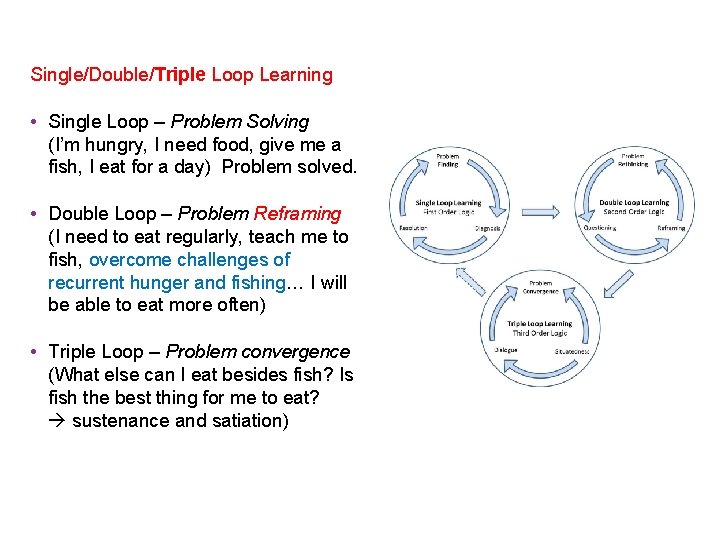
Dialogue and Convergence – Triple Loop Learning Single/Double/Triple Loop Learning • Single Loop – Problem Solving (I’m hungry, I need food, give me a fish, I eat for a day) Problem solved. • Double Loop – Problem Reframing (I need to eat regularly, teach me to fish, overcome challenges of recurrent hunger and fishing… I will be able to eat more often) • Triple Loop – Problem convergence (What else can I eat besides fish? Is fish the best thing for me to eat? sustenance and satiation)
Triple Loop Learning – Literature Review Triple Loop learning: • Developing a profound understanding of our own and others beliefs, perceptions, and understandings. • Triple-loop learning is a type of double-loop thinking about double-loop learning (Peschl, 2007). • Not only pro and con arguments used, but questioning: – Are we are studying the right issue? – In the right way? – At the right time? • Engaging researchers in each other’s studies. • What would X think of Y?
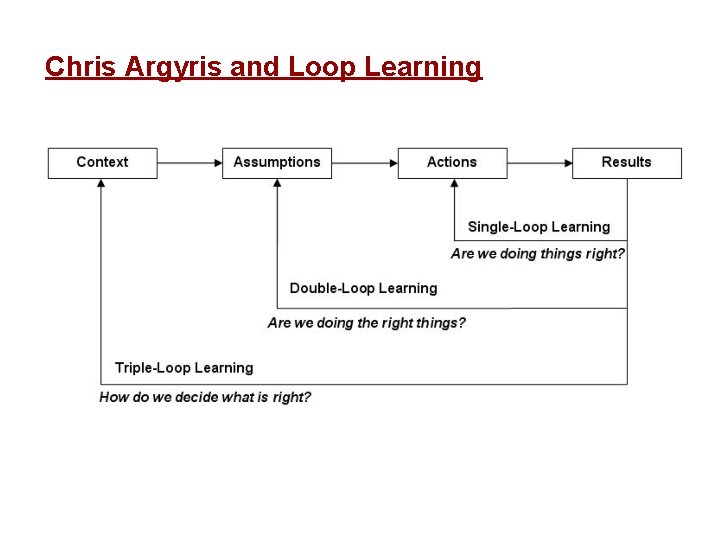
Chris Argyris and Loop Learning a. Model
Literature Review & Triple Loop Learning As you review the Literature… 1. Understand how problems and solutions are related, even when separated by time and space 2. Understand why previous actions led to current problems (Situatedness*). What happened to the economy in 2008 how it affects decisions in 2016. 3. Uncover and question premises and cognitive patterns 4. Synthesize new perspectives to emerge, and 5. Establish a rationale for new research * Polanyi, M. (1998 [orig. 1958]). Personal Knowledge: Towards a Post-Critical Philosophy. London, Routledge.
More like a conversation between Authors where new ideas are generated. These authors are toasting you as the newest member of the team; respect for ideas. AVATARs
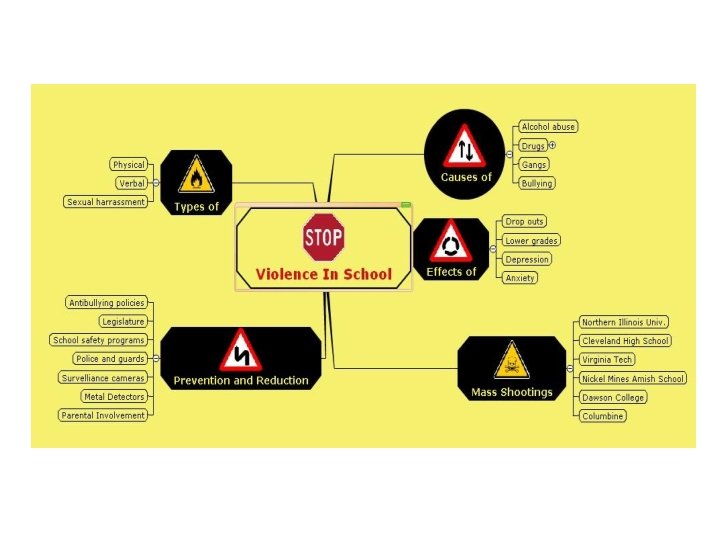
Experiential Learning with Triple Loop Learning Problem: School Violence • Proposed Study: Delphi survey of experts, advocates about what can be done to Stop School Violence • Brainstorm with a group of Colleagues • Create a mindmap on areas to research • Present potential single, double, triple loop learning strategies • Assess situatedness, dialogue with participants until convergence is reached. • What key word searches can be used?
Stop School Violence • What can be done to stop school violence? (mind -map – one idea) • Single-Loop: What is school violence? What can be and has done to stop school violence? Generate support for idea. • Double-Loop: Pros and Cons – Support - Refute idea • Triple-Loop: Situatedness – what is the context? • Loop ideas to others
How does this map compare to yours?
Opening Narrative Introduction to the Literature Review • Organization of the Review • Strategy for searching • What else do you need to include? • Minimum of 25 pages – usually 30 -40 pages, depending on topic.
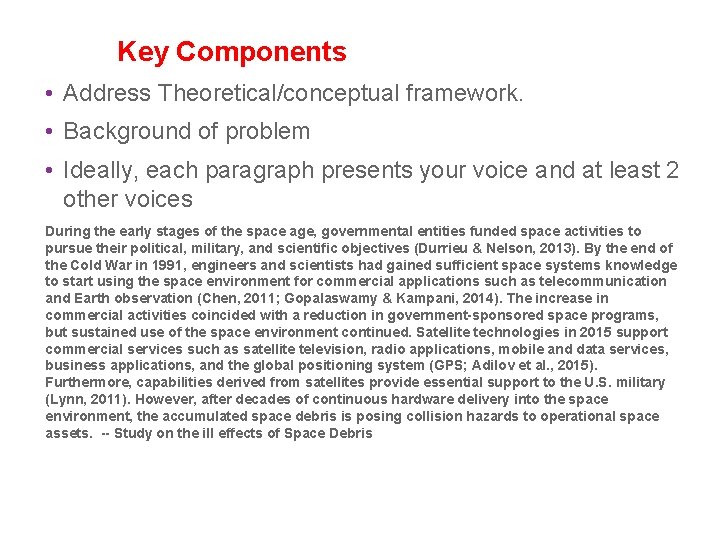
Kep Key Components • Address Theoretical/conceptual framework. • Background of problem • Ideally, each paragraph presents your voice and at least 2 other voices During the early stages of the space age, governmental entities funded space activities to pursue their political, military, and scientific objectives (Durrieu & Nelson, 2013). By the end of the Cold War in 1991, engineers and scientists had gained sufficient space systems knowledge to start using the space environment for commercial applications such as telecommunication and Earth observation (Chen, 2011; Gopalaswamy & Kampani, 2014). The increase in commercial activities coincided with a reduction in government-sponsored space programs, but sustained use of the space environment continued. Satellite technologies in 2015 support commercial services such as satellite television, radio applications, mobile and data services, business applications, and the global positioning system (GPS; Adilov et al. , 2015). Furthermore, capabilities derived from satellites provide essential support to the U. S. military (Lynn, 2011). However, after decades of continuous hardware delivery into the space environment, the accumulated space debris is posing collision hazards to operational space assets. -- Study on the ill effects of Space Debris
Creating an Innovative and Scholarly Review of the Literature Triple Loop Dialogic Processing In creating a solid literature review: • The task is to orchestrate the voices and ideas of many into a form of textual unity. • Parts Whole, Whole Parts • Framework for relating new findings and a profound understanding of how new research can advance prior research. • You will be an EXPERT in the field • Deep knowing profound change/innovation - Peschl
References Argyris, C. , 1994, July. Good communication that blocks learning. Harvard Business Review. Argyris, C. , Putnam, R. , & Mc. Lain Smith, D. , 1985. Action science: concepts, methods, and skills for research and intervention. San Francisco: Jossey-Bass Bakhtin, M. , 1973. Problems of Dostoevsky's poetics (R. D. Rotsel, Trans. ). New York, NY: Ardis. Bohm, D. , 1996. On dialogue. New York, NY: Routledge. Boote, D. , & Biele, P. , 2005. Scholars before researchers: On the centrality of the dissertation literature review in research preparation. Journal: Educational Researcher, 34(6), 3 -15. doi: 10. 3102/0013189 X 034006003 Buber, M. , 1996. The letters of Martin Buber: A life of dialogue. Syracuse, NY: Syracuse University Press. Cooper, H. , 1988. Organizing knowledge synthesis: A taxonomy of literature reviews. Knowledge in society (1), 104 -106. Canales, J. , 2010. Comparative neuroscience of stimulant-induced memory `dysfunction: role for neurogenesis in the adult hippocampus, Behavioural Pharmacology, 21, 5 -6, 379 Ellinor, L. , & Gerard, G. , 1998. Dialogue: Rediscover the transforming power of conversation. London, England: Wiley. Franklin, S. P. , 1995. Artificial minds. MIT Press, Cambridge, Mass Gilovich, T. , 1991. How we know what isn't so: The fallibility of human reason in everyday life. New York, NY: Macmillan. Isaacs, W. N. , 1993. Taking flight: Dialogue, collective thinking, and organizational learning. Organizational Dynamics, 22(2), 24 -39. Isaacs, W. N. , 1999. Dialogue and the art of thinking together: A pioneering approach to communicating in business and in life. New York, NY: Bantam Doubleday Dell.
References Kabat-Zinn J. , 2003. Mindfulness-based interventions in context: Past, present, and future. Clinical Psychology: Science and Practice. 10: 144– 156. Lindblom J. & Ziemke T. , 2003. Social situatedness of natural and artificial intelligence: Vygotsky and beyond. Adaptive Behavior, 11 (2): 79 -96. Myers, D. G. , 2004. Psychology. New York, New York: Worth Publishers. Peschl, M. F. , 2007. Triple-loop learning as foundation for profound change, individual cultivation, and radical innovation. Construction. Retrieved from http: //cogprints. org/6161/1/pesc 07_ Polanyi, M. (1998 [orig. 1958]). Personal Knowledge: Towards a Post-Critical Philosophy. London, Routledge Richardson, V. , 2003. The Ph. D. in education. Retrieved from http: //www. carnegiefoundation. org/CID/essays /CID_educ_Richardson. pdf Rogers, P. Hohoff, C. Heatherley, S. Mullings, Maxfield, P Evershed, R. Deckert. J. and Nutt. D. (2010) Association of the Anxiogenic and Alerting Effects of Caffeine with ADORA 2 A and ADORA 1 Polymorphisms and Habitual Level of Caffeine Consumption. Neuropsychopharmacology, DOI: 10. 1038/npp. 2010. 71. Shulman, L. S. , 1999. Professing educational scholarship. In E. C. Lagemann & L. S. Shulman (Eds. ), Issues in education research: Problems and possibilities (pp. 159 -165). San Francisco, CA: Jossey-Bass. Slavin, R. E. , 1986. Best-evidence synthesis: An alternative to meta-analysis and traditional reviews. Educational Researcher, 15(9), 5 -11. Simon, M. K. , & Goes, J. , 2013. Dissertation and scholarly research: Recipes for success (2013 ed. ). Seattle, WA: Dissertation Success. Retrieved from http: //dissertationrecipes. com/ Trede, F. ; Higgs, J. & Rothwell, R. , 2008. Critical Transformative Dialogues: A Research Method Beyond the Fusions of Horizons [37 paragraphs]. Forum Qualitative Sozialforschung / Forum: Qualitative Social Research, 10(1), Usher, R. , & Bryant, I. , 1989. Adult education as theory, practice and research. London, England: Routledge.