
Using Longitudinal Assessment Data Feedback Tool for Teachers
Using Longitudinal Assessment Data: Feedback Tool for Teachers and Schools Dr. Nathan Balasubramanian Centennial Board of Cooperative Educational Services (CBOCES) Dr. Paul Bankes Thompson School District R 2 -J “I skate where the puck is going to be, not where it has been. ” (Wayne Gretzky, hockey player) Balasubramanian & Bankes, 2009
Think-write (Pre) – How would you monitor and support teachers? School improvement efforts based on student learning have produced minimal impact on institutional effectiveness. Teachers have been increasingly skeptical and critical of “attempts to link learning gains to teacher work. ” Write down TWO ways how you might, as a decisionmaker, monitor and support the professional growth of your teachers? “We must always change, renew, rejuvenate ourselves; otherwise, we harden. ” (Johann Wolfgang von Goethe) Balasubramanian & Bankes, 2009
What are we going to learn today? Teachers as Researchers (please see p. 3 on Narrative Paper) 1. How we might actively support teachers to maximize learning opportunities for every student Administrators as Evaluators (please see p. 4 on Narrative Paper) 2. Understand how different strategies, programs, and classroom interventions at our schools/districts might be evaluated based on measured student learning “I kept six honest serving men. They taught me all I knew: Their names were What and Why and When And How and Where and Who. ” (Verse from Rudyard Kipling’s Elephant child) Balasubramanian & Bankes, 2009
What are our challenges? “We need to educate students, not merely prepare them for tests. ” (Robert J. Sternberg, Dean of the School of Arts & Sciences, Tufts University, MA) Balasubramanian & Bankes, 2009
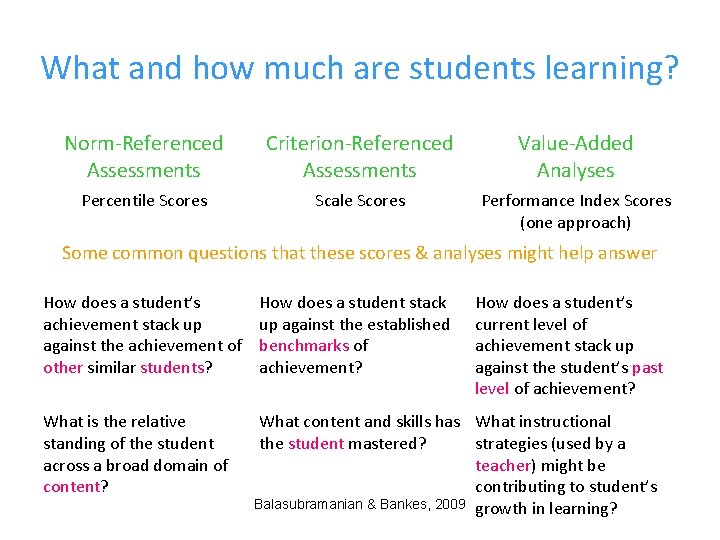
What and how much are students learning? Norm-Referenced Assessments Criterion-Referenced Assessments Value-Added Analyses Percentile Scores Scale Scores Performance Index Scores (one approach) Some common questions that these scores & analyses might help answer How does a student’s achievement stack up against the achievement of other similar students? How does a student stack up against the established benchmarks of achievement? How does a student’s current level of achievement stack up against the student’s past level of achievement? What is the relative standing of the student across a broad domain of content? What content and skills has What instructional the student mastered? strategies (used by a teacher) might be contributing to student’s Balasubramanian & Bankes, 2009 growth in learning?
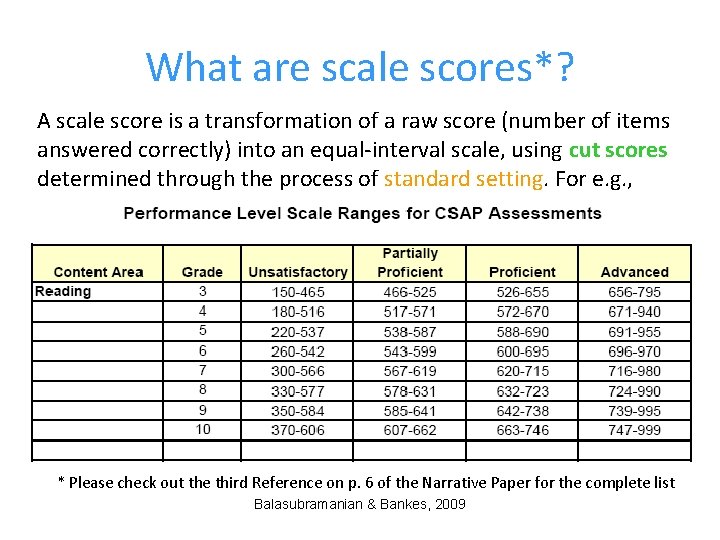
What are scale scores*? A scale score is a transformation of a raw score (number of items answered correctly) into an equal-interval scale, using cut scores determined through the process of standard setting. For e. g. , * Please check out the third Reference on p. 6 of the Narrative Paper for the complete list Balasubramanian & Bankes, 2009
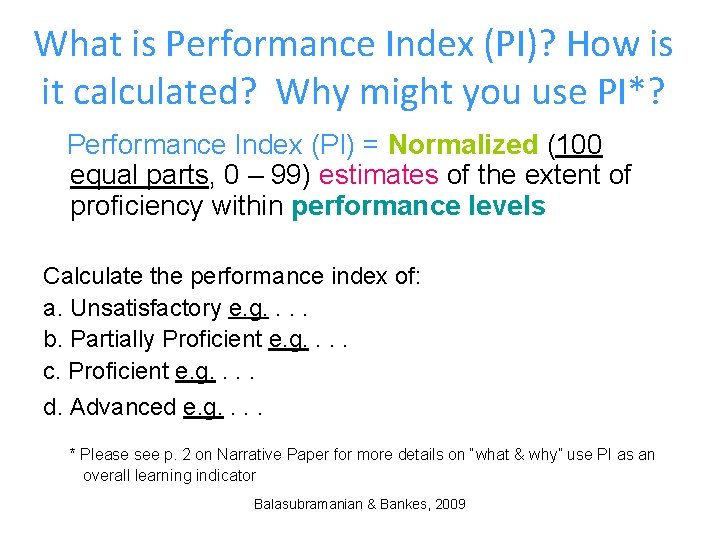
What is Performance Index (PI)? How is it calculated? Why might you use PI*? Performance Index (PI) = Normalized (100 equal parts, 0 – 99) estimates of the extent of proficiency within performance levels Calculate the performance index of: a. Unsatisfactory e. g. . b. Partially Proficient e. g. . c. Proficient e. g. . d. Advanced e. g. . * Please see p. 2 on Narrative Paper for more details on “what & why” use PI as an overall learning indicator Balasubramanian & Bankes, 2009
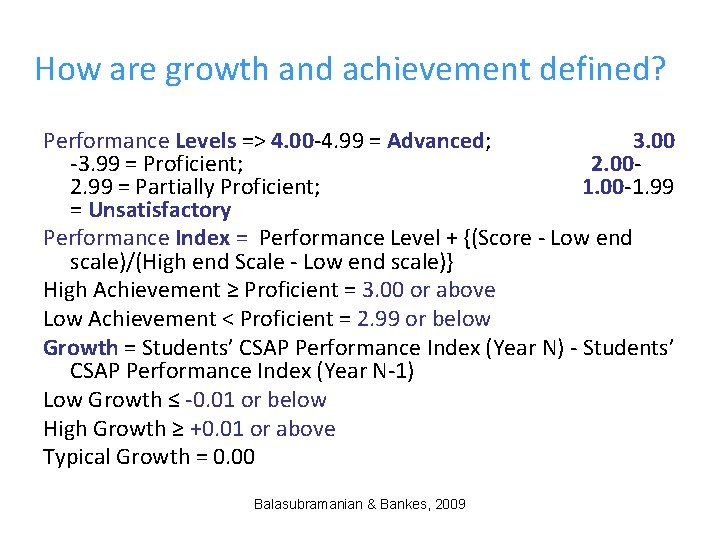
How are growth and achievement defined? Performance Levels => 4. 00 -4. 99 = Advanced; 3. 00 -3. 99 = Proficient; 2. 002. 99 = Partially Proficient; 1. 00 -1. 99 = Unsatisfactory Performance Index = Performance Level + {(Score - Low end scale)/(High end Scale - Low end scale)} High Achievement ≥ Proficient = 3. 00 or above Low Achievement < Proficient = 2. 99 or below Growth = Students’ CSAP Performance Index (Year N) - Students’ CSAP Performance Index (Year N-1) Low Growth ≤ -0. 01 or below High Growth ≥ +0. 01 or above Typical Growth = 0. 00 Balasubramanian & Bankes, 2009
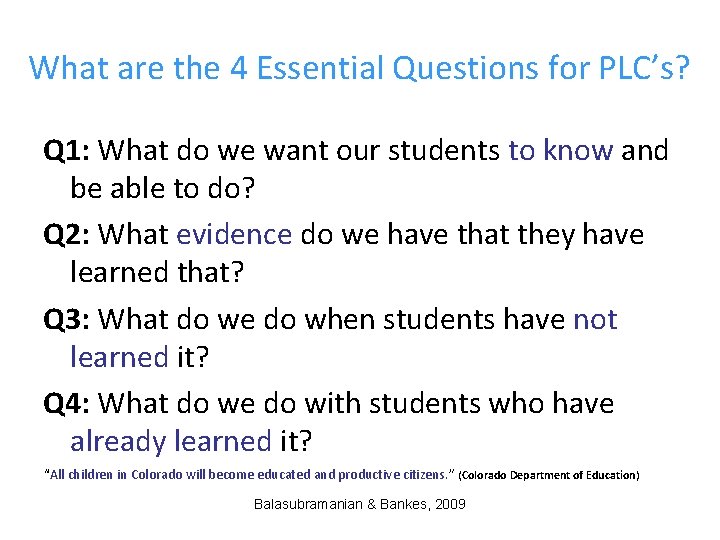
What are the 4 Essential Questions for PLC’s? Q 1: What do we want our students to know and be able to do? Q 2: What evidence do we have that they have learned that? Q 3: What do we do when students have not learned it? Q 4: What do we do with students who have already learned it? “All children in Colorado will become educated and productive citizens. ” (Colorado Department of Education) Balasubramanian & Bankes, 2009
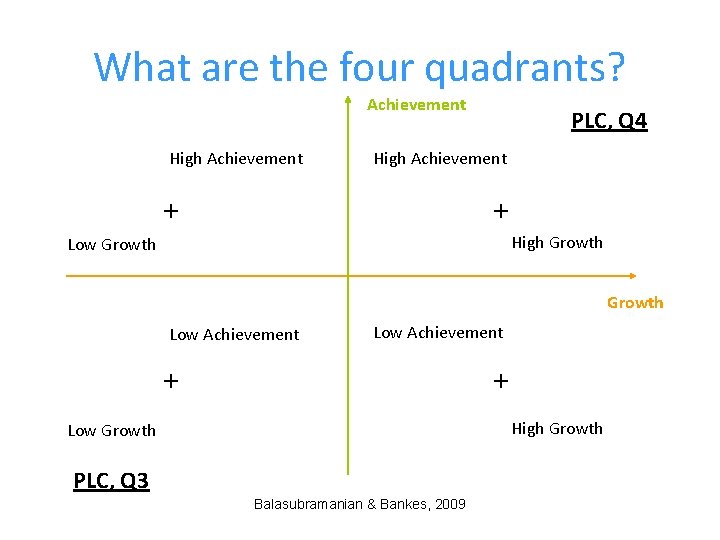
What are the four quadrants? Achievement High Achievement PLC, Q 4 High Achievement + + High Growth Low Achievement + + High Growth Low Growth PLC, Q 3 Balasubramanian & Bankes, 2009
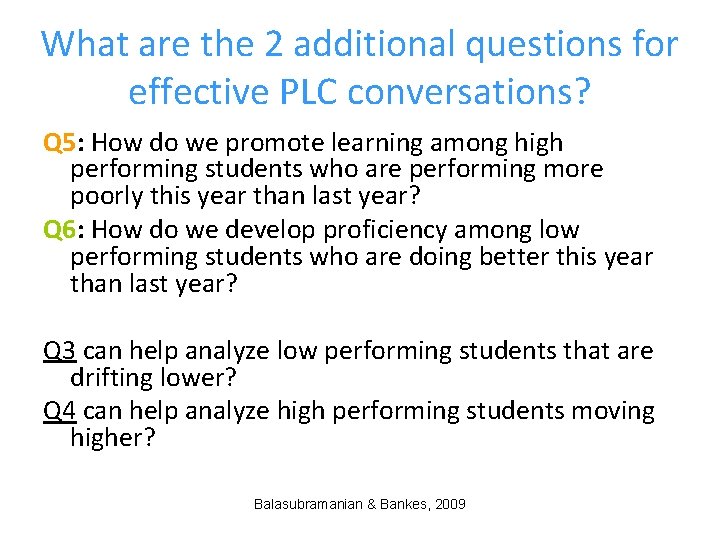
What are the 2 additional questions for effective PLC conversations? Q 5: How do we promote learning among high performing students who are performing more poorly this year than last year? Q 6: How do we develop proficiency among low performing students who are doing better this year than last year? Q 3 can help analyze low performing students that are drifting lower? Q 4 can help analyze high performing students moving higher? Balasubramanian & Bankes, 2009
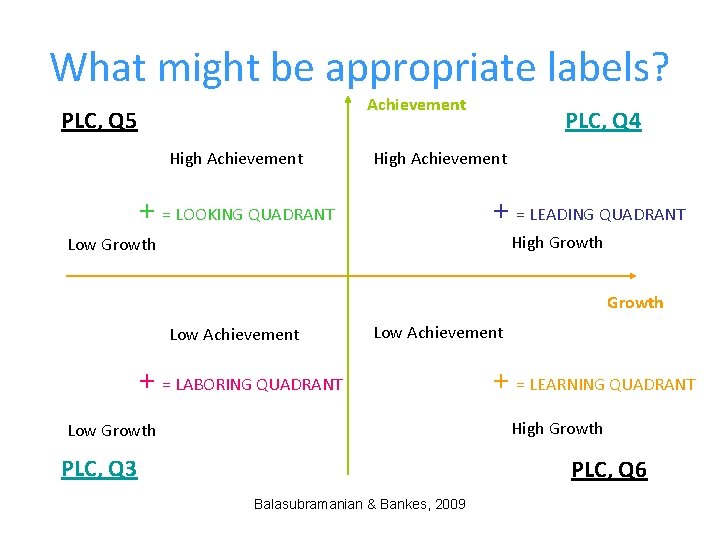
What might be appropriate labels? Achievement PLC, Q 5 High Achievement PLC, Q 4 High Achievement + = LOOKING QUADRANT + = LEADING QUADRANT High Growth Low Achievement + = LABORING QUADRANT + = LEARNING QUADRANT High Growth Low Growth PLC, Q 3 PLC, Q 6 Balasubramanian & Bankes, 2009
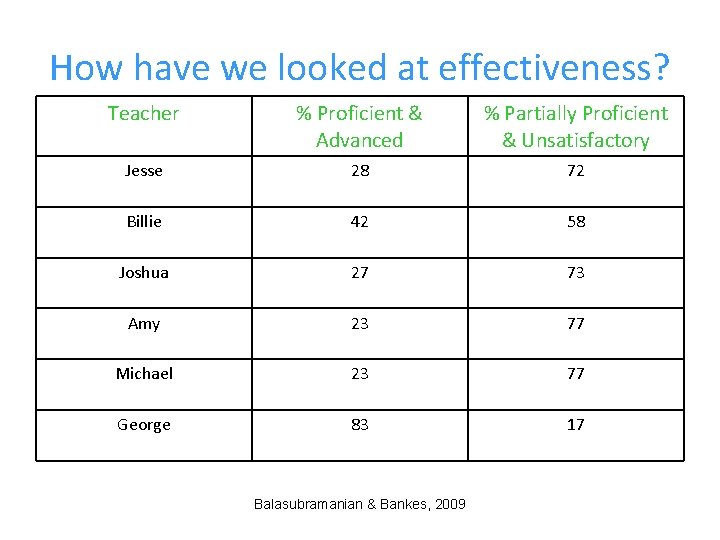
How have we looked at effectiveness? Teacher % Proficient & Advanced % Partially Proficient & Unsatisfactory Jesse 28 72 Billie 42 58 Joshua 27 73 Amy 23 77 Michael 23 77 George 83 17 Balasubramanian & Bankes, 2009
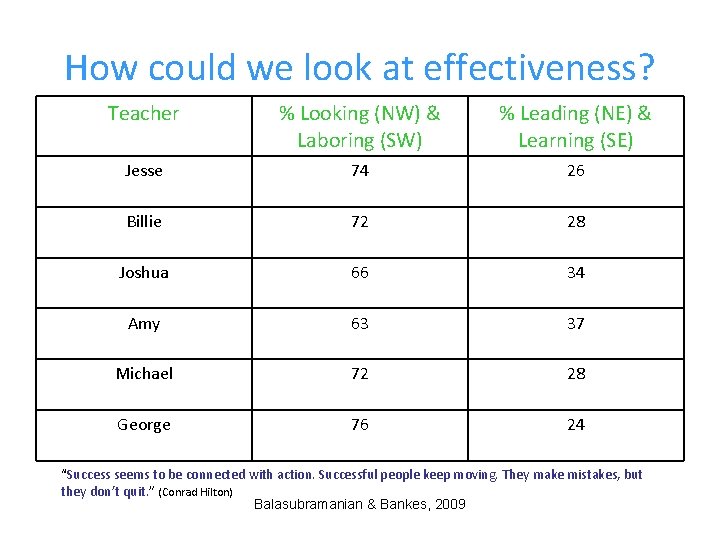
How could we look at effectiveness? Teacher % Looking (NW) & Laboring (SW) % Leading (NE) & Learning (SE) Jesse 74 26 Billie 72 28 Joshua 66 34 Amy 63 37 Michael 72 28 George 76 24 “Success seems to be connected with action. Successful people keep moving. They make mistakes, but they don’t quit. ” (Conrad Hilton) Balasubramanian & Bankes, 2009
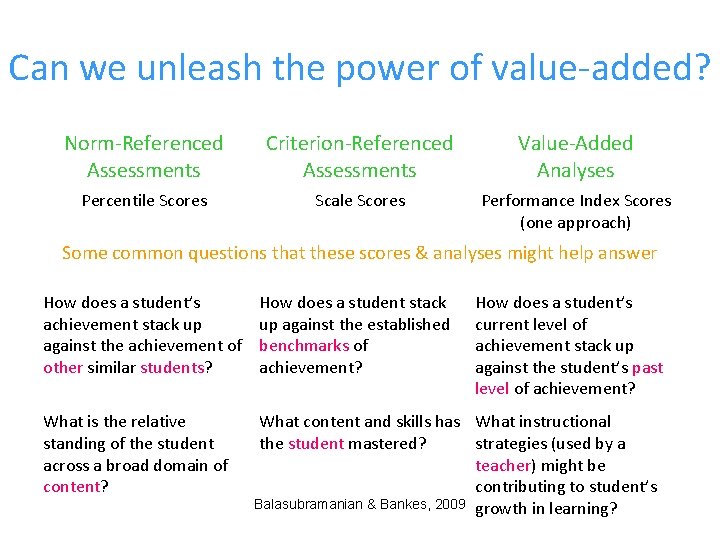
Can we unleash the power of value-added? Norm-Referenced Assessments Criterion-Referenced Assessments Value-Added Analyses Percentile Scores Scale Scores Performance Index Scores (one approach) Some common questions that these scores & analyses might help answer How does a student’s achievement stack up against the achievement of other similar students? How does a student stack up against the established benchmarks of achievement? How does a student’s current level of achievement stack up against the student’s past level of achievement? What is the relative standing of the student across a broad domain of content? What content and skills has What instructional the student mastered? strategies (used by a teacher) might be contributing to student’s Balasubramanian & Bankes, 2009 growth in learning?
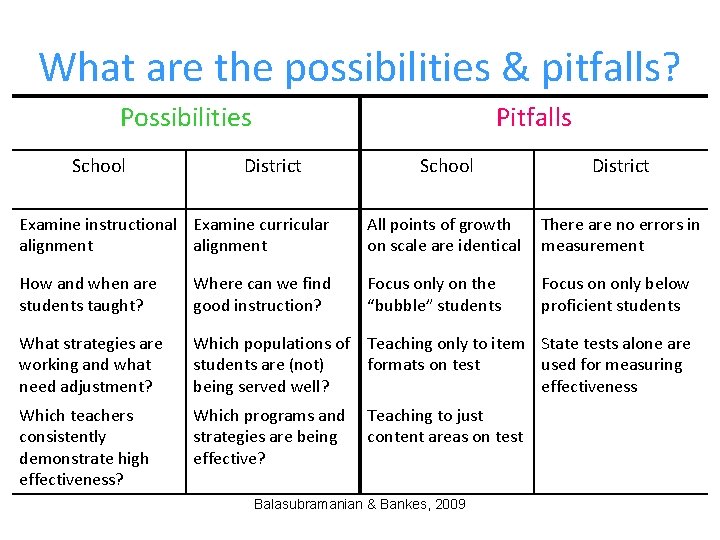
What are the possibilities & pitfalls? Possibilities School Pitfalls District School District Examine instructional Examine curricular alignment All points of growth on scale are identical There are no errors in measurement How and when are students taught? Where can we find good instruction? Focus only on the “bubble” students Focus on only below proficient students What strategies are working and what need adjustment? Which populations of Teaching only to item State tests alone are students are (not) formats on test used for measuring being served well? effectiveness Which teachers consistently demonstrate high effectiveness? Which programs and strategies are being effective? Teaching to just content areas on test Balasubramanian & Bankes, 2009
Think-write (Post-) – How might we monitor and support teachers? Teacher and Principal Effectiveness is a high priority challenge in both Race to the Top (R 2 T) and Investing in Innovation Fund (i 3 Fund) along with giving timely and accurate feedback to teachers and schools. Write down TWO ways how you might, as a decisionmaker, monitor and support the professional growth of your teachers based on student learning? “Great works are performed not by strength, but by perseverance. ” (Samuel Johnson) Balasubramanian & Bankes, 2009
In Summary “Things do not happen. Things are made to happen” (John F. Kennedy) Balasubramanian & Bankes, 2009
Thank You Very Much For Your Time If you want to Contact Us. . . Nathan Balasubramanian, Ph. D. Centennial BOCES 830 South Lincoln Street Longmont, CO 80501 Paul Bankes, Ed. D. Thompson School District R 2 -J 800 South Taft Avenue Loveland, CO 80537 nbala@cboces. org Phone: (303) 502 -0477 bankesp@thompson. k 12. co. us Phone: (970) 613 -5025 “We must BE the change we want for the world!” (Mahatma Gandhi) Balasubramanian & Bankes, 2009
- Slides: 19