
Using Linear Combination 1 Arrange the equations so
Using Linear Combination 1. Arrange the equations so that like terms are lined up in columns. 2. Look at both equations to see if any like terms are opposites of each other. a) If so, simply add (going down) the 2 equations together. b) If not, multiply one or both equations by a real number so that when the equations are added together one variable will cancel out.
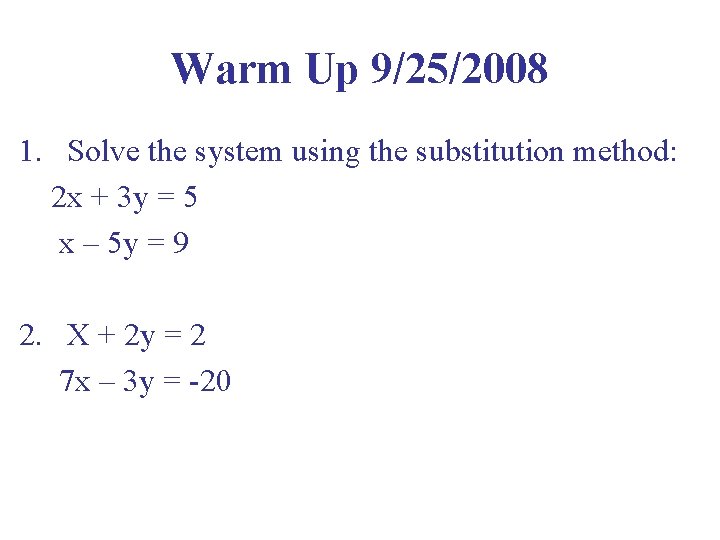
Warm Up 9/25/2008 1. Solve the system using the substitution method: 2 x + 3 y = 5 x – 5 y = 9 2. X + 2 y = 2 7 x – 3 y = -20
3. Solve. 4. Substitute (Plug – in). 5. Write the solution as an ordered pair (x, y). What are the different strategies in solving linear systems and how are they used?
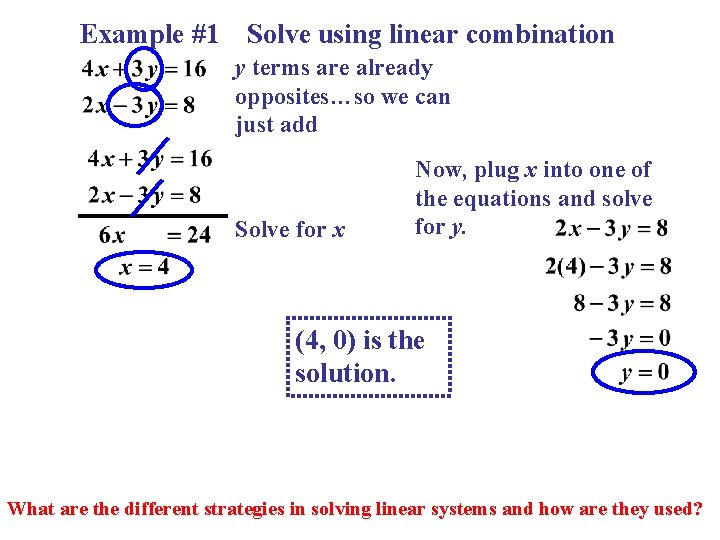
Example #1 Solve using linear combination y terms are already opposites…so we can just add Solve for x Now, plug x into one of the equations and solve for y. (4, 0) is the solution. What are the different strategies in solving linear systems and how are they used?

Example 2 Solve using linear combinations. One of the equations needs to be rearranged so that the like terms line up. Now, plug y into one of the equations and solve for x. (1, 2) is the solution. What are the different strategies in solving linear systems and how are they used?
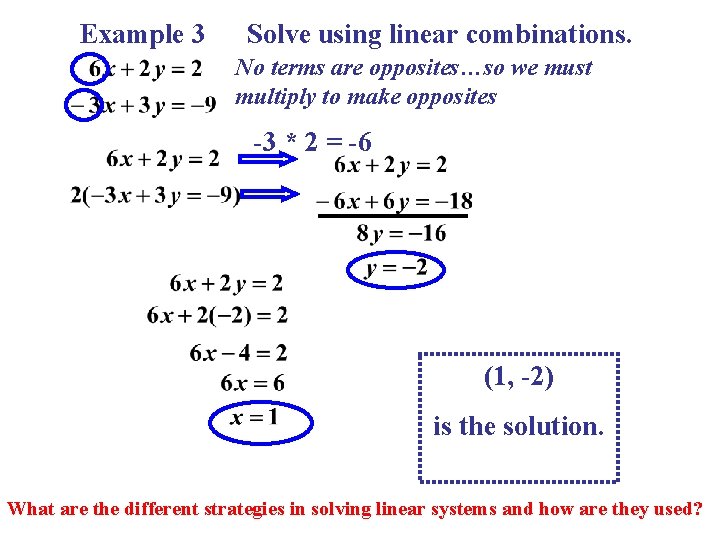
Example 3 Solve using linear combinations. No terms are opposites…so we must multiply to make opposites -3 * 2 = -6 (1, -2) is the solution. What are the different strategies in solving linear systems and how are they used?

Example 4 Solve using linear combinations. No terms are opposites…so we must multiply to make opposites 3 * 4 = 12 What are the different strategies in solving linear systems and how are they used?

Daily Work • P. 142 # 11, 12, 21, 22, 32 -34 • P. 152 # 11 -16, 23 -28, 35, 36 You will be using graph paper throughout the semester and need to have some no later than Monday 9/17.
- Slides: 8