
Using learner feedback to develop and improve elearning
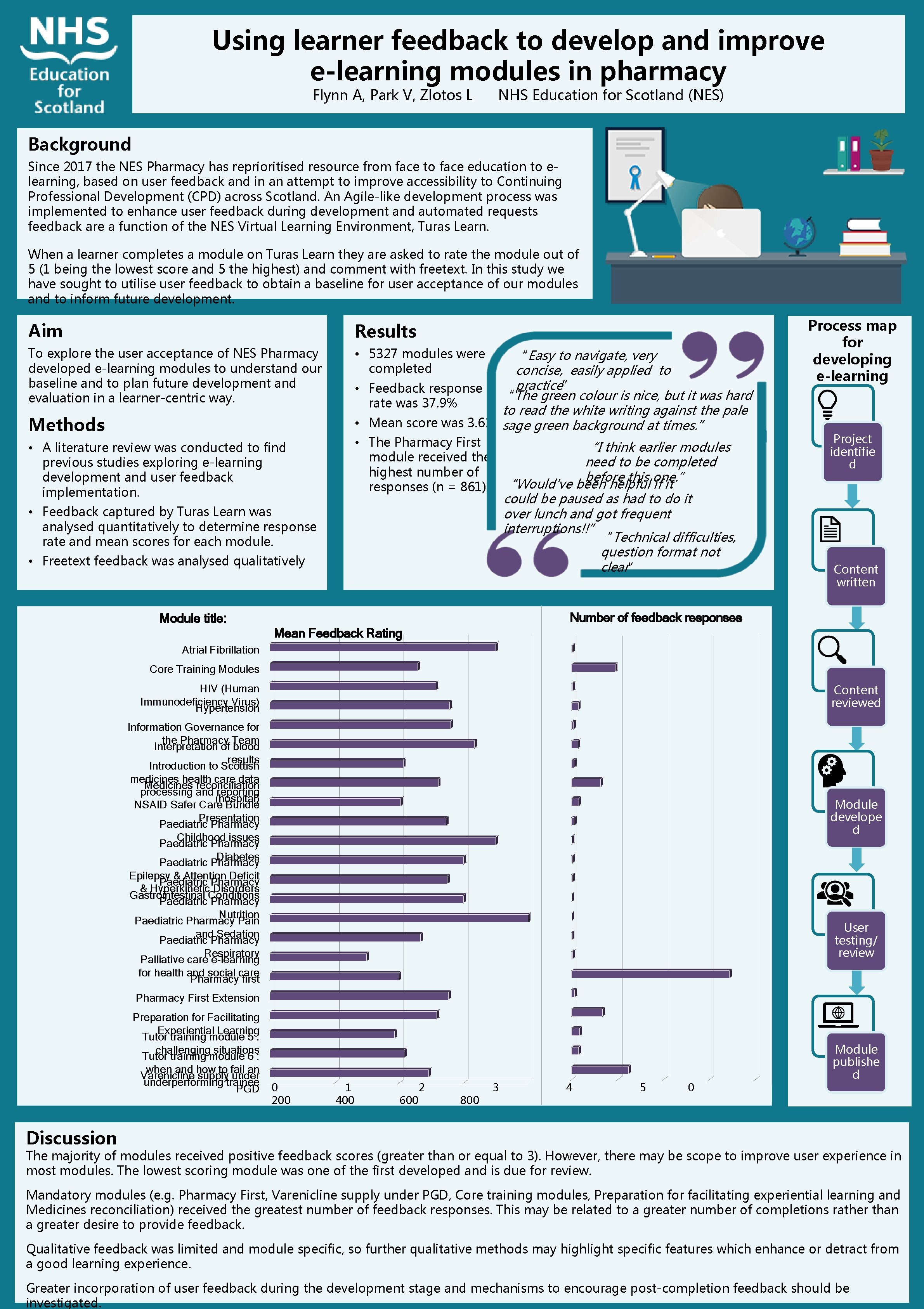
Using learner feedback to develop and improve e-learning modules in pharmacy Flynn A, Park V, Zlotos L NHS Education for Scotland (NES) Background Since 2017 the NES Pharmacy has reprioritised resource from face to face education to elearning, based on user feedback and in an attempt to improve accessibility to Continuing Professional Development (CPD) across Scotland. An Agile-like development process was implemented to enhance user feedback during development and automated requests feedback are a function of the NES Virtual Learning Environment, Turas Learn. When a learner completes a module on Turas Learn they are asked to rate the module out of 5 (1 being the lowest score and 5 the highest) and comment with freetext. In this study we have sought to utilise user feedback to obtain a baseline for user acceptance of our modules and to inform future development. Aim Results To explore the user acceptance of NES Pharmacy developed e-learning modules to understand our baseline and to plan future development and evaluation in a learner-centric way. • 5327 modules were completed “Easy to navigate, very concise, easily applied to practice” • Feedback response “The green colour is nice, but it was hard rate was 37. 9% to read the white writing against the pale • Mean score was 3. 63 sage green background at times. ” • The Pharmacy First “I think earlier modules Methods • A literature review was conducted to find previous studies exploring e-learning development and user feedback implementation. module received the highest number of responses (n = 861). need to be completed before this one. ” “Would've been helpful if it could be paused as had to do it over lunch and got frequent interruptions!!” “Technical difficulties, question format not clear” • Feedback captured by Turas Learn was analysed quantitatively to determine response rate and mean scores for each module. • Freetext feedback was analysed qualitatively Process map for developing e-learning Project identifie d Content written Number of feedback responses Module title: Mean Feedback Rating Atrial Fibrillation Core Training Modules Content reviewed HIV (Human Immunodeficiency Virus) Hypertension Information Governance for the Pharmacy Team Interpretation of blood results Introduction to Scottish medicines health care data Medicines reconciliation processing and reporting (hospital) NSAID Safer Care Bundle Presentation Paediatric Pharmacy Childhood issues Paediatric Pharmacy Diabetes Paediatric Pharmacy Epilepsy & Attention Deficit Paediatric Pharmacy & Hyperkinetic Disorders Gastrointestinal Conditions Paediatric Pharmacy Nutrition Paediatric Pharmacy Pain and Sedation Paediatric Pharmacy Respiratory Palliative care e-learning for health and social care Pharmacy first Module develope d User testing/ review Pharmacy First Extension Preparation for Facilitating Experiential Learning Tutor training module 5 : challenging situations Tutor training module 6 : when and how to fail an Varenicline supply underperforming trainee PGD 0 200 1 400 600 2 800 3 4 5 0 Module publishe d Discussion The majority of modules received positive feedback scores (greater than or equal to 3). However, there may be scope to improve user experience in most modules. The lowest scoring module was one of the first developed and is due for review. Mandatory modules (e. g. Pharmacy First, Varenicline supply under PGD, Core training modules, Preparation for facilitating experiential learning and Medicines reconciliation) received the greatest number of feedback responses. This may be related to a greater number of completions rather than a greater desire to provide feedback. Qualitative feedback was limited and module specific, so further qualitative methods may highlight specific features which enhance or detract from a good learning experience. Greater incorporation of user feedback during the development stage and mechanisms to encourage post-completion feedback should be investigated.
- Slides: 1