
Using Kansas Early Learning Standards KELS to Support
- Slides: 34
Using Kansas Early Learning Standards (KELS) to Support Active Parent Partnerships and Engagement
KELS Toolkits • This is one in a series of toolkit presentations developed to guide early care and education providers in appropriate and effective use of the Kansas Early Learning Standards (KELS). • As a pre-requisite to this training, participants should first be familiar with the KELS Overview Toolkit and the KELS document.
How do Kansas Early Learning Standards (KELS) Support Partnering with Parents? Making the connections: • Conceptual knowledge and skills • Guiding principles from School Readiness Framework • Kansas College and Career Ready Standards (KCCRS) Kansas Early Learning Standards (2014 Revision) http: //www. ksde. org/Portals/0/Early%20 Childhood/Early %20 Learning%20 Standards/Ks. Early. Learning. Standards. pdf
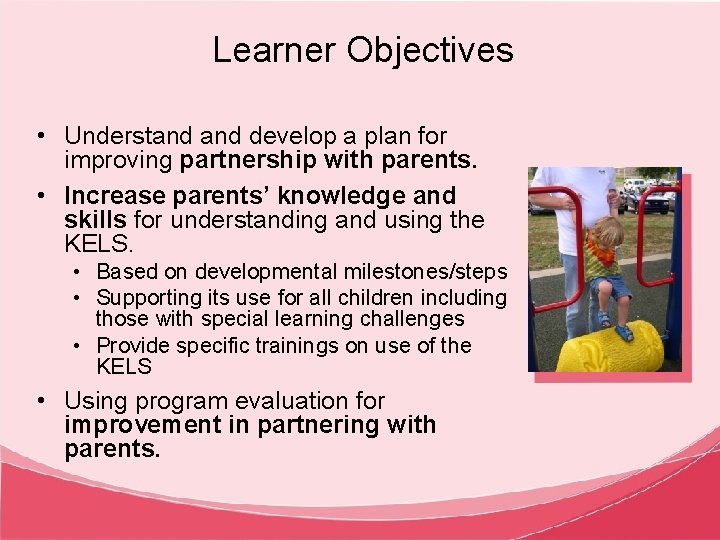
Learner Objectives • Understand develop a plan for improving partnership with parents. • Increase parents’ knowledge and skills for understanding and using the KELS. • Based on developmental milestones/steps • Supporting its use for all children including those with special learning challenges • Provide specific trainings on use of the KELS • Using program evaluation for improvement in partnering with parents.
Prior Knowledge and Experience • Who has written policies that include ways to partner/collaborate with parents • Tell the person sitting beside you how you partner with parents in your program • Tell the person next to you the ways that you communicate with parents • How do you use the KELS to partner with parents currently
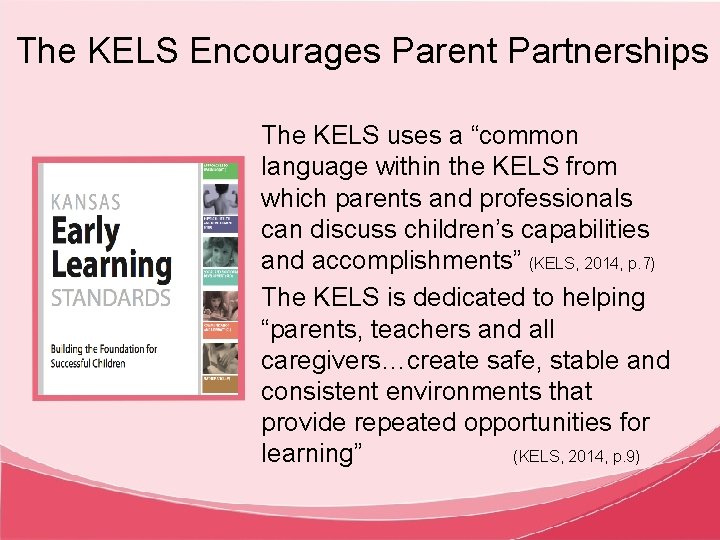
The KELS Encourages Parent Partnerships The KELS uses a “common language within the KELS from which parents and professionals can discuss children’s capabilities and accomplishments” (KELS, 2014, p. 7) The KELS is dedicated to helping “parents, teachers and all caregivers…create safe, stable and consistent environments that provide repeated opportunities for learning” (KELS, 2014, p. 9)
Research/Evidence • Partnering with parents/family members has been shown to increase developmental and later academic skill levels. (Editorial Projects in Education Research Center, 2004; Epstein, 2011; Snow, 2015) • One way to partner with parents is to use the KELS (which used research/evidence-based resources in its development) as a guide to understanding what is expected of the child, and what the parent can do within home and community environments to promote skills.
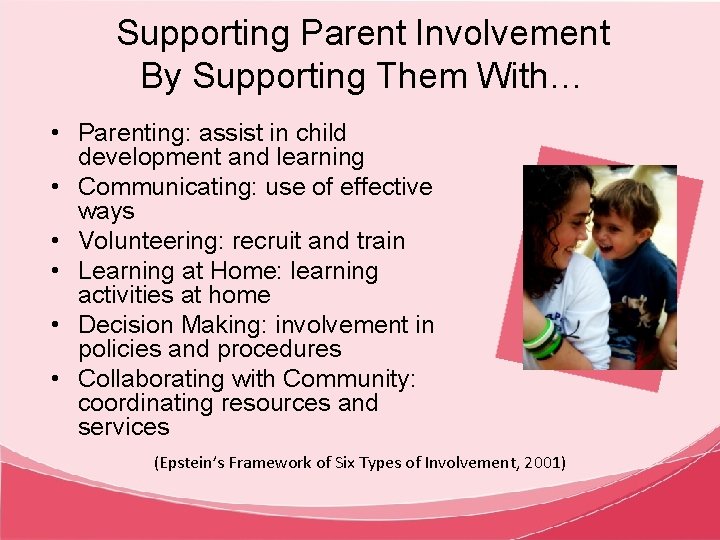
Supporting Parent Involvement By Supporting Them With… • Parenting: assist in child development and learning • Communicating: use of effective ways • Volunteering: recruit and train • Learning at Home: learning activities at home • Decision Making: involvement in policies and procedures • Collaborating with Community: coordinating resources and services (Epstein’s Framework of Six Types of Involvement, 2001)
Family Engagement “Substantial research supports family involvement, and a growing body of intervention evaluations demonstrates that family involvement can be strengthened with positive results for young children and their school readiness. ” (Kansas Family Engagement and Partnership Standards for Early Childhood, 2015)
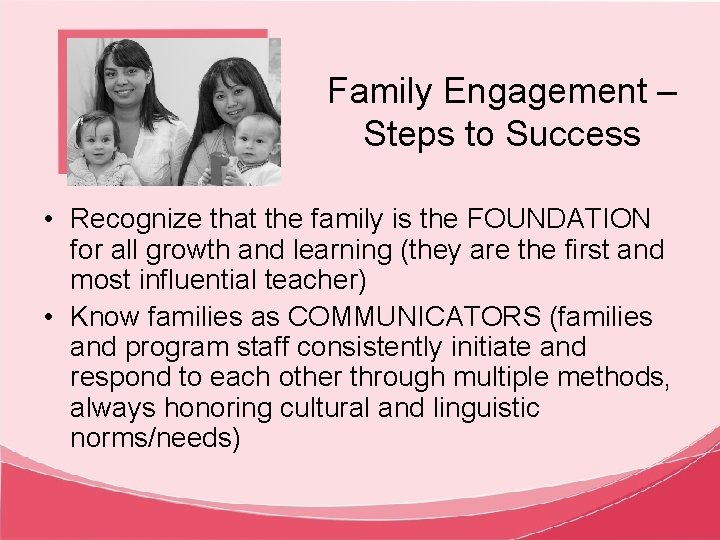
Family Engagement – Steps to Success • Recognize that the family is the FOUNDATION for all growth and learning (they are the first and most influential teacher) • Know families as COMMUNICATORS (families and program staff consistently initiate and respond to each other through multiple methods, always honoring cultural and linguistic norms/needs)
Family Engagement – Steps to Success • Acknowledge and support families as active advocates and decision-makers (give them informed options, active leadership, and provide needed resources) • Engage families as partners (working together)
Family Engagement – Steps to Success Families are community members (support their needs for resources and services within the community)
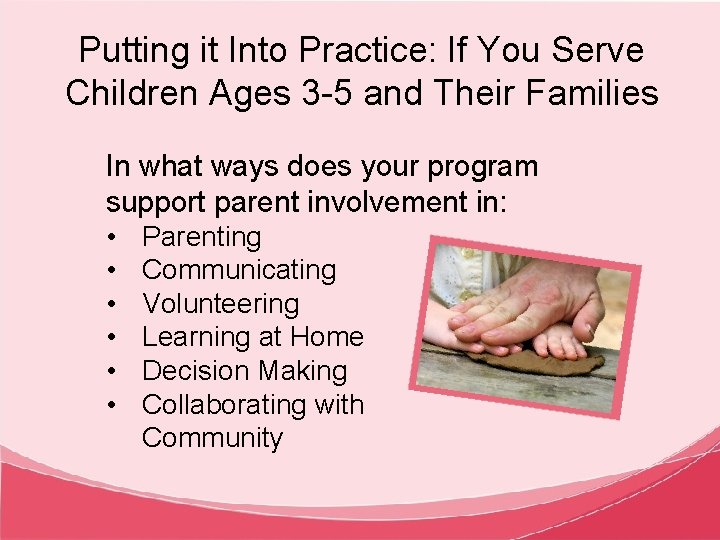
Putting it Into Practice: If You Serve Children Ages 3 -5 and Their Families In what ways does your program support parent involvement in: • • • Parenting Communicating Volunteering Learning at Home Decision Making Collaborating with Community
Putting it into Practice: Children Ages 0 -5 and Their Families TIPS from others: • Parenting: (provide both written and visual resources when training skills; always keep in mind their home language) • Communicating: (ask how the parent prefers to communicate – in-person, phone, technology – then honor their choice) • Volunteering: (recruitment is only one part; be sure and train)
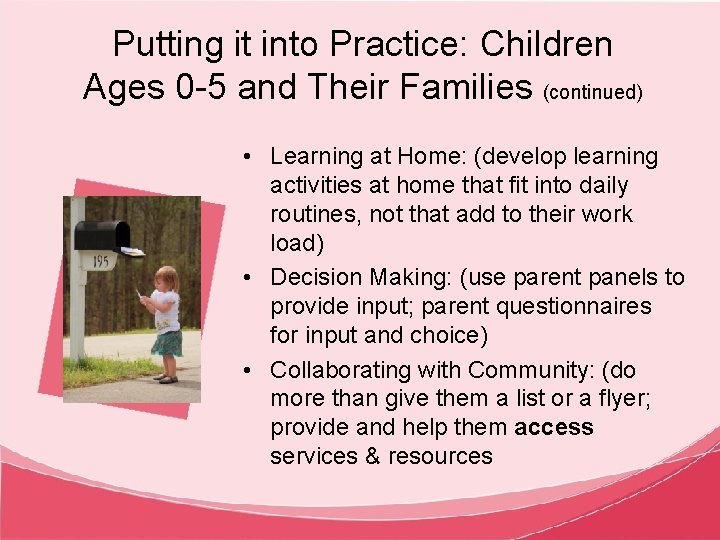
Putting it into Practice: Children Ages 0 -5 and Their Families (continued) • Learning at Home: (develop learning activities at home that fit into daily routines, not that add to their work load) • Decision Making: (use parent panels to provide input; parent questionnaires for input and choice) • Collaborating with Community: (do more than give them a list or a flyer; provide and help them access services & resources
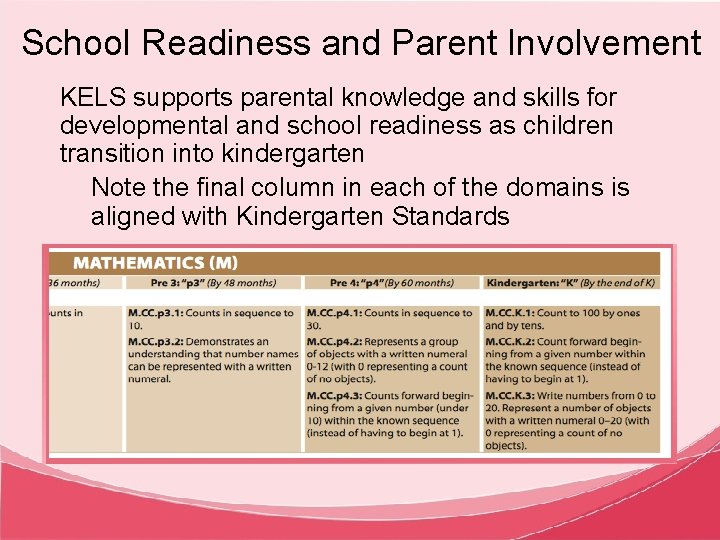
School Readiness and Parent Involvement KELS supports parental knowledge and skills for developmental and school readiness as children transition into kindergarten Note the final column in each of the domains is aligned with Kindergarten Standards
Assuring Parents of Foundations to Learning: Now and Later Programs assure parents that early childhood programs are laying foundations for later academics through developmentally appropriate practices that include intentional, planned and child initiated activities through play (what looks like only play actually links to language arts, science, mathematics, history, social studies, the arts, and other academic areas).
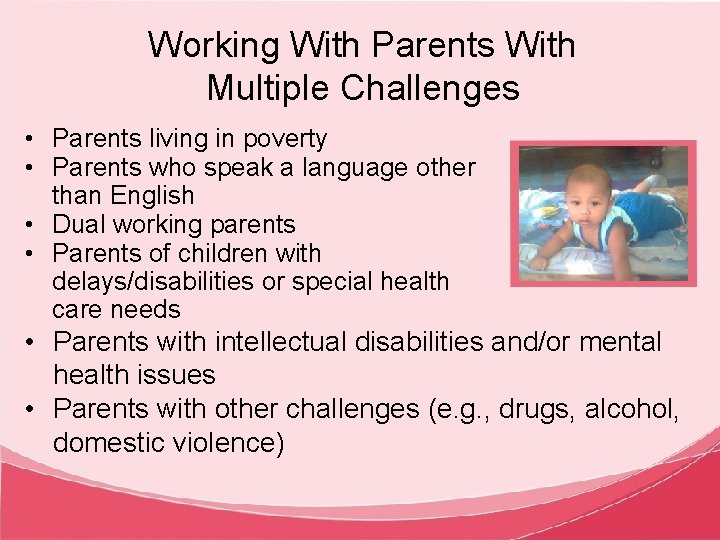
Working With Parents With Multiple Challenges • Parents living in poverty • Parents who speak a language other than English • Dual working parents • Parents of children with delays/disabilities or special health care needs • Parents with intellectual disabilities and/or mental health issues • Parents with other challenges (e. g. , drugs, alcohol, domestic violence)
Practice From Your Perspectives Your Turn – What challenges do you see families of the children you care for and teach facing each day? How do you help, if you work in any of the following: • Child Care Settings (home or center-based) • Preschool Settings • During Transitions (e. g. , hospital to home, home to center-base, Part C to Part B, into Kindergarten, from multiple programs within the day)
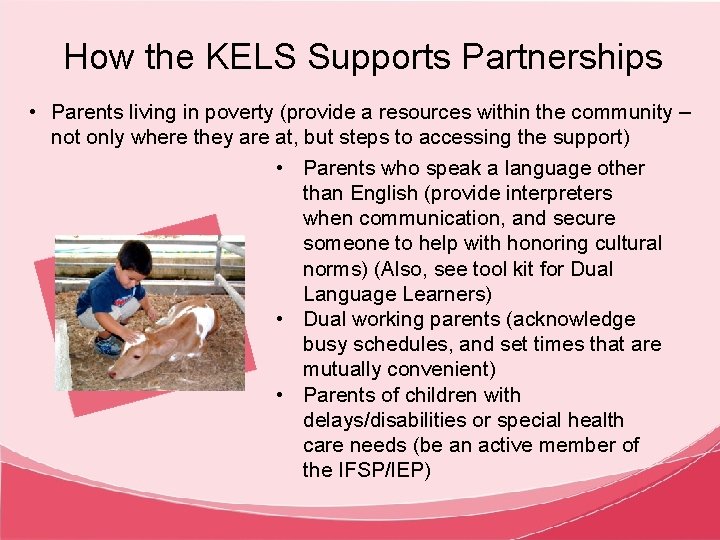
How the KELS Supports Partnerships • Parents living in poverty (provide a resources within the community – not only where they are at, but steps to accessing the support) • Parents who speak a language other than English (provide interpreters when communication, and secure someone to help with honoring cultural norms) (Also, see tool kit for Dual Language Learners) • Dual working parents (acknowledge busy schedules, and set times that are mutually convenient) • Parents of children with delays/disabilities or special health care needs (be an active member of the IFSP/IEP)
Assessment for Program Improvement “Some evidence indicates that there is considerable agreement in the ECE field about the elements that constitute the quality of … family and provider/teacher partnerships. The challenge is how to measure this quality. This is a significant issue for ECE stakeholders who seek to assess their efforts to improve these relationships at the program and system level. ” (Porter, Bromer, & Forry, 2015)
Assessment for Program Improvement • Informal measures can be program check sheets you develop with outcomes you have set listed that can be rated, analyzed, and improvement identified • Formal measure examples include resources such as: The New Measures for Assessing the Quality of Family and Provider/Teacher Relationships (FPTRQ) provides tools for educators, child care providers, and other professionals. Common features of it include: Ecological perspectives Child outcomes Family related outcomes Strengths-based family-provider partnerships
Assessment for Program Improvement Other formal examples include: • A Survey for Assessing School Level Family and Community Partnerships (from the Working Together: School-Family-Community Partnerships) • Measuring What Matters: Using Data to Support Family Progress: Overview (from the Office of Head Start National Centers on Parent, Family, and Community Engagement)
For More Information KELS Virtual Toolkit: Active Parent Partnerships • • QT I need a better understanding of this topic. Where should I begin How do I find out what works to support infants and young children in this area Show me what implementation looks like (for adults and children) in classroom and non-classroom settings How can I get additional training on this topic I would like to share this information with others, in a group setting. Is there a trainer's version of this virtual toolkit Evaluation
Evaluation • What is one big idea or take home message from what you heard today • What excites you or concerns you about what you learned • Any insights from the session • How will you use what you learned from this session
References Editorial Projects in Education Research Center (2004, August 4). Issues A-Z: Parent Involvement. Education Week. Retrieved http: //www. edweek. org/ew/issues/parent-involvement/ Epstein, J. L. (2001). School, family, and community partnerships: Preparing educators and improving schools. Boulder, CO: Westview Press Epstein (2011). School, family, and community partnerships: Preparing educators and improving schools. Second Edition. Boulder, CO: Westview Press
References Head Start (20). Measuring what matters: Using data to support family progress. Retrieved: http: //eclkc. ohs. acf. hhs. gov/hslc/tta-system/family/docs/measuringwhat-matters-overview. pdf Kansas Family Engagement and Partnership Standards for Early Childhood (2015). Kansas Coalition for Effective Family Engagement, Kansas Families and Schools Together, Topeka, KS. Porter, T. , Bromer, J. , & Forry, N. (2015). Assessing Quality in Family and Provider/Teacher Relationships: Using the Family and Provider Teacher Relationship Quality (FPTRQ) Measures in Conjunction with Strengthening Families and the Head Start Parent, Family and Community Engagement Frameworks and their Self. Assessment Tools. OPRE Report 2015 -56. Washington, D. C. : Office of Planning, Research and Evaluation, Administration for Children and Families, U. S. Department of Health and Human Services
References Snow, K. (2015). Research news you can use: Family engagement and early childhood education. National Association for the Education of Young Children. Retrieved: http: //www. naeyc. org/content /research-news-familyengagement
National Resources National Association for the Education of Young Children – Family Engagement: http: //www. naeyc. org/content/researchnews-family-engagement Harvard Family Research Project: http: //www. hfrp. org Center for Parent Information and Resources: http: //www. parentcenterhub. org/repository /parent-participation-ei/
National Resources Council for Exceptional Children’s Division for Early Childhood (Recommended Practices): http: //www. dec-sped. org/recommendedpractices U. S. Department of Education’s Parent and Family Engagement: http: //www. ed. gov/parent-and-familyengagement
State Resources Families Together, Inc. http: //www. familiestogetherinc. org Kansas Family Engagement and Partnership Standards for Early Childhood http: //www. kcefe. net Kansas Technical Assistance System Network (TASN) Kansas Parent Information Resource Center: http: //www. ksdetasn. org/kpirc Kansas State Department of Education – Parents’ Rights in Special Education (Procedural Safeguards): http: //www. ksde. org/Portals/0/SES/ forms/KSDE_IDEA_Part_B_Proc. Safeguards Kansas. pdf
Acknowledgement The Kansas Early Learning Standards (KELS) Training Project, a project of the University of Kansas, Life Span Institute at Parsons, was funded through a grant from the Kansas State Department of Education with funds from the Kansas Children’s Cabinet and Trust Fund Leadership support for this project was provided by the Kansas State Agencies Early Childhood Leadership Team with representatives from: • Kansas Children’s Cabinet and Trust Fund • Kansas Department for Children and Families • Kansas Department of Health and Environment • Kansas State Department of Education
Contacts Kansas Children’s Cabinet and Trust Fund Landon State Office Building 900 SW Jackson St. , Rm. 152 Topeka, Kansas 66612 785. 368. 7044 or 877. 204. 5171 Kansas Department for Children and Families Child Care and Early Education 555 S. Kansas Avenue Topeka, Kansas 66032 785. 296. 3271 or 800. 332. 6262 Kansas Department of Health and Environment Children and Families Services Curtis State Office Building 1000 SW Jackson St. Topeka, Kansas 66612 785. 296. 1500 or 800. 332. 6262 Kansas State Department of Education Early Childhood, Special Education, and Title Services Landon State Office Building 900 SW Jackson St. Topeka, Kansas 66612 785. 296. 7454 or 800. 203 -9462
Acknowledgement Suggested reference for this Power. Point: Mitchell, L. , Rinkel, P. , Heintz, C. , & Lindeman, D. P. (2016). Using Kansas Early Learning Standards (KELS) to Support: Active Parent Partnerships and Engagement. Life Span Institute at Parsons, University of Kansas, Parsons, KS.