
Using image analysis to monitor cow and calf
- Slides: 1
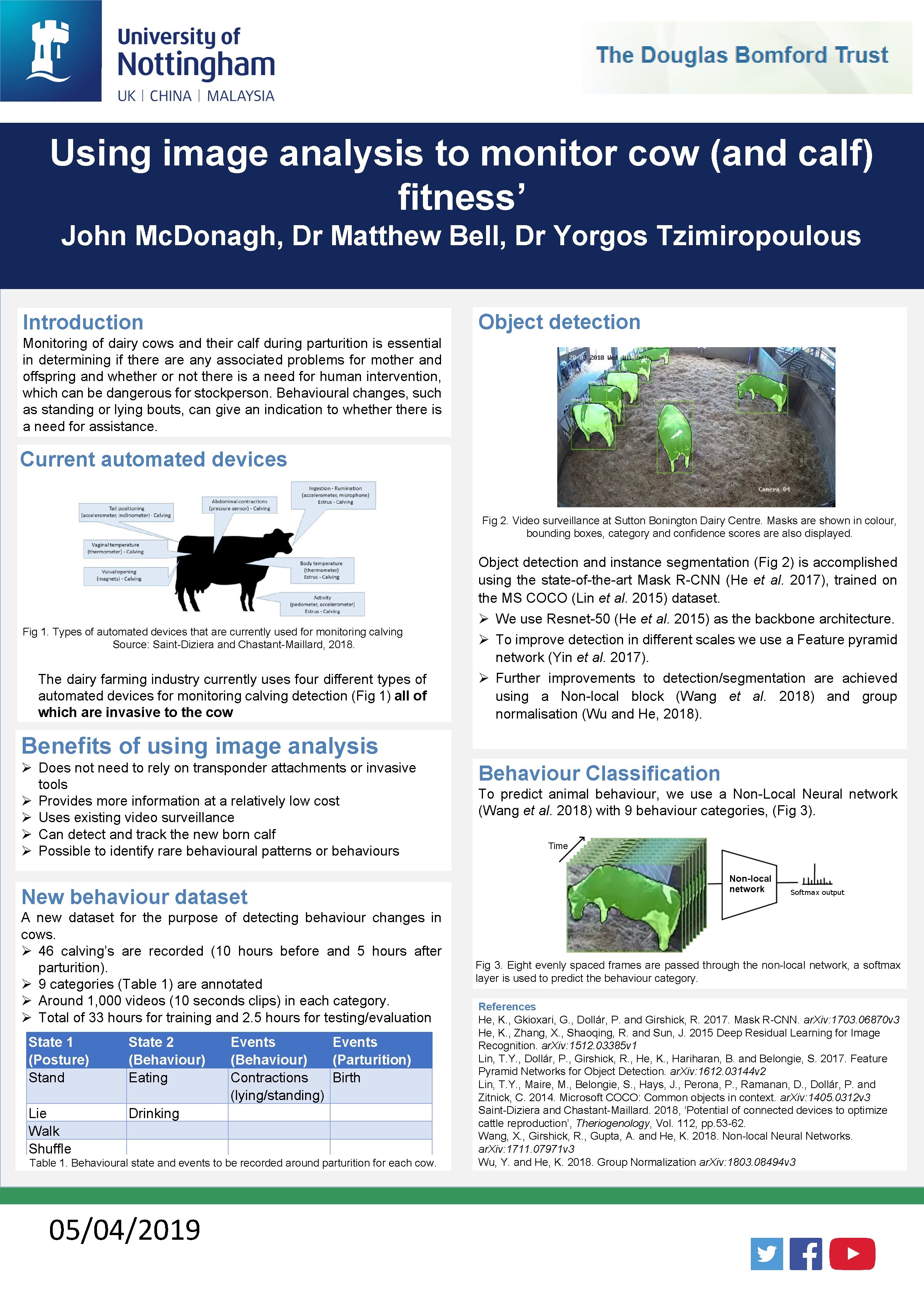
Using image analysis to monitor cow (and calf) fitness’ John Mc. Donagh, Dr Matthew Bell, Dr Yorgos Tzimiropoulous Object detection Introduction Monitoring of dairy cows and their calf during parturition is essential in determining if there any associated problems for mother and offspring and whether or not there is a need for human intervention, which can be dangerous for stockperson. Behavioural changes, such as standing or lying bouts, can give an indication to whethere is a need for assistance. Current automated devices Fig 2. Video surveillance at Sutton Bonington Dairy Centre. Masks are shown in colour, bounding boxes, category and confidence scores are also displayed. Object detection and instance segmentation (Fig 2) is accomplished using the state-of-the-art Mask R-CNN (He et al. 2017), trained on the MS COCO (Lin et al. 2015) dataset. Fig 1. Types of automated devices that are currently used for monitoring calving Source: Saint-Diziera and Chastant-Maillard, 2018. The dairy farming industry currently uses four different types of automated devices for monitoring calving detection (Fig 1) all of which are invasive to the cow Ø We use Resnet-50 (He et al. 2015) as the backbone architecture. Ø To improve detection in different scales we use a Feature pyramid network (Yin et al. 2017). Ø Further improvements to detection/segmentation are achieved using a Non-local block (Wang et al. 2018) and group normalisation (Wu and He, 2018). Benefits of using image analysis Ø Does not need to rely on transponder attachments or invasive tools Ø Provides more information at a relatively low cost Ø Uses existing video surveillance Ø Can detect and track the new born calf Ø Possible to identify rare behavioural patterns or behaviours Behaviour Classification To predict animal behaviour, we use a Non-Local Neural network (Wang et al. 2018) with 9 behaviour categories, (Fig 3). New behaviour dataset A new dataset for the purpose of detecting behaviour changes in cows. Ø 46 calving’s are recorded (10 hours before and 5 hours after parturition). Ø 9 categories (Table 1) are annotated Ø Around 1, 000 videos (10 seconds clips) in each category. Ø Total of 33 hours for training and 2. 5 hours for testing/evaluation State 1 (Posture) Stand State 2 (Behaviour) Eating Lie Walk Shuffle Drinking Events (Behaviour) (Parturition) Contractions Birth (lying/standing) Table 1. Behavioural state and events to be recorded around parturition for each cow. 05/04/2019 Fig 3. Eight evenly spaced frames are passed through the non-local network, a softmax layer is used to predict the behaviour category. References He, K. , Gkioxari, G. , Dollár, P. and Girshick, R. 2017. Mask R-CNN. ar. Xiv: 1703. 06870 v 3 He, K. , Zhang, X. , Shaoqing, R. and Sun, J. 2015 Deep Residual Learning for Image Recognition. ar. Xiv: 1512. 03385 v 1 Lin, T. Y. , Dollár, P. , Girshick, R. , He, K. , Hariharan, B. and Belongie, S. 2017. Feature Pyramid Networks for Object Detection. ar. Xiv: 1612. 03144 v 2 Lin, T. Y. , Maire, M. , Belongie, S. , Hays, J. , Perona, P. , Ramanan, D. , Dollár, P. and Zitnick, C. 2014. Microsoft COCO: Common objects in context. ar. Xiv: 1405. 0312 v 3 Saint-Diziera and Chastant-Maillard. 2018, ‘Potential of connected devices to optimize cattle reproduction’, Theriogenology, Vol. 112, pp. 53 -62. Wang, X. , Girshick, R. , Gupta, A. and He, K. 2018. Non-local Neural Networks. ar. Xiv: 1711. 07971 v 3 Wu, Y. and He, K. 2018. Group Normalization ar. Xiv: 1803. 08494 v 3