
Using IDEA 10 to Detect and Deter Corporate


- Slides: 31
Using IDEA 10 to Detect and Deter Corporate Fraud James Loughlin, CIDA Head of Technical & Training, Audit. Ware
The Scale of Fraud in the UK • KPMG’s Fraud Barometer report for January 2017 highlights that the total cost of fraudulent activity in the UK has surpassed a billion pounds (£ 1. 1 bn) for the first time since 2011. • There were seven super cases in the year, which have caused the average fraud loss to double to £ 5. 2 m
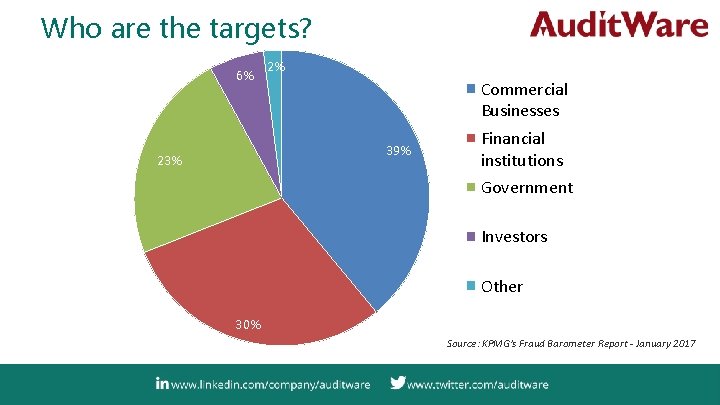
Who are the targets? 6% 2% Commercial Businesses 39% 23% Financial institutions Government Investors Other 30% Source: KPMG’s Fraud Barometer Report - January 2017
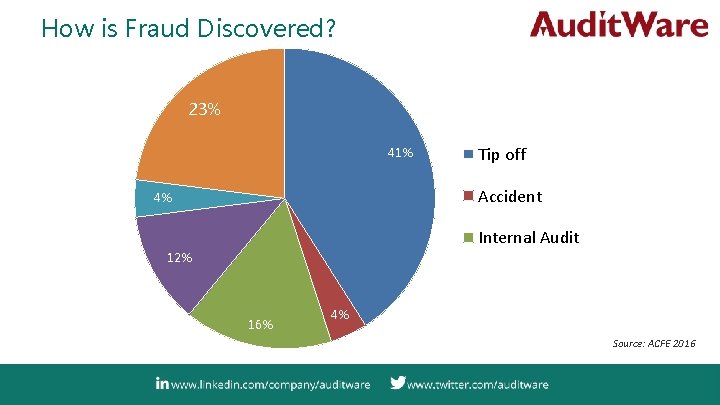
How is Fraud Discovered? 23% 41% Tip off Accident 4% Internal Audit 12% 16% 4% Source: ACFE 2016
Examples of Fraud from Recent Press • • Large Welcome donations being made to non-profit foundations in exchange for government favours (South Korea). • What’s New in Version 10. 2 • Bribe paid to a rival bidder to submit an uncompetitive bid. • What’s coming in the future • Bribes disguised as “General Consulting Fees” to secure contracts. • Over-stated profits by £ 300 m to influence share prices (Tesco). At present, hardly a day seems to pass without one fraud or another featuring in the mainstream media.
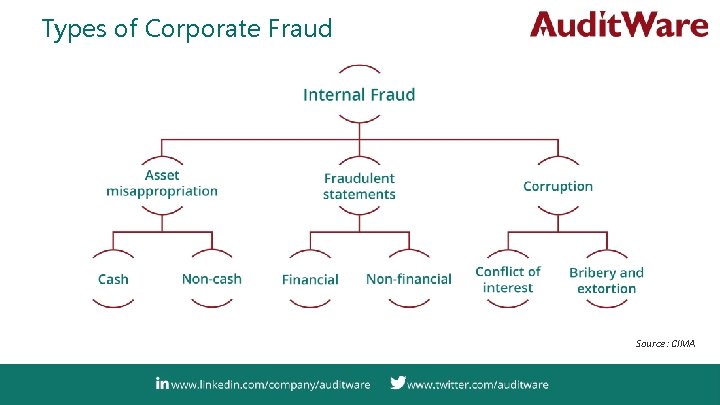
Types of Corporate Fraud Source: CIMA
Examples of Cash Fraud • Skimming • Voids/Under-rings • Swapping cheques for cash • Kiting • Alteration of cash receipt documentation • Fictitious refunds and discounts • Journal entries
Detecting Cash Fraud Schemes There are several basic methods to detect cash fraud: • Customer complaints • Surprise Cash Counts • Bank Reconciliations • Journal review • Review and analyses of decreases in gross sales or increases in returns and allowances
Accounts Receivable Fraud • Teeming and Lading of accounts receivable • Diversion of Payments (from written off balances) • Bribes for assigning current receivables to debt collection agency • Fictitious accounts and sales
Detecting Accounts Receivable Fraud • Tests can include: ▪ Stratifying the written off Accounts Receivable data and examine it for possible trends and patterns. For example: i. Same salesperson ii. Same accounting period iii. Same vendor
Financial Statements Fraud • Enhancing revenue with fictitious sales • Omitting expenses and liabilities • Providing incorrect valuations for assets • Manipulating results using timing differences • Improper disclosures by addition or exclusion
Detecting Financial Statements Fraud • Tests can include: ▪ Ratio Analysis i. Comparing a minimum of 2 years’ worth of published accounts for variances
Procurement Fraud • Collusion between suppliers • Unjustified single source awards • Creation of shell companies to facilitate fraudulent payments • False invoices for products and services for suppliers who do not exist • Bid rigging/bid splitting • Purchase order and contract variation orders
Detecting Procurement Fraud • Tests can include: ▪ Using the @age function, calculate the number of days between bid submission date and bid close date. Compare those with shortest day difference to winning bid. ▪ Using Standard deviation analysis to determine how far from the norm the lowest bidder is ▪ Extracting payments coded as extras/adjustments ▪ Joining supplier and employee files on bank details and employee addresses to see matches ▪ Benchmarking unit prices
Corporate Credit Card Fraud • Internal fraud - Employee using a corporate credit card for personal gain instead of legitimate corporate purchases or travel and entertainment expenses • External fraud – Cyber fraud/Cloning
Detecting Credit Card Fraud • Tests can include: ▪ Analysing corporate/procurement cards being used to acquire goods and services from vendors with suspect merchant codes (e. g. home supplies, personal entertainment, etc. ) ▪ Identifying if corporate cards are being used by employees on weekends, or while the employee is absent due to holiday or sickness. ▪ Looking for unusual spending patterns and amounts by category using statistical analysis ▪ Benchmarking by period and category against previous periods
Payroll Fraud • Phantom employees being set up on payroll systems • Duplicate payments • Invalid overtime payments • Employees remaining on the payroll after death or termination
Detecting Payroll Fraud • Tests can detect: ▪ If there is more than one employee with the same bank account details or the same address. ▪ Identify missing or invalid address information for employees For example; invalid social security numbers, invalid Post Codes. ▪ Unusually high overtime amounts based on department/grade comparison and number of hours. ▪ Payroll payments made to employees who were terminated or deceased according to HR records.
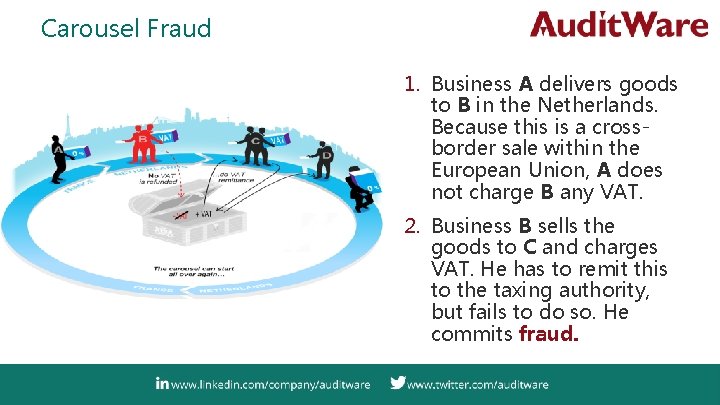
Carousel Fraud 1. Business A delivers goods to B in the Netherlands. Because this is a crossborder sale within the European Union, A does not charge B any VAT. 2. Business B sells the goods to C and charges VAT. He has to remit this to the taxing authority, but fails to do so. He commits fraud.
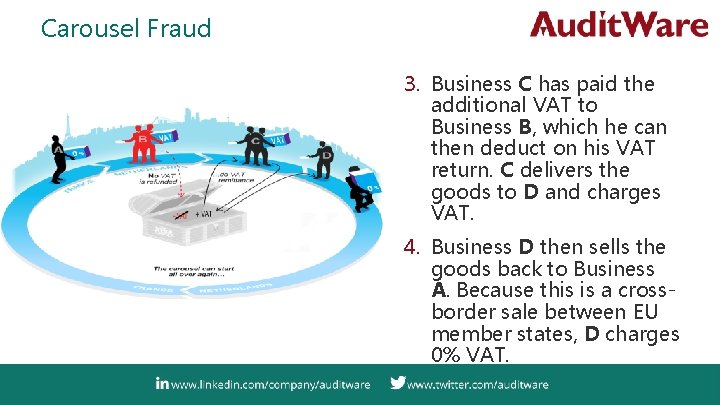
Carousel Fraud 3. Business C has paid the additional VAT to Business B, which he can then deduct on his VAT return. C delivers the goods to D and charges VAT. 4. Business D then sells the goods back to Business A. Because this is a crossborder sale between EU member states, D charges 0% VAT.
Detecting Carousel Fraud • Questioning if the deal too good to be true? • Tests can include: ▪ Using IDEA to compare unit prices, within the industry, using benchmarking data ▪ Compare unit prices from the company’s purchasing history month on month
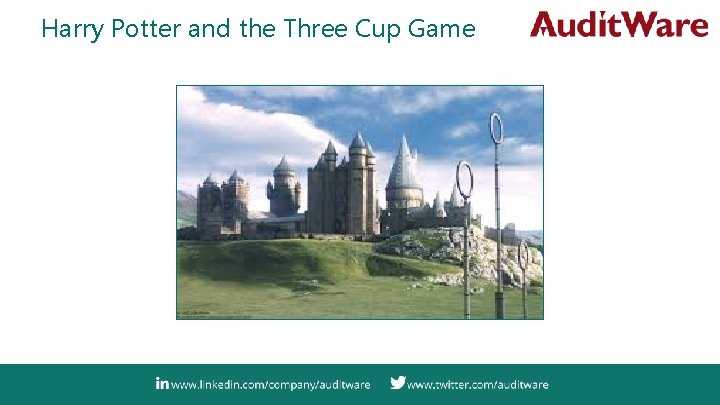
Harry Potter and the Three Cup Game
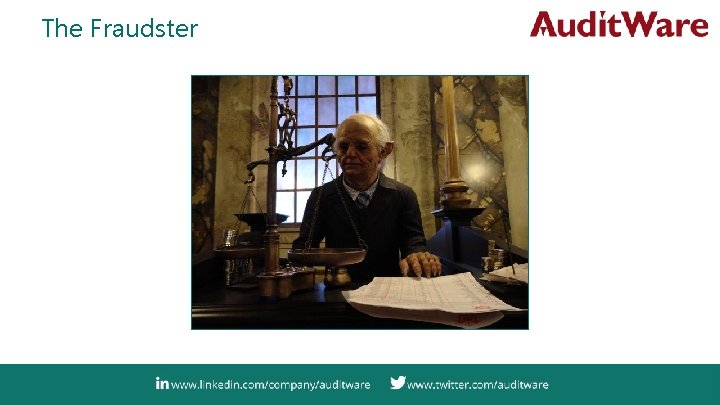
The Fraudster
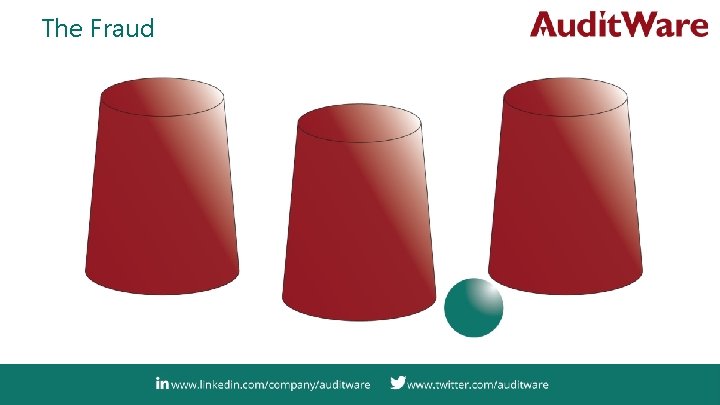
The Fraud
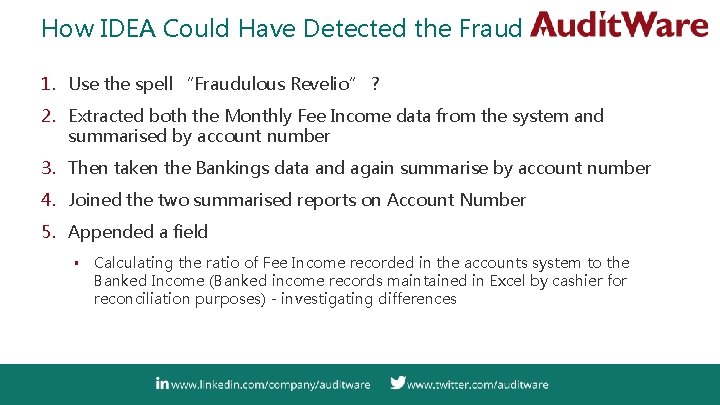
How IDEA Could Have Detected the Fraud 1. Use the spell “Fraudulous Revelio” ? 2. Extracted both the Monthly Fee Income data from the system and summarised by account number 3. Then taken the Bankings data and again summarise by account number 4. Joined the two summarised reports on Account Number 5. Appended a field ▪ Calculating the ratio of Fee Income recorded in the accounts system to the Banked Income (Banked income records maintained in Excel by cashier for reconciliation purposes) - investigating differences
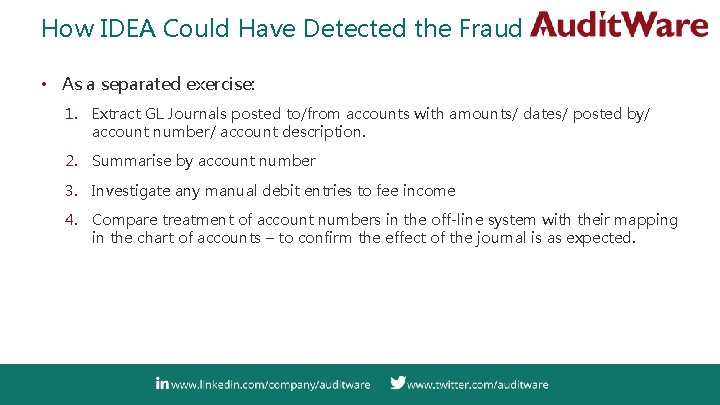
How IDEA Could Have Detected the Fraud • As a separated exercise: 1. Extract GL Journals posted to/from accounts with amounts/ dates/ posted by/ account number/ account description. 2. Summarise by account number 3. Investigate any manual debit entries to fee income 4. Compare treatment of account numbers in the off-line system with their mapping in the chart of accounts – to confirm the effect of the journal is as expected.
“I’m glad I brought my warm gloves. ”
• Meanwhile…
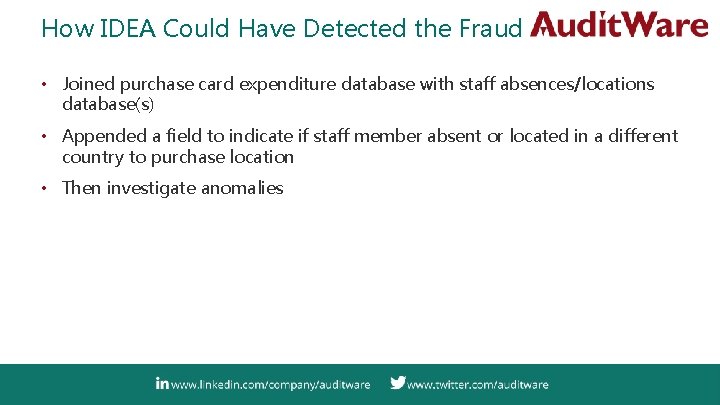
How IDEA Could Have Detected the Fraud • Joined purchase card expenditure database with staff absences/locations database(s) • Appended a field to indicate if staff member absent or located in a different country to purchase location • Then investigate anomalies
IDEA can contribute to a healthy anti-fraud culture by forming an integral part of the corporate policy on fraud. As the Director of the Serious Fraud Office said (2016): “the best ethics and anti-corruption programmes are surely those which are simply stated, inculcated by training, energetically enforced and lived in by all in authority. A thick policy book, carefully lawyered but ignored in practice, is as bad as no policy at all”.
Thank you for your time.