
USING GRAVITATIONAL WAVES TO DISTINGUISH BETWEEN NEUTRON STARS
USING GRAVITATIONAL WAVES TO DISTINGUISH BETWEEN NEUTRON STARS AND BLACK HOLES IN BINARIES STEPHANIE (ALEX) BROWN MAX PLANCK INSTITUTE FOR GRAVITATIONAL PHYSICS ALBERT EINSTEIN INSTITUTE HANNOVER, DE
YOUR STANDARD OUTLINE • Introduction • Methods • Results
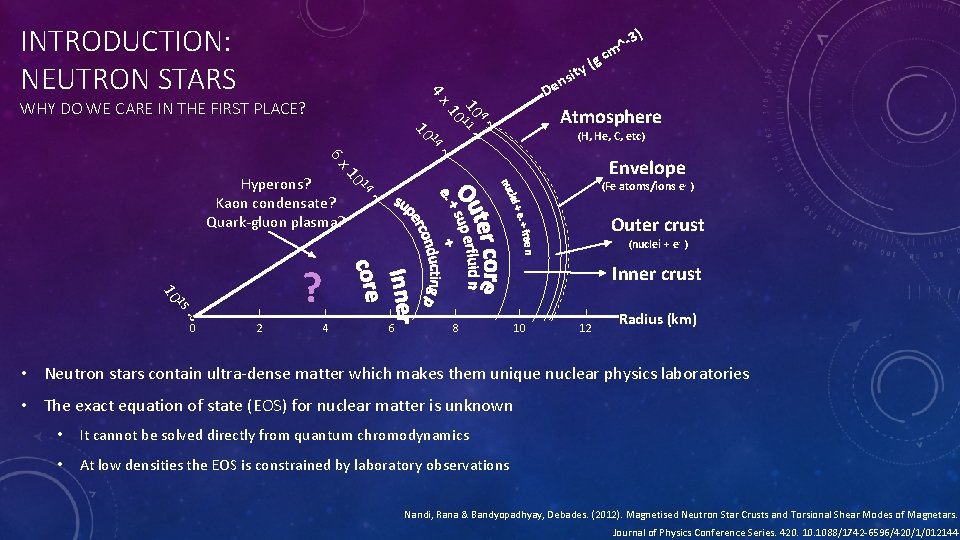
INTRODUCTION: NEUTRON STARS ) 4 x De (g (H, He, C, etc) 14 10 Atmosphere 4 ~ 10 11 ~ 10 WHY DO WE CARE IN THE FIRST PLACE? ty nsi ~ 6 x Envelope 10 (Fe atoms/ions e- ) 14 ~ Hyperons? Kaon condensate? Quark-gluon plasma? -3 ^ cm Outer crust (nuclei + e- ) 15 10 ? ~ 0 2 Inner crust 4 6 8 10 12 Radius (km) • Neutron stars contain ultra-dense matter which makes them unique nuclear physics laboratories • The exact equation of state (EOS) for nuclear matter is unknown • It cannot be solved directly from quantum chromodynamics • At low densities the EOS is constrained by laboratory observations Nandi, Rana & Bandyopadhyay, Debades. (2012). Magnetised Neutron Star Crusts and Torsional Shear Modes of Magnetars. Journal of Physics Conference Series. 420. 1088/1742 -6596/420/1/012144.
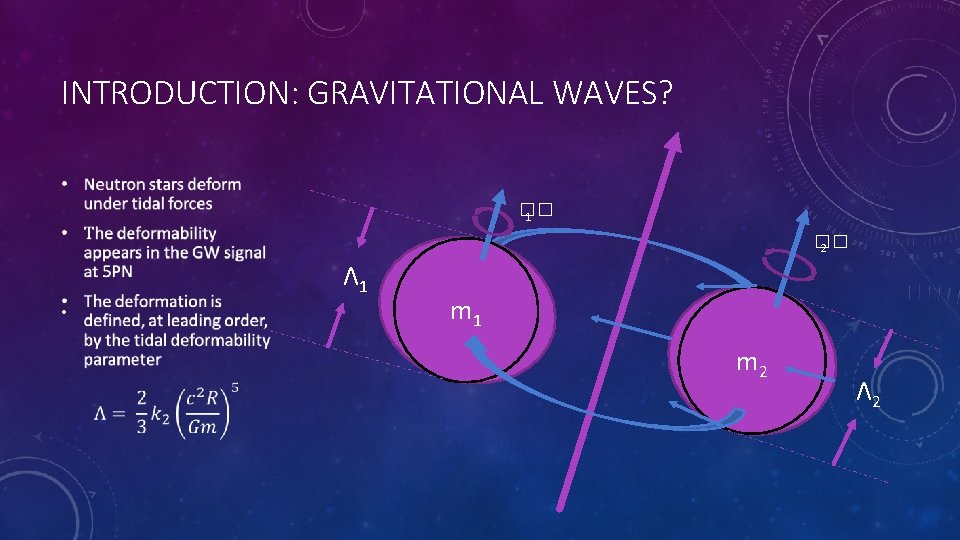
INTRODUCTION: GRAVITATIONAL WAVES? �� 1 �� 2 Λ 1 • m 1 m 2 Λ 2
INTRODUCTION: GRAVITATIONAL WAVES • Detection of GW 170817 in August 2017 opened up a new way study neutron stars • GW 190425 was also announced • Gravitational wave data has added to our knowledge of neutron stars • Placing upper bound of neutron star radius and tidal deformability • However, GW 170817 alone could not prove that the event was a BNS and not a BBH • Coincident GRB 170817 A and transient electromagnetic follow-ups provide evidence for the presence of neutron star matter
QUESTIONS • We ask then, under what conditions could a gravitational wave signal distinguish a binary neutron star system from a binary black hole system • With LIGO-Virgo’s detection of a neutron star-black hole system, the question extends to whether this type of system can be distinguished from a binary black hole • LIGO-Virgo may not be sensitive enough to do so, what about LIGO A+ or LIGO Voyager? Or Cosmic Explorer?
NEUTRON STAR BLACK HOLE SYSTEMS • GW confirmation of the existence of neutron matter may especially important for neutron star black hole binaries • Results from Capano et al suggest that average mass neutron stars won’t be disrupted by black holes with no to low spin except in the case of unusually low mass companions • If you have an object in the mass gap, we would have to rely on the GW signal to tell what sort of object it is
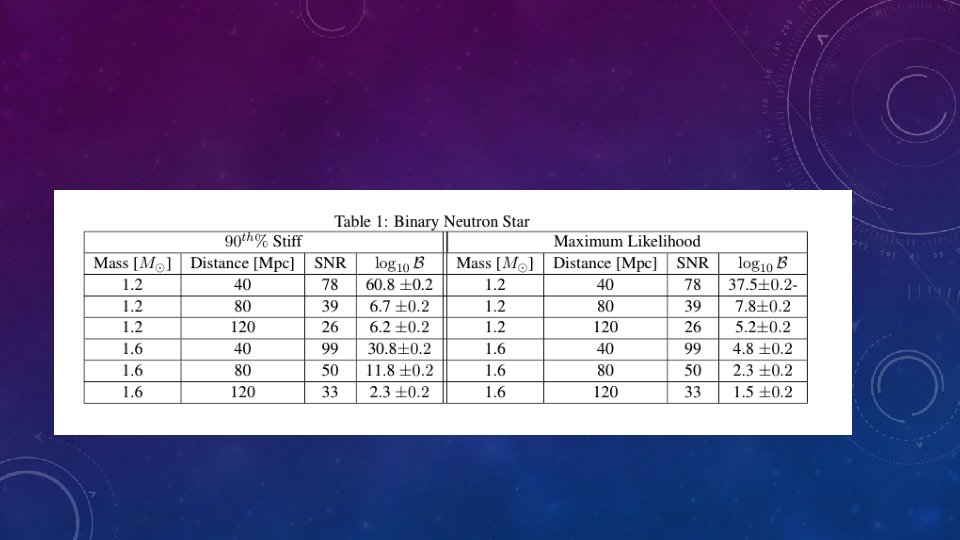
BASIC APPROACH • Make a series of injections of neutron star containing systems • Different distances, masses, and equations of state • For each injection, parameter estimation is done twice • Once with ’neutron star’ model (Non-zero tidal deformability) • Once with ‘binary black hole’ model (Zero tidal deformability) • Bayesian statistics generate posteriors and calculate evidence • Look at the Bayes Factor of Neutron Star hypothesis/ Binary Black hole hypothesis
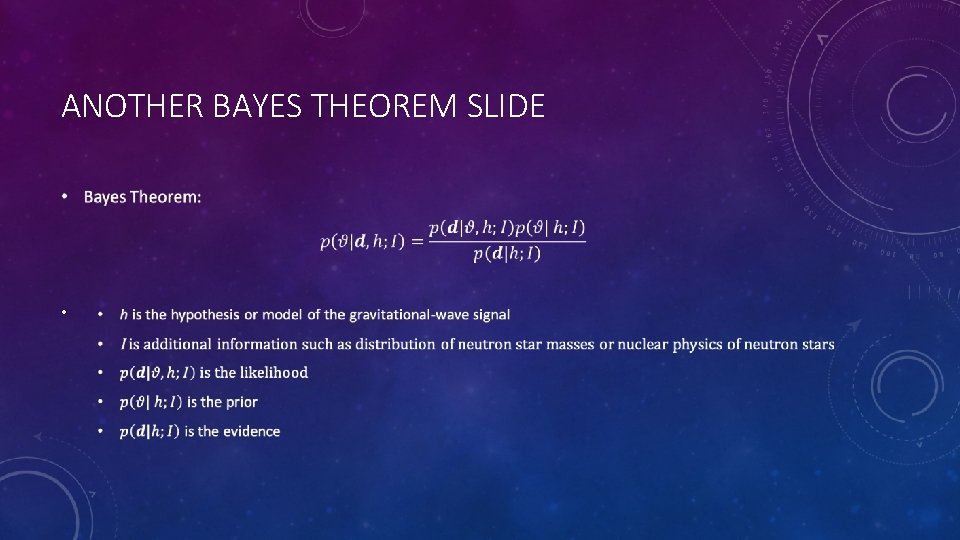
ANOTHER BAYES THEOREM SLIDE •
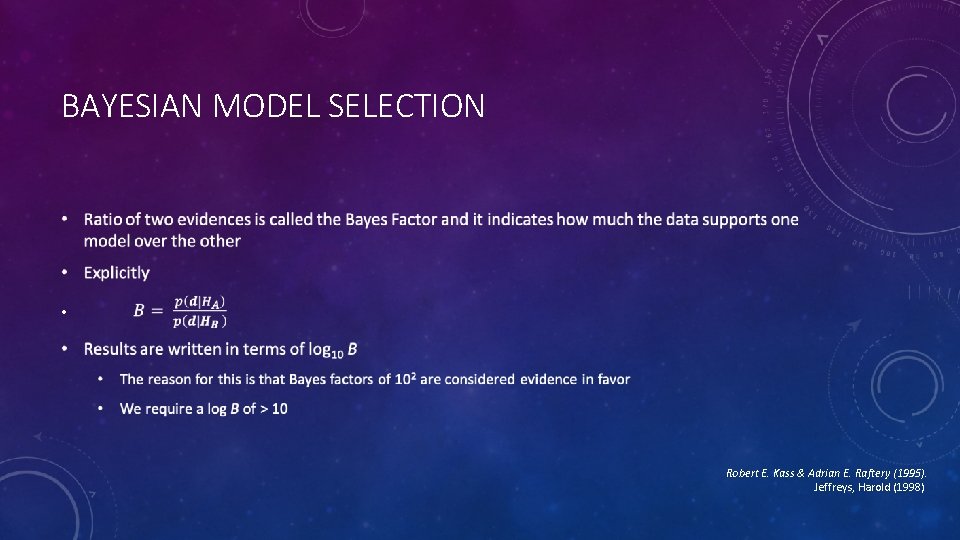
BAYESIAN MODEL SELECTION • Robert E. Kass & Adrian E. Raftery (1995). Jeffreys, Harold (1998)
FOR MODEL SELECTION • We need three things • Simulated Gravitational Wave Signal • Two models • Machinery to Calculate the evidence
FOR MODEL SELECTION • We need three things • Simulated Gravitational Wave Signal • Two models • Machinery to Calculate the evidence
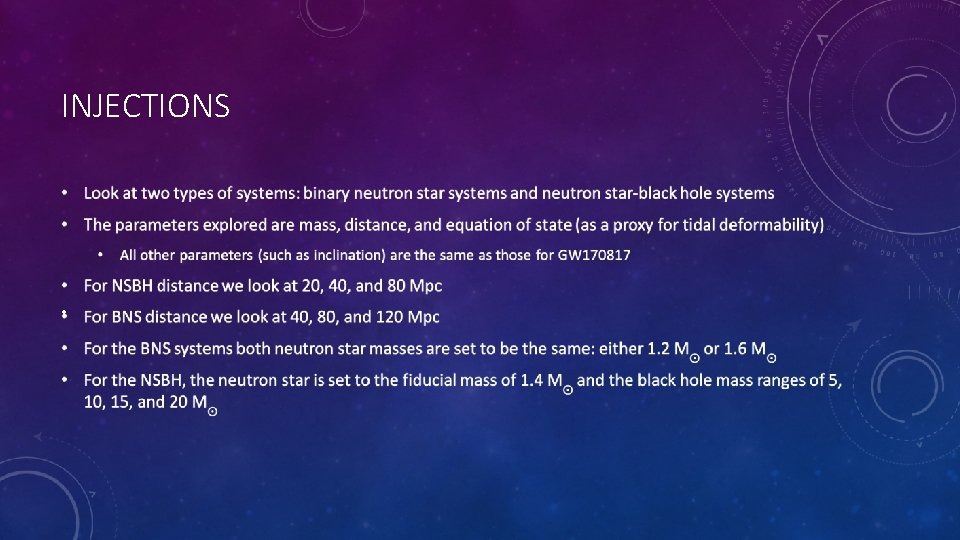
INJECTIONS •
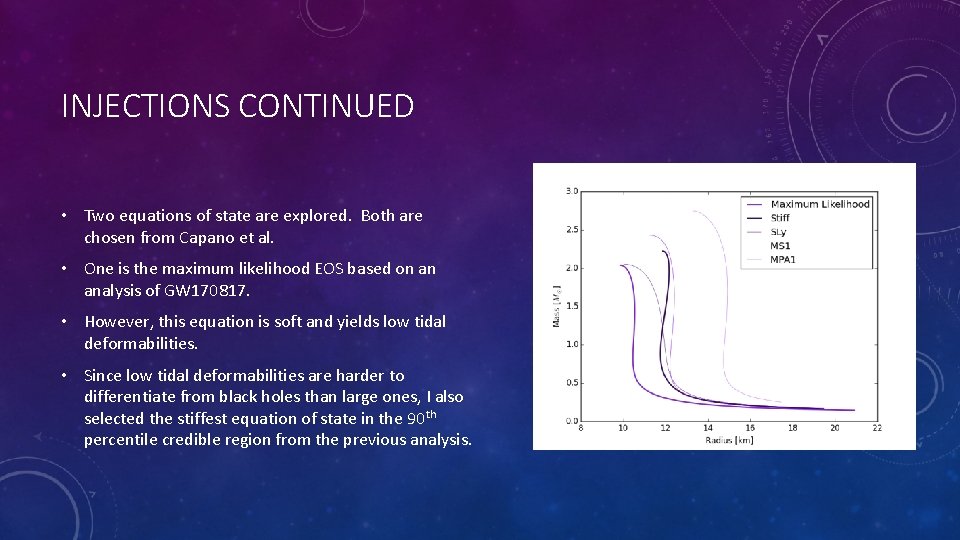
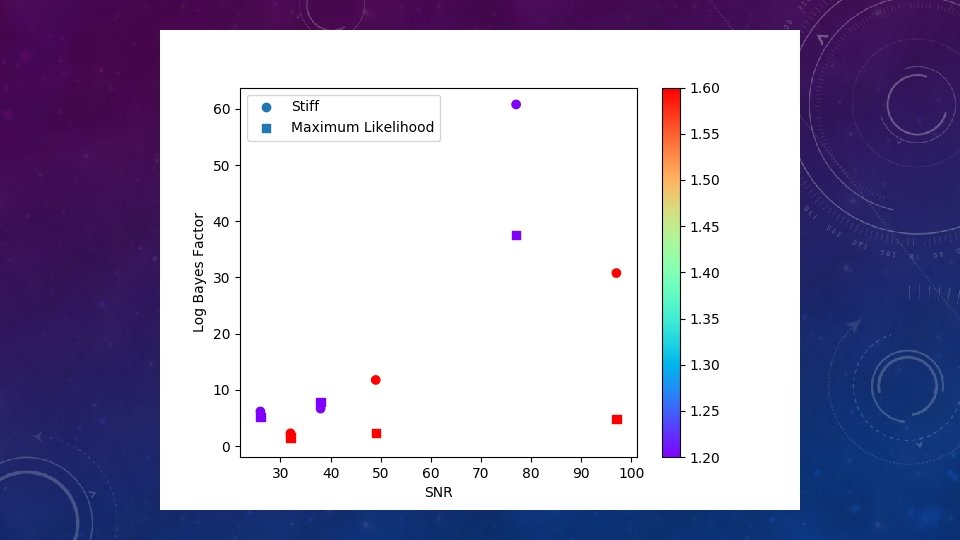
INJECTIONS CONTINUED • Two equations of state are explored. Both are chosen from Capano et al. • One is the maximum likelihood EOS based on an analysis of GW 170817. • However, this equation is soft and yields low tidal deformabilities. • Since low tidal deformabilities are harder to differentiate from black holes than large ones, I also selected the stiffest equation of state in the 90 th percentile credible region from the previous analysis.
FOR MODEL SELECTION • We need three things • Simulated Gravitational Wave Signal • Two models • Machinery to Calculate the evidence
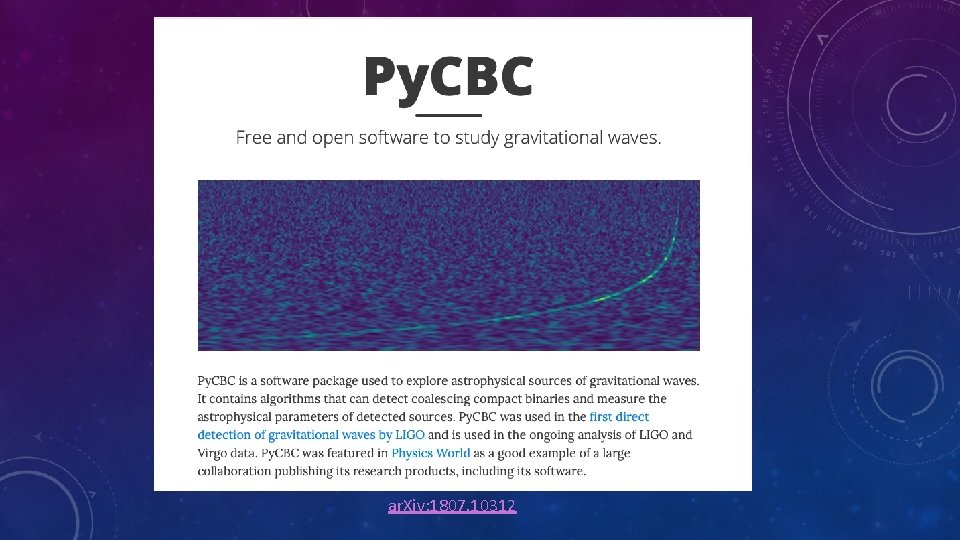
MODEL 1: NEUTRON STAR CONTAINING SYSTEM • Neutron Star parameter estimation method is the same as the recent publication • Available on arxiv: ar. Xiv: 1908. 10352 • We analyzed GW 170817 using a new sampling method and improved constraints on neutron star radius • I use the same method, so I will review quickly
PREVIOUS WORK • Our work was novel in that it avoid making any generalizations relating Λ 1 and Λ 2 by sampling EOS space directly in our parameter analysis • The EOS is from a state-of-the-art nuclear physics model called Chiral Effective field theory. • This uses the most general Lagrangian that it can while being consistent with fundamental theories of nuclear interactions and including pions and nucleons • Chiral effective field theory also allows for a reliable estimation of theoretical uncertainties. • They are defined by Chiral EFT up to a transition density. Above that density the EOS are constrained only by the requirement that they are causal, stable, and able to support a neutron star of mass 1. 9 M ☉. • These equations are designed to be as general as possible and include phase transitions
MODEL 2: BINARY BLACK HOLE • Easy: both objects have 0 tidal deformability • All other priors are kept the same in order to make a 1: 1 comparison. • You can argue that it doesn’t make sense to physically restrict spin and mass if you are assuming BH. However, broadening the BBH priors will wash out some of the evidence.
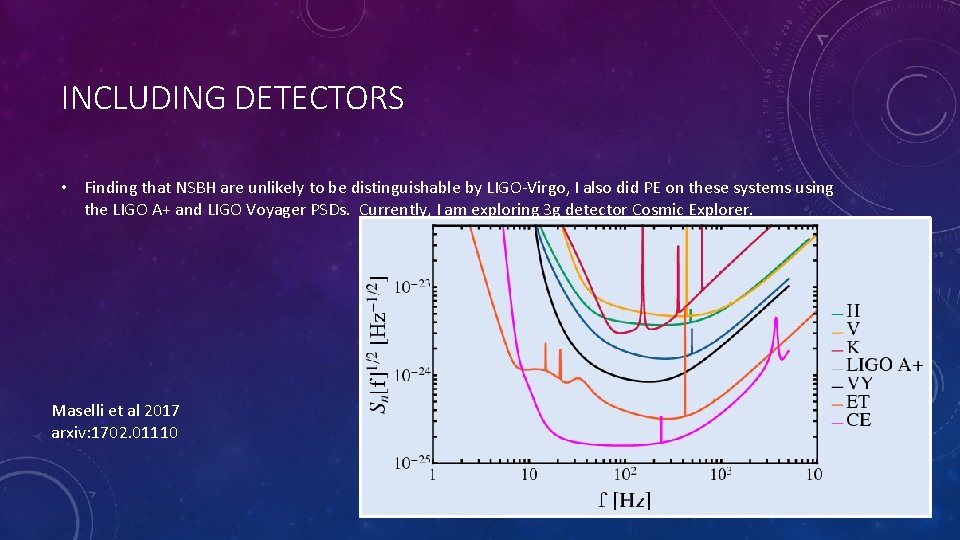
INCLUDING DETECTORS • Finding that NSBH are unlikely to be distinguishable by LIGO-Virgo, I also did PE on these systems using the LIGO A+ and LIGO Voyager PSDs. Currently, I am exploring 3 g detector Cosmic Explorer. Maselli et al 2017 arxiv: 1702. 01110
PARAMETER ESTIMATION: PRIORS •
FOR MODEL SELECTION • We need three things • Simulated Gravitational Wave Signal • Two models • Machinery to Calculate the evidence
ar. Xiv: 1807. 10312
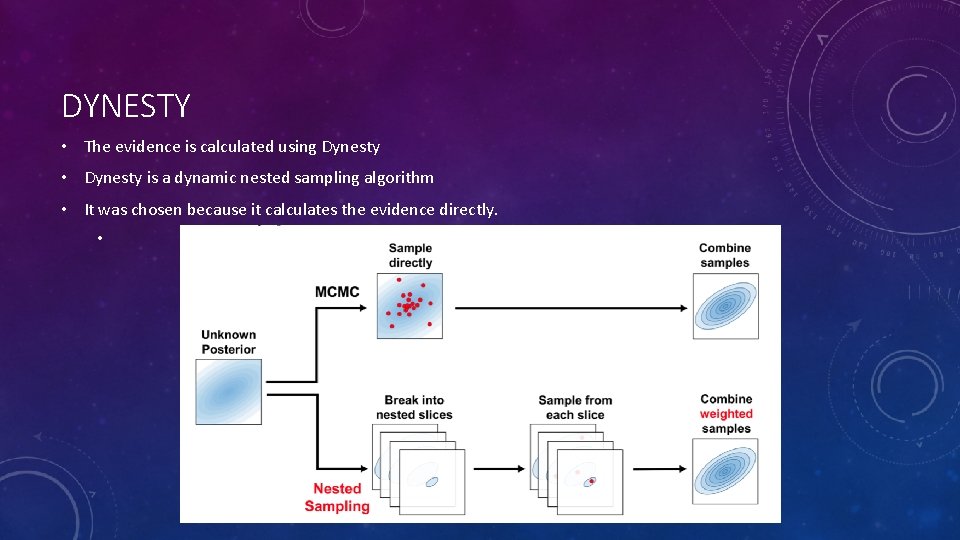
DYNESTY • The evidence is calculated using Dynesty • Dynesty is a dynamic nested sampling algorithm • It was chosen because it calculates the evidence directly. •

RESULTS: BNS
RESULTS: NSBH
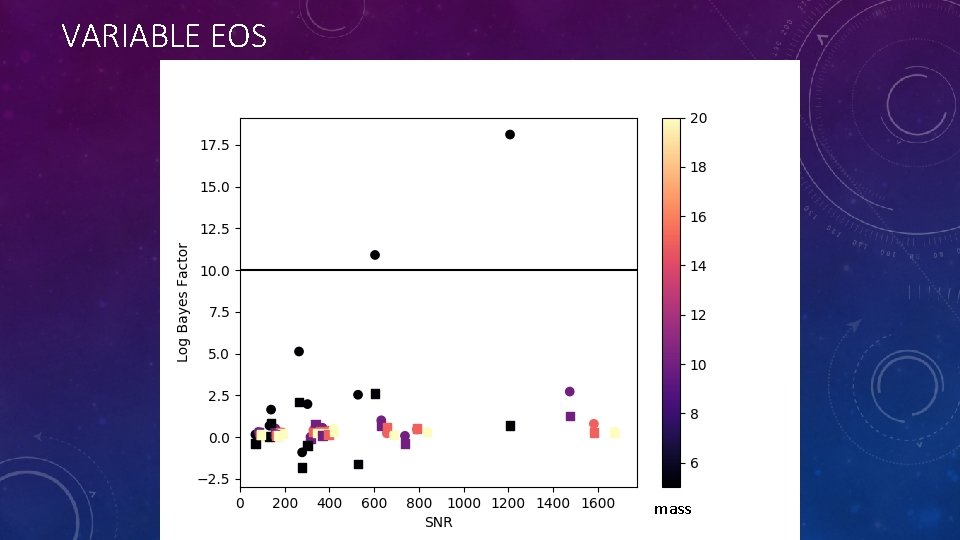
VARIABLE EOS mass
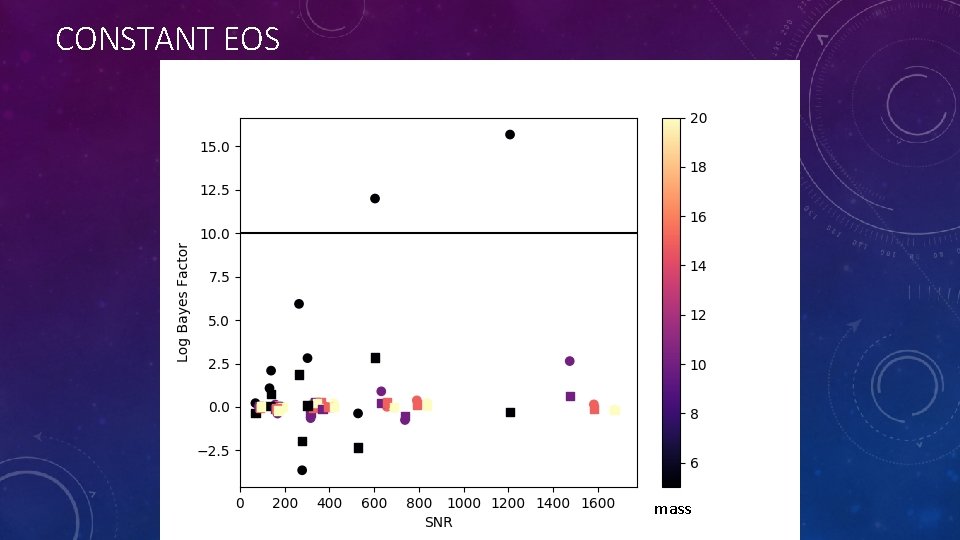
CONSTANT EOS mass

THANK YOU QUESTIONS?
ADDITIONAL SLIDES: CAPANO ET AL • The unique about our approach is that we sample over the EOS directly • EOS are generated and sorted into bins according to their radius at 1. 4 M☉. • 2000 EOS are selected such that the prior is uniform in R. • This selection process is important as fewer EOS have very small or very large radii.
ADDITIONAL SLIDES: CAPANO ET AL • Each EOS has a data file tabulating the radius, mass, and tidal deformability. • Py. CBC’s Markov Chain Monte Carlo samples the EOS prior by drawing a number. The code then opens the data file associated with that EOS and the tidal deformability is taken from the table using the mass. • The sampler draws two masses and an EOS and calculates Λ 1 and Λ 2 using the EOS, ensuring that both use the exact same EOS

ADDITIONAL SLIDES: POSTERIORS
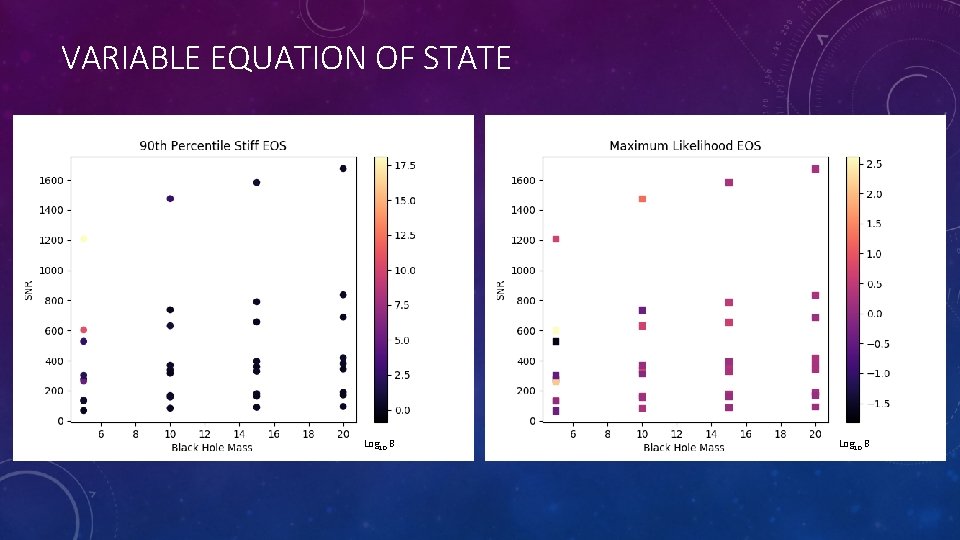
VARIABLE EQUATION OF STATE Log 10 B
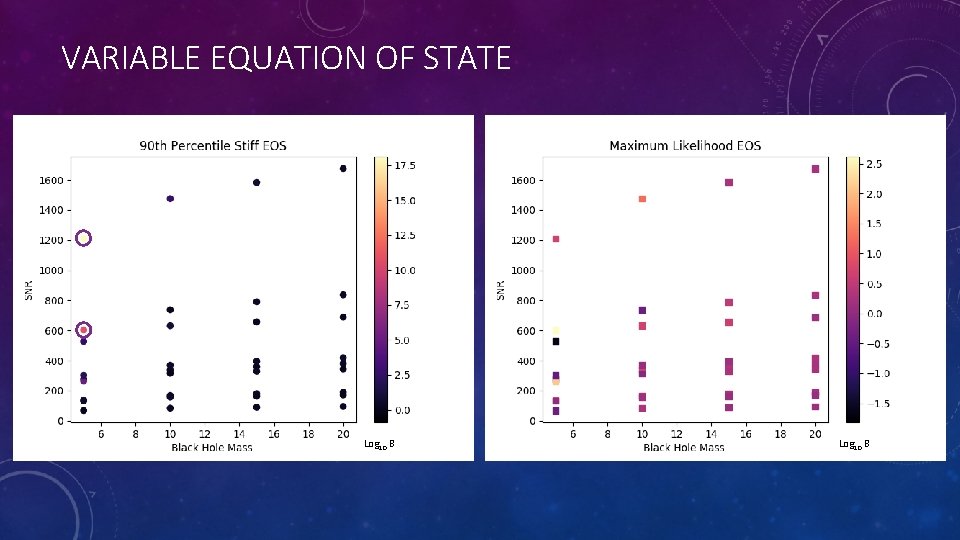
VARIABLE EQUATION OF STATE Log 10 B
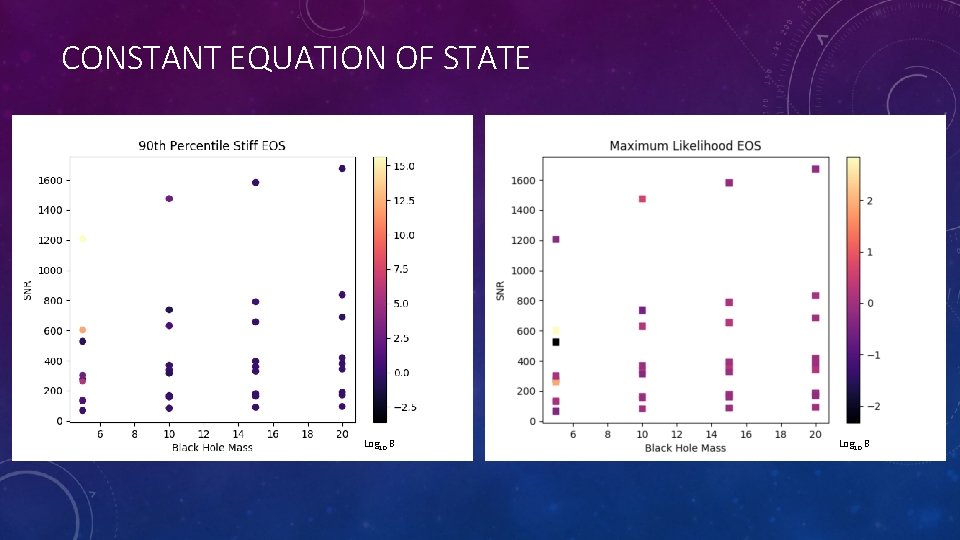
CONSTANT EQUATION OF STATE Log 10 B
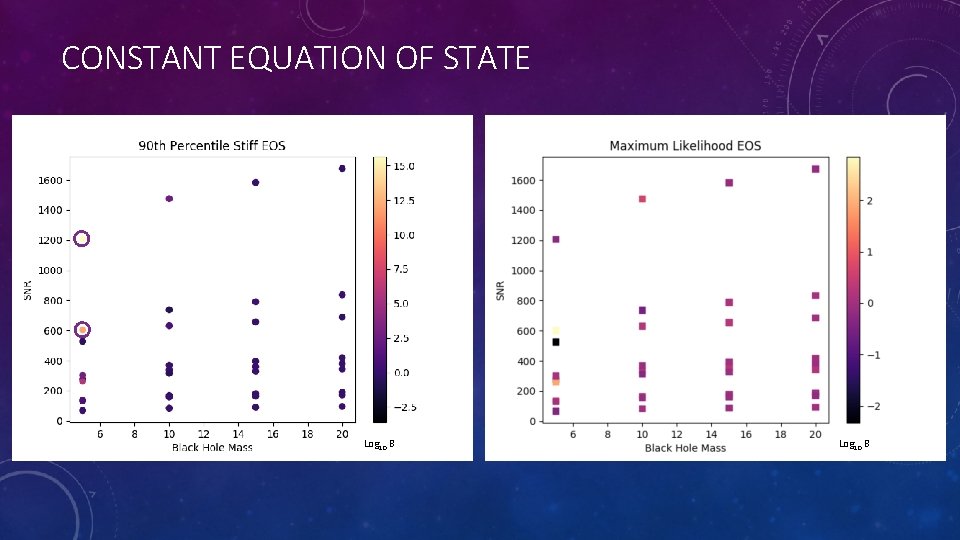
CONSTANT EQUATION OF STATE Log 10 B
- Slides: 37