
Using Geo Gebra to Connect Geometry Measurement and
Using Geo. Gebra to Connect Geometry, Measurement, and Algebra for Elementary Learners Florida Council of Teachers of Mathematics Orlando, FL October 20, 2012 Dr. Joseph M. Furner Florida Atlantic University Jupiter, Florida Copyright 2012 Carol A. Marinas, Joseph M. Furner Dr. Carol A. Marinas Barry University Miami Shores, Florida
Research: Students Involved Interactively • NCTM, Piaget, Montesorri, and Burns support mathematics classroom where students are involved and active, constructing their own understanding of mathematical ideas. • Geo. Gebra allows students to actively constructing their own understanding of geometry, measurement, and algebra! Copyright 2012 Carol A. Marinas, Joseph M. Furner
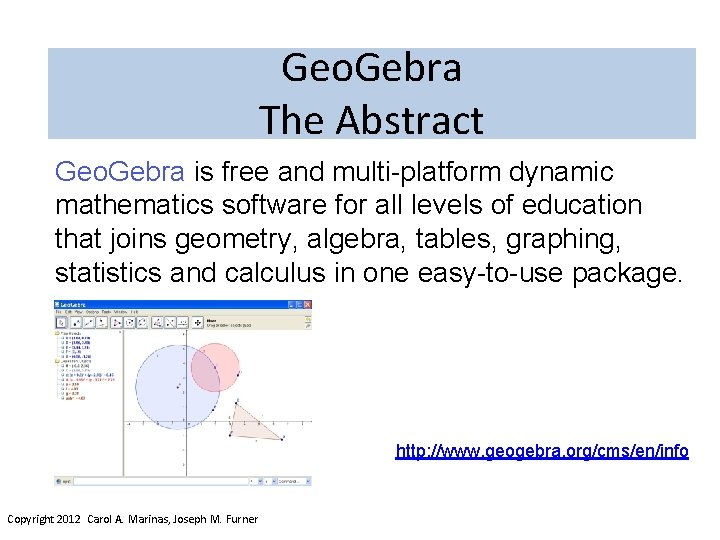
Geo. Gebra The Abstract Geo. Gebra is free and multi-platform dynamic mathematics software for all levels of education that joins geometry, algebra, tables, graphing, statistics and calculus in one easy-to-use package. http: //www. geogebra. org/cms/en/info Copyright 2012 Carol A. Marinas, Joseph M. Furner
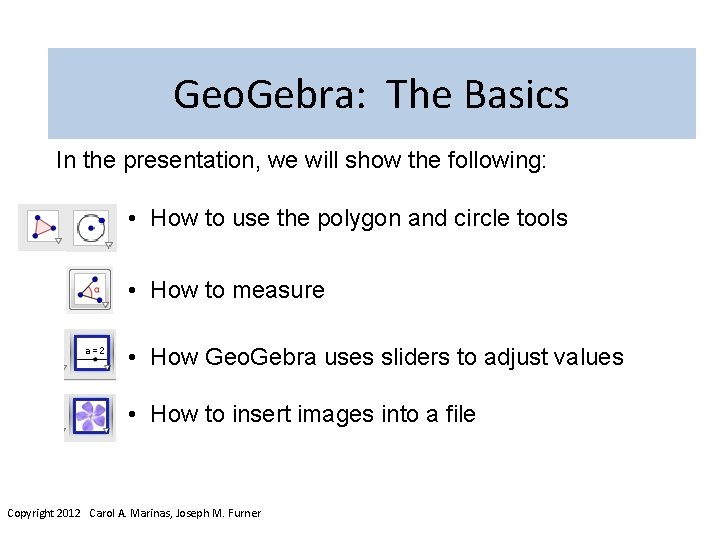
Geo. Gebra: The Basics In the presentation, we will show the following: • How to use the polygon and circle tools • How to measure • How Geo. Gebra uses sliders to adjust values • How to insert images into a file Copyright 2012 Carol A. Marinas, Joseph M. Furner
Using Technology to Teach Math of NCTM’s Principles for Teaching Technology and Mathematics: Get Connected ! Use of technological tools, students can : • work at higher levels of generalization • model and solve complex problems • focus on decision-making and reasoning Mathematical power can arise from technology that includes : • increased opportunity for learning • increased opportunities for real-life social contexts • orientation to the future Copyright 2012 Carol A. Marinas, Joseph M. Furner
Using Technology to Teach Math of NCTM’s Principles for Teaching The focus is to : • promote technology as an essential tool for learning mathematics in the 21 st century • integrate the principles and process standards with teaching the content standards • provide access to all five mathematics content standards for all students. • support learner-centered strategies that address the diverse needs of all learners of mathematics Effective teachers maximize the potential of technology to : • develop students’ understanding • stimulate their interest • increase their proficiency in mathematics Copyright 2012 Carol A. Marinas , Joseph M. Furner
Standards for Quadrilaterals Common Core Math Standards http: //www. corestandards. org/ Grade 3 Geometric measurement: recognize perimeter as an attribute of plane figures and distinguish between linear and area measures. Reason with shapes and their attributes. 3. G. 1. Understand that shapes in different categories (e. g. , rhombuses, rectangles, and others) may share attributes (e. g. , having four sides), and that the shared attributes can define a larger category (e. g. , quadrilaterals). Recognize rhombuses, rectangles, and squares as examples of quadrilaterals, and draw examples of quadrilaterals that do not belong to any of these subcategories. 3. G. 2. Partition shapes into parts with equal areas. Express the area of each part as a unit fraction of the whole. For example, partition a shape into 4 parts with equal area, and describe the area of each part as 1/4 of the area of the shape. Copyright 2012 Carol A. Marinas, Joseph M. Furner
Standards on Triangles Common Core Math Standards http: //www. corestandards. org/ Grades 6 6. G. 1. Find the area of right triangles, other triangles, special quadrilaterals, and polygons by composing into rectangles or decomposing into triangles and other shapes; apply these techniques in the context of solving real-world and mathematical problems. 6. G. 3. Draw polygons in the coordinate plane given coordinates for the vertices; use coordinates to find the length of a side joining points with the same first coordinate or the same second coordinate. Apply these techniques in the context of solving real-world and mathematical problems. Copyright 2012 Carol A. Marinas, Joseph M. Furner
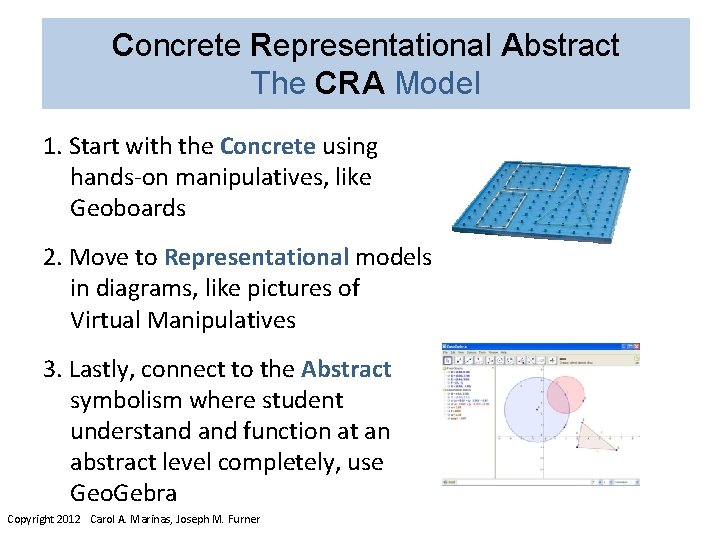
Concrete Representational Abstract The CRA Model 1. Start with the Concrete using hands-on manipulatives, like Geoboards 2. Move to Representational models in diagrams, like pictures of Virtual Manipulatives 3. Lastly, connect to the Abstract symbolism where student understand function at an abstract level completely, use Geo. Gebra Copyright 2012 Carol A. Marinas, Joseph M. Furner
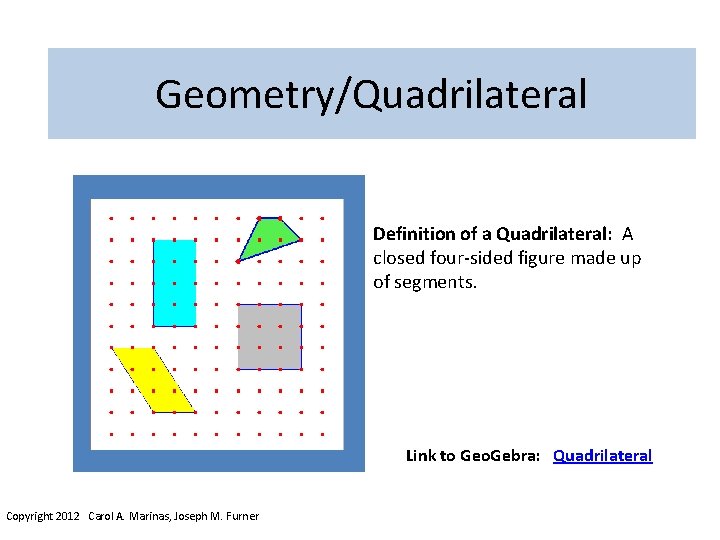
Geometry/Quadrilateral Definition of a Quadrilateral: A closed four-sided figure made up of segments. Link to Geo. Gebra: Quadrilateral Copyright 2012 Carol A. Marinas, Joseph M. Furner
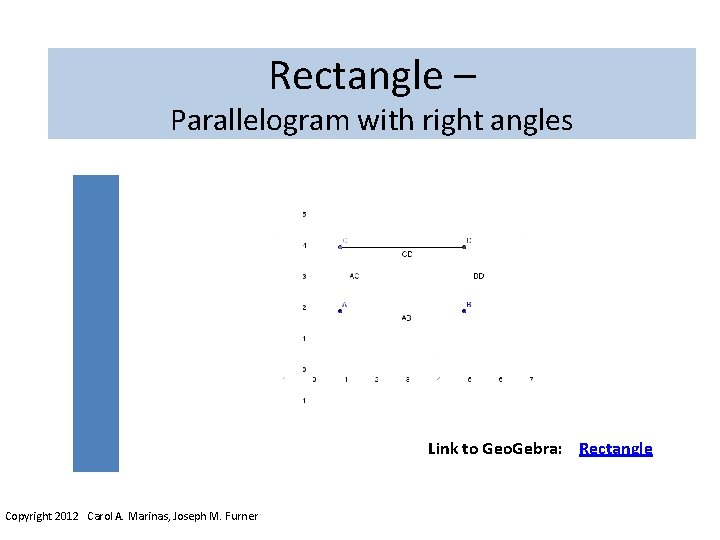
Rectangle – Parallelogram with right angles Link to Geo. Gebra: Rectangle Copyright 2012 Carol A. Marinas, Joseph M. Furner
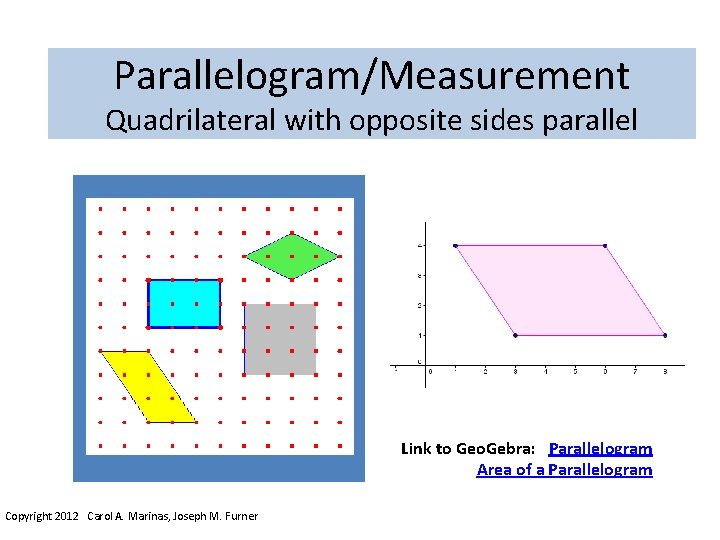
Parallelogram/Measurement Quadrilateral with opposite sides parallel Link to Geo. Gebra: Parallelogram Area of a Parallelogram Copyright 2012 Carol A. Marinas, Joseph M. Furner
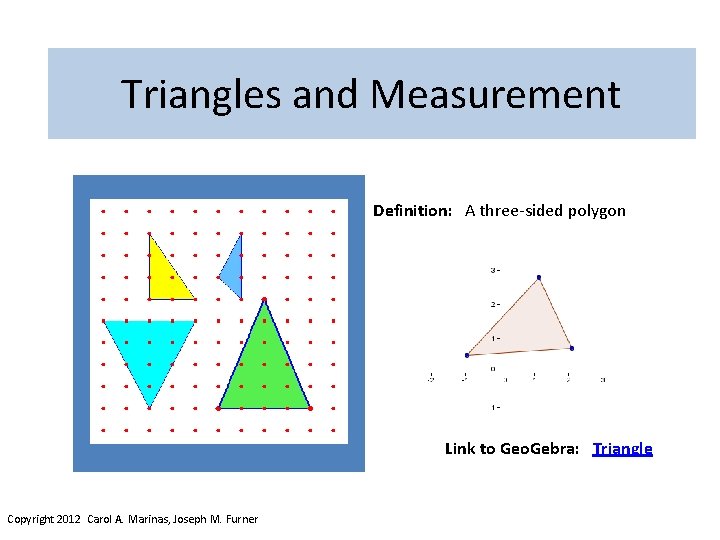
Triangles and Measurement Definition: A three-sided polygon Link to Geo. Gebra: Triangle Copyright 2012 Carol A. Marinas, Joseph M. Furner
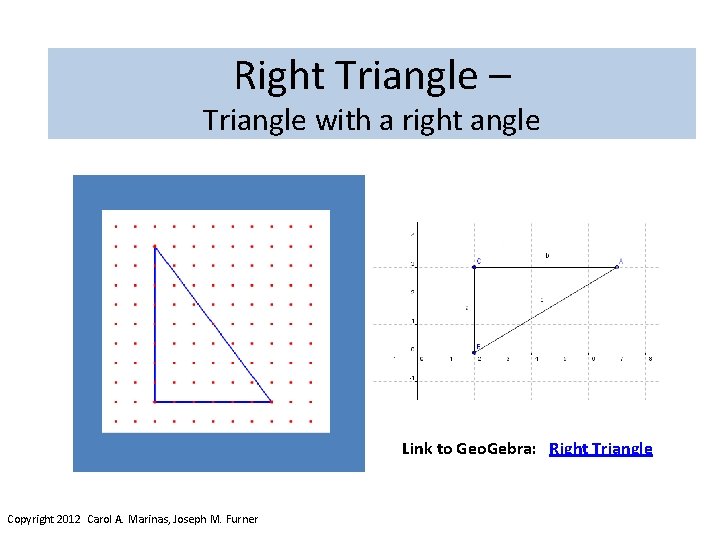
Right Triangle – Triangle with a right angle Link to Geo. Gebra: Right Triangle Copyright 2012 Carol A. Marinas, Joseph M. Furner
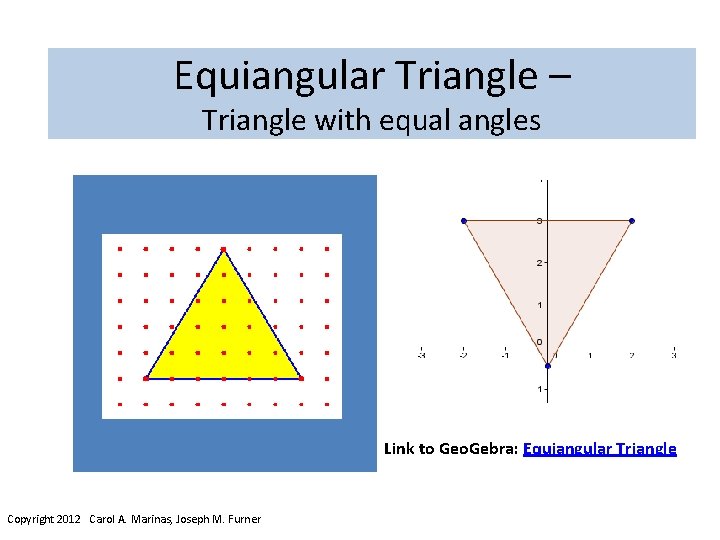
Equiangular Triangle – Triangle with equal angles Link to Geo. Gebra: Equiangular Triangle Copyright 2012 Carol A. Marinas, Joseph M. Furner
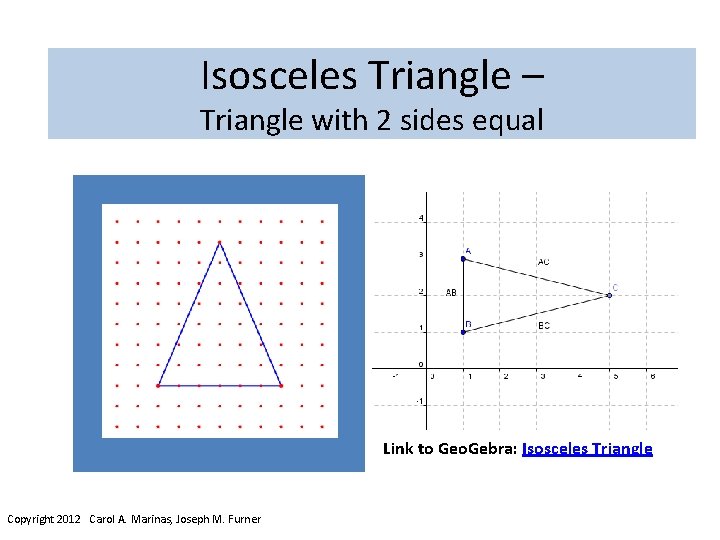
Isosceles Triangle – Triangle with 2 sides equal Link to Geo. Gebra: Isosceles Triangle Copyright 2012 Carol A. Marinas, Joseph M. Furner
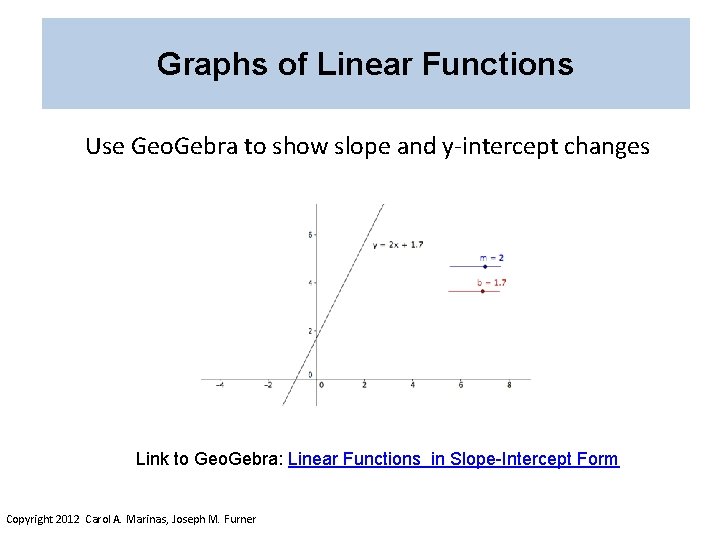
Graphs of Linear Functions Use Geo. Gebra to show slope and y-intercept changes Link to Geo. Gebra: Linear Functions in Slope-Intercept Form Copyright 2012 Carol A. Marinas, Joseph M. Furner
Math Problem Solving • NCTM has advocated problem solving as the central theme of the math curriculum for many years now. • We suggest that students use Geo. Gebra to solve their word problems using the software the demonstrate understanding of the mathematics. • Students can do weekly problem solving in groups or alone using the Geo. Gebra software. Copyright 2012 Carol A. Marinas, Joseph M. Furner
Example Math Problem using Geometry, Measurement, & Algebra Example : On Japanese trains, there is a rule that forbids passengers bringing onto the train objects longer than 36 inches. How did a passenger travel with a ceremonial sword that was 42 inches long? Discuss strategies and solutions. Copyright 2012 Carol A. Marinas, Joseph M. Furner
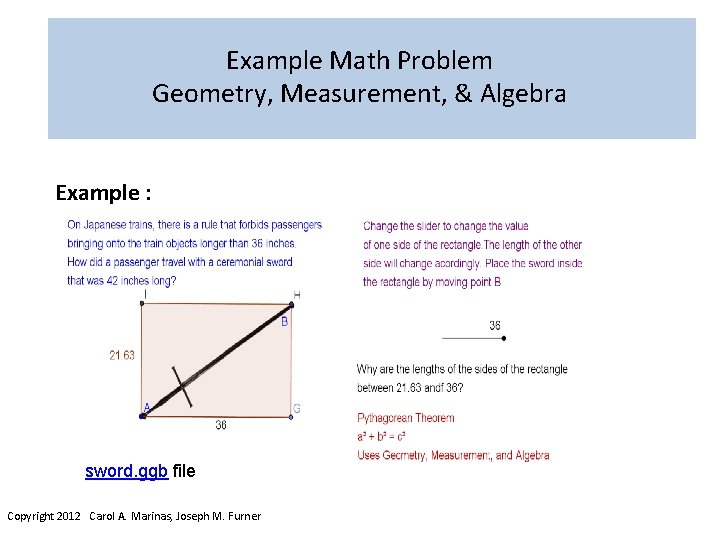
Example Math Problem Geometry, Measurement, & Algebra Example : sword. ggb file Copyright 2012 Carol A. Marinas, Joseph M. Furner
Algebra – Connections from Geometry & Measurement • Everything that is Geometric we want to measure! • All measurements can by synthesized into formulas that use algebra and algebraic expressions! Copyright 2012 Carol A. Marinas, Joseph M. Furner
Having Fun with Geo. Gebra How to construct geometric shapes with Geo. Gebra ! Copyright 2012 Carol A. Marinas, Joseph M. Furner
Geo. Gebra Resources • Provides many resources and teaching tools at its wiki for educators at: http: //wiki. geogebra. org/en • • • Addition of Integers Addition of Fractions Venn Diagrams Relationship between Perimeter and Area Tangrams Design #1 and Design #2 Copyright 2012 Carol A. Marinas, Joseph M. Furner
So why should we use Geo. Gebra? A Summary Free download. Go to geogebra. org Up and coming dynamic teaching tool in schools. User-friendly for students and teachers. Great connect from the hands-on Geoboards to virtual Geoboards to something a more abstract. • Provides many resources and teaching tools at its wiki for educators at: http: //wiki. geogebra. org/en • Can even be used for primary-aged students. • • Copyright 2012 Carol A. Marinas, Joseph M. Furner
Thanks for coming to our Presentation! Power. Point and Data Files: http: //matharoundus. com/geogebra Contact Information: Dr. Joseph M. Furner (Florida Atlantic University) jfurner@fau. edu Dr. Carol A. Marinas (Barry University) drmarinas@yahoo. com Copyright 2012 Carol A. Marinas, Joseph M. Furner
- Slides: 25