
Using Formulas and Literal Equations Section 3 6
- Slides: 8
Using Formulas and Literal Equations Section 3. 6 Solve literal equations for a specific variable and use formulas to solve problems.
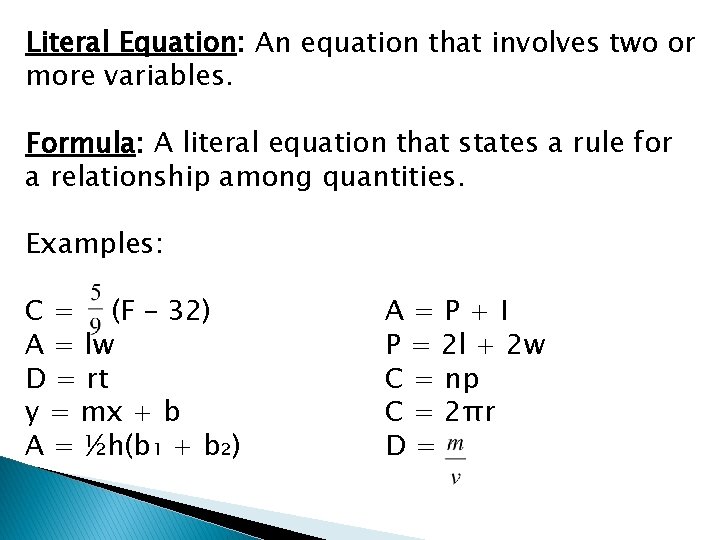
Literal Equation: An equation that involves two or more variables. Formula: A literal equation that states a rule for a relationship among quantities. Examples: C = (F – 32) A = lw D = rt y = mx + b A = ½h(b₁ + b₂) A=P+I P = 2 l + 2 w C = np C = 2πr D=
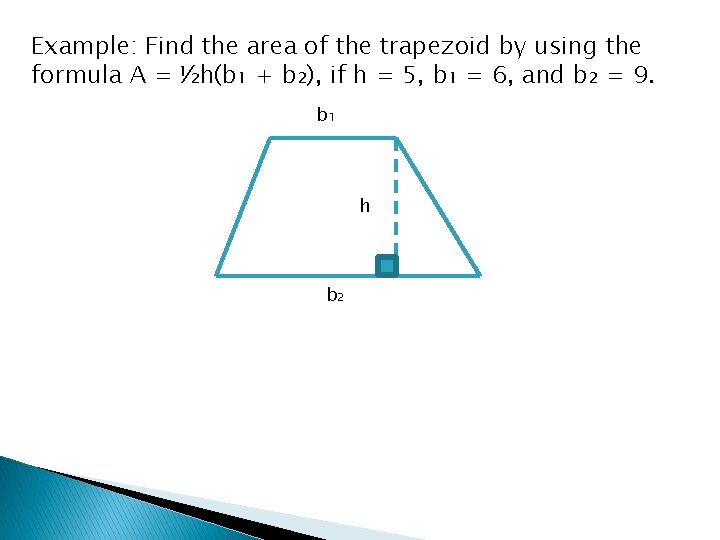
Example: Find the area of the trapezoid by using the formula A = ½h(b₁ + b₂), if h = 5, b₁ = 6, and b₂ = 9. b₁ h b₂
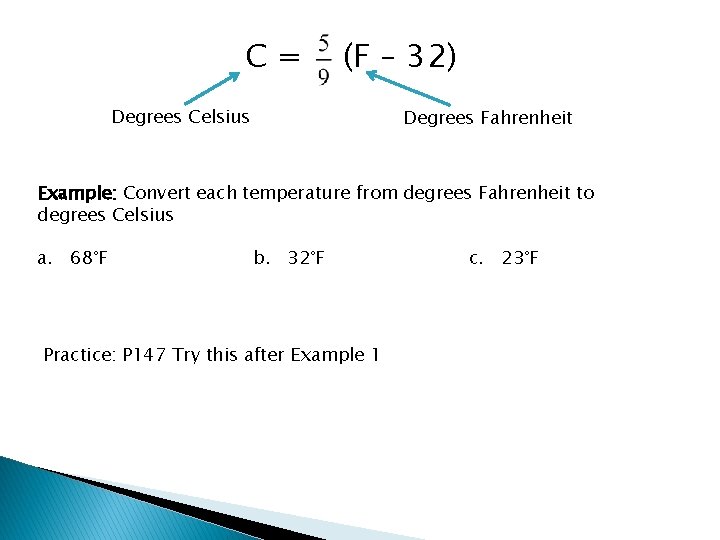
C= (F – 32) Degrees Celsius Degrees Fahrenheit Example: Convert each temperature from degrees Fahrenheit to degrees Celsius a. 68°F b. 32°F Practice: P 147 Try this after Example 1 c. 23°F
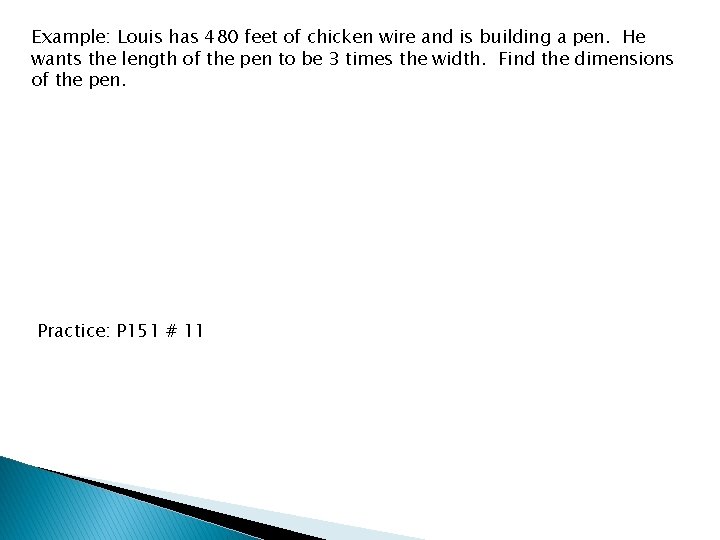
Example: Louis has 480 feet of chicken wire and is building a pen. He wants the length of the pen to be 3 times the width. Find the dimensions of the pen. Practice: P 151 # 11
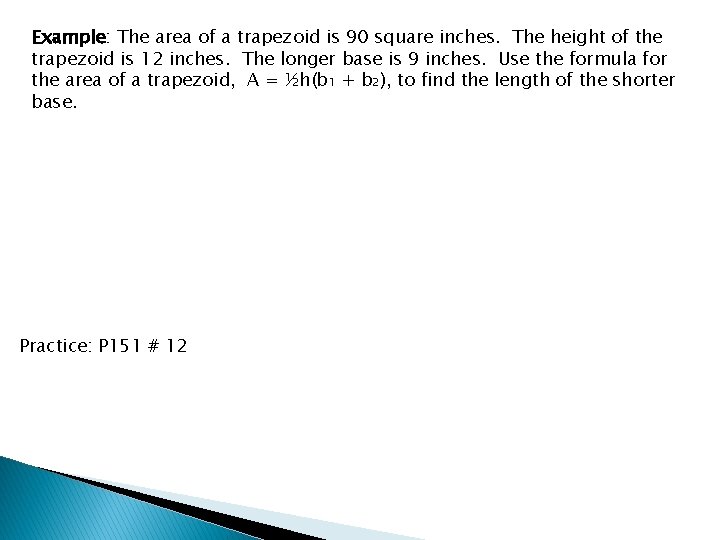
Example: The area of a trapezoid is 90 square inches. The height of the trapezoid is 12 inches. The longer base is 9 inches. Use the formula for the area of a trapezoid, A = ½h(b₁ + b₂), to find the length of the shorter base. Practice: P 151 # 12
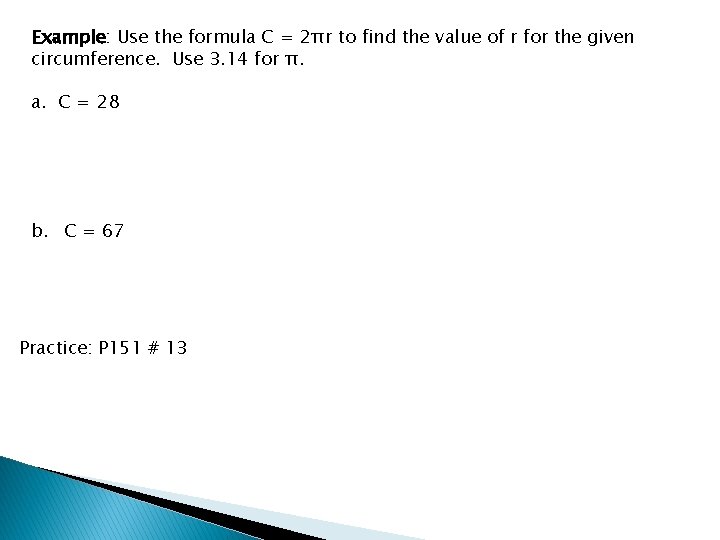
Example: Use the formula C = 2πr to find the value of r for the given circumference. Use 3. 14 for π. a. C = 28 b. C = 67 Practice: P 151 # 13
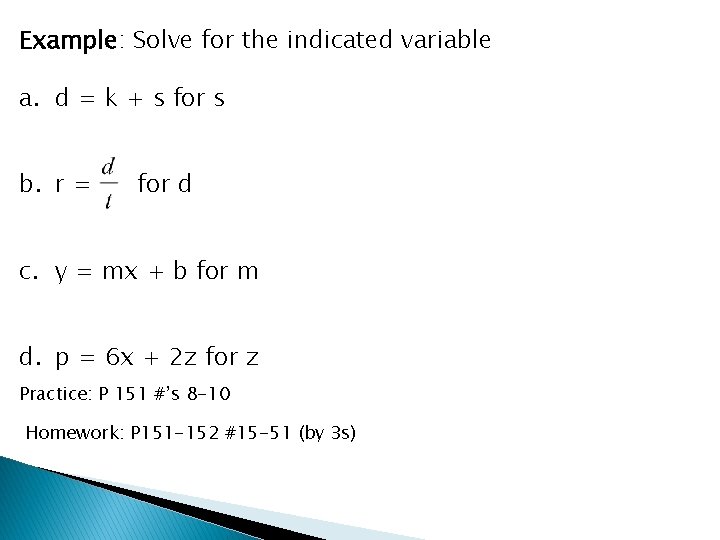
Example: Solve for the indicated variable a. d = k + s for s b. r = for d c. y = mx + b for m d. p = 6 x + 2 z for z Practice: P 151 #’s 8 -10 Homework: P 151 -152 #15 -51 (by 3 s)