
Using Formative Research to create a learning environment
- Slides: 27
Using Formative Research to create a learning environment to inform education policy implementation and educational system regeneration in Africa presented by Kathryn TOURE, Education Research Network for West and Central Africa (ERNWACA) 27 March 2006 Seminar of Working Group on Education Sector Analysis (WGESA) ADEA Biennale, Libreville, Gabon + 17 October 2006 Rencontres ROCARE Ouagadougou, Burkina Faso
WGESA strategies WGESA = ADEA Working Group on Education Sector Analysis Renewed Sector Analysis: beyond planning to implementation n Peer reviews and formative research n Africanization: n – deeper appropriation of sector analysis – national and regional capacity among individuals and within institutions – more local shaping of issues and approaches Formative Research, WGESA / October 2006 - 2
What is formative research? Assessment tool to modify and improve policies, programs, or products during their planning, development, implementation. Formative Research, WGESA / October 2006 - 3
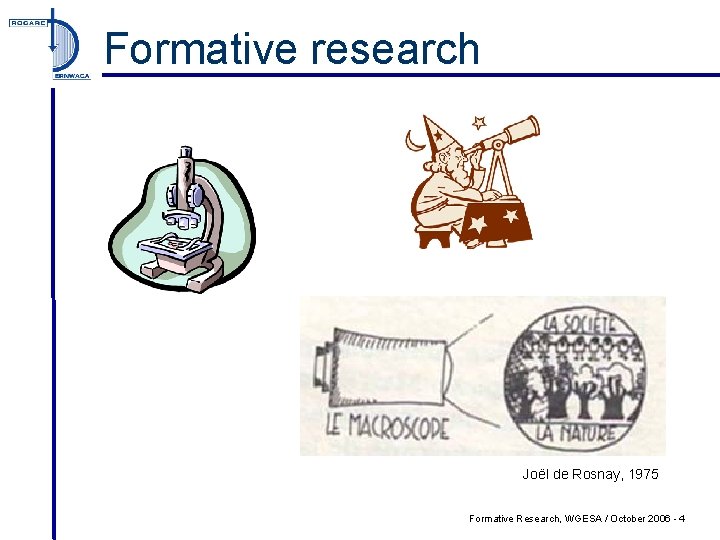
Formative research Joël de Rosnay, 1975 Formative Research, WGESA / October 2006 - 4
What is formative research? Proscriptive rather than descriptive n Entails asking: - What methods worked well? n - What did not work well? - How can implementation be improved? - How can theory informing the policy, and the policy itself, be improved? n Involves “finding out together” Formative Research, WGESA / October 2006 - 5
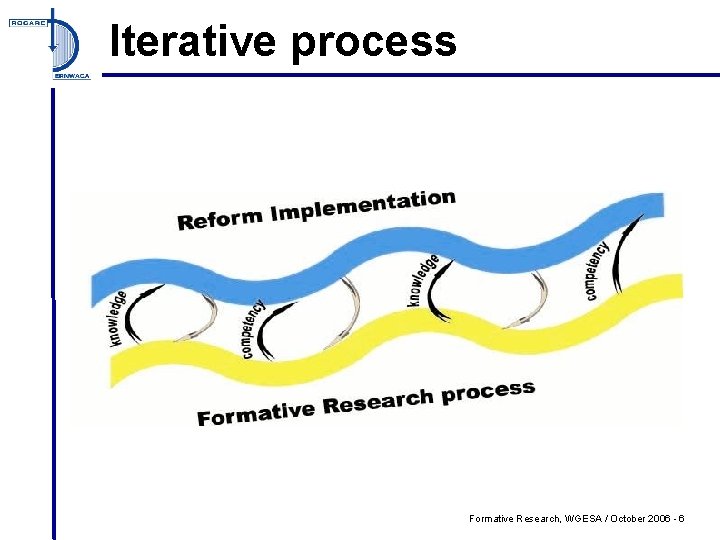
Iterative process Formative Research, WGESA / October 2006 - 6
ERNWACA / ROCARE countries with sector programs (examples) n n n n Burkina Faso: Plan décennal de l’éducation de base (PDDEB), 2001 -2010 Gambia: National Education Policy, 2004 -2015; developed via highly participatory process Ghana: Free Compulsory Universal Basic Education (FCUBE) Program, 1995 -2005 Mali: Programme Décennal de l’Education (PRODEC), 1998 -2008 Niger: Programme Décennal de Développement de l’Education (PDDE), 2003 -2013 Nigeria: Universal Basic Education program Sénégal: Programme Décennal de l’Éducation et de la Formation (PDEF), 2000 -2010 Formative Research, WGESA / October 2006 - 7
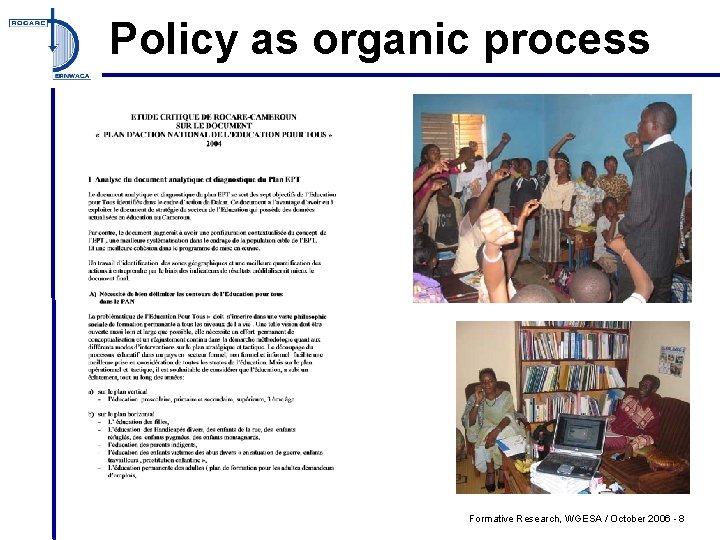
Policy as organic process Formative Research, WGESA / October 2006 - 8
Why use formative research? n Improve program implementation n Reduce policy failure Formative Research, WGESA / October 2006 - 9
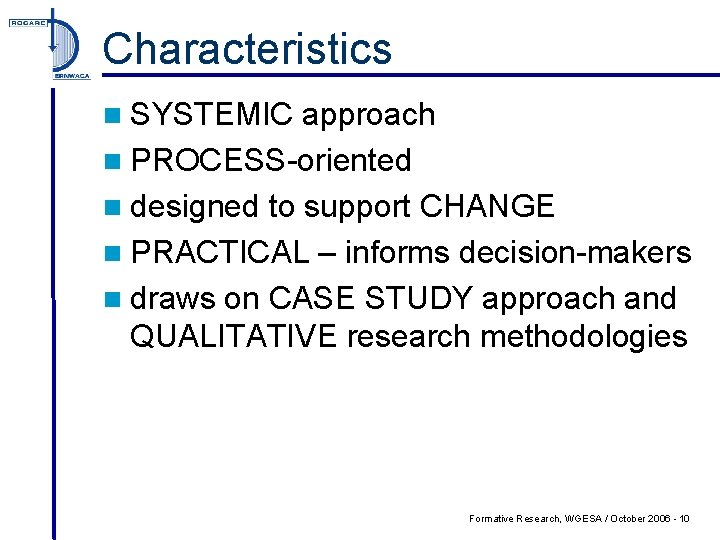
Characteristics n SYSTEMIC approach n PROCESS-oriented n designed to support CHANGE n PRACTICAL – informs decision-makers n draws on CASE STUDY approach and QUALITATIVE research methodologies Formative Research, WGESA / October 2006 - 10
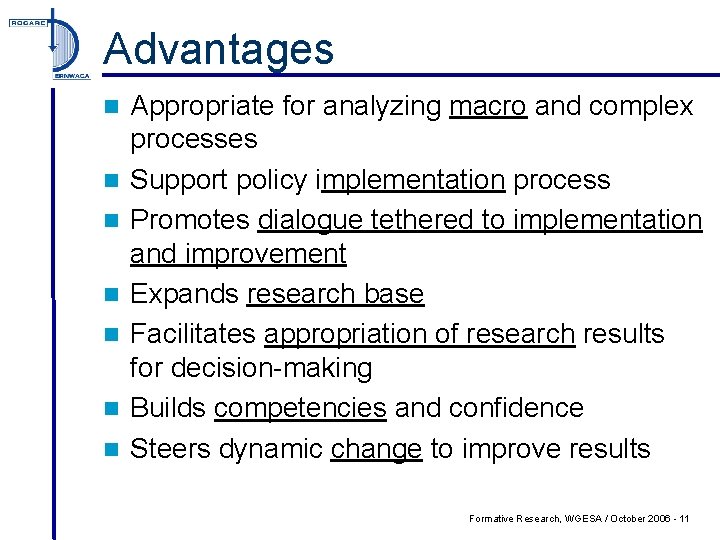
Advantages n n n n Appropriate for analyzing macro and complex processes Support policy implementation process Promotes dialogue tethered to implementation and improvement Expands research base Facilitates appropriation of research results for decision-making Builds competencies and confidence Steers dynamic change to improve results Formative Research, WGESA / October 2006 - 11
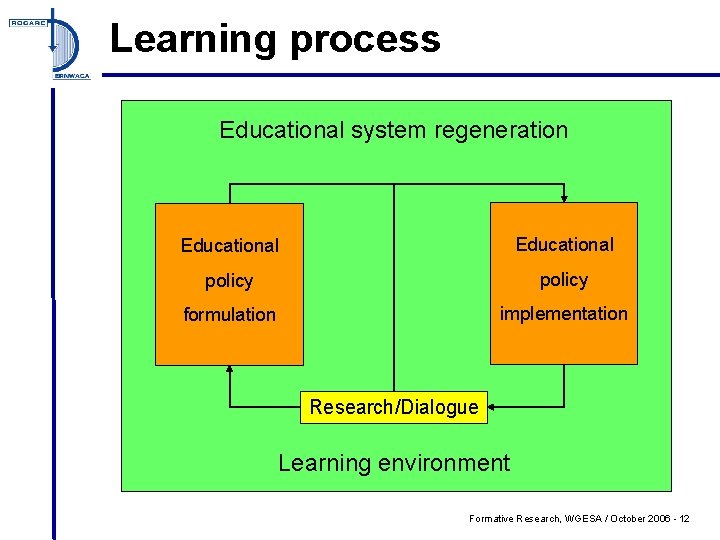
Learning process Educational system regeneration Educational policy formulation implementation Research/Dialogue Learning environment Formative Research, WGESA / October 2006 - 12
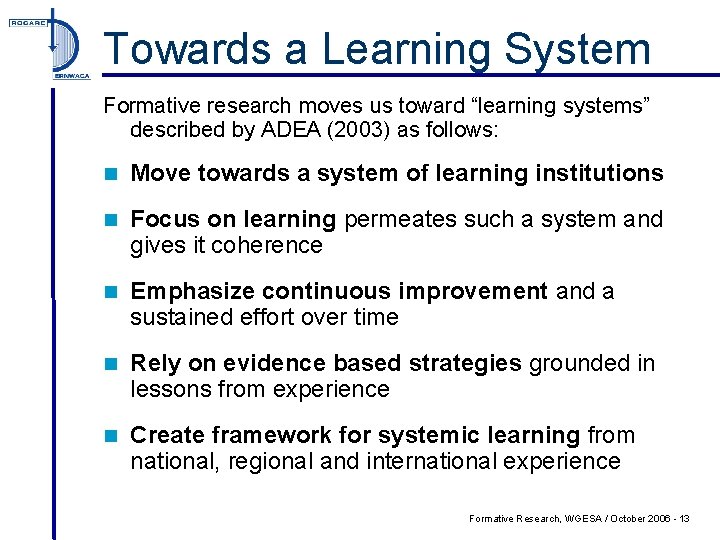
Towards a Learning System Formative research moves us toward “learning systems” described by ADEA (2003) as follows: n Move towards a system of learning institutions n Focus on learning permeates such a system and gives it coherence n Emphasize continuous improvement and a sustained effort over time n Rely on evidence based strategies grounded in lessons from experience n Create framework for systemic learning from national, regional and international experience Formative Research, WGESA / October 2006 - 13
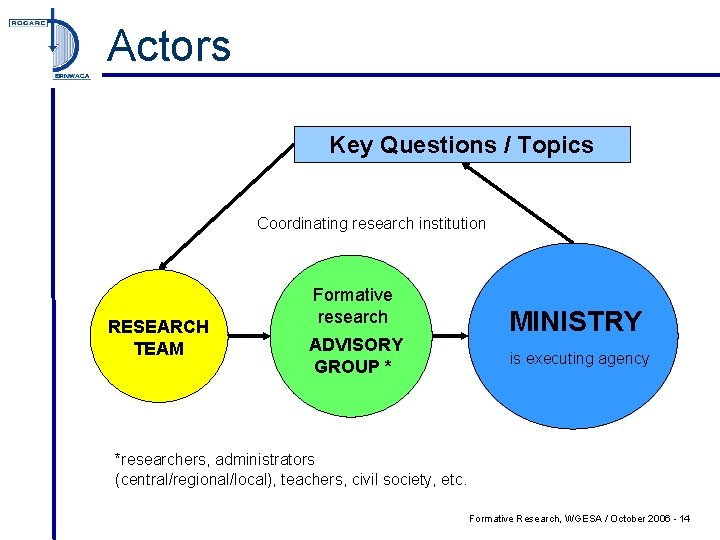
Actors Key Questions / Topics Coordinating research institution RESEARCH TEAM Formative research ADVISORY GROUP * MINISTRY is executing agency *researchers, administrators (central/regional/local), teachers, civil society, etc. Formative Research, WGESA / October 2006 - 14
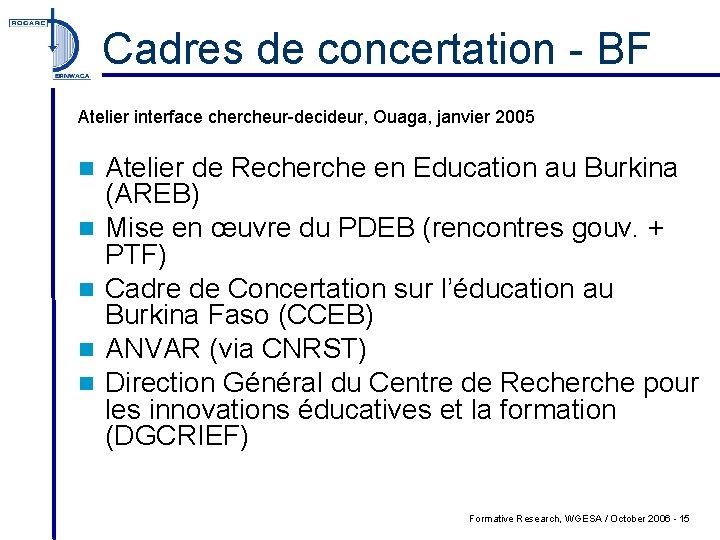
Cadres de concertation - BF Atelier interface chercheur-decideur, Ouaga, janvier 2005 n n n Atelier de Recherche en Education au Burkina (AREB) Mise en œuvre du PDEB (rencontres gouv. + PTF) Cadre de Concertation sur l’éducation au Burkina Faso (CCEB) ANVAR (via CNRST) Direction Général du Centre de Recherche pour les innovations éducatives et la formation (DGCRIEF) Formative Research, WGESA / October 2006 - 15
Requires specific skills n Human resource management n Negotiation n Communication Formative Research, WGESA / October 2006 - 16
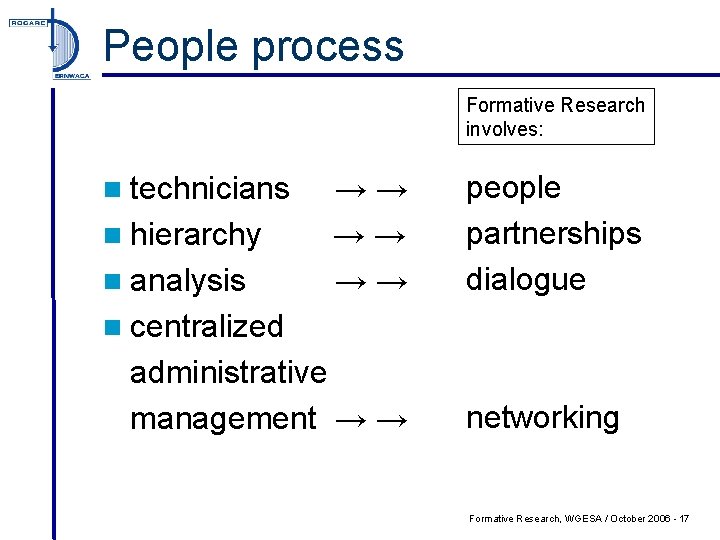
People process Formative Research involves: n technicians n hierarchy n analysis →→ →→ →→ people partnerships dialogue n centralized administrative management → → networking Formative Research, WGESA / October 2006 - 17
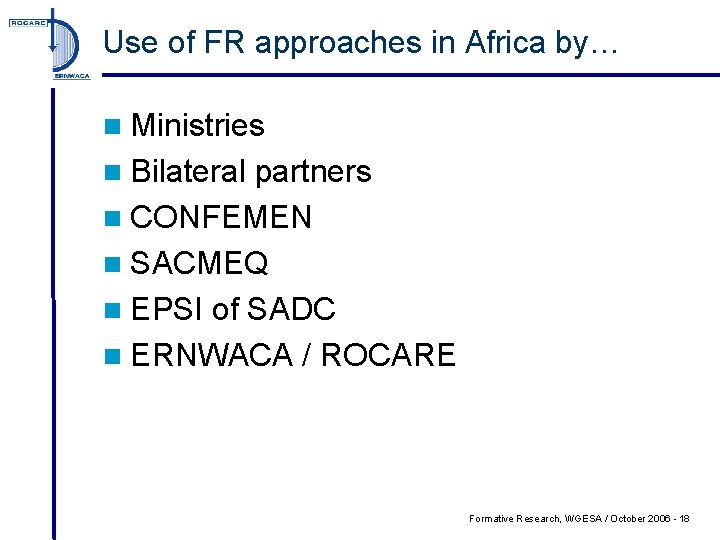
Use of FR approaches in Africa by… n Ministries n Bilateral partners n CONFEMEN n SACMEQ n EPSI of SADC n ERNWACA / ROCARE Formative Research, WGESA / October 2006 - 18
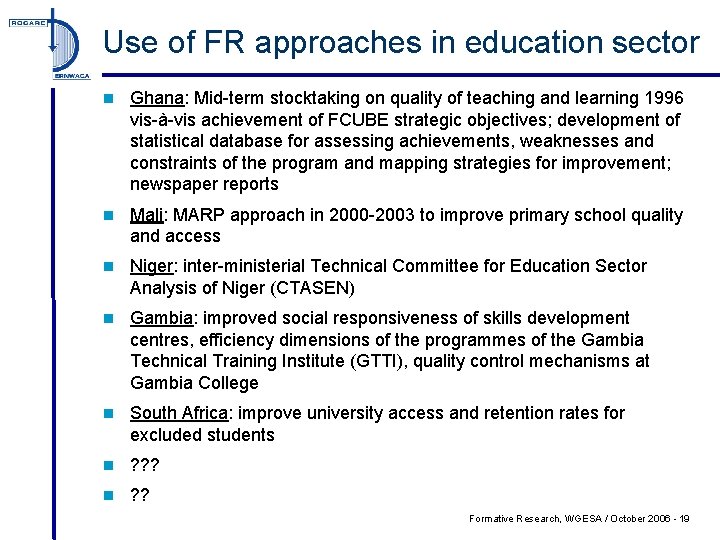
Use of FR approaches in education sector n Ghana: Mid-term stocktaking on quality of teaching and learning 1996 vis-à-vis achievement of FCUBE strategic objectives; development of statistical database for assessing achievements, weaknesses and constraints of the program and mapping strategies for improvement; newspaper reports n Mali: MARP approach in 2000 -2003 to improve primary school quality and access n Niger: inter-ministerial Technical Committee for Education Sector Analysis of Niger (CTASEN) n Gambia: improved social responsiveness of skills development centres, efficiency dimensions of the programmes of the Gambia Technical Training Institute (GTTI), quality control mechanisms at Gambia College n South Africa: improve university access and retention rates for excluded students n ? ? ? n ? ? Formative Research, WGESA / October 2006 - 19
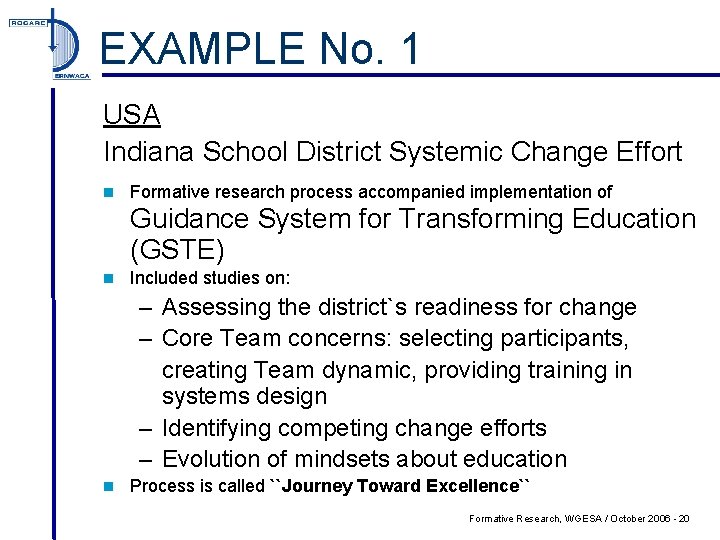
EXAMPLE No. 1 USA Indiana School District Systemic Change Effort n Formative research process accompanied implementation of Guidance System for Transforming Education (GSTE) n Included studies on: – Assessing the district`s readiness for change – Core Team concerns: selecting participants, creating Team dynamic, providing training in systems design – Identifying competing change efforts – Evolution of mindsets about education n Process is called ``Journey Toward Excellence`` Formative Research, WGESA / October 2006 - 20
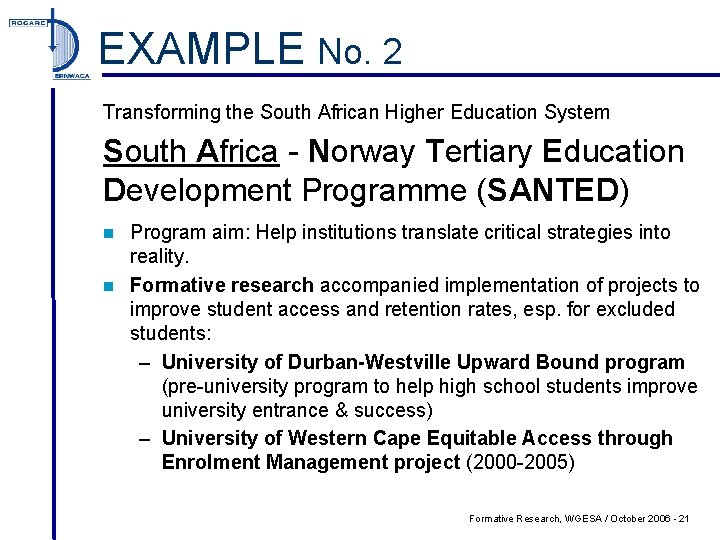
EXAMPLE No. 2 Transforming the South African Higher Education System South Africa - Norway Tertiary Education Development Programme (SANTED) Program aim: Help institutions translate critical strategies into reality. n Formative research accompanied implementation of projects to improve student access and retention rates, esp. for excluded students: – University of Durban-Westville Upward Bound program (pre-university program to help high school students improve university entrance & success) – University of Western Cape Equitable Access through Enrolment Management project (2000 -2005) n Formative Research, WGESA / October 2006 - 21
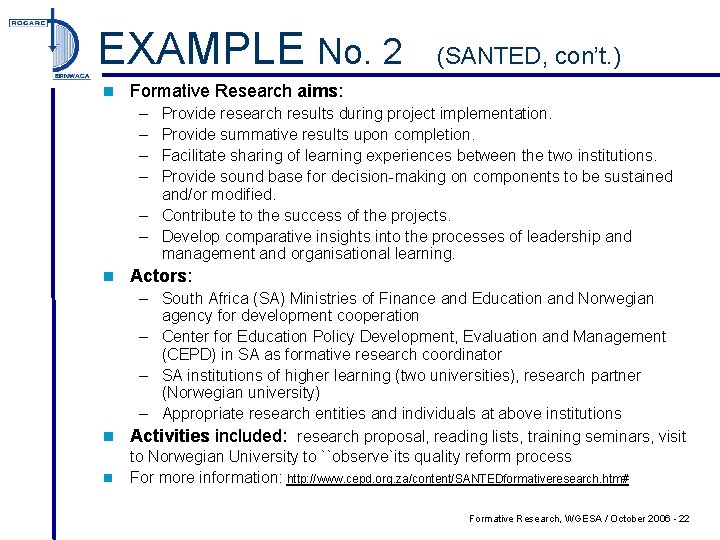
EXAMPLE No. 2 n (SANTED, con’t. ) Formative Research aims: – – Provide research results during project implementation. Provide summative results upon completion. Facilitate sharing of learning experiences between the two institutions. Provide sound base for decision-making on components to be sustained and/or modified. – Contribute to the success of the projects. – Develop comparative insights into the processes of leadership and management and organisational learning. n Actors: – South Africa (SA) Ministries of Finance and Education and Norwegian agency for development cooperation – Center for Education Policy Development, Evaluation and Management (CEPD) in SA as formative research coordinator – SA institutions of higher learning (two universities), research partner (Norwegian university) – Appropriate research entities and individuals at above institutions n Activities included: research proposal, reading lists, training seminars, visit to Norwegian University to ``observe`its quality reform process n For more information: http: //www. cepd. org. za/content/SANTEDformativeresearch. htm# Formative Research, WGESA / October 2006 - 22
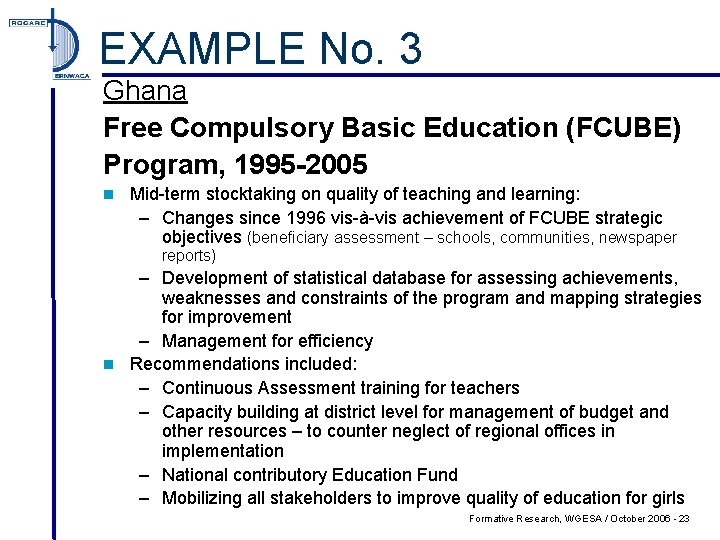
EXAMPLE No. 3 Ghana Free Compulsory Basic Education (FCUBE) Program, 1995 -2005 n Mid-term stocktaking on quality of teaching and learning: – Changes since 1996 vis-à-vis achievement of FCUBE strategic objectives (beneficiary assessment – schools, communities, newspaper reports) – Development of statistical database for assessing achievements, weaknesses and constraints of the program and mapping strategies for improvement – Management for efficiency n Recommendations included: – Continuous Assessment training for teachers – Capacity building at district level for management of budget and other resources – to counter neglect of regional offices in implementation – National contributory Education Fund – Mobilizing all stakeholders to improve quality of education for girls Formative Research, WGESA / October 2006 - 23
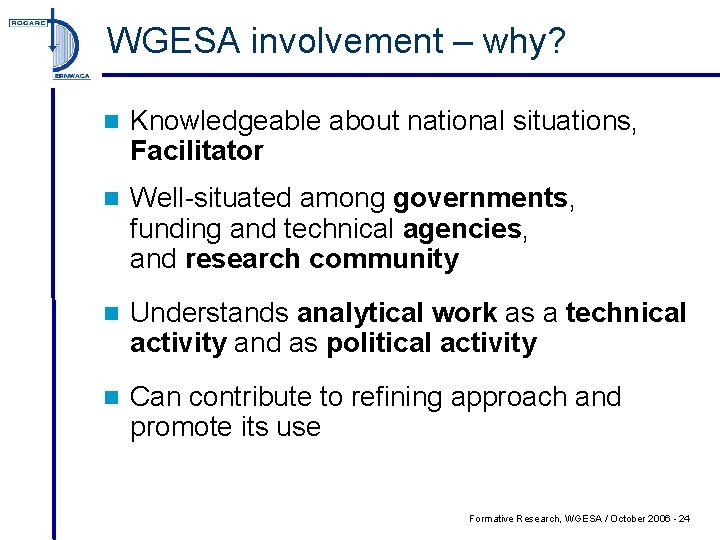
WGESA involvement – why? n Knowledgeable about national situations, Facilitator n Well-situated among governments, funding and technical agencies, and research community n Understands analytical work as a technical activity and as political activity n Can contribute to refining approach and promote its use Formative Research, WGESA / October 2006 - 24
Where to start? n Foundation – study existing examples of FR – capacity for communities – consensus on concerns – resource mobilization n Experimentation: small scale learn-by-doing n Expansion: building on lessons learned… Formative Research, WGESA / October 2006 - 25
Bibliography § ADEA (2003). Le defi de l’apprentissage: ameliorer la qualite de l’education de base en Afrique subsaharienne. Document de travail en cours d’elaboration. § Bennett, Yves & Maikaireh N’Jie (2004). Formative Research in The Gambia, ERNWACA-Gambia, 26 pp. § Breier, Mignonne (University of the Western Cape, South Africa) (2002). Some reflections on the South African visit to Bergen (Norway) as part of the SANTED formative research project, prepared for SANTED Seminar Proceedings. § Chevrier, Jacques (1994). La recherche en education comme source de changement. Les Editions LOGIQUE, Montréal (Québec), Canada. § Feldberg, Karen and K. Tornes (2002). Sector Wide Approach Programmes in the Development of the Education Sector: From Project to Process and Partnership. Oslo: Norwegian Ministry of Education and Research. § Journey Toward Excellence: A systemic change effort in the metropolitan school district of Decatur Township, Indianapolis, Indiana, USA, facilitated by Indiana University, http: //www. indiana. edu/~ syschang/decatur/formative_research. htm § Kremmerer, Frances (1994). L’analyse sectorielle de l’education et ses utilisations, UNESCO/IIPE, Paris, France. § Namata, Issa; Youssouf Adam; Ernest Ilboudo Mwalimu J. Malale (2005). Report on WGESA International Seminar on Formative Research, Niamey, Niger. § Obanya, Pai (2005). The PAF Approach To Research And Development In Education, ERNWACA-Nigeria, First Annual Café: 17 February 2005, Lagos, Nigeria. § Obanya, Pai ; Paulin Hountondji (2005). Informing Education Policy Development through Formative Research. White paper for ADEA Working Group on Education Sector Analysis (WGESA), Paris, France. § Obanya, Pai and Kathryn Touré (2003). Emerging Trends in Research on the Quality of Education: A synthesis of educational research reviews from 1992 -2002 in eleven countries of West and Central Africa. ERNWACA for ADEA. Bamako, Mali. § Reigeluth, Charles M. and Theodore W. Frick (1999). Formative Research: A Methodology for Creating and Improving Design Theories. In C. M. Reigeluch (ed. ), Instructional-Design Theories and Models: A New Paradigm of Instructional Theory. (Volume II). Hillsdale, NJ: Lawrence Erlbaum Assoc. § Revue Canadienne d’Evaluation de Programmes (bilingues) § Savoie-Zajc, Lorraine (1993). Les modeles de changement planifié en education, Les Editions LOGIQUES, Montréal (Québec), Canada. § Tornes, Kristen (2003). A Model for Formative Research, based on experiences from the cooperation between Norwegian and Nepalese ministries of education. Report to NORAD, Norwegian Ministry of Education and Research, 24 pp. § Touré, Harouna (2006). La recherche formative : Un outil de mise en œuvre des politiques éducatives, ROCARE-Mali, Bamako. § Viens, Daniel and James Lynch. Decade of Reform and Innovation in Higher Education in Madagascar: Institutional Capacity. Building in a Development Perspective, World Bank, www. worldbank. org/afr/findings/english/find 159. htm, 4 p. § Voices of Urban Nigerian Youth: Formative Research and Communicating for Change, http: //cfcnigeria. org/CONTENT/ready-ornot/formative_research. htm Formative Research, WGESA / October 2006 - 26
We must demystify research by making it more proactive, participatory and accessible. Alhaji Raheem Gbadamoshi, ERNWACA National Coordinator, Ghana The ERNWACA logo represents the multiplication of voices in the universe, voices which encourage social development by creating new dialogues. Les leçons tirées du passé suggèrent que le renforcement de capacité en recherche et l’analyse des politiques éducatives doivent être poursuivis par une activité continue et soigneusement élaborée. J. M. Sibry Tapsoba, x. CRDI, actuellement à la BAD Formative Research, WGESA / October 2006 - 27