
Using Formative Assessment Effectively in Your Classroom This
- Slides: 15
Using Formative Assessment Effectively in Your Classroom This presentation will equate you with using formative assessment in the classroom. We will look at its definition, and how it can be implemented in your classroom. We will also examine what you should consider when using this assessment, and also what issues may arise. We will look at the benefits formative assessments offer for teachers and students, and finally we will look at three types of formative assessments that you may want to try in your classrooms. This Power. Point presentation was created and submitted for presentation By: Colette Kinsella Barbara Nutter Caroline Wilson
What is meant by Formative Assessment? Formative assessment is part of the instructional process, and when it is incorporated into the classroom can provide the information needed to adjust teaching and learning as they are happening. Simply stated, formative assessments inform both the teacher and the student about a student’s understanding at a point when timely adjustments can be made. These adjustments help ensure that students get standards based learning goals within the specified time frame.
Considerations and Issues Related to Formative Assessment. Why Should I “Consider” Using this? • Since formative assessments are considered part of learning, they do not need to be graded as summative assessments( end-of-course exams, for example) might be. • They serve as “practice” for students, much like a meaningful homework assignment. • They check for understanding along the way and guide teacher instruction. • They provide feedback so students can improve their performance. • They help to differentiate instruction, thereby improving student achievement.
Issues to Consider…… • Teachers may see formative assessments as “one more assessment” to be added to the already extensive list currently used. If it is seen as an “add-on”, it can hamper the implementation process, as it will be one more thing to squeeze into an already full academic calendar. • Since formative assessments have similar features of standards based assessments some teachers may feel they already know this. • Designing formative assessments can be a bit daunting since teachers have been taught to focus on the inputs of teaching, i. e. curriculum, instructional materials, and resources, rather than the output of teaching, i. e. our growth and student growth. Asking for, receiving, and using the results of this assessment requires a partnership between teacher and student. This may necessitate a shift in the traditional role of each. Teachers may find it difficult to allow students to take on a more active role in analyzing their work and the work of peers.
Benefits for Teachers • Teachers are able to determine what standards students already know and to what degree. • Teachers are able to discern what changes or modifications are needed in the instruction so that students can succeed in the upcoming instruction and on future assessments. • Teachers can inform their students about their current progress in order to set personal goals for improvement. • Teachers can create lesson for groups of learners or individual students.
Benefits for Students • • Students are motivated to learn. Students will take responsibility for their own learning. Students will become users of assessments alongside their teachers. Students will learn some life-long lessons such as: goal setting, self -assessment, and self evaluation.
Let’s Look at 3 Formative Assessments You Can Implement in Your Classroom! • A Portfolio is a collection of student work with a common theme or purpose. An interesting note is that portfolio's can be used by students to show they “can do” what is taught. • First, decide on a theme or purpose. As the teacher ask yourself “What do I want my students to learn to apply”? • Next consider what samples you want your students to include in their portfolio. What samples might work best to illustrate the standard or goal in question. Can they use videotapes, pictures illustrations of a product or activity, maybe a testimonial would be beneficial). • You will need to determine how the samples will be selected. Depending on the assignment students may be able to work with their teachers, parents, and the community.
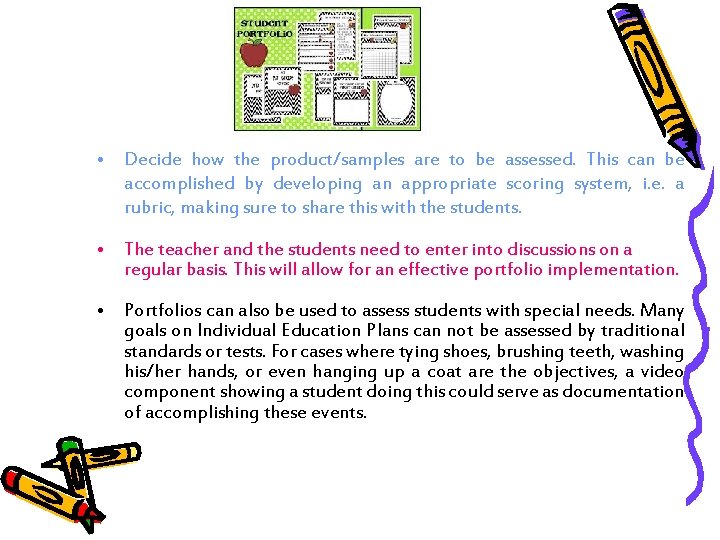
• Decide how the product/samples are to be assessed. This can be accomplished by developing an appropriate scoring system, i. e. a rubric, making sure to share this with the students. • The teacher and the students need to enter into discussions on a regular basis. This will allow for an effective portfolio implementation. • Portfolios can also be used to assess students with special needs. Many goals on Individual Education Plans can not be assessed by traditional standards or tests. For cases where tying shoes, brushing teeth, washing his/her hands, or even hanging up a coat are the objectives, a video component showing a student doing this could serve as documentation of accomplishing these events.
• The use of this technology also validates that teacher effectiveness has been addressed, as it demonstrates that students have met the goals of their IEP’s, and that along with technology other varied techniques are being used in the classroom.
Role Play • Role Play, which is a performances based assessment has been used as a learning tool for quite a while in all content areas, and it offers advantages for both teachers and students. • First, students interest in the topic being addressed will be raised, anytime a student can be an active participant/recipient of the teachers’ wisely words…. It is a bonus. • This type of assessment can also teach empathy to students as they will be taking on the role of a character, learning, and acting as that individual would do in atypical setting. • This can also used by the guidance counselors to teach students about peer pressure and bullying. • The guidelines for assessing the role play must be clearly articulated to the students before the event begins.
• Role play can also be used to introduce a new unit of study, building on the premise of background knowledge, and through the course of study build on that knowledge, while adding new information. • Remember, role play can take on many formats: skits, plays, or even newscasts. • The culminating activity to be shared by all is a discussion of the events after the role play has concluded.
Journals • Using journals as an assessment tool gives students the responsibility for recording their thoughts about learning in a subject. • Writing in a journal allows a student to clarify and reflect on their thinking, and allows teachers insight into what modifications to the lesson may be needed to enhance a student’s learning. • It is important to make the process, criteria, and standards clear to students. • Frequent feedback to students is necessary about the quality of their work. This can be done by the teacher, peers, or can include self-assessment of the work. This is important as it teaches the students not to rely on the teachers as the sole source of evaluation. • The findings should be use to identify strengths and weaknesses, and to modify instruction accordingly.
Journals (cont. ) • Journals can been used to encourage students to ask “How’s My Writing”? • By providing students with a checklist they can evaluate their own writing. • A copy of a sample checklist is on the next slide! I’ll bet you can’t wait to see it.
• Name_______________ • • • My Journal Writing Checklist _______ 1. I wrote the date at the top of my journal entry. _______ 2. I copied the journal topic at the top of my journal entry. _______ 3. I used a capital letter at the beginning of my sentences. _______ 4. There is a punctuation mark at the end of each of my sentences (. ? !) _______ 5. I only wrote about the topic my teacher told me to write about. _______ 6. I thought what I wrote about was very interesting. _______ 7. My journal entry was written in my neatest handwriting. _______ 8. I remembered to sound out words that I was not sure how to spell. It was not too hard for me to read the words I wrote that I was not sure how to spell. _______ 9. I stayed in the lines on both sides of the paper in my Journal. _______ 10. I would want to read my journal entry to my neighbor. • • • Some Things I Can Work On… 1. ___________________________________________ 2. ___________________________________________ 3. ___________________________________________ 4. ___________________________________________ 5. ___________________________________________ Date______________
• • Students and teachers can benefit from having alternatives to traditional assessments, and anything as educators we can do to make the academic experience more desirable will only serve to help us create life-long learners! I hope you enjoyed viewing this presentation, and that you will consider implementing one or all of these formative assessment choices. Thank you, Barbara, Colette, and Caroline