
Using fixed parameter tractable time or sub exponential

Using fixed parameter tractable time or sub exponential time to get better approximation ratios Guy Kortsarz
What is a FPT time? • Given an input and some parameter k, we hope is small, we allow time f(k)∙poly(n). • What can k be? • In most cases it’s the size of the optimum. Very interesting idea. • Also genus value, Diameter, number of terminals, and many other parameters
The class FPT • We denote by FPT the class of problems that have an f(k)∙Poly(n) time solution (never mind what is the k). • When we say that a problem belongs to FPT we shall say by what parameter. • It is widely believed the Clique and Set Cover do not belong to FPT when the parameter is opt.
The W[i] classes • Classes W[1], W[2], . . were defined. • It is believed that a “complete” problems in W[i], i≥ 1, are not in FPT. • For example Clique belongs to W[1] and is W[1]-hard. Also called W[1]-complete. • We say that a reduction from the Clique to a problem Q, is “parametrized reduction ” if the new optimum is f(opt), with opt the optimum for Clique.
Clearly this implies that Q is not in FPT • Otherwise Clique has a solution with running time r(f(opt))∙Poly(n). This is a “contradiction” • After that a “parametrized” reduction from Q to a new problem R, implies R FPT • Set Cover is W[2]-complete. Any problem that admits a parameterized reduction from Set Cover is not in FPT. • The precise definition of W[i] is omitted.
The Exponential Time Hypotesis • The 3 -SAT problem with n variables and m clauses can not be solved in time 2 o(n) • Due to Impagliazzo, Paturi and Zane. FOCS 1998. Lemma of Calabro, Impagliazzo and Paturi: • The 3 -SAT problem with n variables and m clauses can not be solved in time 2 o(m) • This is called the Sparsification Lemma.
Is this assumption correct? • Of course its an open problem for the longest time. I don’t know. • To develop FPT-theory we need the ETH. • In fact the ETH implies that Clique FPT and Set Cover FPT • If we trust the ETH, we can prove that problems are not in FPT.
The subject of this talk • Say that we parameterize a problem by opt and allow time f(opt)∙ Poly(n) time, can we get better approximation than when we only allowed polynomial time? • Can we get a better ratio than the best known ratio for the problem, if we allow any sub exponential time? • And parameterization not in opt. • Kortsarz wrote a chapter in the Encyclopedia on this.
Fixed parameter tractability: a simple example • Saving k colors in coloring. • Input: A graph G(V, E) and a parameter k • Question: Can we find a coloring with n-k colors?
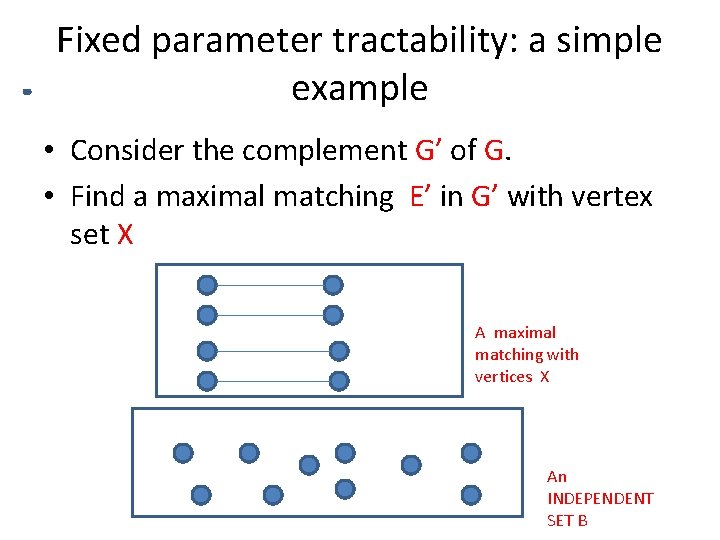
Fixed parameter tractability: a simple example • Consider the complement G’ of G. • Find a maximal matching E’ in G’ with vertex set X A maximal matching with vertices X An INDEPENDENT SET B
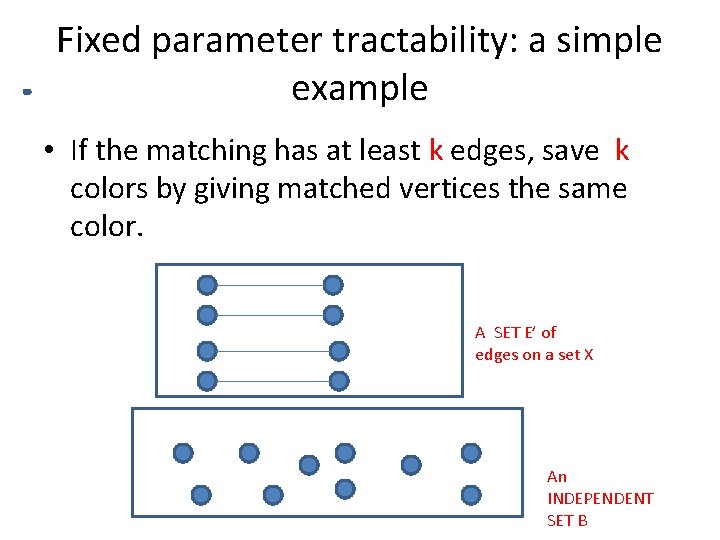
Fixed parameter tractability: a simple example • If the matching has at least k edges, save k colors by giving matched vertices the same color. A SET E’ of edges on a set X An INDEPENDENT SET B
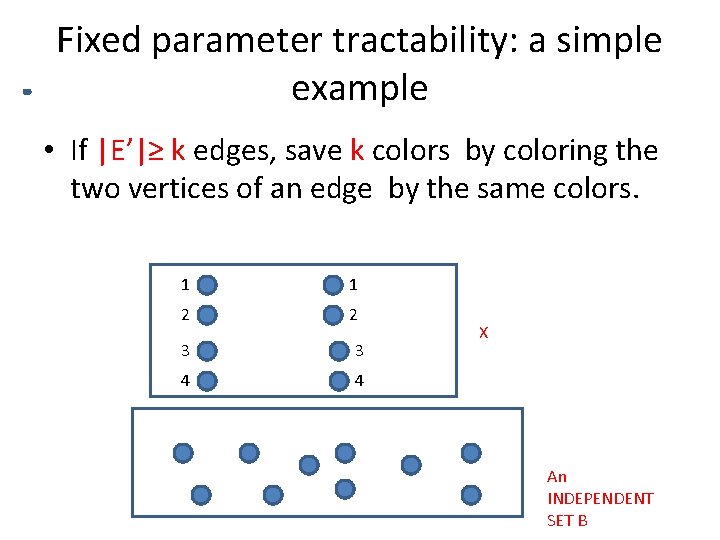
Fixed parameter tractability: a simple example • If |E’|≥ k edges, save k colors by coloring the two vertices of an edge by the same colors. 1 1 2 2 3 3 4 4 X An INDEPENDENT SET B
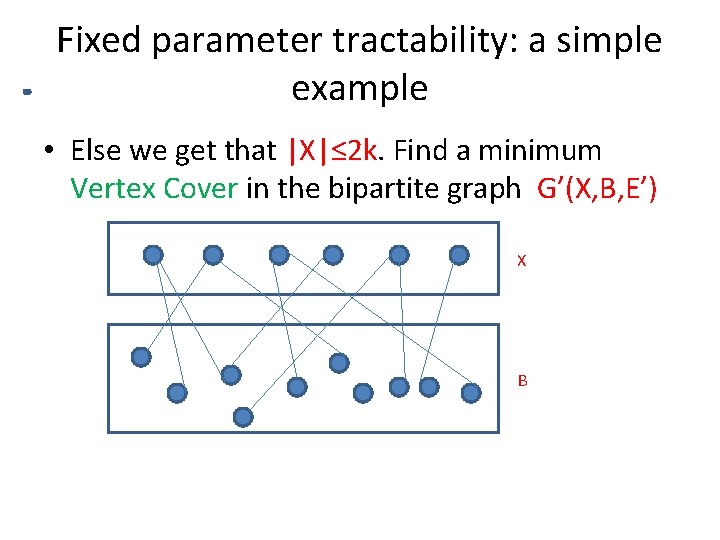
Fixed parameter tractability: a simple example • Else we get that |X|≤ 2 k. Find a minimum Vertex Cover in the bipartite graph G’(X, B, E’) X B
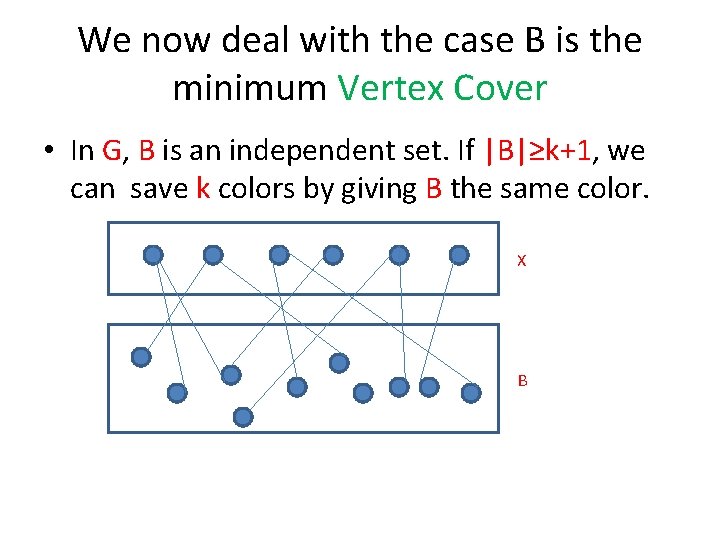
We now deal with the case B is the minimum Vertex Cover • In G, B is an independent set. If |B|≥k+1, we can save k colors by giving B the same color. X B

The total number of vertices • |B+X|≤ 3 k+1, and so we have a FPT solution X B
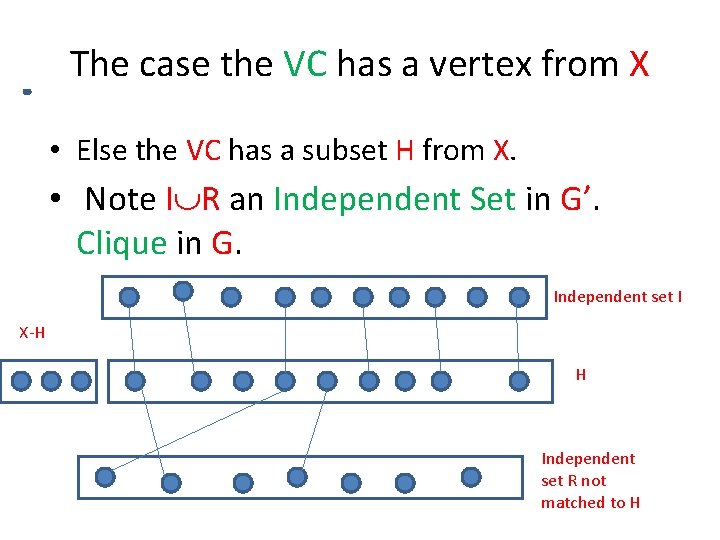
The case the VC has a vertex from X • Else the VC has a subset H from X. • Note I R an Independent Set in G’. Clique in G. Independent set I X-H H Independent set R not matched to H
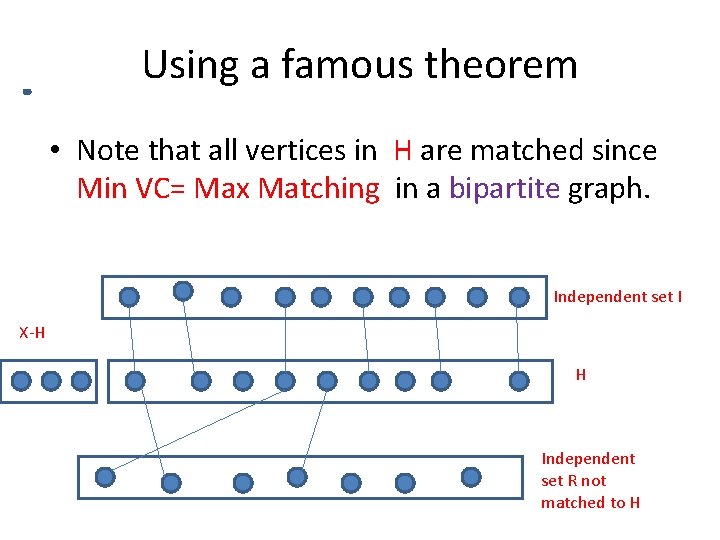
Using a famous theorem • Note that all vertices in H are matched since Min VC= Max Matching in a bipartite graph. Independent set I X-H H Independent set R not matched to H

Save colors or size O(k) • If |H|≥k, this saves k colors. • Else, I R is a Clique in G. • Recurse on X with new colors (|X|≤ 2 k). Independent set I X-H H Independent set R not in the VC
Should we allow both approximation and FPT time? • Yes under two condition. • We have a ratio for the problem • Improving the ratio is a long time standing open problem. • And the problem should be W[i] hard for some I≥ 1. • Example: Remove a min cost collection of edges and get at least k components.
A new result • Known: parameterized by opt the problem is FPT. • But if parameterized by k it is known to be W[i]-hard for some i≥ 1. • Best know approximation 2. Tight, under the Small Set expansion Conjecture. • Gupta et al. gave a constant better than 2 ratio in time f(k)∙Poly(n) time. • In my opinion: very interesting.

The MIN-COST STRONGLY CONNECTED SUBGRAPH PROBLEM • Given a directed graph with positive weights on the edges, A set S of terminals and a number B, is there a subgraph with all terminals so that the graph is strongly connected and has weight at most B? • The problem is W[i] hard when parametrized by the number of terminals k for some i≥ 1 so not in FPT. • The best ratio n for any constant . From 1997. Twenty one years.
The Directed Steiner Tree PROBLEM • Directed Steiner Tree: Given a directed graph with edge costs a number k and a set S V of terminals, is there a directed tree containing S of cost at most k? • DST also admits only the bad ratio n for any constant . The best known since 1997. • But DST is in FPT when parameterized by k.
Seems a bit strange. • To get a MCSCS you just needs an Inward Directed Steiner solution and an Outward Directed Steiner solution. How can it be W[i] hard for i≥ 1? • The hard thing is to have the two solutions share edges. • But clearly a ratio of 2 in FPT time is possible for the MCSCS problem by computing two Directed Steiner trees in time f(k)∙Poly(n)
This is tight • Chitinis, Feldmann and Manurangsi proved that no parametrized algorithm in the optimum, that can give 2 - ratio. I am not aware of any other tight result. • The Directed version of Steiner Forest has a very bad lower bound. Let k be the number of pairs. • For each one of the input pair s, t, there must be a path from s to t in the solution. • A lower bound: No better than k 1/4 approximation even when parametrized by k (Due to Dinur et al).
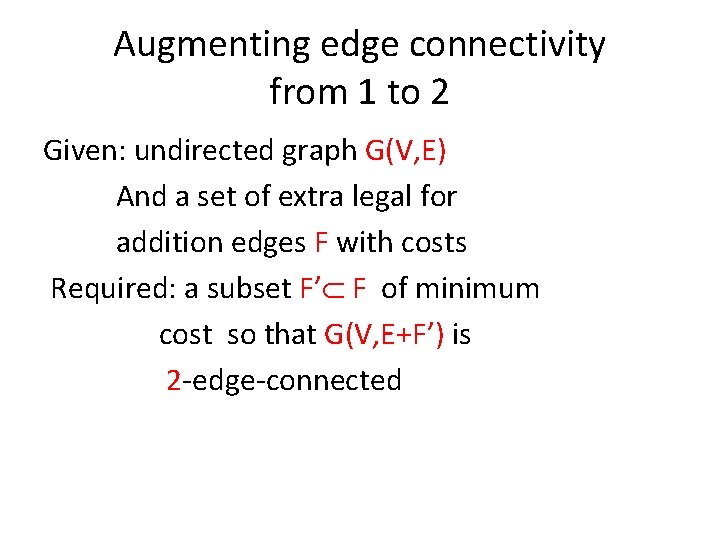
Augmenting edge connectivity from 1 to 2 Given: undirected graph G(V, E) And a set of extra legal for addition edges F with costs Required: a subset F’ F of minimum cost so that G(V, E+F’) is 2 -edge-connected
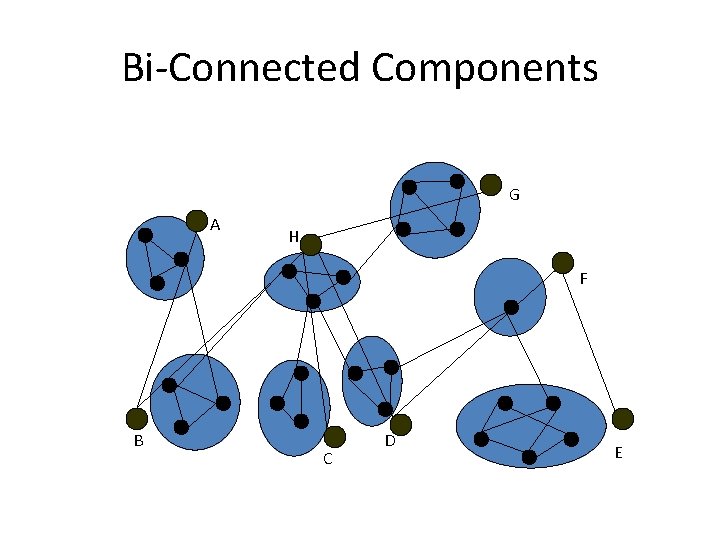
Bi-Connected Components G A H F B C D E
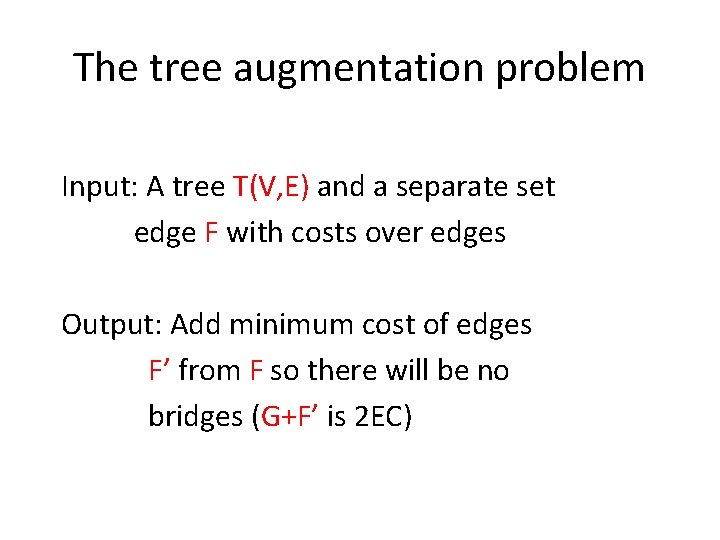
The tree augmentation problem Input: A tree T(V, E) and a separate set edge F with costs over edges Output: Add minimum cost of edges F’ from F so there will be no bridges (G+F’ is 2 EC)
Approximation for the weighted case • The primal-dual algorithm [GW] and the Jain algorithms give ratio 2. Known to have ratio 2 since 1981. 37 years old open problem: improve the 2. • If weights are bounded by a constant better than 2 ratio. Adjiashvili. About 1. 9. LP based. • Improved to 1. 5+ by Florini, Gross, Konemann and Sanita. Clever new LP.

The unweighted case • [KN] 1. 5 combinatorial algorithm, Relatively fast (much faster than any LP based algorithm). • Cheriyan et all combinatorial 3/2 also very fast, proof using lift and project PSD techniques. Not often a combinatorial algorithm studied by lift and project. • Best known 1. 459 by Grandoni Kalaitzis and Zenklusen. This algorith is based on improving the paper of Florini et al. Clever ideas.
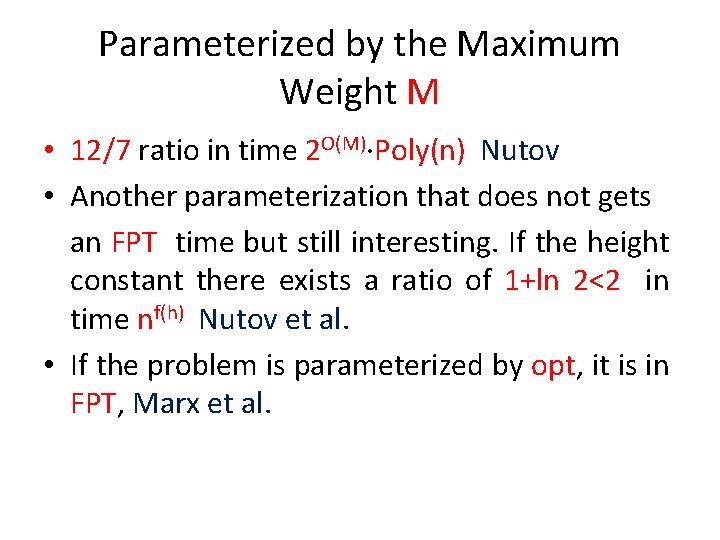
Parameterized by the Maximum Weight M • 12/7 ratio in time 2 O(M)∙Poly(n) Nutov • Another parameterization that does not gets an FPT time but still interesting. If the height constant there exists a ratio of 1+ln 2<2 in time nf(h) Nutov et al. • If the problem is parameterized by opt, it is in FPT, Marx et al.
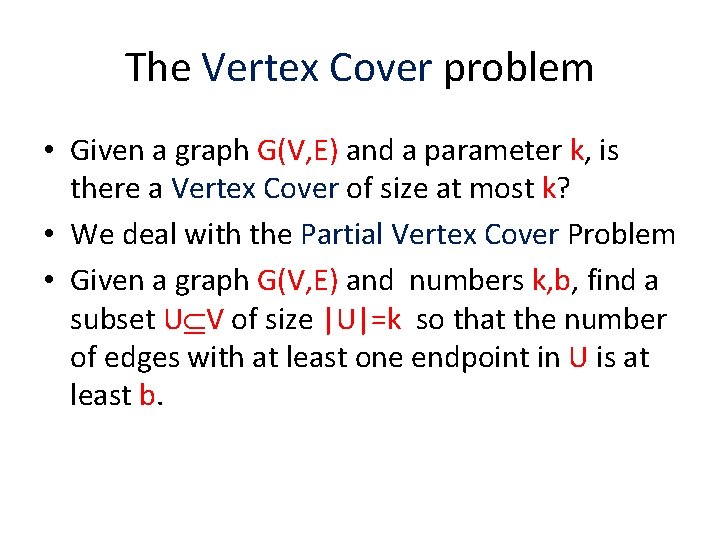
The Vertex Cover problem • Given a graph G(V, E) and a parameter k, is there a Vertex Cover of size at most k? • We deal with the Partial Vertex Cover Problem • Given a graph G(V, E) and numbers k, b, find a subset U V of size |U|=k so that the number of edges with at least one endpoint in U is at least b.
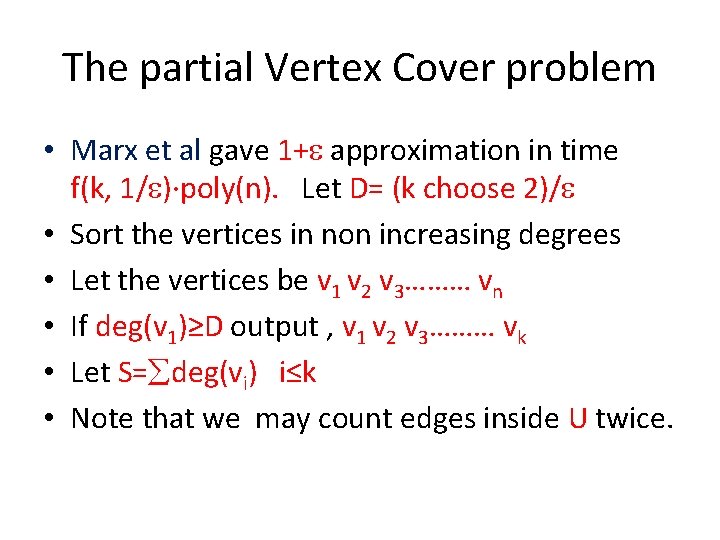
The partial Vertex Cover problem • Marx et al gave 1+ approximation in time f(k, 1/ )∙poly(n). Let D= (k choose 2)/ • Sort the vertices in non increasing degrees • Let the vertices be v 1 v 2 v 3……… vn • If deg(v 1)≥D output , v 1 v 2 v 3……… vk • Let S= deg(vi) i≤k • Note that we may count edges inside U twice.
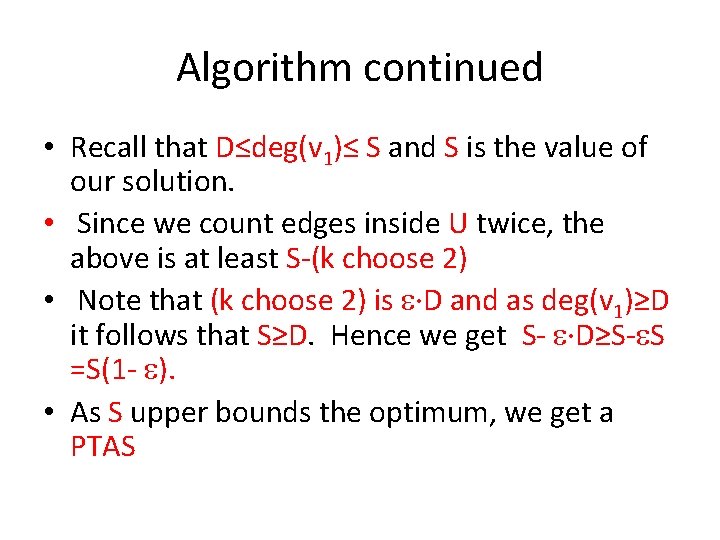
Algorithm continued • Recall that D≤deg(v 1)≤ S and S is the value of our solution. • Since we count edges inside U twice, the above is at least S-(k choose 2) • Note that (k choose 2) is ∙D and as deg(v 1)≥D it follows that S≥D. Hence we get S- ∙D≥S- S =S(1 - ). • As S upper bounds the optimum, we get a PTAS
Now assume D≥ deg(v 1) • The largest degree is bounded by (k choose 2)/ and since our solution has we output has k vertices, the optimum is at most k 3/. We can know opt by trying all values. • We now use a method that is called Color. Coding due to Alon et al.
Let E* be the edges touched by opt • Claim: if all the labels are pairwise different for every vertex, we can solve the problem in time h(k, 1/ ). • Proof: Let {Li} be the labels of the edges of vi • The degree of vi is at most opt otherwise the labels can not be different. • As the number of labels is opt, and Li is a subset of {1, 2, ……. . , opt} the number of ways to choose Li is at most opt = f( , k)
Choosing the sets Li • We can choose the sets Li one after the other which will give us k sets. The time is r( , k). • Say that we have the correct choice of {Li} • We can build a bipartite graph between the vertices and the {Li} and add an edge from ui to Li if Li are the labels of ui • Finding the solution is a maximum matching problem. Will apply for the correct {Li}
How do we make the labels of E* for all vertices disjoint? • Give every edge a label between {1, 2…. . , opt} at random. The probability that the edges of a vertex are different is at least opt -opt • For this to happen for all vertices raise the above by k. • Running it opt∙k times gives a probably of (11/e) for success. This can be derandomized. • The time is indeed h( , k) • But its only (1 - ) approximation (see first step).
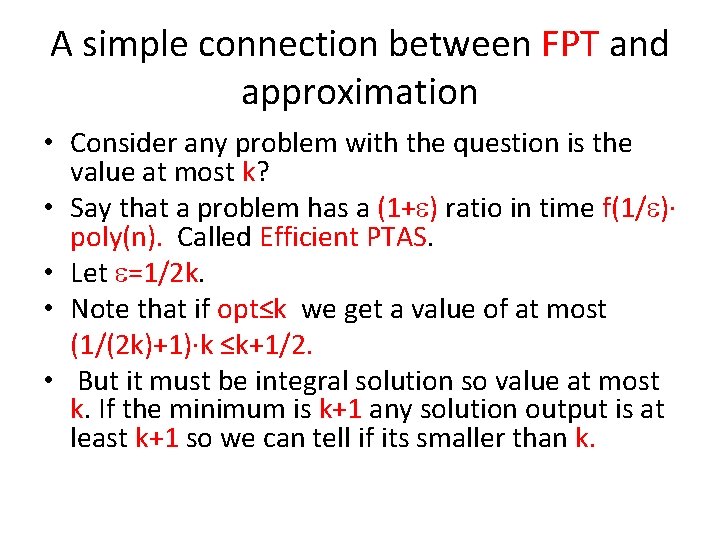
A simple connection between FPT and approximation • Consider any problem with the question is the value at most k? • Say that a problem has a (1+ ) ratio in time f(1/ )∙ poly(n). Called Efficient PTAS. • Let =1/2 k. • Note that if opt≤k we get a value of at most (1/(2 k)+1)∙k ≤k+1/2. • But it must be integral solution so value at most k. If the minimum is k+1 any solution output is at least k+1 so we can tell if its smaller than k.
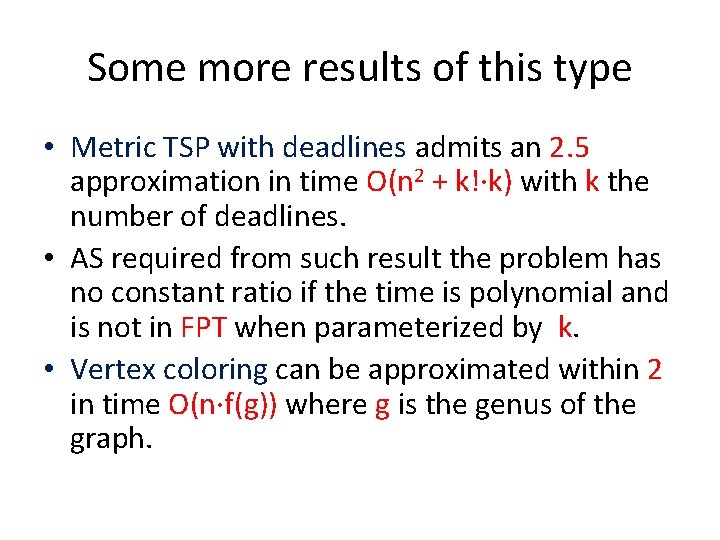
Some more results of this type • Metric TSP with deadlines admits an 2. 5 approximation in time O(n 2 + k!∙k) with k the number of deadlines. • AS required from such result the problem has no constant ratio if the time is polynomial and is not in FPT when parameterized by k. • Vertex coloring can be approximated within 2 in time O(n∙f(g)) where g is the genus of the graph.
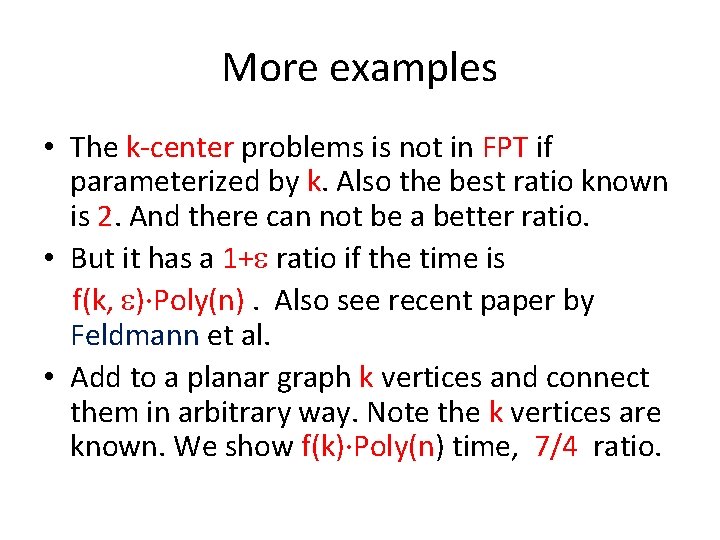
More examples • The k-center problems is not in FPT if parameterized by k. Also the best ratio known is 2. And there can not be a better ratio. • But it has a 1+ ratio if the time is f(k, )∙Poly(n). Also see recent paper by Feldmann et al. • Add to a planar graph k vertices and connect them in arbitrary way. Note the k vertices are known. We show f(k)∙Poly(n) time, 7/4 ratio.
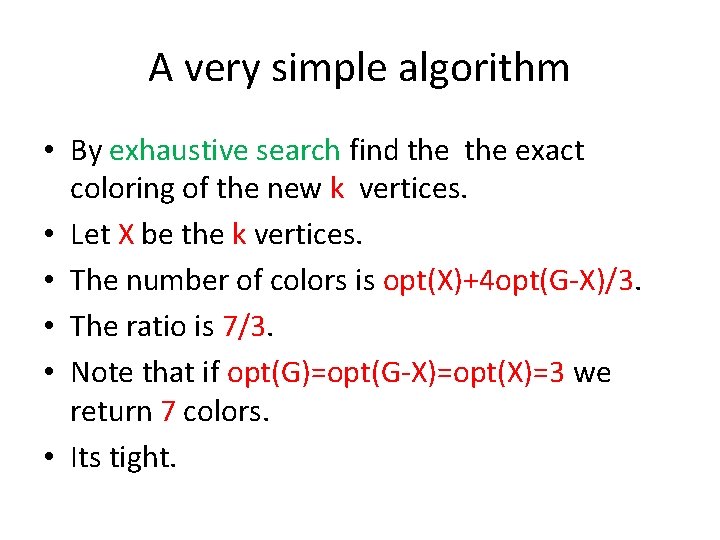
A very simple algorithm • By exhaustive search find the exact coloring of the new k vertices. • Let X be the k vertices. • The number of colors is opt(X)+4 opt(G-X)/3. • The ratio is 7/3. • Note that if opt(G)=opt(G-X)=opt(X)=3 we return 7 colors. • Its tight.
Minimum Sum coloring • Each color is an integer i≥ 1 and neighbors need to get different colors. Find coloring and minimize the sum. • [HK] show: consider the Tree Width of the graph. Say it is t. There is a 1+ ratio if parameterized by t. • Interesting behavior: polynomial time solvable on trees but NPC for tree-width 2.
Some Fixed parameter approximation for the Steiner Tree problem • Steiner tree parametrized by the number of Steiner vertices is W[2]-hard. • The best known ratio for a very long time is 2. Due to Agrawal, Klein and R. Ravi. Dvorac et al present the following result: • The Steiner tree problem admits a 1+ ratio in time T( , p)∙poly(n). p is the # Steiner Vertices. • The same hold for Steiner forest if also parametrized by the number of components.
Better approximation if the running time is super polynomial • If you want approximation ratio of for some problem what is the best possible running time? • You need to do two things • First give an approximation ratio of in some time t(n). • Then show that approximation of , with time better than t(n) would contradicts the ETH.
A desired approximation for Set Cover • Say that we want a (1 -δ)ln n approximation ratio. • We know that we can not compute that in polynomial time Dinur et al. We can do it in exponential time. What is the time required? • Cygan et at showed that in time exp(nδ ) finding such an approximation is possible.
Lower bounds: Almost linear PCP • Consider a ratio of ln n/2. The upper bound is exp(sqrt{n}). • A paper by [CKL] gave a lower bound, under the ETH and the Projection game conjecture (details omitted) of exp(sqrt{n}). • It is an improvement of a paper by Moskovitch.
The reduction needed • We need to start with a SAT instance with n clauses and m variables and reduce to a Set Cover instance with ln N/2 gap, so that the size of the Set Cover is bounded by N=(m+n)2 • exp(o(sqrt{N})) would mean that the ETH does not hold. • Getting the above result is highly non trivial. • A non trivial modification of an involved proof of Moskovich that gave the weaker time.
For general (1 -δ) ln n • An approximation within exp(nδ) • And the lower bound is the same exp(nδ) • Note that Set Cover can be generalize to many problems. • Group Steiner, Submodular Cover, Connected Polymatroid, Directed Steiner tree. • The [CKL] paper gave an upper bound of exp(log n∙nδ) for (1 -δ) ln n for the Directed Steiner Tree problem. And for the Connected Polymatroid problem (very similar algorithms)
The upper and lower bounds • While not tight, very close. • The loss of log n is because getting the approximation ratio (1 -δ) ln n for the Directed Steiner Tree seems more complex than for SETCOVER. • We lost log n in the exponent in the upper bound. Can it be removed? • This is an open question.
A paper by Chekuri and Pal • Gave an exp(logδn) time O(log 2 -δ n) ratio for Group Steiner • Halperin, Krauthgamer: no O(log 2 -δ n) ratio is possible. • This would be a contradiction, but: • If this seems subexponential time for SAT it turns out that the reduction of HK is quasipolynomial. Thus time is exponential.
But they showed something interesting The reduction of HK must be quasi-polynomial Thus under the ETH P Quasi(P) As far as I know, the first time it was shown. Very bad news unfortunately. Directed Steiner admits a polylog ratio in quasi -poly time. But not known in poly time. • I think highly likely: No polylog ratio poly time for Directed Steiner Tree assuming ETH. • • •
The [CKL] paper showed • The time for ratio O(log 2 -δ n) derived by Chekuri and Pal is basically optimal. • This is proven under the ETH. • This is a good example in which larger time allows better ratio. • For several problems we tried sub exponential time and could not improve the ratio. • Finding problems so that in sub exponential time a better ratio is possible, than in polynomial time, perhaps not explored enough?
Lower bounds • Under Gap-ETH for any function R there is no o(opt) ratio approximation algorithms for Clique running time R(opt) poly(n). “Complete FPT Inapproximability (CFI)”. Chalermsook et al. • The same holds for Set-Cover. For every function r and every function t there is no r(opt) ratio in time t(opt)poly(n). • But later a surprising improvement.
A solution for a long time open problem • Many asked if under the ETH we can show that for every two (computable) function r, t there is no r(opt) approximation for Set Cover that runs in time t(opt)∙poly(n). • This was shown to be true in a sequel paper (but not for Clique so far). • This is due to Karthik, Laekhanukit and Munurangsi
More lower bounds • Maximum Balanced Biclique is given a graph G, find a complete bipartite graph with k vertices in both sides with largest k. This problem is CFI under Gap-ETH • Finding Maximum Subgraph with Hereditary Properties is CFI under Gap-ETH • Downey et al The Minimum independent dominating set is CFI under ETH
More lower bounds • Marx. Weighted circuit satisfiability for monotone or antimonotone circuits is CFI. • The paper of Chalermsook et al. gave one lower bound that is not tight. There is no approximation for the Dense k-Subgraph within ko(1) for any time t(k). • The trivial upper bound is k. It is not tight. • The Longest induced path problem is CFI under the weaker assumption W[1] FPT. Chalermsook et al
Open problems • Improve ratios if FPT time is allowed. • The Tree Augmentation Problem: Is there a 2 -δ ratio for constant δ in poly time? • Is there poly time polylog ratio for Directed Steiner Tree? • The integrality gap for Group Steiner problem on Trees has height log n/log n. This means that the largest IG we can get is log 2 n/loglogn. Conjecture: Approximation equals IG.
This is just a conjecture • Unfortunately, from the upper bound, we can get only trees of height h=O(log n) with constant penalty. • In fact [CEK] showed a reduction of any tree to O(log n) height tree with constant loss in the ratio. • The [CEK] paper does not know how to reduce the height to log n/loglog n with constant penalty. I suspect, its not possible. • Still the integrality gap suggests ratio log 2 n /loglogn in poly time may be possible(? )
We tried with no luck • Say that the tree is binary. • Make every subtree of loglog n leaves a variable. • Send flow from a tree to get a path of length log n/loglog n. • We were not able (so far) to make the GKR analysis work. • And others tried as well. Still, maybe its correct?
- Slides: 59