
Using Failure Models for Controlling Data Availability in
Using Failure Models for Controlling Data Availability in Wireless Sensor Networks R. Crepaldi, M. Montanari, I. Gupta, R. Kravets University of Illinois @ Urbana-Champaign
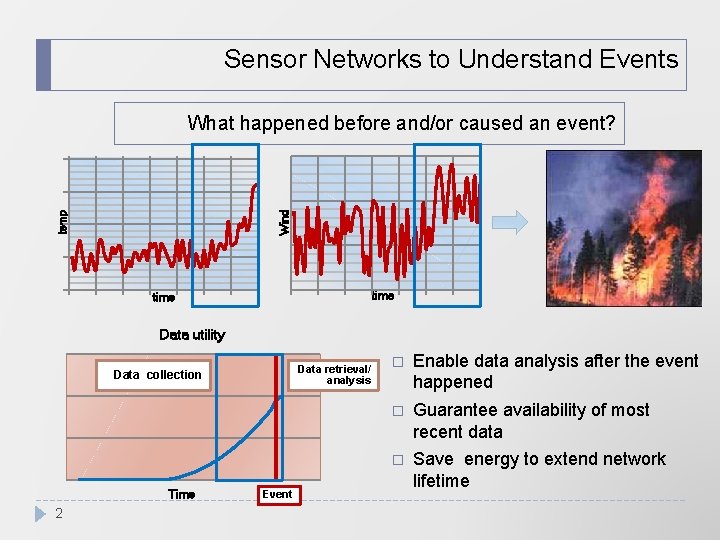
Sensor Networks to Understand Events temp Wind What happened before and/or caused an event? time Data utility Data retrieval/ analysis Data collection Time 2 Event � Enable data analysis after the event happened � Guarantee availability of most recent data � Save energy to extend network lifetime
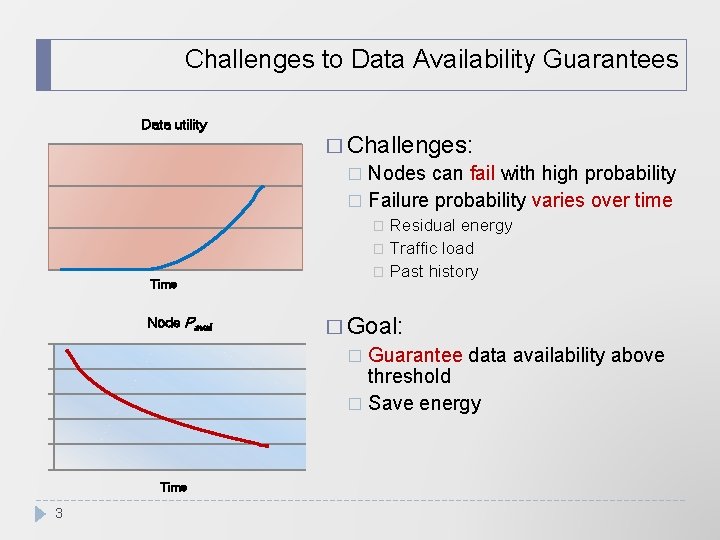
Challenges to Data Availability Guarantees Data utility � Challenges: Nodes can fail with high probability � Failure probability varies over time � Residual energy � Traffic load � Past history � Time Node Pavail � Goal: Guarantee data availability above threshold � Save energy � Time 3
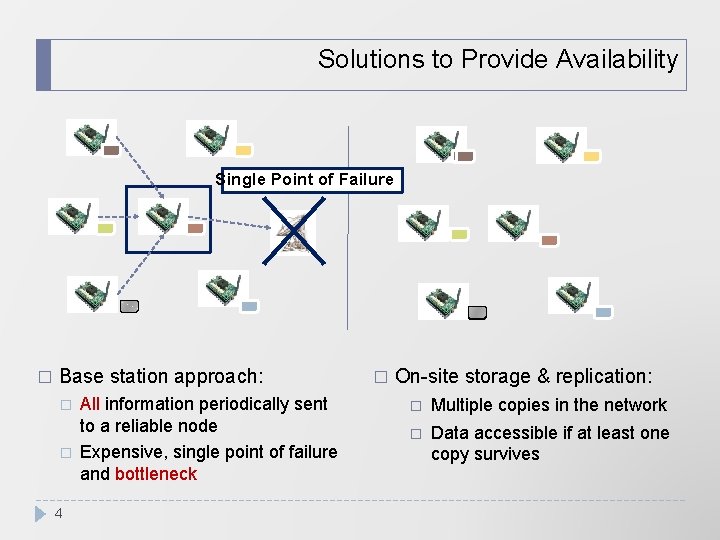
Solutions to Provide Availability Single Point of Failure � Base station approach: � � 4 All information periodically sent to a reliable node Expensive, single point of failure and bottleneck � On-site storage & replication: � Multiple copies in the network � Data accessible if at least one copy survives
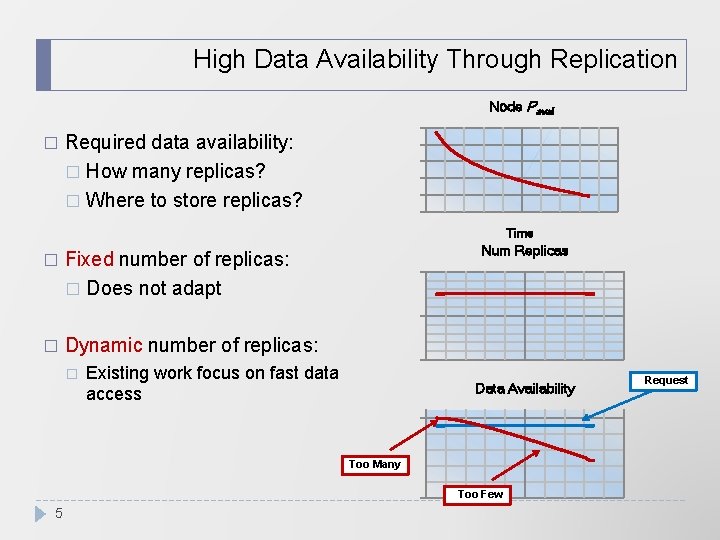
High Data Availability Through Replication Node Pavail � Required data availability: � How many replicas? � Where to store replicas? Time � Fixed number of replicas: � Does not adapt � Dynamic number of replicas: � Num Replicas Existing work focus on fast data access Data Availability Too Many Too Few 5 Request
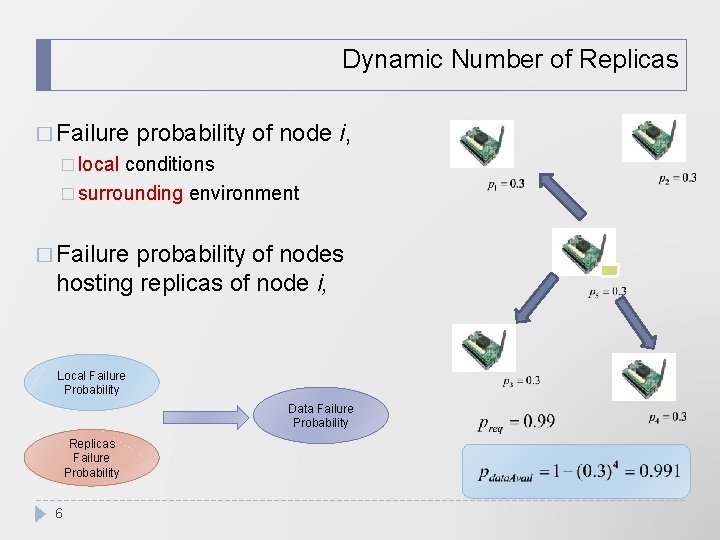
Dynamic Number of Replicas � Failure probability of node i, � local conditions � surrounding environment � Failure probability of nodes hosting replicas of node i, Local Failure Probability Data Failure Probability Replicas Failure Probability 6
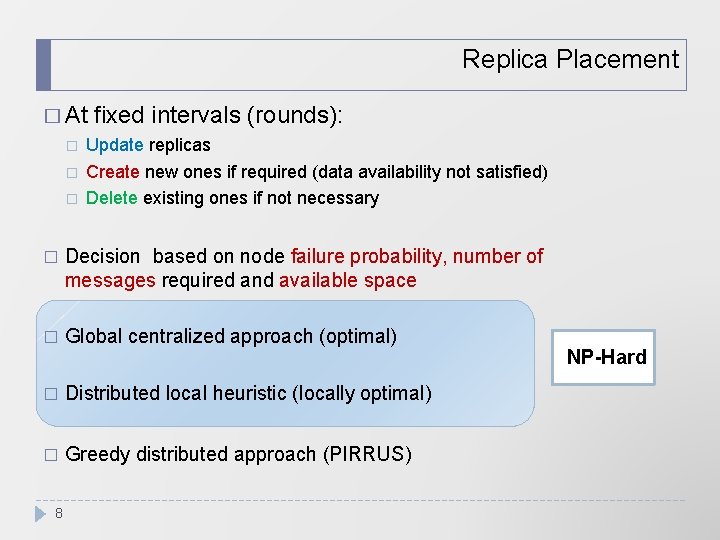
Replica Placement � At fixed intervals (rounds): � Update replicas � Create new ones if required (data availability not satisfied) � Delete existing ones if not necessary � Decision based on node failure probability, number of messages required and available space � Global centralized approach (optimal) � Distributed local heuristic (locally optimal) � Greedy distributed approach (PIRRUS) 8 NP-Hard
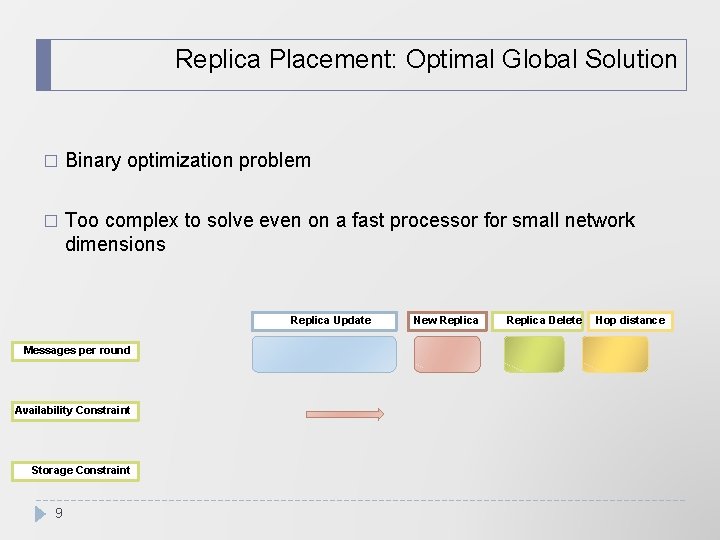
Replica Placement: Optimal Global Solution � Binary optimization problem � Too complex to solve even on a fast processor for small network dimensions Replica Update Messages per round Availability Constraint Storage Constraint 9 New Replica Delete Hop distance
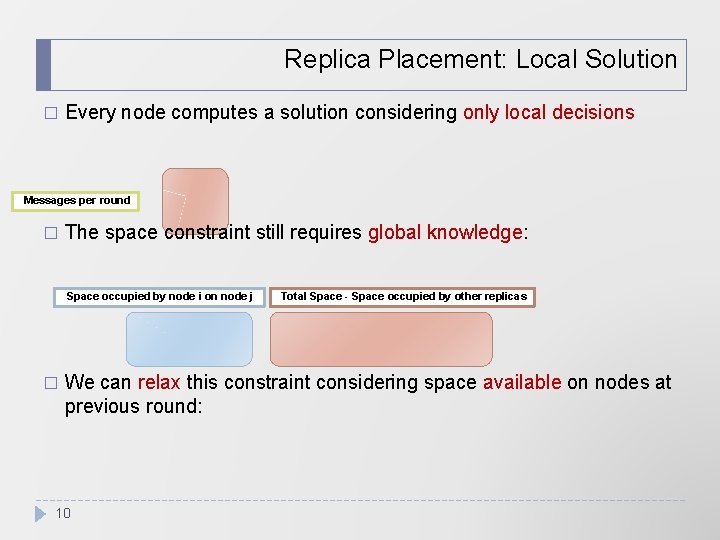
Replica Placement: Local Solution � Every node computes a solution considering only local decisions Messages per round � The space constraint still requires global knowledge: Space occupied by node i on node j � Total Space - Space occupied by other replicas We can relax this constraint considering space available on nodes at previous round: 10
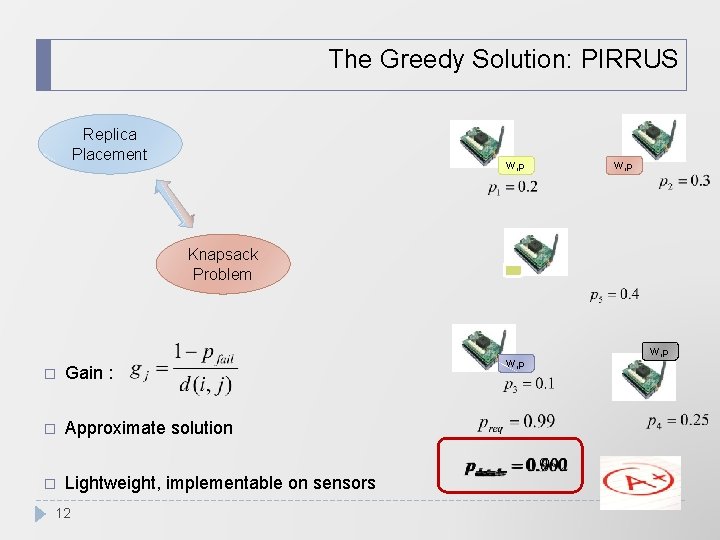
The Greedy Solution: PIRRUS Replica Placement W, p Knapsack Problem W, p � Gain : � Approximate solution � Lightweight, implementable on sensors 12 W, p
Evaluation � Evaluation of dynamic replication: � � Minimum availability guaranteed Number of replicas required Traffic generated Energy spent � ns simulations with 250 nodes � Nodes failure probability increasing over time � Compared to non dynamic replication approach (3 and 5 replicas) 13
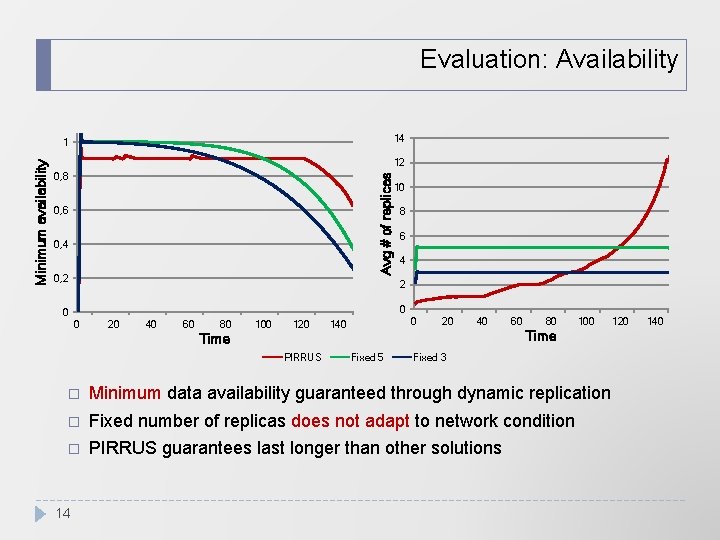
Evaluation: Availability 14 12 0, 8 Avg # of replicas Minimum availability 1 0, 6 0, 4 0, 2 10 8 6 4 2 0 0 0 20 40 60 80 100 120 0 140 20 40 80 100 Time PIRRUS 60 Fixed 5 Fixed 3 � Minimum data availability guaranteed through dynamic replication � Fixed number of replicas does not adapt to network condition � PIRRUS guarantees last longer than other solutions 14 120 140
![Evaluation: Energy Consumption Chart Title 400 140 350 300 100 Energy [J] Traffic [Kbps]](http://slidetodoc.com/presentation_image_h2/8616a6142869bc47eaac054c8e1c10d9/image-13.jpg "Evaluation: Energy Consumption Chart Title 400 140 350 300 100 Energy [J] Traffic [Kbps]")
Evaluation: Energy Consumption Chart Title 400 140 350 300 100 Energy [J] Traffic [Kbps] 120 80 60 40 250 200 150 100 20 50 0 0 20 40 60 80 100 120 140 Time PIRRUS Fixed 5 Fixed 3 BS � Basestation approach requires high traffic to reach the sink � Fixed number of replicas requires constant traffic but fails in providing availability guarantees � PIRRUS saves energy in the first part of the network lifetime and spends it later to satisfy requirements 15
Conclusions and Future Work � Adaptive solutions to cope with variations in the nodes conditions � PIRRUS outperforms non dynamic solutions and is lightweight � Open problem: how precisely can we model the failure probability of nodes? 16
Using Failure Models for Controlling Data Availability in Wireless Sensor Networks R. Crepaldi, M. Montanari, I. Gupta, R. Kravets University of Illinois @ Urbana-Champaign
- Slides: 15