
Using Failure Mode Effects Analysis to Improve Hospital


- Slides: 35
Using Failure Mode & Effects Analysis to Improve Hospital Intensive Care Evacuations Third Annual Emergency Management Summit Washington, DC March 2009 Barbara Bisset, Ph. D MPH MS RN EMT Emergency Services Institute Health & Hospitals Raleigh, North Carolina
Objectives • Awareness of the process and results when using the Failure Mode Effects Analysis (FMEA) for evaluating hospital intensive care unit evacuations – – – Process Findings Action Plan Resulting changes to plans and processes Deliverables • Manager’s Toolkit • Training Plan – Reduction in risk
What is an FMEA? § A proactive approach to identify and resolve potential problems in products or processes, before they occur, prioritizing potential failures, and determining steps to take to reduce or eliminate the associated risks or defects § An FMEA is not like a root cause analysis (RCA), which focuses on avoiding the reoccurrence of adverse events
Why Use FMEAs in Healthcare? • Other industries have used FMEA with great success • The Joint Commission requires the proactive risk assessment of at least one high-risk process per year • Goal is to reduce risks, improve patient safety, and enhance patient satisfaction
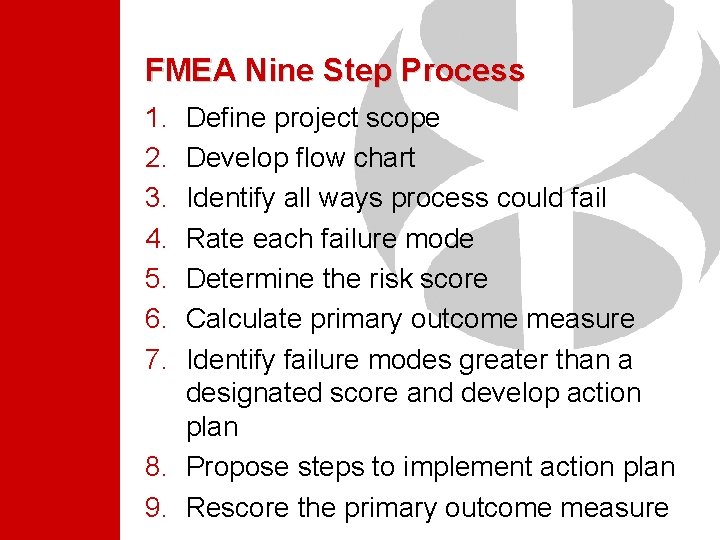
FMEA Nine Step Process 1. 2. 3. 4. 5. 6. 7. Define project scope Develop flow chart Identify all ways process could fail Rate each failure mode Determine the risk score Calculate primary outcome measure Identify failure modes greater than a designated score and develop action plan 8. Propose steps to implement action plan 9. Rescore the primary outcome measure
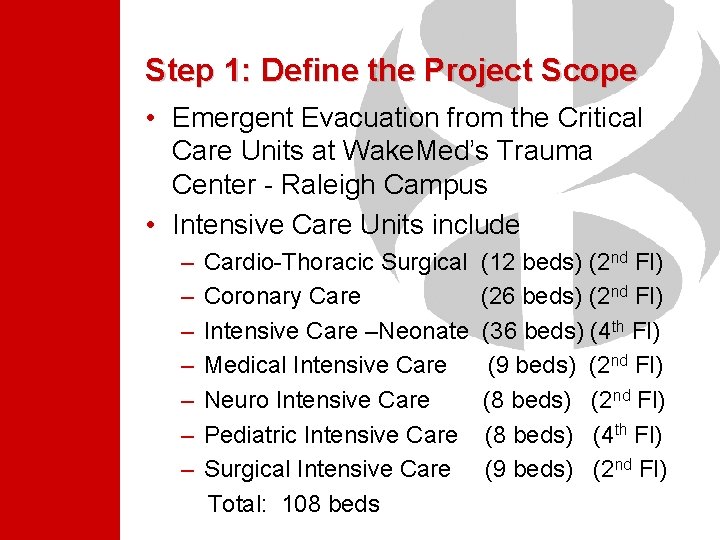
Step 1: Define the Project Scope • Emergent Evacuation from the Critical Care Units at Wake. Med’s Trauma Center - Raleigh Campus • Intensive Care Units include – Cardio-Thoracic Surgical (12 beds) (2 nd Fl) – Coronary Care (26 beds) (2 nd Fl) – Intensive Care –Neonate (36 beds) (4 th Fl) – Medical Intensive Care (9 beds) (2 nd Fl) – Neuro Intensive Care (8 beds) (2 nd Fl) – Pediatric Intensive Care (8 beds) (4 th Fl) – Surgical Intensive Care (9 beds) (2 nd Fl) Total: 108 beds
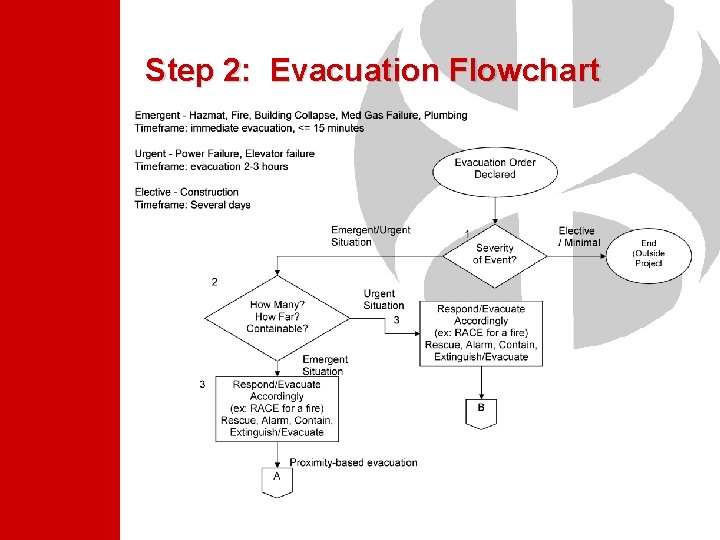
Step 2: Evacuation Flowchart
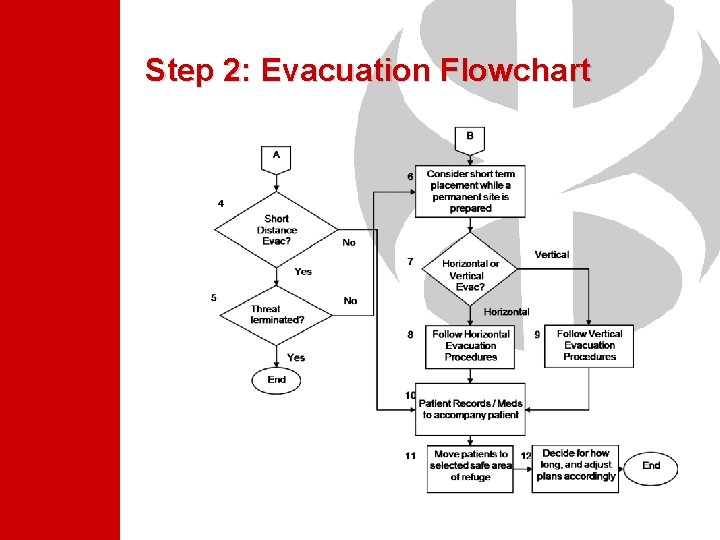
Step 2: Evacuation Flowchart
Step 3: Potential Failure Modes, Causes and Effects • Identify what “could”¹ go wrong at each of the process steps on the flow chart • Identify “why it might happen” • The causes of those failures • The effects of those failures ¹ These are referred to as the “Failure Modes”
Step 3: Process Failure Modes Findings • • Misidentification of evacuation distance needed Insufficient staff for unit evacuation Insufficient oxygen tanks to support evacuation Insufficient monitoring capability at designated safe areas • Inadequate access to defibrillators during patient transport to safe area • Insufficient space to maintain patient at final evacuation location • Shortage of medications at safe area
Step 3: Process Failure Modes Findings (continued) • Shortage of specialized supplies at safe area • Insufficient electrical/med gas infrastructure for patient support at safe area location(s) • Patient movement issues: vertical evacuation • Insufficient equipment for vertical evacuation • Insufficient staffing for vertical evacuation • Safe areas for evacuation not identified • Evacuation route blocked • Traffic jams when moving patients in their beds • Automatic doors may not work (incoming help)
Step 3: Process Failure Modes Findings (continued) • Insufficient suction equipment to support unit evacuation • Insufficient portable monitors to support unit evacuation • Elevator nearest evacuation point not available – may be type of event in which elevators cannot be used or may be in use by fire department • Failure to correctly assess containment of the event
Step 3: Process Failure Modes Findings (continued) • If elevators can be used, elevator evacuation not planned • RACE or ECAR procedure not followed • Misidentification of event response urgency • Misidentification of # of patients impacted • Insufficient lighting for patient evacuation • Lack of knowledge re: alternate stairwells for vertical evacuation • Patient records not accessible
Step 4: Rate Each Failure Mode Three factors: Severity, Probability of Occurrence, and Detection Capability – The “severity” is the consequence of the failure should it occur – The “probability of occurrence” is the likelihood of a failure mode occurring – The “detection rating” is the ability to catch the error before causing patient harm
Step 5: Determine the Risk Score Risk Priority Number = Severity x Occurrence x Detect ability Scores are 1 -10; The resulting number is 1 -1000 (Minor problem: RPN <= 100)
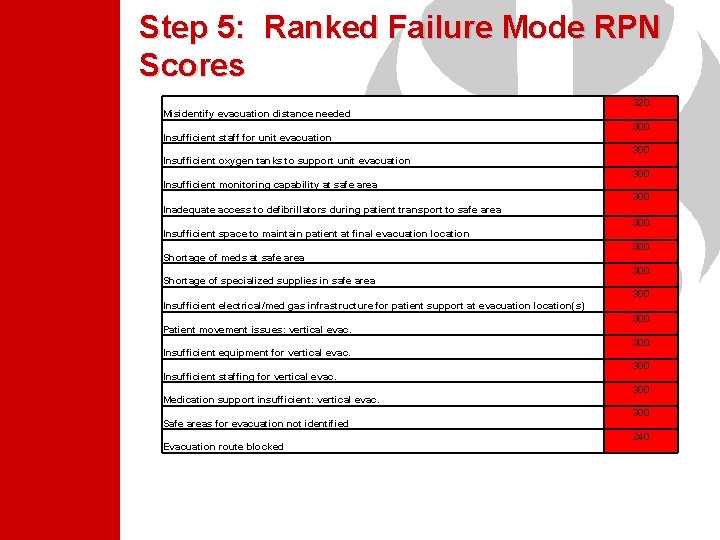
Step 5: Risk Score § Example, “Insufficient Staff for Patient Evacuation” was scored at 300 Severity of the potential effects was rated a “ 10” (Very High Severity) Probability was rated a “ 10” (Certain probability if an evacuation order is declared) Detection was rated a “ 3” (Moderate) RPN for this failure mode: 10 x 3 = “ 300” (High Concern)
Step 5: Ranked Failure Mode RPN Scores Misidentify evacuation distance needed Insufficient staff for unit evacuation Insufficient oxygen tanks to support unit evacuation Insufficient monitoring capability at safe area 320 300 300 Inadequate access to defibrillators during patient transport to safe area 300 Insufficient space to maintain patient at final evacuation location Shortage of meds at safe area Shortage of specialized supplies in safe area 300 300 Insufficient electrical/med gas infrastructure for patient support at evacuation location(s) Patient movement issues: vertical evac. Insufficient equipment for vertical evac. Insufficient staffing for vertical evac. Medication support insufficient: vertical evac. Safe areas for evacuation not identified Evacuation route blocked 300 300 300 240
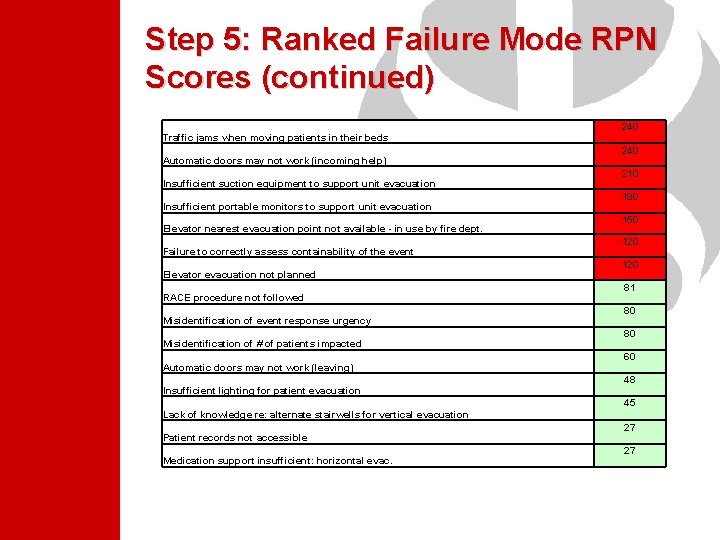
Step 5: Ranked Failure Mode RPN Scores (continued) Traffic jams when moving patients in their beds Automatic doors may not work (incoming help) Insufficient suction equipment to support unit evacuation Insufficient portable monitors to support unit evacuation Elevator nearest evacuation point not available - in use by fire dept. Failure to correctly assess containability of the event Elevator evacuation not planned RACE procedure not followed Misidentification of event response urgency Misidentification of # of patients impacted Automatic doors may not work (leaving) Insufficient lighting for patient evacuation 240 210 180 150 120 81 80 80 60 48 45 Lack of knowledge re: alternate stairwells for vertical evacuation Patient records not accessible Medication support insufficient: horizontal evac. 27 27
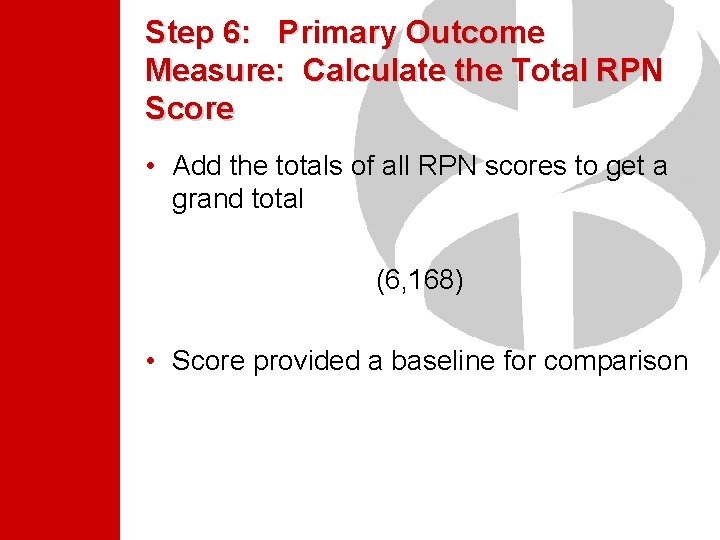
Step 6: Primary Outcome Measure: Calculate the Total RPN Score • Add the totals of all RPN scores to get a grand total (6, 168) • Score provided a baseline for comparison
Steps 7: Identify Action Plan § Identify the failure modes that have an RPN Score of 100 or higher. These are the items requiring the greatest attention. § Develop an action plan to address each of these high-hazard score failure modes. The action plan should include who, what, when, why, etc.
Step 8: Implement Action Plan • Identified safe areas of refuge on the 2 nd and 4 th floors • Identified primary and secondary evacuation routes • Updated the Wake. Med Emergency Evacuation Operations Plan • Evaluated and purchased evacuation equipment
Step 8: Implement Action Plan • Identified evacuation and receiving team membership – Multi-disciplinary – Identified in incident command structure – Job Action Sheets • Created a master equipment inventory list • Conducted assessments of infrastructure capability at identified receiving areas
Step 8: Implement Action Plan • Purchased emergency supplies in event of electrical failure • Assessed ingress/egress capability in intensive care areas (secured units) • Developed Manager’s Evacuation Document Toolkits • Developed unit-based emergency evacuation “quick response” guides
Step 8: Implement Action Plan • Staff Training – Modules • • Frontline Staff Managers Response Teams Incident Command – Vertical Evacuation Simulation Training (VEST) • Staff required to walk horizontal and vertical evacuation routes on a regular basis
Step 9: Determine FMEA Project Success § Recalculate the RPN scores after implementing the action plan § Compare with the first FMEA analysis § Address any items with a recalculated RPN Score of 100 or higher
Results • Baseline score: 6168 • Final score: 1657 • Reduction in scored risk assessment: 73. 1%
Evacuation Manager’s Toolbox • • • Evacuation Preparedness Instructions Assessment Tool Receiving Areas Equipment & Supplies Department Evacuation Plan Template Training Guide Quick Response Guides – Evacuation and Areas of Refuge – Employees – Managers – Special Populations – Patient Equipment Management in Vertical Evacuations – Evacuation Equipment / Person Carries
Project Limitations • Time factors for processes not assessed • Clinical status changes when moving patients • Staff stressors during evacuation • Due to time frame of recent completion of project, drill has not yet been conducted to formally evaluate staff’s performance • Bias of task force members
Next Steps • Finalize staff training • Conduct pilot drill • Expand project through entire healthcare system • Incorporate evacuation annual training into departments • Study human simulator data to ascertain impact on patients • Nursing Triage Study
Summary • Awareness of FEMA process steps • Awareness of action plan development • Awareness of operational/plan changes • Awareness of project’s limitations • Awareness of next steps
FMEA ICU Team Acknowledgement • • • Todd Reichert Facilitator Lee Ann Scott Risk Mgmt Tim O’Rourke Facility Services Don Divita Clinical Engineering Robert Maloney Safety Officer Shannon Wisowaty Administrative Assistant Wayne Worden Respiratory Care Sylvia Scholl Trauma Services Ellen Wheaton Cardiothoracic ICU • • Melissa Craft / Catrice Ayscue / Beverly Baffaro Neuro ICU Angie Bullock Surgical ICU Carolyn Mc. Kay Medical ICU Wanda Bowman Pediatrics ICU Susan Gutierrez / Stephanie Burnside Neonates Juanita Murray Coronary Care Osi Udekwu Trauma Surgeon
Project Funding Acknowledgement • Evacuation Equipment purchased by the Assistant Secretary Preparedness and Response (ASPR) Healthcare Facility Partnership Program Award No. 1 HFPEP 070007 -01 -00
References ISMP Website, Example of a Health Care Failure Mode and Effects Analysis for IV Patient Controlled Analgesia (PCA), ISMP. Com Mc. Dermott, Robin E. , The Basics of FMEA, PRODUCTVITY, 1996. Palady, Paul, FMEA: Author’s Edition, PAL Publications, 1998. The Basics of Healthcare Failure Modes and Effect Analysis, Videoconference Course, VA National Center for Patient Safety, 2001. Understanding the Failure Modes and Effects Analysis, an on-line course, HCProfessor. com, 2002. Phone #: 800 -650 -6787.
Questions?
Wake. Med Health & Hospitals Raleigh, North Carolina