
USING ELECTRICITY Class 7 HEATING EFFECTS OF ELECTRICITY
- Slides: 12
USING ELECTRICITY – Class 7 HEATING EFFECTS OF ELECTRICITY Done by Mrs. Aparna. S
HEATING EFFECT OF ELECTRICITY Concept, Application and Uses
HEATING EFFECT OF ELECTRICITY When electricity is passed through a conductor (wire), a part of it is converted into heat energy and heats up the conductor (wire). ¡ This kind of heating is called Ohmic or Joule heating ¡ The heat produced depends on: ¡ • • • The current (number of cells) The material of the wire The time for which the current is passed
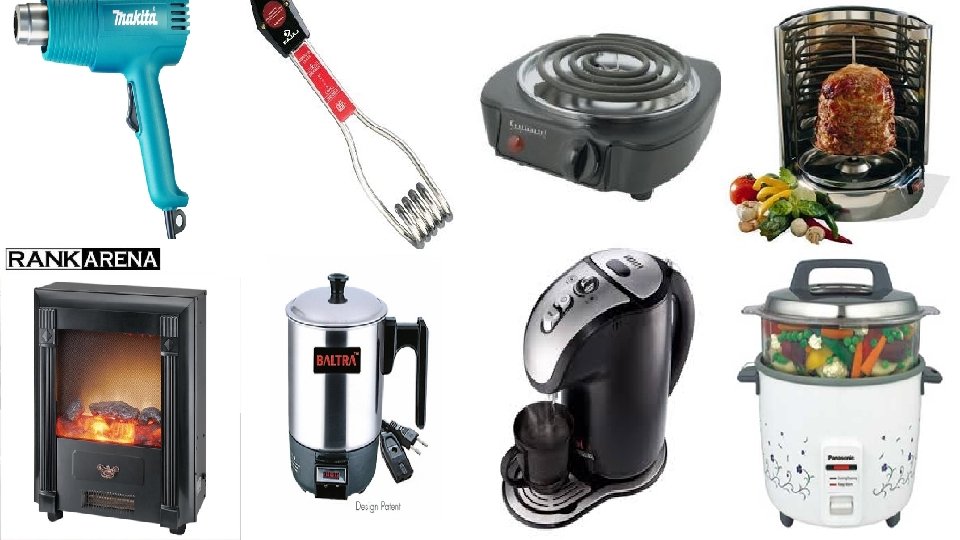
HEATING EFFECT OF ELECTRICITY ¡ ¡ The heating effect of current has many practical applications. Eg. Electric bulbs, toasters, iron box, room heater, induction cookers, electric kettle, geyser, hot plates, immersion heater, ovens, hairdryers, electric water boilers and many more…
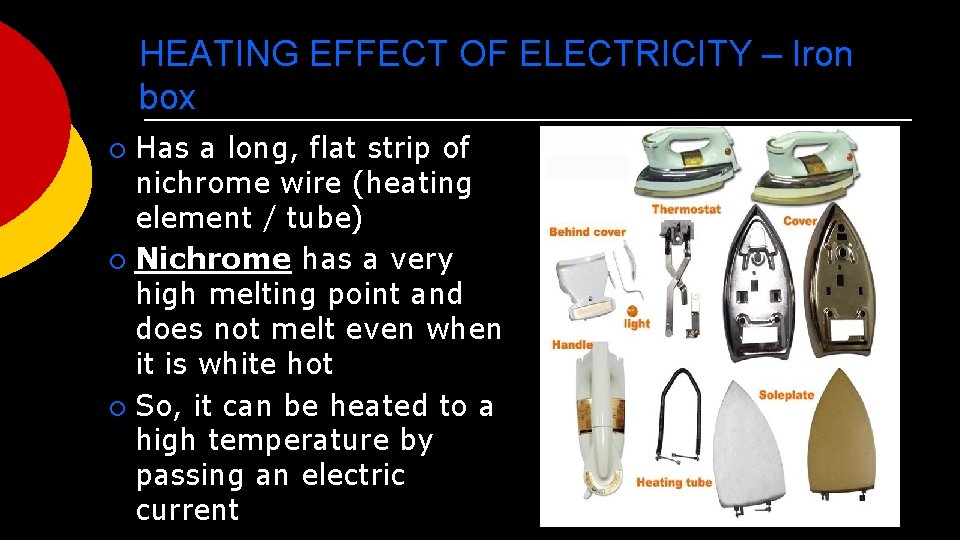
HEATING EFFECT OF ELECTRICITY – Iron box Has a long, flat strip of nichrome wire (heating element / tube) ¡ Nichrome has a very high melting point and does not melt even when it is white hot ¡ So, it can be heated to a high temperature by passing an electric current ¡
HEATING EFFECT OF ELECTRICITY - FUSE ¡ ¡ ¡ Another important application of this heating effect of electricity is in a ‘fuse’ Electrical appliances work when an electric current passes through them. Every electrical circuit is allowed to carry a certain load of current.
HEATING EFFECT OF ELECTRICITY - FUSE ¡ ¡ Sometimes, when a large amount of electric current is drawn into an appliance, it causes the wires to get overheated, and the appliance gets damaged or the insulation may even catch fire! This may happen when: l l There is a short circuit (positive and negative wires coming directly into contact accidentally) Any other fault in the circuit like overloading of current
HEATING EFFECT OF ELECTRICITY - FUSE ¡ To prevent this, a safety device called a ‘fuse’ is included in every circuit ¡ A fuse is a safety device used in an electrical circuit to prevent a large amount of current flowing through a circuit. ¡ It consists of an alloy of low melting point fitted into a carrier made of porcelain or glass. ¡ Fuses are commonly found inside electric plugs
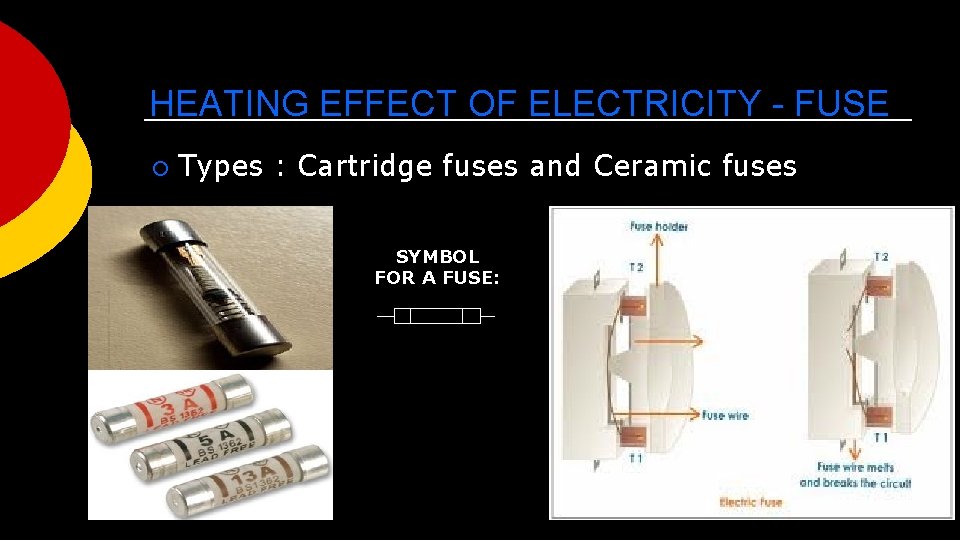
HEATING EFFECT OF ELECTRICITY - FUSE ¡ Types : Cartridge fuses and Ceramic fuses SYMBOL FOR A FUSE:
HEATING EFFECT OF ELECTRICITY - FUSE ¡ If a fuse blows, switch off all appliances in the circuit, and pull out all their plugs. ¡ Get an electrician to locate and repair the fault and then fit a new fuse (with a proper fuse wire and not any kind of wire)
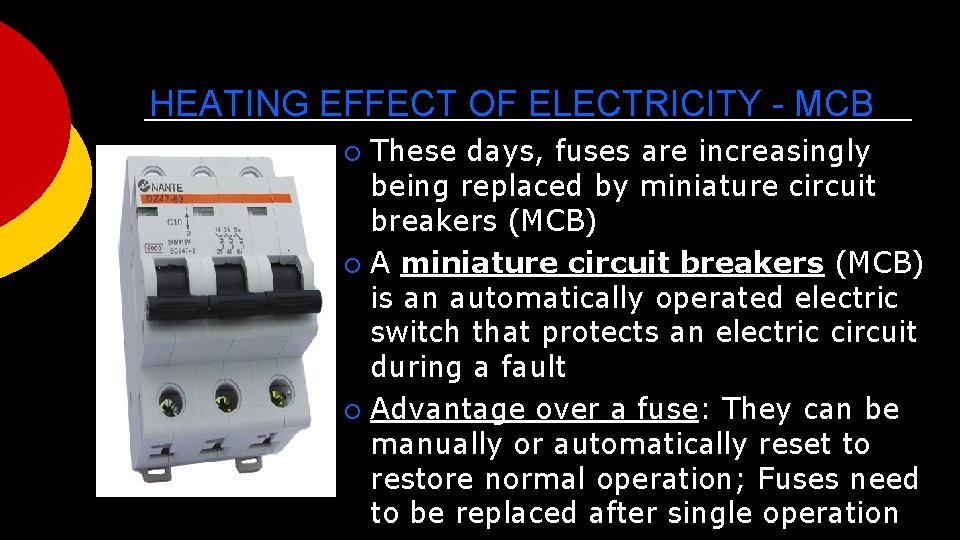
HEATING EFFECT OF ELECTRICITY - MCB These days, fuses are increasingly being replaced by miniature circuit breakers (MCB) ¡ A miniature circuit breakers (MCB) is an automatically operated electric switch that protects an electric circuit during a fault ¡ Advantage over a fuse: They can be manually or automatically reset to restore normal operation; Fuses need to be replaced after single operation ¡