
Using Electrical Energy Grade 9 Science Measuring Electrical



- Slides: 12
Using Electrical Energy Grade 9 Science
Measuring Electrical Energy • Energy is defined as the ability to do work. • Electrical energy can be defined as the energy transferred to an electrical load by moving electric charges. • The symbol for electrical energy is E and the unit for measuring energy is the joule. • Energy can also be measured in larger units such as watt hours or kilowatt hours.
Three Factors • There are three factors that determine the amount of electric energy that is used: 1. Voltage drop (V) – a measure of the energy each electric charge gave up as it moved through a circuit. 2. Electric Current (I) – a measure of the rate at which the electric charges moved through a circuit. 3. Time (Δt) – The length of time the electric current is flowing in a circuit.
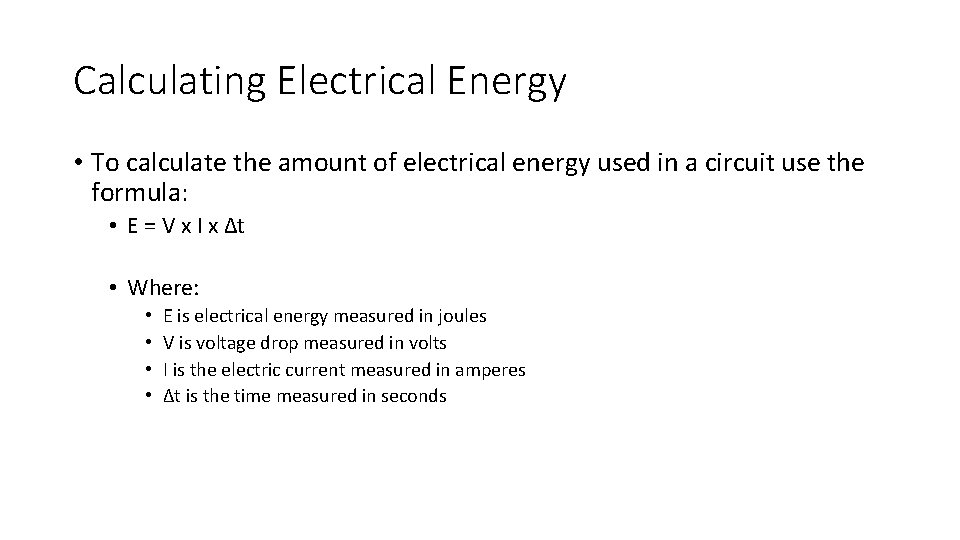
Calculating Electrical Energy • To calculate the amount of electrical energy used in a circuit use the formula: • E = V x I x Δt • Where: • • E is electrical energy measured in joules V is voltage drop measured in volts I is the electric current measured in amperes Δt is the time measured in seconds
Units • Although the correct SI unit for measuring energy is the joule (J), it is not a very practical unit for measuring electrical energy in everyday use. • When we use electric devices we usually measure time in minutes or hours, not seconds. • Consequently, electrical energy is also measured in other more convenient units such as watt hours (Wh) or kilowatt hours (k. Wh)
Example 1 • Calculate the energy, in joules, released from a battery in a flashlight bulb that was switched on for 4. 5 hours, in which the voltage drop was 6 V and the current flowing through the bulb was 0. 35 A • Solution: E = V x I x Δt • E=? E = 6 x 0. 35 x 16200 E = 34 020 J • V=6 V • I = 0. 35 A • Δt = 4. 5 h = 16 200 s (multiply by 3600 to go from hours to seconds)
Example 2 • Use the same information as in the previous example, but now find energy in Watt hours. • Leaving time in hours automatically gives us Wh as a unit for our answer • • E=? V=6 V I = 0. 35 A Δt = 4. 5 h E = V x I x Δt E = 6 x 0. 35 x 4. 5 E = 9. 45 Wh
The Rate at Which Energy is Used • Electrical power is a measure of the rate at which electrical eergy is being used. • The symbol for electrical power is P and the unit for electrical power is the watt.
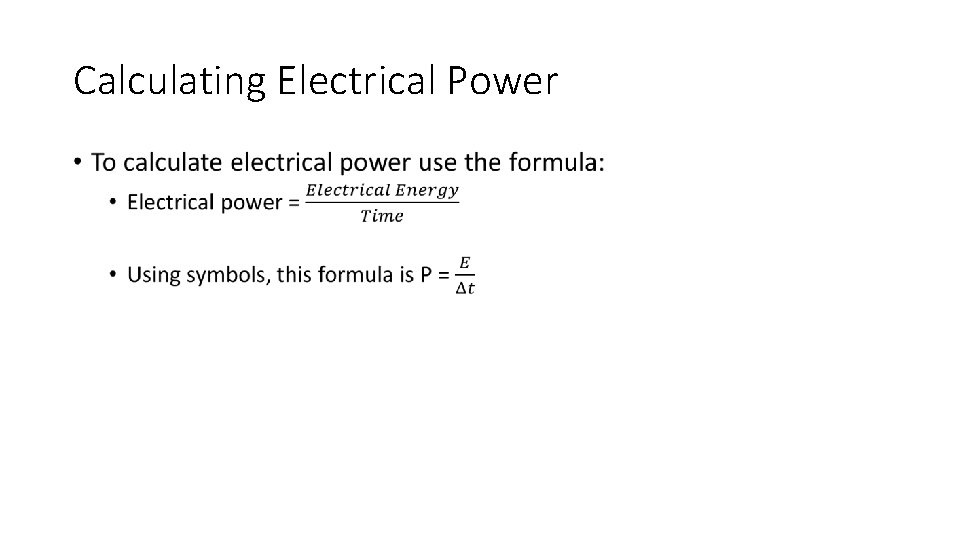
Calculating Electrical Power •
Sample Problem 1 • Calculate the power of a toaster that uses 72000 J of energy in 50 seconds. • E = 72000 J • Δt = 50 s • P=?
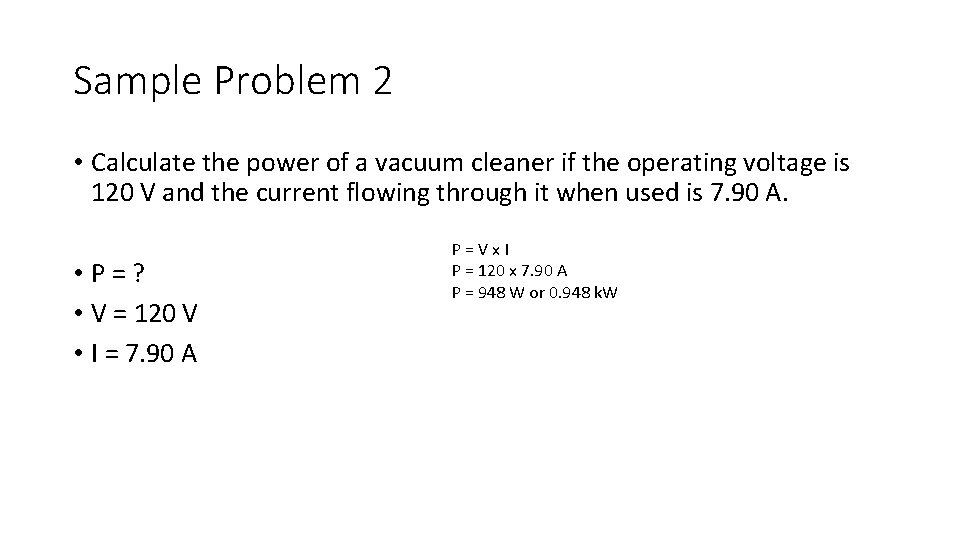
Sample Problem 2 • Calculate the power of a vacuum cleaner if the operating voltage is 120 V and the current flowing through it when used is 7. 90 A. • P=? • V = 120 V • I = 7. 90 A P=Vx. I P = 120 x 7. 90 A P = 948 W or 0. 948 k. W