
Using Effective Communication Skills What is communication I
- Slides: 24
Using Effective Communication Skills
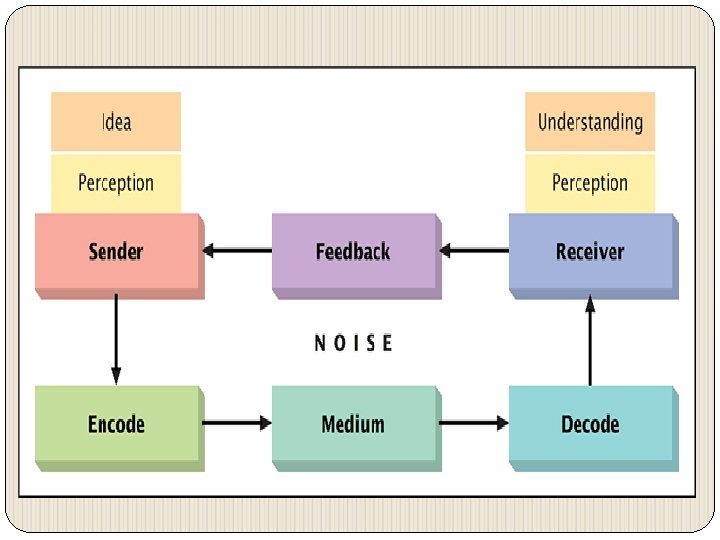
What is communication? I. Communication is a complex process involving distinct elements that together convey a message. Communication is the process of sending and receiving messages in which two or more people achieve understanding. It is the process of exchanging information
Objective 1 Continued There are 3 major goals or purposes of communication. o 1. To inform (i. e. , the process of giving information to another person) o 2. To influence (i. e. , the process of persuading a person to behave in a certain way) o 3. To express feeling (i. e. , the process of explaining one’s feelings)
The communication process consists of three major components. the sender the receiver the message.
The sender o Seeks to communicate something by speaking, writing, sending nonverbal signals, or producing a visual message. o An example of a sender is a customer interested in having his or her yard landscaped.
The Receiver: • Seeks to understand the sender’s meaning by listening to a verbal message or by reading or observing the non-verbal signals of a visual message. • An example of a receiver is a landscape designer interested in working with a customer.
Channels Linkage between the sender & the receiver Feedback is the return channel from the receiver to the sender
The Message othe information being transmitted from the sender to the receiver. o. An example of a message between a customer and a landscape designer is a completed landscape design.
Factors affecting the success of communication Deadlines - limited time one has to communicate about a problem or to gather information. Interference - “noise” or as a barrier to communication.
Types of Communication A. Self-communication is communication directed to you interpersonal conversation. o 1. Self-communication is a neverending process. o 2. External communication is not successful unless you communicate effectively with yourself.
Types of Communication B. One-to-one communication takes place when an individual communicates directly with another person. o 1. This can be informal, such as a quick hello, or formal, such as a prepared presentation. o 2. This is the most widely used form of communication.
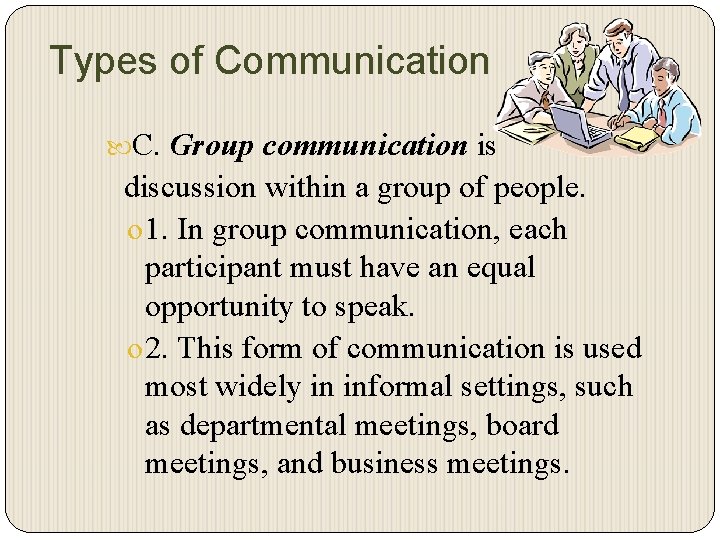
Types of Communication C. Group communication is discussion within a group of people. o 1. In group communication, each participant must have an equal opportunity to speak. o 2. This form of communication is used most widely in informal settings, such as departmental meetings, board meetings, and business meetings.
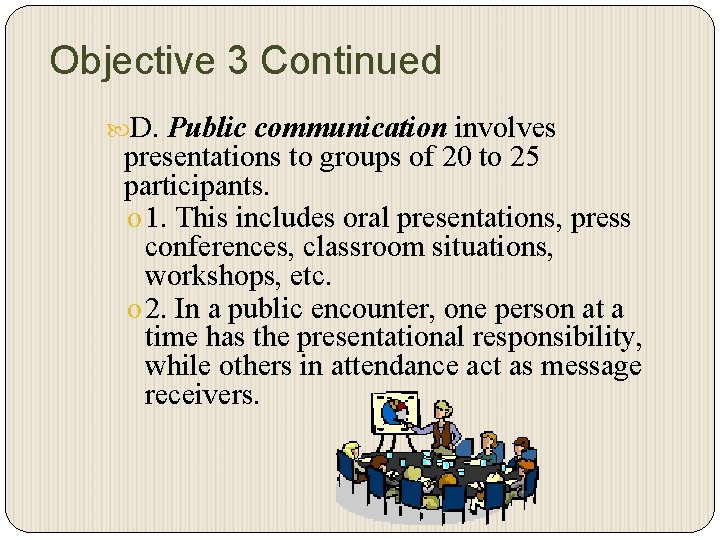
Objective 3 Continued D. Public communication involves presentations to groups of 20 to 25 participants. o 1. This includes oral presentations, press conferences, classroom situations, workshops, etc. o 2. In a public encounter, one person at a time has the presentational responsibility, while others in attendance act as message receivers.
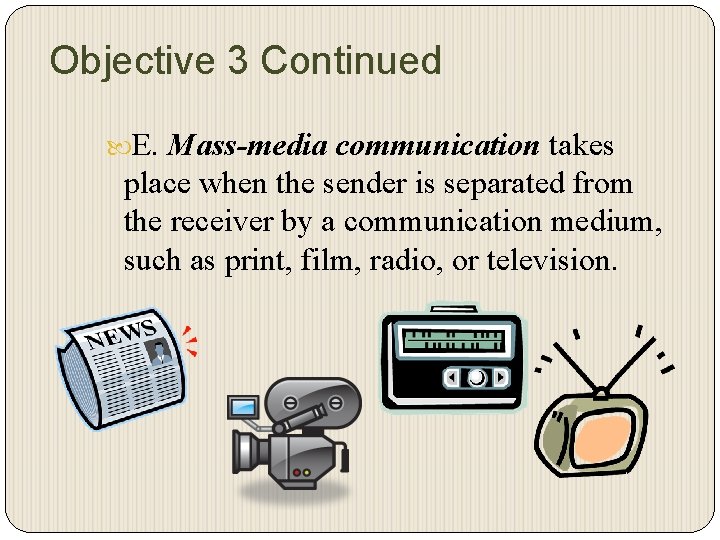
Objective 3 Continued E. Mass-media communication takes place when the sender is separated from the receiver by a communication medium, such as print, film, radio, or television.
Barriers to Communication Selective perception — occurs when people block out information that they do not want to hear. This is sometimes referred to as selective listening. Example: You are watching TV and mom asks you to take out the garbage.
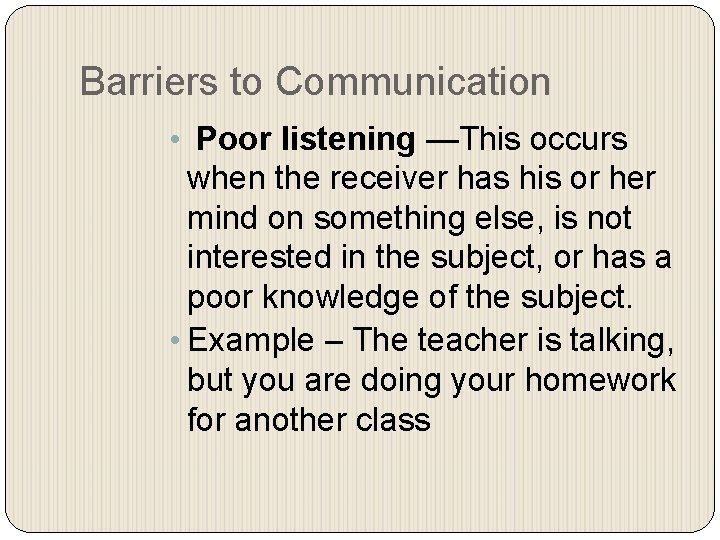
Barriers to Communication • Poor listening —This occurs when the receiver has his or her mind on something else, is not interested in the subject, or has a poor knowledge of the subject. • Example – The teacher is talking, but you are doing your homework for another class
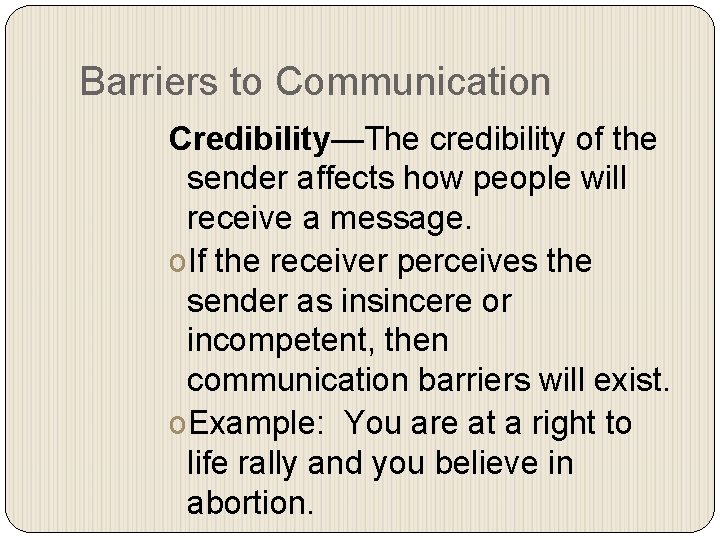
Barriers to Communication Credibility—The credibility of the sender affects how people will receive a message. o. If the receiver perceives the sender as insincere or incompetent, then communication barriers will exist. o. Example: You are at a right to life rally and you believe in abortion.
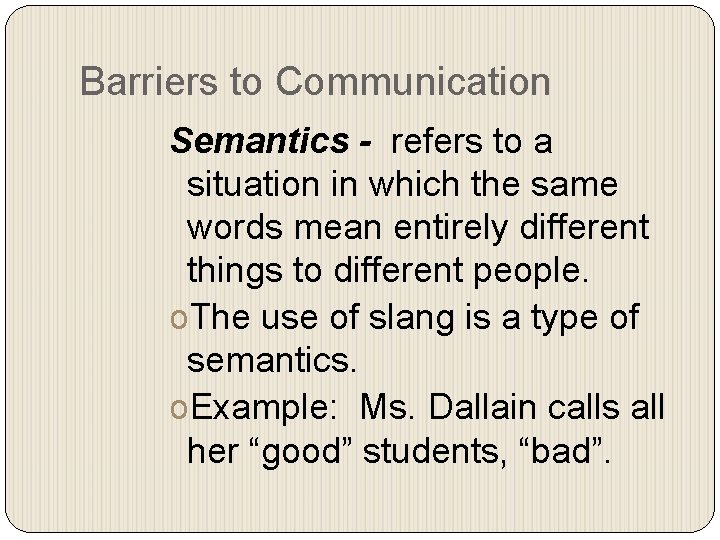
Barriers to Communication Semantics - refers to a situation in which the same words mean entirely different things to different people. o. The use of slang is a type of semantics. o. Example: Ms. Dallain calls all her “good” students, “bad”.
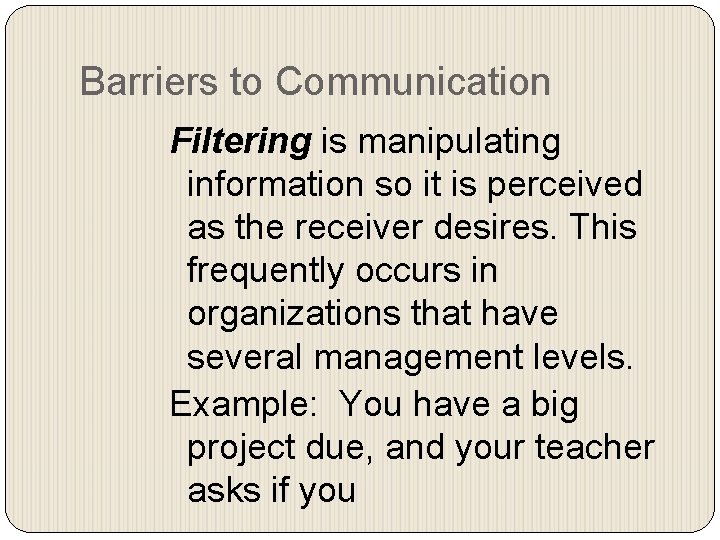
Barriers to Communication Filtering is manipulating information so it is perceived as the receiver desires. This frequently occurs in organizations that have several management levels. Example: You have a big project due, and your teacher asks if you
Barriers to Communication Avoiding details—The human mind usually avoids detail and cannot remember many details after a short period of time. Example: Mr. Hook gave us information about your ACT scores, but I only remember that they went up.
Interference from the environment can be described as “static, ” similar to what occasionally occurs on radio or television. 1. 2. Interference may occur from the sender if the information is inaccurate or if the sender misinterprets the receiver’s feedback.
Interference 3. Interference in the message is usually the result of sending inappropriate words, signals, or images. 4. Interference from the receiver is usually the result of the receiver’s personal opinions keeping him or her from listening or reading with an open mind.
Good Leaders are Good Communicators Leadership is the ability to move or influence others to achieve individual and/or group goals.