
USING EEOC CHARGE DATA TO STUDY WORKPLACE DISCRIMINATION

- Slides: 16
USING EEOC CHARGE DATA TO STUDY WORKPLACE DISCRIMINATION: RESEARCH AND PRACTICE Elizabeth Hirsh University of British Columbia
Civil Rights Law and Enforcement Civil Rights Act of 1964 established U. S. Equal Employment Opportunity Commission to enforce law Responsibility of workers to identify discrimination and mobilize their rights by filing formal claims with EEOC and in court Before proceeding to court, workers must file with EEOC ~80, 000 -90, 000 EEOC charges per year
Overview Charge Process Data Structure Getting access I. III. IV. V. VI. Confidentiality agreements Getting to know the data Matching data sources Research applications Future research
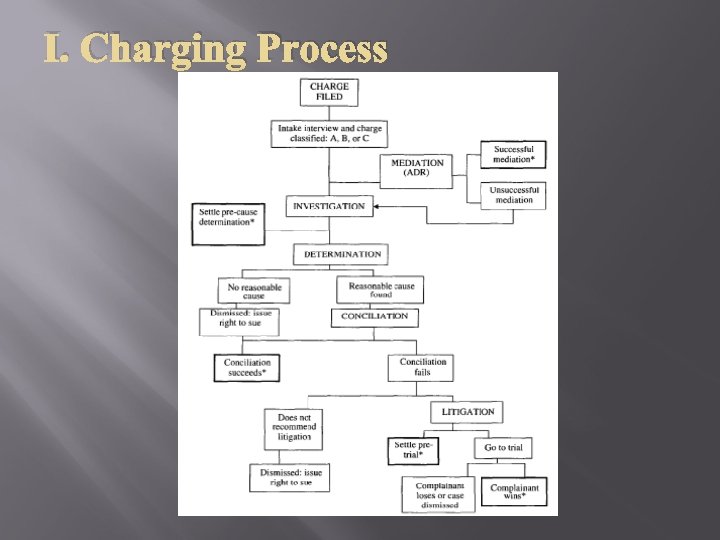
I. Charging Process
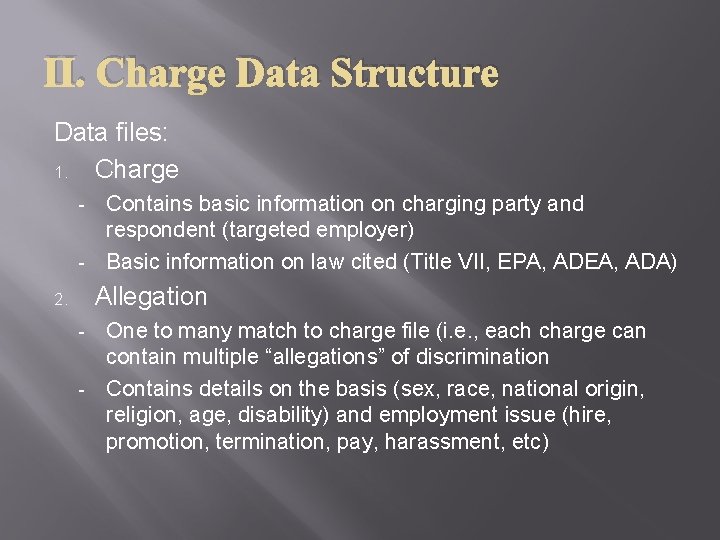
II. Charge Data Structure Data files: 1. Charge Contains basic information on charging party and respondent (targeted employer) - Basic information on law cited (Title VII, EPA, ADEA, ADA) - Allegation 2. One to many match to charge file (i. e. , each charge can contain multiple “allegations” of discrimination - Contains details on the basis (sex, race, national origin, religion, age, disability) and employment issue (hire, promotion, termination, pay, harassment, etc) -
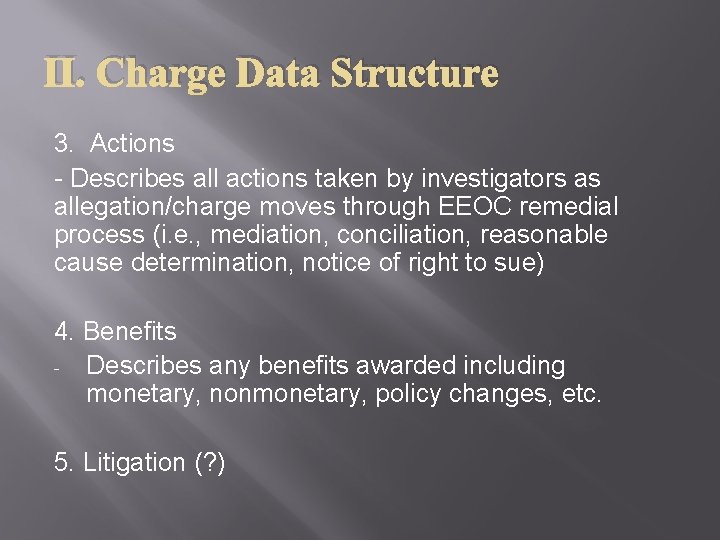
II. Charge Data Structure 3. Actions - Describes all actions taken by investigators as allegation/charge moves through EEOC remedial process (i. e. , mediation, conciliation, reasonable cause determination, notice of right to sue) 4. Benefits Describes any benefits awarded including monetary, nonmonetary, policy changes, etc. 5. Litigation (? )
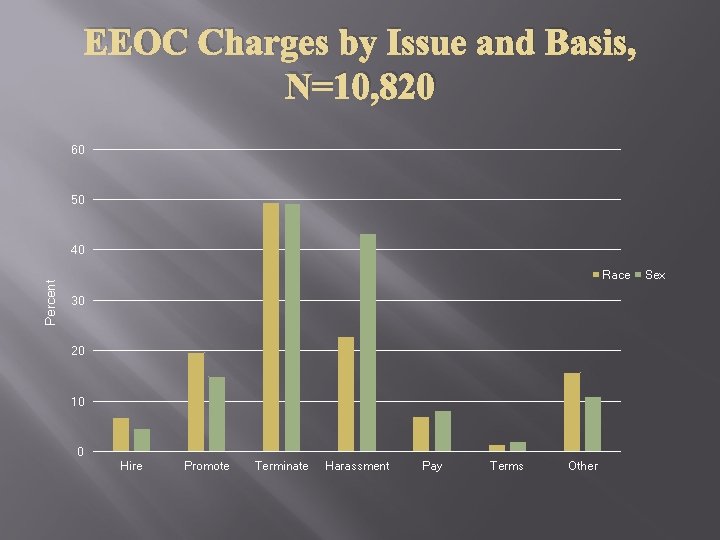
EEOC Charges by Issue and Basis, N=10, 820 60 50 Percent 40 Race 30 20 10 0 Hire Promote Terminate Harassment Pay Terms Other Sex
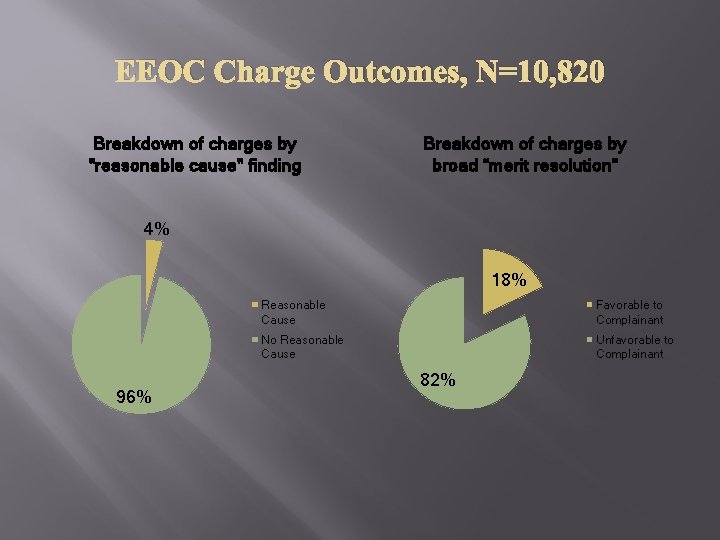
EEOC Charge Outcomes, N=10, 820 Breakdown of charges by "reasonable cause" finding Breakdown of charges by broad “merit resolution” 4% 18% 96% Reasonable Cause Favorable to Complainant No Reasonable Cause Unfavorable to Complainant 82%
EEOC Charge Benefits, N=10, 820
III. Obtaining Access 1. Confidentiality agreement with EEOC - Under intergovernmental personnel act - Become an unpaid employee of the EEOC 2. Getting to know the data - Becoming an unpaid intern at an EEOC district office, investigation unit - Processed charges from intake through conciliation - Investigators’ employee manual as “codebook”
IV. Matching Data Sources Matching to EEO-1 Data (or other survey data) Recently, intake officers assigning EEO-1 numbers to charges/allegations as they come in Historically, no connection between EEOC charge data and EEO-1 employer data Using natural language search in SQL to look up and extract charges for various samples of EEO-1 reporting firms/establishments 60% success rate 40% manually look up in charge data by name and zip code Matching to legal data sources Tracing high-profile litigation back to original EEOC charge(s)
V. Research Applications Project 1: Organizational origins and impact of charges Using matched sample of 2166 EEO-1 reporting establishments to 10, 820 charges, examined contexts that give rise to charges, charge processing/outcomes, and impact of charges on workplace segregation Examined workplace conditions that lead to charges, charge outcomes, and impact on workplace equality (Hirsh 2008; Hirsh and Kornrich 2008; Hirsh 2009)
V. Research Applications Project 2: Diversity-oriented HR Practices and Charges (with Julie Kmec) Surveyed 300 EEO-1 reporting establishments about HR practices, matched survey data to charges Examining effect of HR policies on charges and outcomes (as well as substantive measures of inequality)
V. Research Applications Project 3: EEO lawsuits and legal mobilization Examining 500 high-profile lawsuits, interviewing subset of plaintiffs about legal mobilization/experiences Extracting original charge data for these lawsuits
V. Research Applications Other applications: - Laura Beth Nielsen, Robert Nelson, Ryon Lancaster, Ellen Berrey and colleagues match litigation to charge data (Nielsen, Nelson, Lancaster 2010) - Susanne Bruyere, Sarah Von Schrader and colleagues at Cornell’s Employment and Disability Institute analyzing trends in ADA charges
VI. Future Research EEO/charge “report cards” or “compliance record” for industries (or even firms) Matching charge data to geographical data “Reverse” discrimination charges Focus on retaliation charges and intra/intergroup relations Ethnography of charging/resolution process